Version 1
Nov 23, 2026. Compare with the current version · Version history
A Trojan asteroid is an asteroid that shares a larger planet's orbit around the Sun without colliding with it, because it gathers around one of two special places in that orbit, the L4 and L5 Lagrangian points.[1] NASA says the Jupiter Trojans form the most significant population.[1]
How they stay in Jupiter's orbit
NASA says Trojans share an orbit with a larger planet but do not collide with it because they cluster around two points in the orbit, L4 and L5, where the gravitational pull from the Sun and the planet is balanced against the asteroid's tendency to otherwise fly out of orbit.[1] NASA's mission blog on the spacecraft Lucy calls these two regions "islands of stability" where thousands of asteroids share Jupiter's orbit, guided by the combined gravitational pull of the Sun and Jupiter.[2] The group around L4 travels ahead of Jupiter in its orbit, and the group around L5 trails behind the planet.[2] NASA says Trojans in these clusters are as far from Jupiter as Jupiter is from the Sun, about 484 million miles, and are separated from each other by more than 6 million miles on average.[2]
How many
NASA says the Jupiter Trojans are thought to be as numerous as the asteroids in the main asteroid belt, and that there are also Mars and Neptune Trojans.[1] NASA says it announced the discovery of an Earth Trojan in 2011.[1] The labelled diagram on the Asteroid belt entry shows the Jupiter Trojan clouds as two crescents along Jupiter's orbit, though that diagram is schematic.
Why they matter
NASA says Lucy's scientists expect that studying Trojans up close will help them refine theories of how the solar system's planets formed 4.5 billion years ago and how they came to their current configuration, and describes the Jupiter Trojans as primitive solar-system bodies.[2] The sources read do not say where the Trojans themselves came from.
The Lucy mission
NASA's Lucy spacecraft launched on 16 October 2021, and on 28 October 2026 NASA reported that, after more than 2.2 billion miles of travel, Lucy is the first spacecraft to enter a region of the Jupiter Trojans, approaching L4.[2] NASA says mission engineers know it is approaching L4 from tracking its radio signals and images of surrounding stars, though space has no well-defined boundaries.[2] Because Trojans are so far apart, they will look like pinpricks of light until Lucy closes on its targets.[2] NASA says no earlier spacecraft visited them, because of their distance from Jupiter, and only Lucy has had a reason to travel there.[2]
NASA gives the planned encounters: Eurybates on 11 August 2027, then Polymele in September 2027, Leucus in April 2028 and Orus in November 2028, all among the leading group. Lucy then returns to Earth in 2030 for a third gravity assist that sends it toward Jupiter's trailing group, where it will explore the binary pair Patroclus and Menoetius in March 2033.[2] NASA says the spacecraft and instruments continue to operate as expected and have adapted to cooler temperatures and dimmer light more than five times farther from the Sun than Earth.[2]
See also
The Asteroid entry describes asteroids in general, and the Solar System entry puts the Trojans in context. The Gas giant entry describes Jupiter.
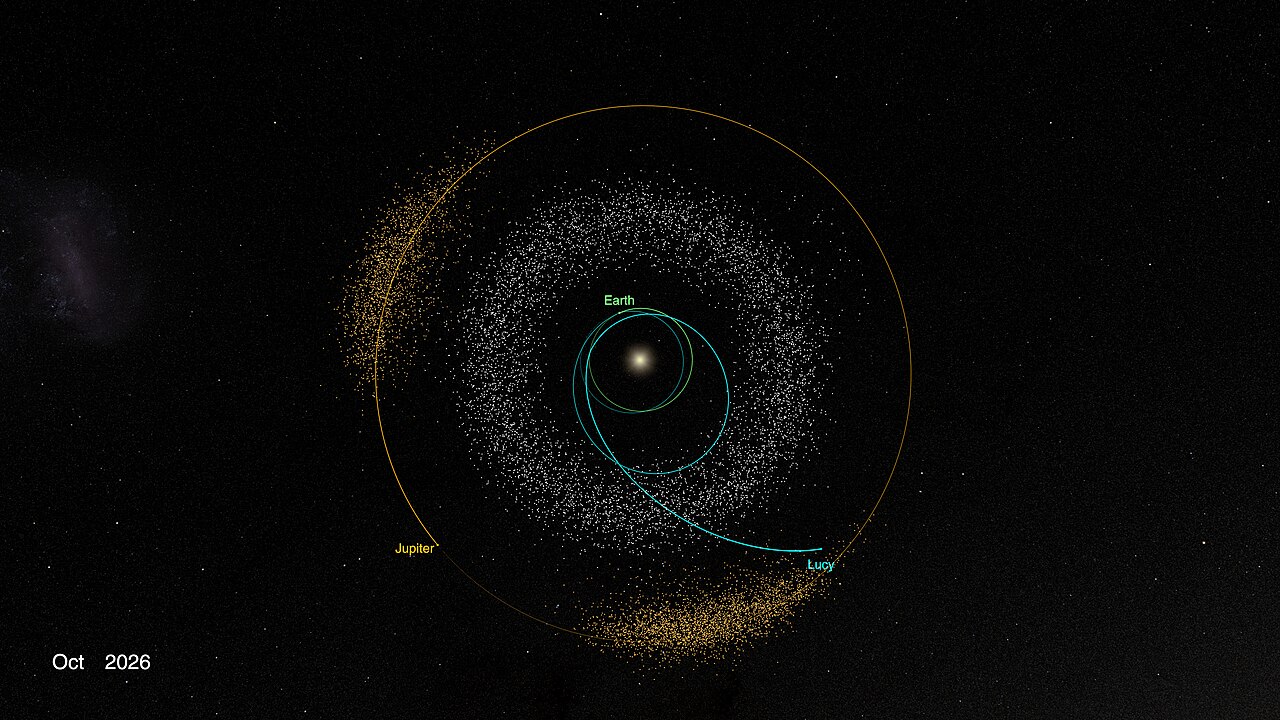
Via Wikimedia Commons: Lucy Mission Trajectory with Jupiter Trojans and Main Belt Asteroids ( by NASA's Scientific Visualization Studio - Science and Technol, public domain.
Sources
- NASA Science. "Asteroid Facts." science.nasa.gov/solar-system/asteroids/facts/ (read 23 November 2026)
- NASA Science, Lucy blog. "NASA's Lucy Reaches Trojan Asteroid Region 5 Years After Launch." 28 October 2026. science.nasa.gov/blogs/lucy/2026/10/28/nasas-lucy-reaches-trojan-as… (read 23 November 2026)
