Version 1
Nov 23, 2026. Compare with the current version · Version history
A Kuiper belt object, or KBO, is one of the many icy bodies in the Kuiper belt beyond Neptune.[1][2] NASA says they are fairly diverse in size, shape and colour, from dwarf planets more than 1,000 kilometres wide down to small bodies tens of kilometres across.[1][2]
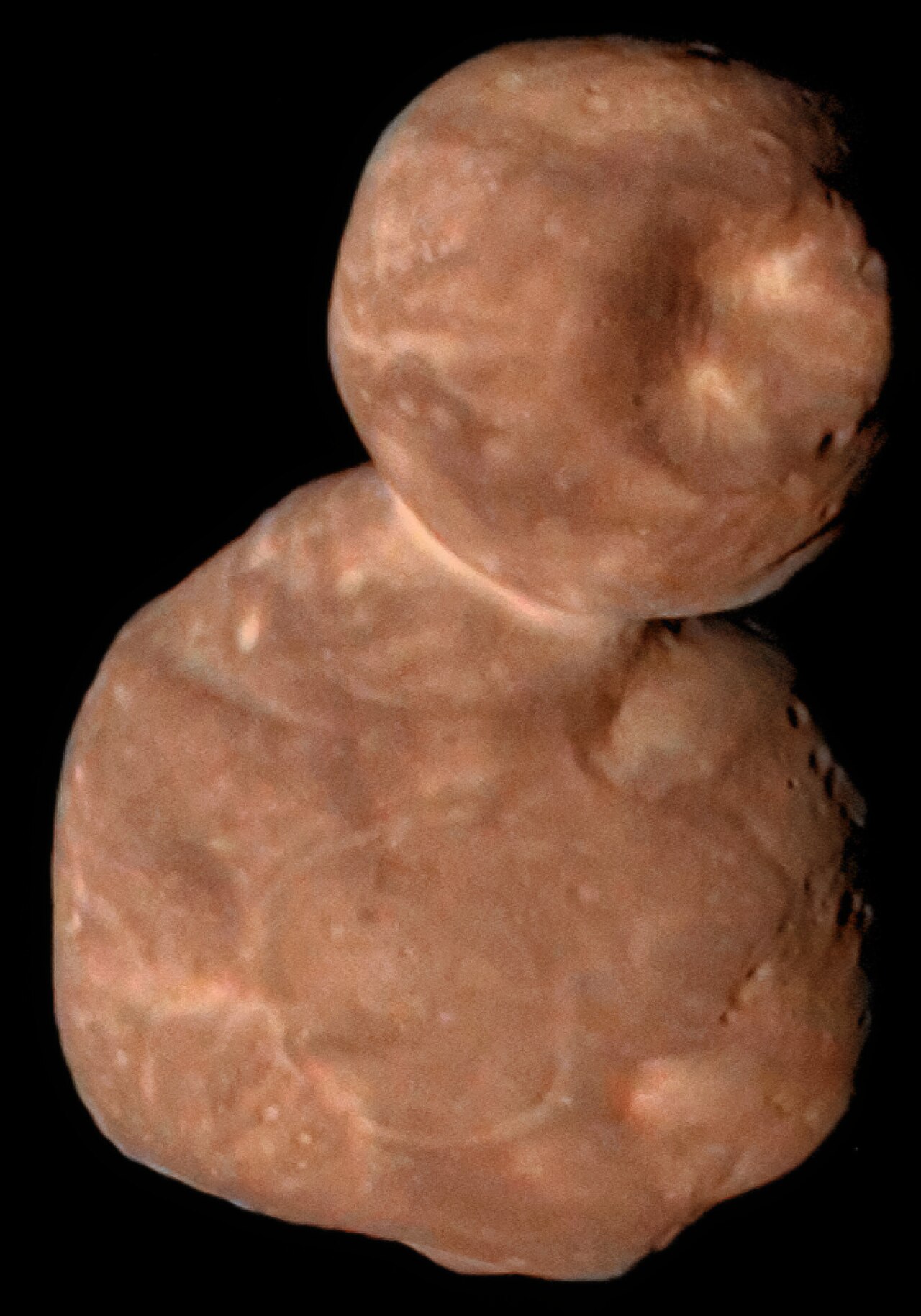
Via Wikimedia Commons: Composite Image of Arrokoth (ann19067a) by NASA/Johns Hopkins University Applied Physics Laboratory/Sou, CC BY 4.0.
Names
NASA says the region is named for the astronomer Gerard Kuiper, who published a paper in 1951 speculating about objects beyond Pluto, and that Kenneth Edgeworth mentioned such objects in papers in the 1940s, so it is sometimes called the Edgeworth–Kuiper Belt. NASA adds that some researchers prefer to call it the Trans-Neptunian Region and its objects trans-Neptunian objects, or TNOs.[1] NASA's Webb team describes TNOs as icy bodies ranging from Pluto and Eris, dwarf planets with diameters of about 1,500 miles, down to tens of miles, as for Arrokoth, and even smaller, on orbits comparable to or much larger than Neptune's, with the region usually called the Kuiper Belt and its objects sometimes called KBOs.[3]
Sizes and examples
NASA says there are probably hundreds of thousands of Kuiper belt objects more than 100 kilometres wide and some, including Pluto, more than 1,000 kilometres wide.[1] Pluto, found in 1930, was the first one discovered, and NASA says it is the largest in the region although Eris has a slightly higher mass.[1] NASA says Haumea and Makemake are also Kuiper belt objects, and that all four, Pluto, Eris, Haumea and Makemake, have moons.[1] NASA's Webb team says the second object found, in 1992, was 1992 QB1, now named Albion, discovered by Dave Jewitt and Jane Luu.[3]
Orbits
NASA says the objects are not evenly distributed: once astronomers began finding them in the early 1990s, they learned they fall into groups by the shape and size of their orbits, which depend on how each has interacted with Neptune's gravity. The groups are the classical objects, in cold and hot types; the resonant objects, including the plutinos; the scattered disk; and detached objects such as Sedna. NASA also says the Centaurs are understood as scattered objects that Neptune pushed inward.[1] See Kuiper belt and Centaur.
What they are made of
NASA says that besides rock and water ice, Kuiper belt objects contain other frozen compounds such as ammonia and methane.[1] NASA's Webb team reports that Webb has taken high-quality spectra of over 75 trans-Neptunian objects in its first two years of science operations, nearly 60 of them in a large programme called DiSCo-TNOs, and that Webb is the first observatory able to give detailed compositions of typical objects smaller than about 500 miles across.[3] The team's main result, published in Nature Astronomy in 2024 by Noemí Pinilla-Alonso and colleagues, is three spectral classes that no earlier study had expected.[3]
- Bowl-type spectra are dominated by water ice, with some carbon dioxide ice and signs of silicate-rich dust, and are the least red.[3]
- Double-dip spectra show complex organic molecules and carbon dioxide and carbon monoxide ices, with very abundant, pure carbon dioxide ice, and are intermediate in colour.[3]
- Cliff spectra show even more complex organics and carbon dioxide, and methanol, and are the reddest.[3]
The team's hypothesis, as reported by NASA, is that the types reflect temperature in the early disk: bowl types formed closer to the Sun, where higher temperatures baked off carbon dioxide and methane, while double-dips and cliffs formed farther out, where those compounds were more stable. NASA says an important clue is that all the objects on undisturbed cold-classical orbits are cliffs, while objects on other orbits include all three types, as expected if Neptune's outward migration reshuffled them.[3] NASA says the surfaces are colder than about −170 °C.[3] This is the team's hypothesis, and the sources do not call it settled.
Moons and binaries
NASA says a fairly large number of Kuiper belt objects have moons or are binaries, and some touch to form a contact binary.[1] It says most binaries may be ancient and little altered since formation, and that one leading idea is that they form from low-speed collisions, which were more common billions of years ago when orbits were more circular and flatter.[1]
Arrokoth
NASA says Arrokoth, also known as (486958) 2014 MU69 and nicknamed Ultima Thule, is a small Kuiper belt object discovered on 26 June 2014 by NASA's New Horizons science team using the Hubble Space Telescope, and that the name is Powhatan/Algonquian for "sky".[4] New Horizons flew past on 1 January 2019, and NASA says it is a double-lobed object that looks like a partially flattened snowman, and is very red, redder even than Pluto and the reddest outer solar system object a spacecraft has visited.[4] NASA says it is the most distant and most primitive object explored by a spacecraft, that its shape, unlike any seen before, was the biggest surprise of the flyby, and that nothing like it has been found elsewhere in the solar system.[4] NASA says Kuiper belt objects have been only slightly heated since they formed, so they are thought to be well-preserved frozen samples of the outer solar system as it was after its birth more than 4.5 billion years ago.[4]
How many are known
NASA's Kuiper Belt page says more than 2,000 trans-Neptunian objects had been cataloged, a tiny fraction of those thought to exist, while its Webb team says over 5,000 had been identified by February 2025.[1][3] On 2 April 2026 the Rubin Observatory announced roughly 380 new trans-Neptunian candidates found in less than two months, adding to the 5,000 discovered over the past three decades, and two of them, provisionally 2025 LS2 and 2025 MX348, on orbits that reach about 1,000 times Earth's distance from the Sun, among the 30 most distant minor planets known.[5]
See also
The Dwarf planet entry describes the largest of these objects, the Solar System entry places them in context, and the Asteroid entry describes their inner-solar-system counterparts.
Sources
- NASA Science. "Kuiper Belt Facts." science.nasa.gov/solar-system/kuiper-belt/facts/ (read 23 November 2026)
- NASA Science. "The Kuiper Belt." science.nasa.gov/solar-system/kuiper-belt/ (read 23 November 2026)
- NASA Science, Webb blog. "NASA's Webb Reveals the Ancient Surfaces of Trans-Neptunian Objects." 12 February 2025. science.nasa.gov/blogs/webb/2025/02/12/nasas-webb-reveals-the-ancie… (read 23 November 2026)
- NASA Science. "Arrokoth." science.nasa.gov/solar-system/kuiper-belt/arrokoth-2014-mu69/ (read 23 November 2026)
- NSF–DOE Vera C. Rubin Observatory. "Early Data from NSF–DOE Vera C. Rubin Observatory Reveals Over 11,000 New Asteroids." 2 April 2026. rubinobservatory.org/news/11000-new-asteroids (read 23 November 2026)
