A plutino is a small body in the Kuiper belt region whose orbit is locked in a 3:2 resonance with Neptune, so that it circles the Sun twice for every three orbits Neptune completes.[1] Pluto is in this resonance and gave the group its name.[1]
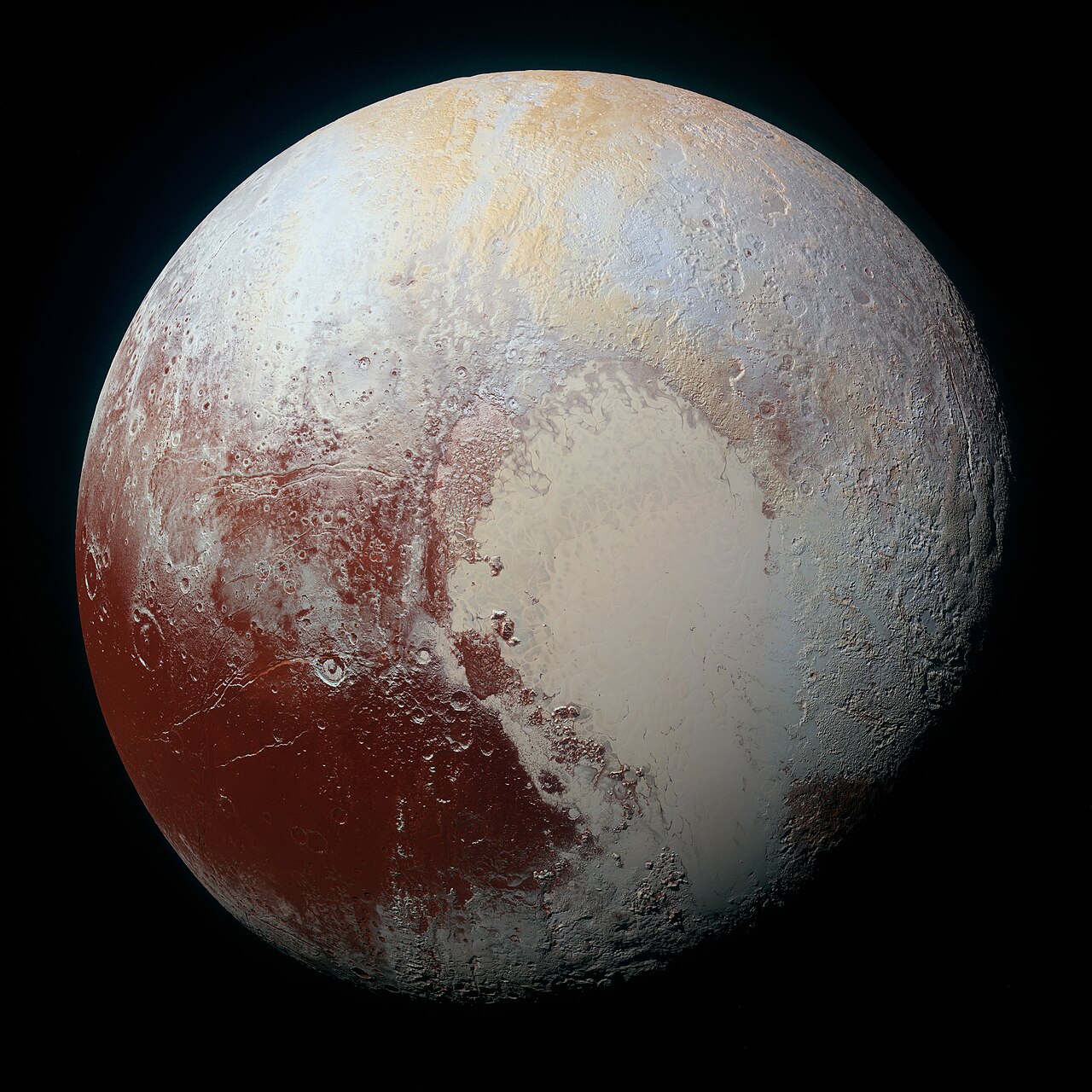
Via Wikimedia Commons: Pluto-01 Stern 03 Pluto Color TXT by NASA / Johns Hopkins University Applied Physics Laboratory /, public domain.
The 3:2 resonance
NASA says some Kuiper belt objects orbit in "resonance" with Neptune, meaning that their orbits follow a stable, repeating pattern with it, and that several such resonances exist, including 1:1, 4:3, 3:2 and 2:1. Enough objects share the 3:2 pattern with Pluto that astronomers gave them their own category among the resonant objects: the plutinos.[1] NASA's description of Pluto adds that the pattern means Pluto never comes close enough to Neptune to be affected much by its gravity, even though Pluto's orbit crosses Neptune's. NASA says Pluto gets physically closer to Uranus than it ever does to Neptune.[1]
The paper by Muñoz-Gutiérrez and colleagues (see below) uses the same ratio for Neptune's 3:2 resonance and calls the objects in the 2:1 resonance "Twotinos".[3]
Where plutinos come from
NASA's account of the Kuiper belt's history says that Neptune moved outward early in the solar system's life, and that its gravity forced the surviving icy bodies into the range of orbits found today.[1] The sources read for this entry do not say how any individual plutino was captured into the resonance, and the sources do not give a date or a mechanism for the capture.
How many there are
The 2016 survey by Mike Alexandersen and colleagues (submitted to arXiv in November 2014) found 77 trans-Neptunian objects in a 32-square-degree survey, of which 18 were plutinos. The authors rejected a single power-law size distribution for the plutinos and found they favour a "divot", a deficit of objects smaller than about 100 kilometres across. From that small sample the authors estimated about 9,000 ± 3,000 plutinos brighter than an absolute magnitude (H_r) of 8.66, and about 37,000 (+12,000, −10,000) brighter than H_r of 10.0.[2] The abstract does not convert those magnitudes into sizes, and a survey of 18 objects is a small sample, so the estimates carry wide uncertainties, as the authors' own error ranges show. I read only the abstract of this paper, not the full text.[2]
Do plutinos stay in the resonance?
A 2025 paper by Marco Muñoz-Gutiérrez and colleagues, accepted in the Astronomical Journal (arXiv version revised 27 January 2026), used numerical simulations of the plutino and Twotino populations over 4 billion years. They report that the number of objects in each resonance declines over time, that the decline can be modelled as an exponential decay plus an offset set by a long-term stable population, and that the most massive trapped objects, especially Pluto, change the decay rate noticeably for the 3:2 resonance. I read only the abstract; the abstract does not give the decay rate or any numbers.[3]
Source disagreement to note
NASA's Kuiper Belt pages treat Pluto as part of the group: they say enough objects share Pluto's 3:2 orbits "along with Pluto" to form the plutino category.[1] Whether Pluto itself counts as a plutino or as the object after which the class is named is a matter of wording that the sources I read do not address directly.
See also
Kuiper belt, Kuiper belt object, Trans-Neptunian object and Neptune.
Sources
- NASA Science. "Kuiper Belt Facts." science.nasa.gov/solar-system/kuiper-belt/facts/ (read 23 November 2026)
- Alexandersen, M., Gladman, B., Kavelaars, J. J., Petit, J.-M., Gwyn, S., Shankman, C. "A carefully characterised and tracked Trans-Neptunian survey, the size-distribution of the Plutinos and the number of Neptunian Trojans." arXiv:1411.7953 (abstract). arxiv.org/abs/1411.7953 (read 23 November 2026)
- Muñoz-Gutiérrez, M. A., Ramírez, S., Peimbert, A., Pérez-Villegas, A., Petrovich, C. "The Effect of Massive Trans-Neptunian Objects in the Long-term Evolution and Leaking Rates of Neptune's 3:2 and 2:1 Mean Motion Resonances." arXiv:2503.03900 (abstract, v3, 27 January 2026). arxiv.org/abs/2503.03900 (read 23 November 2026)
