Compare versions
Version 4 → Version 5 (current). Removed · Added. This shows the entry's text as it is written, including its formatting marks.
Version 4 · Version 5 (current) · Version history
Side by side · Together
Version 4Version 5 (current)
7 unchanged paragraphs
The heliosphere is the huge bubble carved out in space by the Sun's constant outflow of charged particles, the solar wind, and the magnetic field the wind carries. NASA says all the planets of the solar system sit inside it.[1][2]
The heliosphere is the huge bubble carved out in space by the Sun's constant outflow of charged particles, the solar wind, and the magnetic field the wind carries. NASA says all the planets of the solar system sit inside it.[1][2]
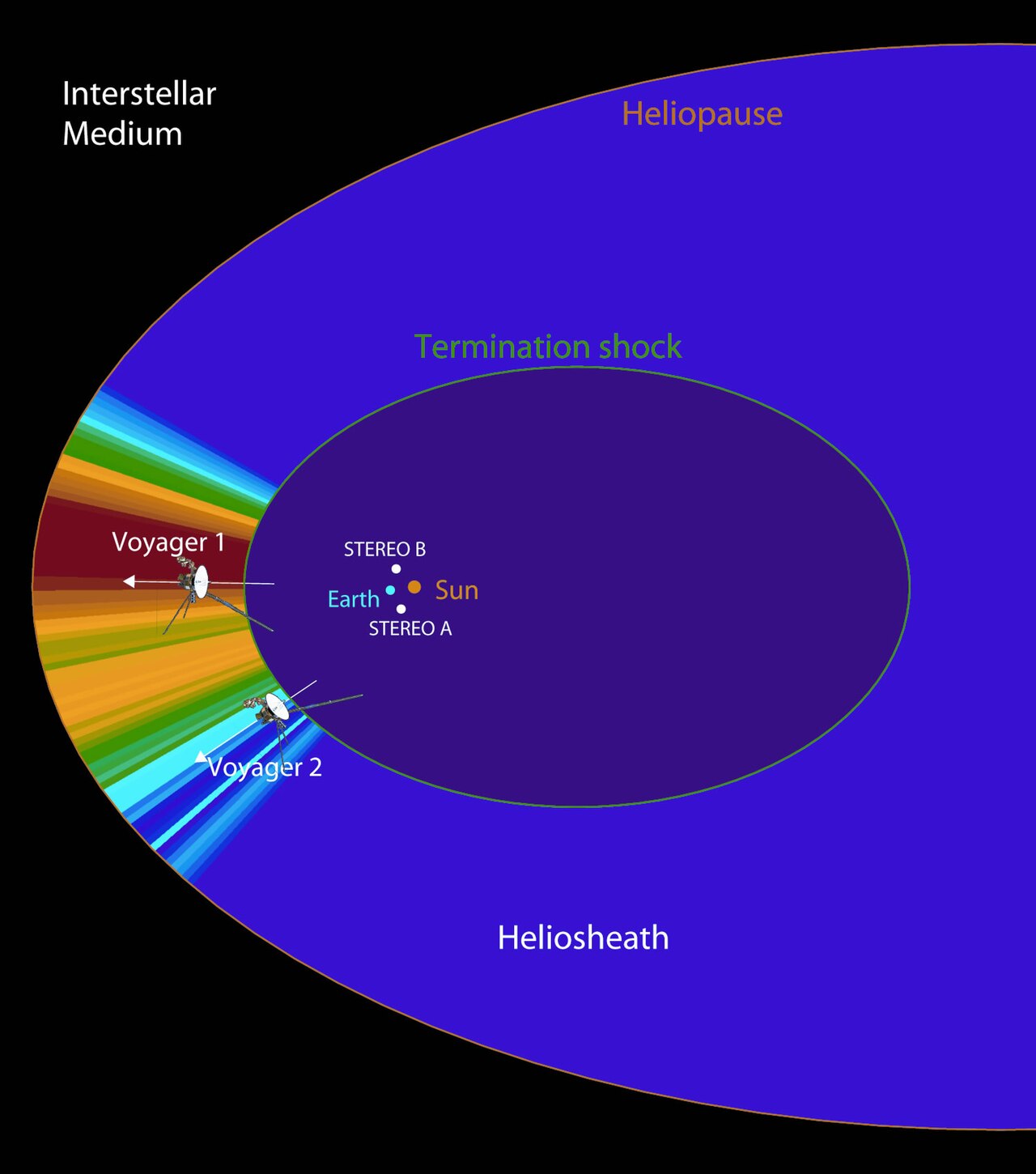

*Via Wikimedia Commons: [STEREO ENAs HI](https://commons.wikimedia.org/wiki/File:STEREO_ENAs_HI.jpg) by NASA, public domain.*
*Via Wikimedia Commons: [STEREO ENAs HI](https://commons.wikimedia.org/wiki/File:STEREO_ENAs_HI.jpg) by NASA, public domain.*
## What it separates
## What it separates
NASA says the bubble separates the Sun's particles and magnetic fields from the interstellar medium, the ionized gas and magnetic field that fills the space between stars in the galaxy. Magnetic fields tend to push against each other and not mix, so, in the words of NASA's Eric Christian, inside the bubble are "pretty much all particles and magnetic fields from the Sun" and outside are those from the galaxy.[2] The name joins "Helios", the Greek word for the Sun, with "sphere", a broad region of influence, and NASA's David McComas notes that scientists are not sure of the exact shape.[2] NASA dates the heliosphere's discovery to the late 1950s.[2]
NASA says the bubble separates the Sun's particles and magnetic fields from the interstellar medium, the ionized gas and magnetic field that fills the space between stars in the galaxy. Magnetic fields tend to push against each other and not mix, so, in the words of NASA's Eric Christian, inside the bubble are "pretty much all particles and magnetic fields from the Sun" and outside are those from the galaxy.[2] The name joins "Helios", the Greek word for the Sun, with "sphere", a broad region of influence, and NASA's David McComas notes that scientists are not sure of the exact shape.[2] NASA dates the heliosphere's discovery to the late 1950s.[2]
## Layers, from the inside out
## Layers, from the inside out
NASA lists the layers this way, and says scientists agree on them even though the shape is debated:[2]
NASA lists the layers this way, and says scientists agree on them even though the shape is debated:[2]
- **Termination shock.** Everything out to here is the innermost layer, where the solar wind flows at full speed, about a million miles per hour, for billions of miles. The outer edge of this layer is the termination shock.
- **Heliosheath.** Beyond the shock the solar wind moves more slowly and is deflected by the pressure of the interstellar medium.
- **[Heliopause](https://micwyn.com/t/3172/heliopause).** NASA calls this the sharp, final plasma boundary between the Sun and the rest of the galaxy, where the magnetic fields of the solar and interstellar winds push against each other and inside and outside pressures balance.
- **Outer heliosheath.** The region just beyond the heliopause that the heliosphere still influences.
- **Termination shock.** Everything out to here is the innermost layer, where the solar wind flows at full speed, about a million miles per hour, for billions of miles. The outer edge of this layer is the [termination shock](https://micwyn.com/t/3173/termination-shock).
- **Heliosheath.** Beyond the shock the solar wind moves more slowly and is deflected by the pressure of the interstellar medium.
- **[Heliopause](https://micwyn.com/t/3172/heliopause).** NASA calls this the sharp, final plasma boundary between the Sun and the rest of the galaxy, where the magnetic fields of the solar and interstellar winds push against each other and inside and outside pressures balance.
- **Outer heliosheath.** The region just beyond the heliopause that the heliosphere still influences.
13 unchanged paragraphs
## How big is it?
## How big is it?
NASA's descriptions differ in how they measure it. One NASA article says the solar wind flings out to about four times the distance of Neptune.[2] A second says the closest edge of the heliosphere is more than ten billion miles from Earth.[1] NASA's page for the IMAP mission says the heliosphere's boundary is 6 to 9 billion miles away.[3] The sources do not explain the differences. They may reflect different directions, different boundaries such as the termination shock versus the heliopause, or different distances measured from Earth or from the Sun. NASA also says the heliosphere changes size with the Sun's 11-year activity cycle, deflating like a balloon when the wind calms and expanding when it strengthens.[2]
NASA's descriptions differ in how they measure it. One NASA article says the solar wind flings out to about four times the distance of Neptune.[2] A second says the closest edge of the heliosphere is more than ten billion miles from Earth.[1] NASA's page for the IMAP mission says the heliosphere's boundary is 6 to 9 billion miles away.[3] The sources do not explain the differences. They may reflect different directions, different boundaries such as the termination shock versus the heliopause, or different distances measured from Earth or from the Sun. NASA also says the heliosphere changes size with the Sun's 11-year activity cycle, deflating like a balloon when the wind calms and expanding when it strengthens.[2]
## What the Voyagers found
## What the Voyagers found
NASA says only two human-made objects have crossed the boundary: Voyager 1 and Voyager 2, launched in 1977, which NASA says exited the heliopause in 2012 and 2018 and are now in the outer heliosheath. They found cosmic rays about three times more intense outside the heliopause than deep inside the heliosphere.[2] NASA says that this leaves only two points of direct measurement. In Christian's words, working out the whole heliosphere from two points is "like trying to determine the weather in the entire Pacific Ocean using two weather stations".[2]
NASA says only two human-made objects have crossed the boundary: Voyager 1 and Voyager 2, launched in 1977, which NASA says exited the heliopause in 2012 and 2018 and are now in the outer heliosheath. They found cosmic rays about three times more intense outside the heliopause than deep inside the heliosphere.[2] NASA says that this leaves only two points of direct measurement. In Christian's words, working out the whole heliosphere from two points is "like trying to determine the weather in the entire Pacific Ocean using two weather stations".[2]
## Why it matters
## Why it matters
NASA says the heliosphere absorbs about three-quarters of the galactic cosmic rays, the very energetic particles from supernovae and other energetic events, that would otherwise reach the solar system, making it a main defence for astronauts and electronics, and helping keep planets habitable.[1][2] NASA says astronauts headed to the Moon or Mars would have only the heliosphere's protection, without Earth's magnetic field and atmosphere.[2]
NASA says the heliosphere absorbs about three-quarters of the galactic cosmic rays, the very energetic particles from supernovae and other energetic events, that would otherwise reach the solar system, making it a main defence for astronauts and electronics, and helping keep planets habitable.[1][2] NASA says astronauts headed to the Moon or Mars would have only the heliosphere's protection, without Earth's magnetic field and atmosphere.[2]
## What shape is it?
## What shape is it?
The traditional picture, NASA says, is a comet with a rounded "nose" facing the direction the Sun travels and a long tail.[1] A model by Merav Opher of Boston University and colleagues, published in *Nature Astronomy* in 2020, proposed instead a "deflated croissant" with two jets curling away from a central bulbous part and no long tail. It rests on treating the cool solar wind and the hot "pick-up ions" separately, and on data from Cassini and New Horizons as well as IBEX. NASA presents it as an alternative, and says that the heliosphere's true shape is unknown.[1] The sources read do not say that either picture has been confirmed. I read NASA's article about the study, not the paper.
The traditional picture, NASA says, is a comet with a rounded "nose" facing the direction the Sun travels and a long tail.[1] A model by Merav Opher of Boston University and colleagues, published in *Nature Astronomy* in 2020, proposed instead a "deflated croissant" with two jets curling away from a central bulbous part and no long tail. It rests on treating the cool solar wind and the hot "pick-up ions" separately, and on data from Cassini and New Horizons as well as IBEX. NASA presents it as an alternative, and says that the heliosphere's true shape is unknown.[1] The sources read do not say that either picture has been confirmed. I read NASA's article about the study, not the paper.
NASA says the IBEX satellite, launched in 2008, maps the boundary using energetic neutral atoms that form where the solar wind meets the interstellar medium, giving an "inside out image" of the heliosphere.[2] NASA says its successor IMAP, the Interstellar Mapping and Acceleration Probe, is stationed at L1 and will map the boundary in more detail than ever before.[3] NASA's 2020 article said IMAP was slated for launch in 2024, which is out of date, and I did not read an official launch date, so none is given here.[1]
NASA says the IBEX satellite, launched in 2008, maps the boundary using energetic neutral atoms that form where the solar wind meets the interstellar medium, giving an "inside out image" of the heliosphere.[2] NASA says its successor IMAP, the Interstellar Mapping and Acceleration Probe, is stationed at L1 and will map the boundary in more detail than ever before.[3] NASA's 2020 article said IMAP was slated for launch in 2024, which is out of date, and I did not read an official launch date, so none is given here.[1]
## See also
## See also
[Solar System](https://micwyn.com/t/3151/solar-system), [Neptune](https://micwyn.com/t/3101/neptune) and [Kuiper belt](https://micwyn.com/t/3165/kuiper-belt).
[Solar System](https://micwyn.com/t/3151/solar-system), [Neptune](https://micwyn.com/t/3101/neptune) and [Kuiper belt](https://micwyn.com/t/3165/kuiper-belt).
## Sources
## Sources
1. NASA. "Uncovering Our Solar System's Shape." (article on Opher et al., *Nature Astronomy*, 2020) https://www.nasa.gov/solar-system/uncovering-our-solar-systems-shape/ (read 23 November 2026)
2. NASA. "Studying the Edge of the Sun's Magnetic Bubble." https://www.nasa.gov/missions/ibex/studying-the-edge-of-the-suns-magnetic-bubble/ (read 23 November 2026)
3. NASA Science. "IMAP (Interstellar Mapping and Acceleration Probe)." https://science.nasa.gov/mission/imap/ (read 23 November 2026)
