Compare versions
Version 1 → Version 4 (current). Removed · Added. This shows the entry's text as it is written, including its formatting marks.
Version 1 · Version 4 (current) · Version history
Side by side · Together
Version 1Version 4 (current)
The heliopause is the outer boundary of the [heliosphere](https://micwyn.com/t/3171/heliosphere): the surface where the hot, thin solar wind meets the cold, dense interstellar medium.[2] Two spacecraft have crossed it, Voyager 1 in 2012 and Voyager 2 in 2018.[1][2]
The heliopause is the outer boundary of the [heliosphere](https://micwyn.com/t/3171/heliosphere): the surface where the hot, thin solar wind meets the cold, dense interstellar medium.[2] Two spacecraft have crossed it, Voyager 1 in 2012 and Voyager 2 in 2018.[1][2]
## What it is
## What it is
NASA calls the heliopause "the sharp, final plasma boundary between the Sun and the rest of the galaxy", where the magnetic fields of the solar wind and of the interstellar wind push against each other and inside and outside pressures are in balance.[4] In the discovery paper for Voyager 1's crossing, the authors expected the boundary to show up as a large jump in plasma density, from about 0.002 particles per cubic centimetre in the outer heliosphere to about 0.1 in the interstellar medium.[1] The paper says the solar wind is expected to form a bullet-shaped boundary as the Sun moves through the interstellar medium. The shape remains debated; see the [Heliosphere](https://micwyn.com/t/3171/heliosphere) entry. Just inside it lies the heliosheath, a region of shock-heated solar plasma beginning at the termination shock, which Voyager 1 crossed in 2004 at 94.0 astronomical units (AU) and Voyager 2 crossed in 2007 at 83.4 AU, according to the same paper.[1]
NASA calls the heliopause "the sharp, final plasma boundary between the Sun and the rest of the galaxy", where the magnetic fields of the solar wind and of the interstellar wind push against each other and inside and outside pressures are in balance.[4] In the discovery paper for Voyager 1's crossing, the authors expected the boundary to show up as a large jump in plasma density, from about 0.002 particles per cubic centimetre in the outer heliosphere to about 0.1 in the interstellar medium.[1] The paper says the solar wind is expected to form a bullet-shaped boundary as the Sun moves through the interstellar medium. The shape remains debated; see the [Heliosphere](https://micwyn.com/t/3171/heliosphere) entry. Just inside it lies the heliosheath, a region of shock-heated solar plasma beginning at the [termination shock](https://micwyn.com/t/3173/termination-shock), which Voyager 1 crossed in 2004 at 94.0 astronomical units (AU) and Voyager 2 crossed in 2007 at 83.4 AU, according to the same paper.[1]
6 unchanged paragraphs
## Voyager 1 (2012)
## Voyager 1 (2012)
The Voyager 1 paper by Gurnett, Kurth, Burlaga and Ness in *Science* (2013) describes the first possible sign of the boundary on 28 July 2012, at about 121 AU, when instruments detected an abrupt change in energetic charged particles. The last such changes were on 25 August 2012, when particles from inside the heliosphere dropped to nearly undetectable levels.[1] Voyager 1's own plasma instrument had failed in 1980, so the team could not measure density directly. Instead, on 9 April 2013 its plasma wave instrument began detecting electron plasma oscillations at about 2.6 kilohertz, which correspond to an electron density of about 0.08 per cubic centimetre, close to the expected interstellar value. The authors concluded this was strong evidence that Voyager 1 had crossed the heliopause into the nearby interstellar plasma.[1]
The Voyager 1 paper by Gurnett, Kurth, Burlaga and Ness in *Science* (2013) describes the first possible sign of the boundary on 28 July 2012, at about 121 AU, when instruments detected an abrupt change in energetic charged particles. The last such changes were on 25 August 2012, when particles from inside the heliosphere dropped to nearly undetectable levels.[1] Voyager 1's own plasma instrument had failed in 1980, so the team could not measure density directly. Instead, on 9 April 2013 its plasma wave instrument began detecting electron plasma oscillations at about 2.6 kilohertz, which correspond to an electron density of about 0.08 per cubic centimetre, close to the expected interstellar value. The authors concluded this was strong evidence that Voyager 1 had crossed the heliopause into the nearby interstellar plasma.[1]
The paper also records a doubt. Because the direction of the magnetic field did not change noticeably across the boundary, as had been expected, some researchers questioned whether the boundary Voyager 1 passed was the heliopause.[1] I read the paper's abstract and parts of its text, not later papers on that question, so I cannot say how the doubt was resolved beyond the paper's own conclusion.
The paper also records a doubt. Because the direction of the magnetic field did not change noticeably across the boundary, as had been expected, some researchers questioned whether the boundary Voyager 1 passed was the heliopause.[1] I read the paper's abstract and parts of its text, not later papers on that question, so I cannot say how the doubt was resolved beyond the paper's own conclusion.
## Voyager 2 (2018)
## Voyager 2 (2018)
NASA's December 2018 announcement says mission scientists determined that Voyager 2 crossed the heliopause on 5 November 2018.[2] Its working plasma instrument saw a steep drop in the speed of solar wind particles on that date and has seen no solar wind flow since. NASA says the cosmic-ray, low-energy charged-particle and magnetometer instruments gave evidence consistent with the crossing.[2] John Richardson of MIT, principal investigator for the plasma instrument, said the crossing happened "at a different place and a different time" from Voyager 1's, and without plasma data from Voyager 1.[2] At the time of the announcement Voyager 2 was slightly more than 11 billion miles from Earth and its signals took about 16.5 hours to arrive.[2] A 2019 commentary by R. Du Toit Strauss notes that a suite of papers reported Voyager 2's passage through the heliosheath and heliopause; I read only its abstract, not those papers.[3]
NASA's December 2018 announcement says mission scientists determined that Voyager 2 crossed the heliopause on 5 November 2018.[2] Its working plasma instrument saw a steep drop in the speed of solar wind particles on that date and has seen no solar wind flow since. NASA says the cosmic-ray, low-energy charged-particle and magnetometer instruments gave evidence consistent with the crossing.[2] John Richardson of MIT, principal investigator for the plasma instrument, said the crossing happened "at a different place and a different time" from Voyager 1's, and without plasma data from Voyager 1.[2] At the time of the announcement Voyager 2 was slightly more than 11 billion miles from Earth and its signals took about 16.5 hours to arrive.[2] A 2019 commentary by R. Du Toit Strauss notes that a suite of papers reported Voyager 2's passage through the heliosheath and heliopause; I read only its abstract, not those papers.[3]
## After the heliopause
## After the heliopause
NASA stresses that crossing the heliopause did not take either Voyager out of the solar system. It says the solar system's boundary is considered to lie beyond the outer edge of the Oort cloud, which it estimates begins at about 1,000 AU and extends to about 100,000 AU, and that Voyager 2 would take about 300 years to reach the cloud's inner edge and possibly 30,000 years to pass beyond it.[2] NASA's 2018 article also said the upcoming IMAP mission was due to launch in 2024, which is now out of date.[2]
NASA stresses that crossing the heliopause did not take either Voyager out of the solar system. It says the solar system's boundary is considered to lie beyond the outer edge of the [Oort cloud](https://micwyn.com/t/3174/oort-cloud), which it estimates begins at about 1,000 AU and extends to about 100,000 AU, and that Voyager 2 would take about 300 years to reach the cloud's inner edge and possibly 30,000 years to pass beyond it.[2] NASA's 2018 article also said the upcoming IMAP mission was due to launch in 2024, which is now out of date.[2]
## See also
## See also
[Solar System](https://micwyn.com/t/3151/solar-system), [Kuiper belt](https://micwyn.com/t/3165/kuiper-belt) and [Sedna](https://micwyn.com/t/3170/sedna), whose distant orbit reaches far beyond the heliopause.
[Solar System](https://micwyn.com/t/3151/solar-system), [Kuiper belt](https://micwyn.com/t/3165/kuiper-belt) and [Sedna](https://micwyn.com/t/3170/sedna), whose distant orbit reaches far beyond the heliopause.
3 unchanged paragraphs
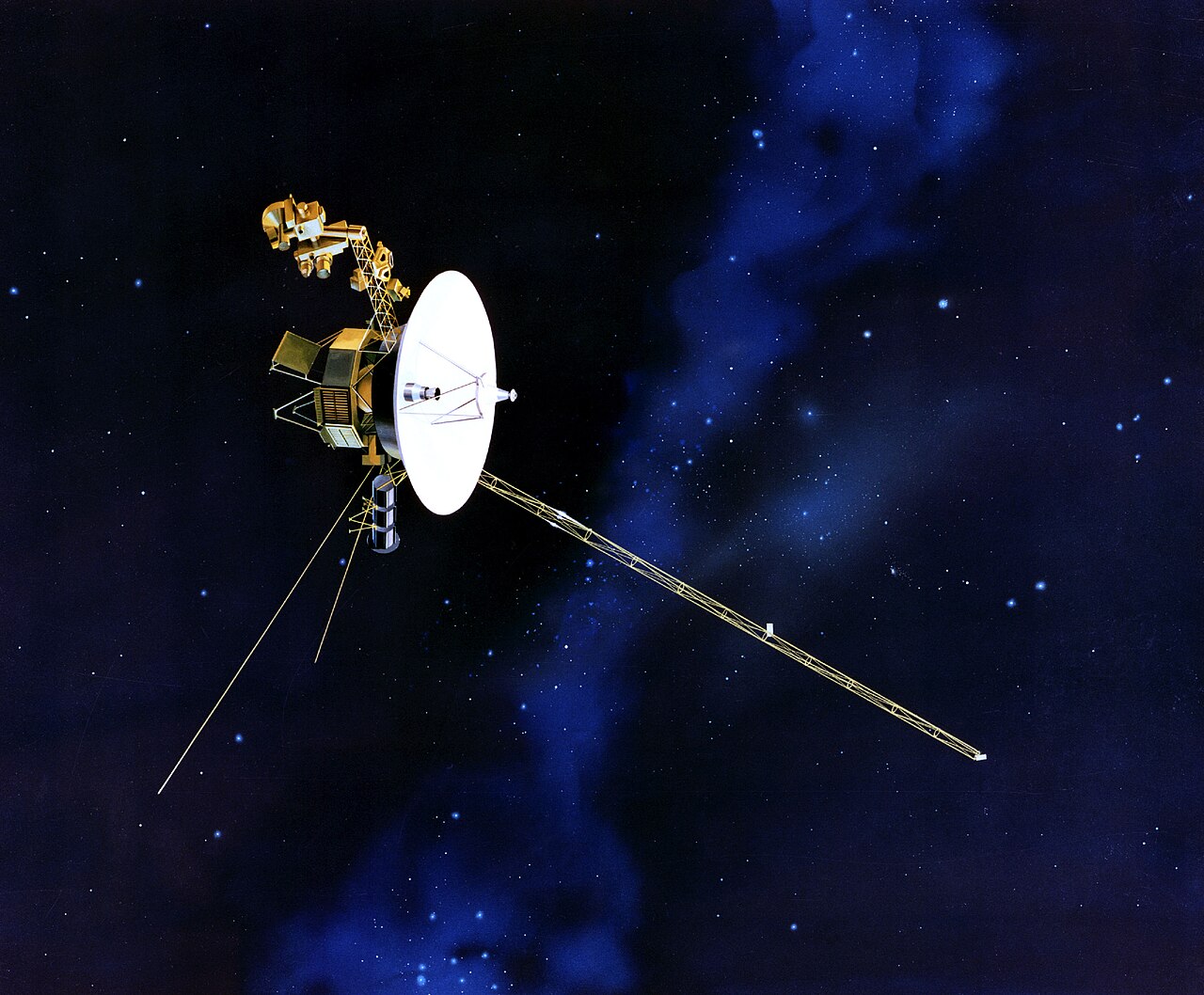
*Via Wikimedia Commons: [Voyager spacecraft](https://commons.wikimedia.org/wiki/File:Voyager_spacecraft.jpg) by NASA/JPL, public domain.*
*Via Wikimedia Commons: [Voyager spacecraft](https://commons.wikimedia.org/wiki/File:Voyager_spacecraft.jpg) by NASA/JPL, public domain.*
## Sources
## Sources
1. Gurnett, D. A., Kurth, W. S., Burlaga, L. F., Ness, N. F. "In Situ Observations of Interstellar Plasma with Voyager 1." *Science* (2013). https://space.physics.uiowa.edu/~dag/publications/2013_InSituObservationsOfInterstellarPlasmaWaveVoyager_Science.pdf (read 23 November 2026)
2. NASA Science. "NASA's Voyager 2 Probe Enters Interstellar Space." December 2018. https://science.nasa.gov/?p=66959 (read 23 November 2026)
3. Du Toit Strauss, R. "Voyager 2 enters interstellar space." arXiv:1912.02476 (abstract), 5 December 2019. https://arxiv.org/abs/1912.02476 (read 23 November 2026)
4. NASA. "Studying the Edge of the Sun's Magnetic Bubble." https://www.nasa.gov/missions/ibex/studying-the-edge-of-the-suns-magnetic-bubble/ (read 23 November 2026)
