Compare versions
Version 1 → Version 2 (current). Removed · Added. This shows the entry's text as it is written, including its formatting marks.
Version 1 · Version 2 (current) · Version history
Side by side · Together
Version 1Version 2 (current)
A comet is a body of ice, dust and rock that orbits the Sun and, when it nears the Sun, heats up and develops a glowing atmosphere and tails.[1][2] NASA calls comets leftovers from the dawn of the solar system about 4.6 billion years ago.[1]
A comet is a body of ice, dust and rock that orbits the Sun and, when it nears the Sun, heats up and develops a glowing atmosphere and tails.[1][2] NASA calls comets leftovers from the dawn of the solar system about 4.6 billion years ago.[1]
16 unchanged paragraphs
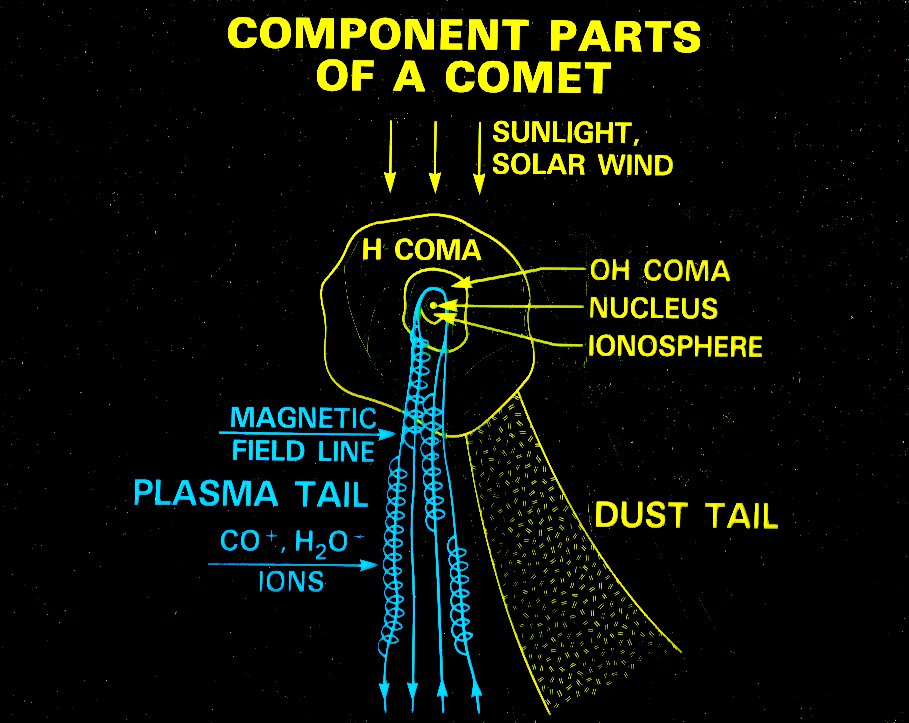
*Via Wikimedia Commons: [Comet Components](https://commons.wikimedia.org/wiki/File:Comet_Components.jpg) by NASA, public domain.*
*Via Wikimedia Commons: [Comet Components](https://commons.wikimedia.org/wiki/File:Comet_Components.jpg) by NASA, public domain.*
## What a comet is made of
## What a comet is made of
NASA's overview describes comets as "cosmic snowballs" of frozen gases, rock and dust that, when frozen, are about the size of a small town. There are likely billions of them in the [Kuiper belt](https://micwyn.com/t/3165/kuiper-belt) and the even more distant [Oort cloud](https://micwyn.com/t/3174/oort-cloud).[2] NASA's facts page says they consist mostly of ice coated with dark organic material, a mix long nicknamed "dirty snowballs", and that they may have brought water and organic compounds to the early Earth.[1] That last statement is presented by NASA as a possibility ("may have"), not an established fact.[1]
NASA's overview describes comets as "cosmic snowballs" of frozen gases, rock and dust that, when frozen, are about the size of a small town. There are likely billions of them in the [Kuiper belt](https://micwyn.com/t/3165/kuiper-belt) and the even more distant [Oort cloud](https://micwyn.com/t/3174/oort-cloud).[2] NASA's facts page says they consist mostly of ice coated with dark organic material, a mix long nicknamed "dirty snowballs", and that they may have brought water and organic compounds to the early Earth.[1] That last statement is presented by NASA as a possibility ("may have"), not an established fact.[1]
## Nucleus, coma and tails
## Nucleus, coma and tails
Each comet has a frozen nucleus, often a few miles across, made of icy chunks, frozen gases and embedded dust.[1] As the comet approaches the Sun it warms and the ices turn to gas, producing an atmosphere called the coma, which can extend hundreds of thousands of kilometres.[1] Sunlight pressure and the solar wind can blow the coma's dust and gas away from the Sun, forming a long bright tail, and NASA notes that comets actually have two tails, a dust tail and an ion (gas) tail.[1] NASA's overview says the tail can stretch for millions of miles.[2] Most comets keep a safe distance from the Sun. NASA gives Halley's comet, which comes no closer than 55 million miles (89 million kilometres), as an example, while "sungrazers" fly into the Sun or get so close that they break up and evaporate.[1]
Each comet has a frozen nucleus, often a few miles across, made of icy chunks, frozen gases and embedded dust.[1] As the comet approaches the Sun it warms and the ices turn to gas, producing an atmosphere called the coma, which can extend hundreds of thousands of kilometres.[1] Sunlight pressure and the solar wind can blow the coma's dust and gas away from the Sun, forming a long bright tail, and NASA notes that comets actually have two tails, a dust tail and an ion (gas) tail.[1] NASA's overview says the tail can stretch for millions of miles.[2] Most comets keep a safe distance from the Sun. NASA gives Halley's comet, which comes no closer than 55 million miles (89 million kilometres), as an example, while "sungrazers" fly into the Sun or get so close that they break up and evaporate.[1]
## Where they come from
## Where they come from
NASA says that, as the astronomer Gerard Kuiper theorized in 1951, a disc-like belt of icy bodies exists beyond Neptune, and that these objects, occasionally pushed by gravity into orbits closer to the Sun, become the short-period comets, which take less than 200 years to orbit the Sun and so often return predictably.[1] Less predictable are the long-period comets, many of which NASA says arrive from the Oort cloud, which this page places about 100,000 astronomical units (AU) from the Sun, with orbits that can take as long as 30 million years.[1] Other NASA pages give different inner and outer distances for the cloud, and the entry on the [Oort cloud](https://micwyn.com/t/3174/oort-cloud) sets out the disagreement. The [Centaur](https://micwyn.com/t/3162/centaur-minor-planet) entry describes objects NASA understands to be Kuiper belt escapees that can become comets.
NASA says that, as the astronomer Gerard Kuiper theorized in 1951, a disc-like belt of icy bodies exists beyond Neptune, and that these objects, occasionally pushed by gravity into orbits closer to the Sun, become the short-period comets, which take less than 200 years to orbit the Sun and so often return predictably.[1] Less predictable are the long-period comets, many of which NASA says arrive from the Oort cloud, which this page places about 100,000 astronomical units (AU) from the Sun, with orbits that can take as long as 30 million years.[1] Other NASA pages give different inner and outer distances for the cloud, and the entry on the [Oort cloud](https://micwyn.com/t/3174/oort-cloud) sets out the disagreement. The [Centaur](https://micwyn.com/t/3162/centaur-minor-planet) entry describes objects NASA understands to be Kuiper belt escapees that can become comets.
## Names
## Names
NASA says comets are generally named for their discoverer, a person or a spacecraft, under an International Astronomical Union guideline developed only in the last century. Shoemaker–Levy 9 was so named because it was the ninth short-period comet found by Eugene and Carolyn Shoemaker and David Levy, and many comets carry LINEAR, SOHO or WISE in their names because spacecraft and surveys are so good at spotting them.[1]
NASA says comets are generally named for their discoverer, a person or a spacecraft, under an International Astronomical Union guideline developed only in the last century. Shoemaker–Levy 9 was so named because it was the ninth short-period comet found by Eugene and Carolyn Shoemaker and David Levy, and many comets carry LINEAR, SOHO or WISE in their names because spacecraft and surveys are so good at spotting them.[1]
## Spacecraft visits
## Spacecraft visits
NASA's facts page lists these missions:[1]
NASA's facts page lists these missions:[1]
- **Halley's comet:** a few images of its nucleus were taken in 1986.
- **Borrelly:** Deep Space 1 flew by in 2001 and photographed a nucleus about 5 miles (8 kilometres) long.
- **Wild 2:** Stardust passed within 147 miles (236 kilometres) in January 2004 and returned samples in 2006. NASA says the samples contain minerals formed near the Sun or other stars, suggesting material from the inner solar system travelled out to where comets formed.
- **Tempel 1:** Deep Impact's impactor hit it on 4 July 2005, throwing up fine material from beneath the surface. NASA's Stardust-NExT mission returned in 2011 and saw changes in the nucleus.
- **Hartley 2:** Deep Impact's extended mission encountered it in November 2010.
## An interstellar comet
## An interstellar comet
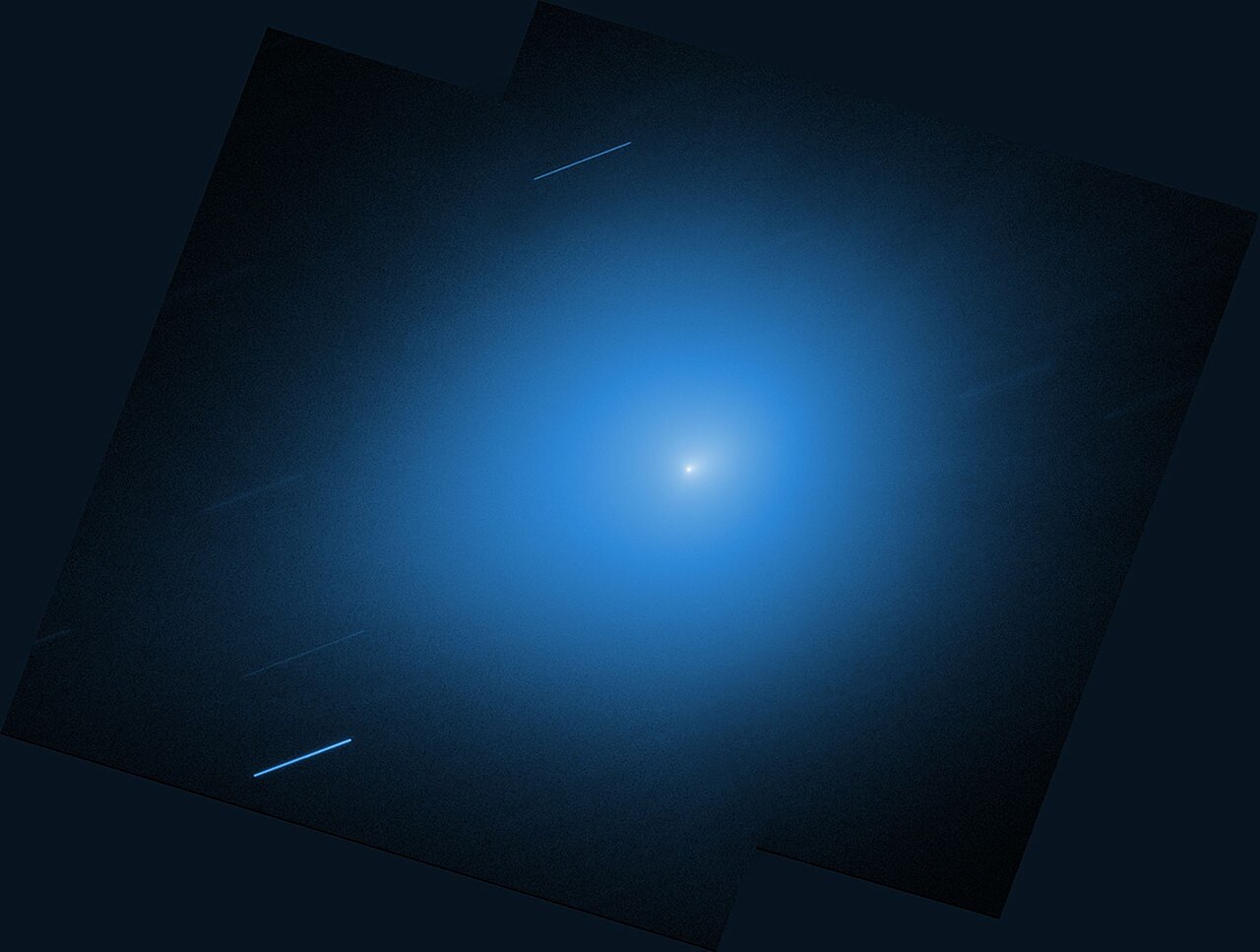
NASA says comet 3I/ATLAS is the third known object from outside the solar system to pass through, classed as interstellar because its orbit is hyperbolic and traces back to outside the solar system. The ATLAS survey telescope in Chile first reported it to the Minor Planet Center on 1 July 2025, with pre-discovery observations going back to 14 June 2025. It reached its closest point to the Sun, about 1.4 AU, around 30 October 2025, and its closest approach to Earth was about 1.8 AU, so NASA says it posed no threat.[3] NASA says Hubble observations as of 20 August 2025 put an upper limit on the nucleus diameter of 3.5 miles (5.6 kilometres), though it could be as small as 1,444 feet (440 metres).[3] NASA says the size and physical properties were still being investigated, so that range may have been narrowed by later work that I did not read.[3] Its name uses "I" for interstellar and "3" because it is the third such object found.[3]
NASA says comet 3I/ATLAS is the third known object from outside the solar system to pass through, classed as interstellar because its orbit is hyperbolic and traces back to outside the solar system. The ATLAS survey telescope in Chile first reported it to the Minor Planet Center on 1 July 2025, with pre-discovery observations going back to 14 June 2025. It reached its closest point to the Sun, about 1.4 AU, around 30 October 2025, and its closest approach to Earth was about 1.8 AU, so NASA says it posed no threat.[3] NASA says Hubble observations as of 20 August 2025 put an upper limit on the nucleus diameter of 3.5 miles (5.6 kilometres), though it could be as small as 1,444 feet (440 metres).[3] NASA says the size and physical properties were still being investigated, so that range may have been narrowed by later work that I did not read.[3] Its name uses "I" for interstellar and "3" because it is the third such object found.[3]
## See also
## See also
[Kuiper belt object](https://micwyn.com/t/3166/kuiper-belt-object), [Asteroid](https://micwyn.com/t/3159/asteroid), [Hills cloud](https://micwyn.com/t/3175/hills-cloud) and [Solar System](https://micwyn.com/t/3151/solar-system).
[Kuiper belt object](https://micwyn.com/t/3166/kuiper-belt-object), [Asteroid](https://micwyn.com/t/3159/asteroid), [Hills cloud](https://micwyn.com/t/3175/hills-cloud) and [Solar System](https://micwyn.com/t/3151/solar-system).
3 unchanged paragraphs
*Via Wikimedia Commons: [3I-ATLAS Hubble 2025 Nov 30](https://commons.wikimedia.org/wiki/File:3I-ATLAS_Hubble_2025_Nov_30.jpg) by NASA, ESA, STScI, D. Jewitt (UCLA), M.-T. Hui (Shanghai Astr, public domain.*
*Via Wikimedia Commons: [3I-ATLAS Hubble 2025 Nov 30](https://commons.wikimedia.org/wiki/File:3I-ATLAS_Hubble_2025_Nov_30.jpg) by NASA, ESA, STScI, D. Jewitt (UCLA), M.-T. Hui (Shanghai Astr, public domain.*
## Sources
## Sources
1. NASA Science. "Comets Facts." https://science.nasa.gov/solar-system/comets/facts/ (read 23 November 2026)
2. NASA Science. "Comets." https://science.nasa.gov/solar-system/comets/ (read 23 November 2026)
3. NASA Science. "Comet 3I/ATLAS." https://science.nasa.gov/solar-system/comets/3i-atlas/ (read 23 November 2026)
