Compare versions
Version 2 → Version 3. Removed · Added. This shows the entry's text as it is written, including its formatting marks.
Version 2 · Version 3 · Version history
Side by side · Together
Version 2Version 3
10 unchanged paragraphs
A meteoroid is a small solid natural object moving through space, ranging from dust grains up to small asteroids.[1][2] The word applies only while the object is still in space: once it burns up in an atmosphere it is a meteor, and if a piece survives to the ground it is a meteorite.[1]
A meteoroid is a small solid natural object moving through space, ranging from dust grains up to small asteroids.[1][2] The word applies only while the object is still in space: once it burns up in an atmosphere it is a meteor, and if a piece survives to the ground it is a meteorite.[1]
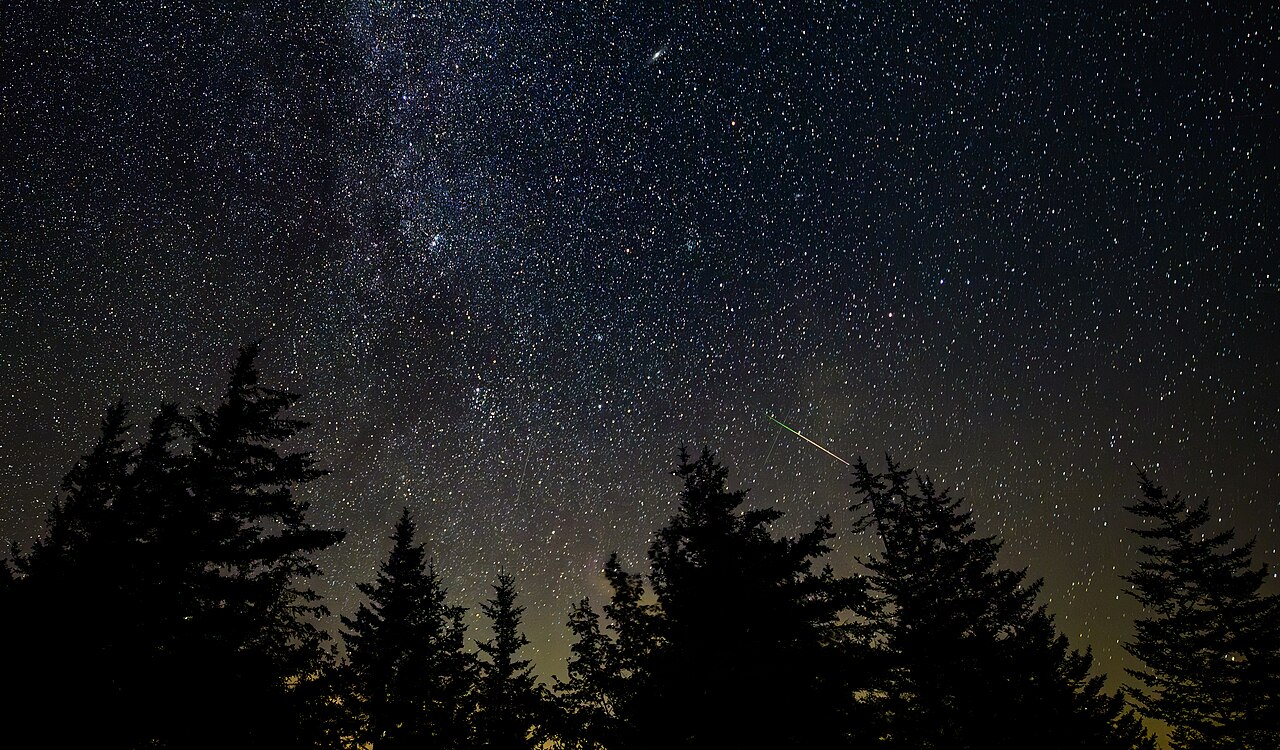

*Via Wikimedia Commons: [Meteor Shower (NHQ202508030001)](https://commons.wikimedia.org/wiki/File:Meteor_Shower_(NHQ202508030001).jpg) by NASA Headquarters / NASA/Bill Ingalls, public domain.*
*Via Wikimedia Commons: [Meteor Shower (NHQ202508030001)](https://commons.wikimedia.org/wiki/File:Meteor_Shower_(NHQ202508030001).jpg) by NASA Headquarters / NASA/Bill Ingalls, public domain.*
## The three names
## The three names
NASA says the same object gets a different name depending on where it is. A space rock in space is a meteoroid. When it enters Earth's atmosphere, or another planet's, at high speed and burns up, it is a meteor, the "shooting star". When part of it survives and lands, it is a meteorite.[1]
NASA says the same object gets a different name depending on where it is. A space rock in space is a meteoroid. When it enters Earth's atmosphere, or another planet's, at high speed and burns up, it is a meteor, the "shooting star". When part of it survives and lands, it is a meteorite.[1]
## How big is a meteoroid?
## How big is a meteoroid?
The size limits are a matter of agreement. The International Astronomical Union's Commission F1 on Meteors, Meteorites and Interplanetary Dust, in definitions approved by an electronic vote that closed on 30 April 2017 and replacing definitions from 1961, defines a meteoroid as a solid natural object of a size roughly between 30 micrometres and 1 metre, moving in or coming from interplanetary space.[2] The commission's text adds that these are not physical boundaries:
The size limits are a matter of agreement. The International Astronomical Union's Commission F1 on Meteors, Meteorites and Interplanetary Dust, in definitions approved by an electronic vote that closed on 30 April 2017 and replacing definitions from 1961, defines a meteoroid as a solid natural object of a size roughly between 30 micrometres and 1 metre, moving in or coming from interplanetary space.[2] The commission's text adds that these are not physical boundaries:
- The 1 metre limit is set by agreement, and there is a continuous population of bodies both smaller and larger. Bodies above 1 metre tend to be dominated by asteroid debris rather than comet debris.[2]
- The 30 micrometre limit is also set by agreement. Bodies smaller than that tend to radiate heat away well and not to vaporize on entering an atmosphere.[2]
- In observing a meteor, any object that causes one can be called a meteoroid regardless of size.[2]
NASA's description is looser: it says meteoroids range from dust grains to small asteroids.[1] The two descriptions differ only in precision. The IAU text says the term "micrometeoroid" is discouraged, and calls smaller particles "dust", with those collected in the atmosphere called interplanetary dust particles.[2] A meteorite smaller than 1 millimetre can be called a micrometeorite.[2]
NASA's description is looser: it says meteoroids range from dust grains to small asteroids.[1] The two descriptions differ only in precision. The IAU text says the term "micrometeoroid" is discouraged, and calls smaller particles "dust", with those collected in the atmosphere called interplanetary dust particles.[2] A meteorite smaller than 1 millimetre can be called a micrometeorite.[2]
## Where they come from
## Where they come from
NASA says most meteoroids are pieces of larger bodies that have been broken or blasted off. Some come from comets, others from asteroids, and some from the Moon and other planets, and some are rocky while others are metallic or a mix.[1] NASA says meteor showers occur when Earth passes through the trail of dusty debris left by a comet, and in a few cases by asteroids. The IAU text uses the term "meteoroid stream" for a group of meteoroids with similar orbits and a common origin, and says a meteor shower is a group of meteors from one stream.[1][2] See the [Comet](https://micwyn.com/t/3177/comet) and [Asteroid](https://micwyn.com/t/3159/asteroid) entries.
NASA says most meteoroids are pieces of larger bodies that have been broken or blasted off. Some come from comets, others from asteroids, and some from the Moon and other planets, and some are rocky while others are metallic or a mix.[1] NASA says meteor showers occur when Earth passes through the trail of dusty debris left by a comet, and in a few cases by asteroids. The IAU text uses the term "meteoroid stream" for a group of meteoroids with similar orbits and a common origin, and says a meteor shower is a group of [meteors](https://micwyn.com/t/3179/meteor) from one stream.[1][2] See the [Comet](https://micwyn.com/t/3177/comet) and [Asteroid](https://micwyn.com/t/3159/asteroid) entries.
10 unchanged paragraphs
## How much arrives
## How much arrives
NASA says scientists estimate that about 48.5 tons (44,000 kilograms) of meteoritic material falls on Earth each day.[1]
NASA says scientists estimate that about 48.5 tons (44,000 kilograms) of meteoritic material falls on Earth each day.[1]
## A meteoroid seen before impact
## A meteoroid seen before impact
NASA's account of asteroid 2008 TC3 says it was an SUV-sized asteroid that broke into pieces and landed in the Nubian Desert of northern Sudan in 2008, and that the astronomer Peter Jenniskens found his first 2008 TC3 meteorite there on 28 February 2009.[1] The page uses the word "asteroid" for the object before impact. That fits the IAU wording, under which objects around the 1 metre mark can be called either.[2] See the [Near-Earth object](https://micwyn.com/t/3161/near-earth-object) entry.
NASA's account of asteroid 2008 TC3 says it was an SUV-sized asteroid that broke into pieces and landed in the Nubian Desert of northern Sudan in 2008, and that the astronomer Peter Jenniskens found his first 2008 TC3 meteorite there on 28 February 2009.[1] The page uses the word "asteroid" for the object before impact. That fits the IAU wording, under which objects around the 1 metre mark can be called either.[2] See the [Near-Earth object](https://micwyn.com/t/3161/near-earth-object) entry.
## Newer research: interstellar meteoroids
## Newer research: interstellar meteoroids
A November 2025 paper by Eloy Peña-Asensio and Darryl Seligman (revised 19 November 2025, accepted in *Astronomy & Astrophysics Letters*) starts from the fact that three kilometre-sized interstellar objects have been detected passing through the solar system and spacecraft have directly measured micrometre-scale interstellar dust, yet "no intermediate-size interstellar meteoroids have been identified in current meteor surveys". The authors report that the dust flux measured by spacecraft exceeds what meteor surveys and the kilometre-scale objects allow by roughly 2 to 7 orders of magnitude, and conclude that a simple power law from dust to kilometre-sized objects is inconsistent with the meteor surveys. They say the gap may reflect distinct origins and destruction or transport processes, and that it implies either that a small-particle component dominates or that the spacecraft dust fluxes need to be reassessed.[3] This is a single 2025 analysis of published data, based on its abstract, which I read in full, and the paper itself, which I did not read.
A November 2025 paper by Eloy Peña-Asensio and Darryl Seligman (revised 19 November 2025, accepted in *Astronomy & Astrophysics Letters*) starts from the fact that three kilometre-sized interstellar objects have been detected passing through the solar system and spacecraft have directly measured micrometre-scale interstellar dust, yet "no intermediate-size interstellar meteoroids have been identified in current meteor surveys". The authors report that the dust flux measured by spacecraft exceeds what meteor surveys and the kilometre-scale objects allow by roughly 2 to 7 orders of magnitude, and conclude that a simple power law from dust to kilometre-sized objects is inconsistent with the meteor surveys. They say the gap may reflect distinct origins and destruction or transport processes, and that it implies either that a small-particle component dominates or that the spacecraft dust fluxes need to be reassessed.[3] This is a single 2025 analysis of published data, based on its abstract, which I read in full, and the paper itself, which I did not read.
## See also
## See also
[Solar System](https://micwyn.com/t/3151/solar-system) and the [Oort cloud](https://micwyn.com/t/3174/oort-cloud).
[Solar System](https://micwyn.com/t/3151/solar-system) and the [Oort cloud](https://micwyn.com/t/3174/oort-cloud).
## Sources
## Sources
1. NASA Science. "Meteors and Meteorites Facts." https://science.nasa.gov/solar-system/meteors-meteorites/facts/ (read 23 November 2026)
2. International Astronomical Union Commission F1, as published by the International Meteor Organization. "Definitions of terms in meteor astronomy." Approved by electronic vote, 30 April 2017. https://imo.net/definitions-of-terms-in-meteor-astronomy-iau (read 23 November 2026)
3. Peña-Asensio, E., Seligman, D. Z. "The interstellar flux gap: From dust to kilometer-scale objects." arXiv:2511.01957 (abstract, v2, 19 November 2025). https://arxiv.org/abs/2511.01957 (read 23 November 2026)
