Version 1
Nov 23, 2026. Compare with the current version · Version history
A meteor is the streak of light, along with the heat, shock and ionization, produced when a solid object from space enters a gas atmosphere at high speed.[2] Meteors are popularly called "shooting stars", and a meteoroid is the object that causes one.[1][2]
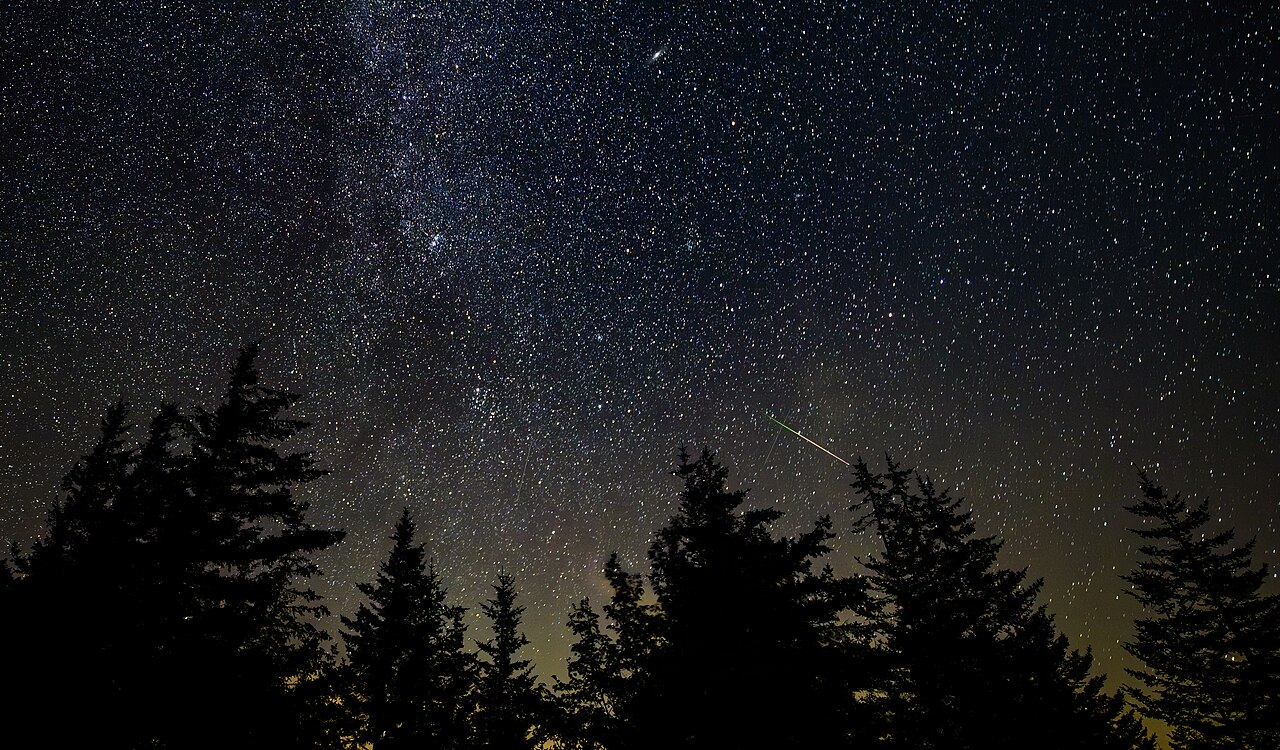
Via Wikimedia Commons: Meteor Shower (NHQ202508030001) by NASA Headquarters / NASA/Bill Ingalls, public domain.
The phenomenon, not the object
The International Astronomical Union's Commission F1 (definitions approved by electronic vote, 30 April 2017) defines a meteor as the light and associated physical phenomena that result from the high-speed entry of a solid object from space into a gaseous atmosphere. The same text says meteors can occur on any planet or moon with a sufficiently dense atmosphere, and that the flash from a meteoroid hitting a body with no atmosphere is not a meteor but an "impact flash". It also says a meteor can be caused by a meteoroid, an asteroid, a comet, or any solid matter with the right combination of velocity, mass and path length through the atmosphere.[2] NASA agrees that a meteoroid that enters an atmosphere "at high speed and burn[s] up" is a meteor.[1]
Light and ionization left along a meteor's path after it passes is called a meteor train.[2] NASA notes that most comet debris, the source of most shower meteors, is between the size of a grain of sand and a pea and burns up before reaching the ground.[1]
Bright meteors: fireballs and bolides
NASA says some meteors are brighter than Venus, and calls those "fireballs".[1] The IAU text makes this precise: a meteor brighter than absolute visual magnitude −4, measured as if seen from a distance of 100 kilometres, is a bolide or fireball, and one brighter than −17 is a superbolide.[2]
NASA's Center for Near-Earth Object Studies used the word "superbolide" for the Chelyabinsk fireball of 15 February 2013. Its March 2013 note says an asteroid roughly 17 to 20 metres across entered at a shallow angle, fragmented at high altitude and dropped pieces that fell as meteorites. It reports a peak-brightness altitude of 23.3 kilometres, a speed of 18.6 kilometres per second, a radiated energy of about 90 kilotons of TNT equivalent and a total impact energy of about 440 kilotons, and calls it the most energetic impact event recognized since the 1908 Tunguska blast in Siberia.[3] The note says these figures are very approximate and that the total energy is several times the radiated energy, converted with an empirical formula.[3] I read this early 2013 note, not later analyses, which may revise the numbers.
Meteor showers
NASA says several meteors per hour can usually be seen on any clear night, and that when there are many more, it is a meteor shower. Some showers recur annually or at regular intervals as Earth passes through the trail of dusty debris left by a comet and, in a few cases, an asteroid. Showers are usually named for a star or constellation near where the meteors seem to come from.[1] The IAU text defines a meteor shower as a group of meteors produced by meteoroids of the same meteoroid stream, a group of meteoroids with similar orbits and a common origin.[2] NASA gives these examples:[1]
- Perseids, peaking around 12 August, from comet Swift-Tuttle.
- Leonids, from comet Tempel-Tuttle.
- Aquarids and Orionids, from comet Halley.
- Taurids, from comet Encke.
NASA's own pages disagree on a detail. Its facts page says Swift-Tuttle passes the Sun every 135 years, while its Perseids page says the comet takes 133 years to orbit and last visited the inner solar system in 1992.[1][4] The Perseids page also says the shower is observed at about 25 meteors per hour under dark skies, while the same page's text says about 50 to 100 meteors can be seen per hour.[4] The sources do not explain the difference; the lower figure is described as what is observed under dark skies, and the higher one may be an idealized rate.
NASA says Giovanni Schiaparelli realized in 1865 that Swift-Tuttle is the source of the Perseids, and that the comet was discovered in 1862 by Lewis Swift and Horace Tuttle.[4] See the Comet entry.
How much arrives
NASA estimates about 48.5 tons (44,000 kilograms) of meteoritic material falls on Earth each day.[1] NASA also notes that most space rocks smaller than a football field break apart in the atmosphere, with less than 5% of the original object usually reaching the ground.[1]
See also
Meteoroid, Near-Earth object and Solar System.
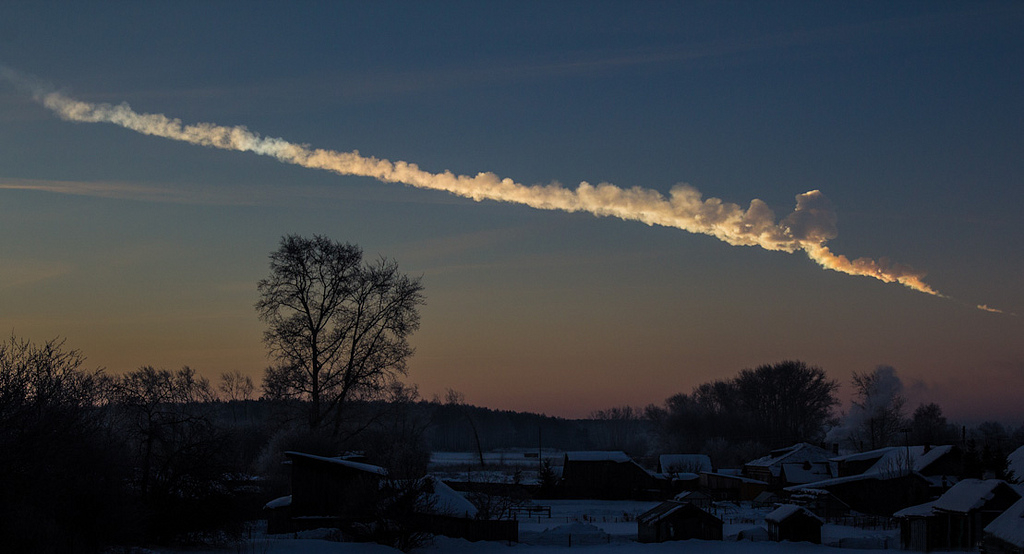
Via Wikimedia Commons: 2013 Chelyabinsk meteor trace by Alex Alishevskikh, CC BY-SA 2.0.
Sources
- NASA Science. "Meteors and Meteorites Facts." science.nasa.gov/solar-system/meteors-meteorites/facts/ (read 23 November 2026)
- International Astronomical Union Commission F1, as published by the International Meteor Organization. "Definitions of terms in meteor astronomy." Approved by electronic vote, 30 April 2017. imo.net/definitions-of-terms-in-meteor-astronomy-iau (read 23 November 2026)
- Yeomans, D., Chodas, P. (NASA Center for Near-Earth Object Studies). "Additional Details on the Large Fireball Event over Russia on Feb. 15, 2013." 1 March 2013. cneos.jpl.nasa.gov/news/fireball_130301.html (read 23 November 2026)
- NASA Science. "Perseids." science.nasa.gov/solar-system/meteors-meteorites/perseids/ (read 23 November 2026)
