Compare versions
Version 2 → Version 3 (current). Removed · Added. This shows the entry's text as it is written, including its formatting marks.
Version 2 · Version 3 (current) · Version history
Side by side · Together
The frost line, more often called the snow line, is the distance from a young star beyond which a molecule such as water freezes into ice in the disk of gas and dust around it.[1][2] It matters because it helps decide where rocky planets and giant planets form.[1][2]
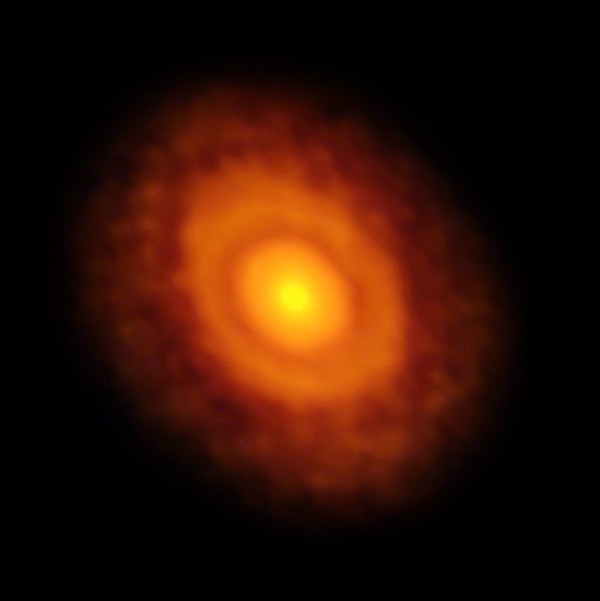
*Via Wikimedia Commons: [ALMA image of the protoplanetary disc around V883 Orionis (eso1626b)](https://commons.wikimedia.org/wiki/File:ALMA_image_of_the_protoplanetary_disc_around_V883_Orionis_(eso1626b).jpg) by ALMA (ESO/NAOJ/NRAO)/L. Cieza, [CC BY 4.0](https://creativecommons.org/licenses/by/4.0).*
## What it is
The Harvard–Smithsonian Center for Astrophysics (CfA) explains that, in a disk around a new star, the farther the gas and dust are from the star, the cooler they are, until at some critical distance molecules in the gas condense onto dust grains. The distance at which a molecular species freezes out is its snow line.[2] The sources read for this entry use "snow line" and do not separately define "frost line", so the two names are treated here as the same idea; that is an assumption, not something the sources state. Each molecule has its own line: NASA's release describes the water snow line, and CfA also describes a carbon monoxide (CO) line much farther out.[1][2]
## Where it is
A NASA release about the young star V883 Orionis says the heat of a typical young Sun-like star keeps water in a protoplanetary disk gaseous out to about 3 astronomical units (AU) from the star. Beyond that, because of extremely low pressure, water vapour changes directly to ice on dust grains.[1] CfA says the water snow line in the young solar system is thought to have been at about 3 AU. The [asteroid belt](https://micwyn.com/t/3158/asteroid-belt) lies in this general region of the solar system, but these sources do not connect the two.[2] A paper on imaging snow lines says the water snow line lies at less than 10 AU for such disks.[3] The sources differ in how loosely they state the number, and CfA's figure is a "thought to have been" estimate, since nobody measured our own disk. The snow line also moves over time as the disk evolves.[1] I did not read a source giving a more exact solar-system value.
## Why it matters for planets
NASA says planet formation is still a mystery, but that rocky planets like Earth are believed to form inside the water snow line and massive gas planets like Jupiter outside it.[1] The release says water ice regulates how efficiently dust grains stick together, the first step in planet formation, so beyond the line the ice helps "cosmic snowballs" form that eventually become gas giants like [Jupiter](https://micwyn.com/t/3029/jupiter).[1] CfA lists four reasons snow lines are thought to mark regions of enhanced growth: more solid material beyond the line, gas that freezes out as it diffuses across it, grains piling up just inside it, and icy grains being stickier.[2] CfA adds that, farther out, methane and CO freezing may have helped feed the zones where [Uranus](https://micwyn.com/t/3073/uranus) and [Neptune](https://micwyn.com/t/3101/neptune) formed, and that recent solar system models say most comets formed even farther out, at about 35 AU.[2] See [Comet](https://micwyn.com/t/3177/comet).
## Seeing one directly
- **V883 Orionis (water).** NASA's release says ALMA took the first image of a water snow line in a planet-forming disk, around V883 Orionis. The star was in a large outburst, about 400 times more luminous and much hotter than before although only 30% more massive than the Sun, which pushed the line out to about 40 AU, similar to the size of Pluto's orbit. That distance is what made it resolvable. The release says lead author Lucas Cieza reported a ring at 40 AU while searching for something else.[1]
- **TW Hydrae (carbon monoxide).** CfA reports that ALMA observations traced the CO snow line at about 30 AU around the young star TW Hya, roughly consistent with some aspects of newer solar system models.[2]
- **HL Tau (water, 2025).** Leemker and colleagues' November 2025 paper (revised February 2026) used ALMA to map water emission around HL Tau and report that the observations are consistent with the water snow line lying inside the central beam, within about 6 AU. They report that only 0.02% to 2% of the water reservoir is visible at mid- and far-infrared wavelengths because dust hides it, while 35% to 70% is visible with ALMA. I read the abstract only.[4]
## Method note
Before these images, the location of the water snow line was estimated only indirectly from spectra that could not resolve the disk. A 2016 paper by Andrea Banzatti and colleagues proposed a way to image it directly, using the pattern the line leaves in the dust properties, and was a proof of concept based on a model, not an observation.[3]
## See also
[Habitable zone](https://micwyn.com/t/3184/habitable-zone), [Solar System](https://micwyn.com/t/3151/solar-system), [Gas giant](https://micwyn.com/t/3156/gas-giant), [Ice giant](https://micwyn.com/t/3157/ice-giant) and [Terrestrial planet](https://micwyn.com/t/3155/terrestrial-planet).
## Sources
1. NASA Science. "Space snow visible in bright baby solar system" (ALMA image of the water snow line around V883 Orionis). https://science.nasa.gov/universe/exoplanets/space-snow-visible-in-bright-baby-solar-system (read 23 November 2026)
2. Center for Astrophysics | Harvard & Smithsonian. "Planets and the Snow Line." https://www.cfa.harvard.edu/news/planets-and-snow-line (read 23 November 2026)
3. Banzatti, A., et al. "Direct imaging of the water snow line at the time of planet formation using two ALMA continuum bands." arXiv:1511.06762 (abstract). https://arxiv.org/abs/1511.06762 (read 23 November 2026)
4. Leemker, M., et al. "Zooming into the water snowline: high resolution water observations of the HL Tau disk." arXiv:2511.16737 (abstract, v2, 12 February 2026). https://arxiv.org/abs/2511.16737 (read 23 November 2026)
