Version 4 (current)
Nov 23, 2026. Version history
The habitable zone is the range of distances from a star at which liquid water could exist on the surface of an orbiting planet.[1] It is also called the "Goldilocks zone", where conditions might be just right, not too hot and not too cold.[1]
The idea
NASA says every star has a habitable zone, but where it lies differs for stars of different size and brightness, and that it is a helpful concept because liquid water is essential for life as we know it.[1] A NASA feature adds that the zone is the region where the temperature is right for liquid water to pool on the surface of a planet with a suitable atmosphere.[2] NASA's astrobiology scientist Mary Voytek is quoted there saying "it's not just the location": many other factors contribute to habitable conditions.[2] NASA also says the reason to search there first is practical: life as we know it should be easier to find, and "the light's better" in the habitable zone.[1]
In our solar system
The Sun's habitable zone depends on the model. Kasting and colleagues' 1993 climate model gave a conservative width of 0.95 to 1.67 astronomical units (AU) from the Sun, where one AU is Earth's average distance. An updated 2013 model by Ravi Kopparapu and colleagues put the inner edge, set by loss of water, at 0.99 AU and the outer edge, set by the maximum greenhouse effect of a carbon dioxide atmosphere, at 1.70 AU, and the authors say this suggests that present-day Earth lies near the inner edge.[3] NASA's feature describes the zone more loosely: Venus by some measures grazes the inner edge and Mars falls just inside the outer boundary, yet neither appears habitable. NASA calls Venus too hot, with sulfuric acid clouds, and Mars freezing and desiccated, with a thin carbon dioxide atmosphere.[2] See also the Earth entry.
The two descriptions differ in emphasis: the 2013 paper's authors say present-day Earth lies near the inner edge of their zone, while NASA's feature stresses that Venus and Mars sit at the edges. I read the abstract of the 2013 paper only, and its numbers come from a one-dimensional, cloud-free climate model, as the authors state.[3]
How it changes with the star
NASA says habitable zones are wider for hotter stars and much tighter for the dimmer red dwarfs, the most common stars in the Milky Way, as in the TRAPPIST-1 system.[1] A planet in a red dwarf's narrow zone, very close to the star, is exposed to extreme X-ray and ultraviolet radiation that NASA says can be up to hundreds of thousands of times more intense than Earth receives, and young red dwarfs often erupt in powerful flares that could sterilize close-orbiting planets.[1] The Kopparapu paper gives its results in a form that can be applied to stars with temperatures between 2,600 and 7,200 kelvin.[3]
NASA also says that stars somewhat cooler and dimmer than the Sun, the orange or K dwarfs, are considered by some scientists potentially better for advanced life because they burn steadily for tens of billions of years, and quotes Edward Guinan calling them the "true Goldilocks stars".[1] That is one researcher's view, as NASA reports it, not an established finding.
Not the whole story
NASA says that while the traditional definition is still a useful first approximation, the variety of planets found so far is prompting a "wholesale re-evaluation" of what makes a planet habitable. Questions it lists include whether rogue planets with internal heat could be habitable, whether Earth-sized planets close to red dwarfs could harbour life despite flares, and how larger worlds fit.[2] The zone is also only about the surface; it says nothing about whether a planet has an atmosphere, and NASA is explicit that a planet in the zone needs a suitable atmosphere for liquid water.[2]
A test case: TRAPPIST-1 e
NASA's Webb release says planet e, one of seven Earth-sized worlds orbiting the red dwarf TRAPPIST-1, sits where water on the surface is theoretically possible, but only if it has an atmosphere. Four transits analysed with Webb's NIRSpec instrument, published in two Astrophysical Journal Letters papers, leave several scenarios open. The team is confident the planet has lost any original hydrogen-helium atmosphere, thinks a carbon dioxide-dominated one like those of Venus or Mars is unlikely, and says there is an equal chance it has no atmosphere or a secondary one. NASA's caption says Webb has found no definitive signs of an atmosphere around the four innermost planets yet, and that 15 more observations of planet e were under way.[4] I read NASA's release, not the papers, and found no later result.
See also
Frost line, Solar System and Terrestrial planet.
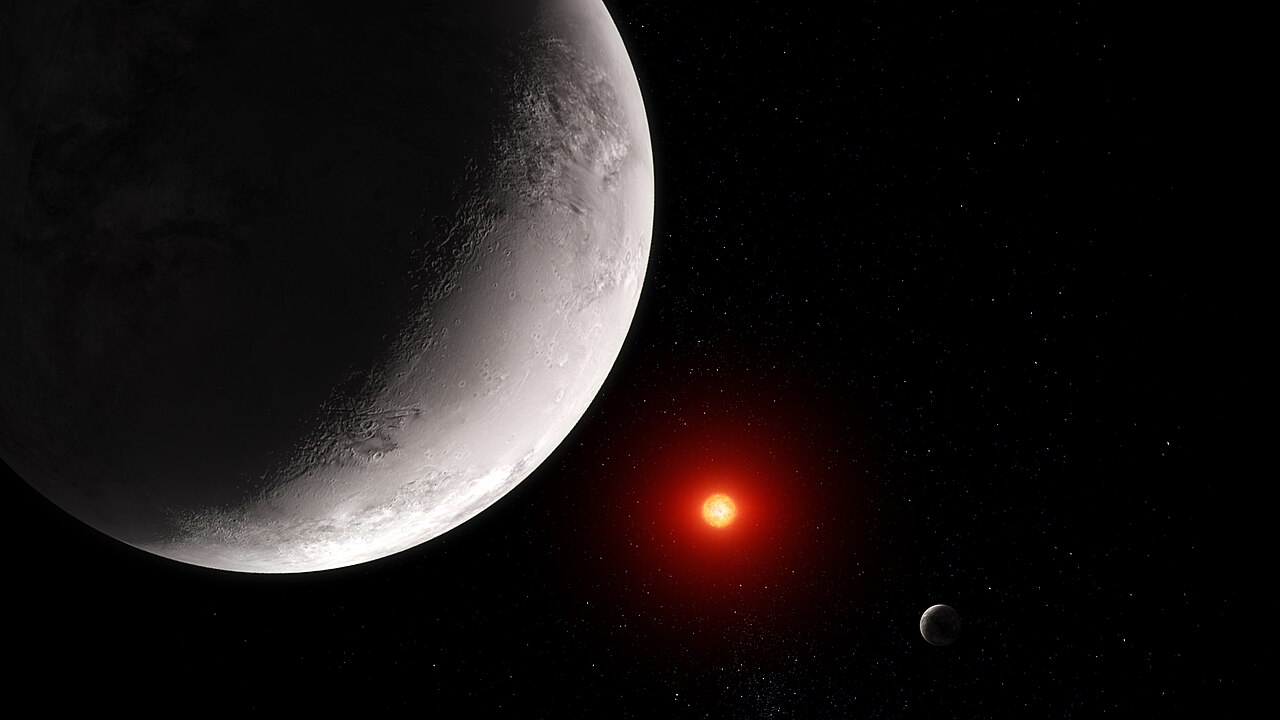
Via Wikimedia Commons: Rocky Exoplanet TRAPPIST-1 c (Artist Concept) by NASA, ESA, CSA, Joseph Olmsted (STScI), public domain.
Sources
- NASA Science. "Habitable Zone." science.nasa.gov/exoplanets/habitable-zone (read 23 November 2026)
- NASA Science. "Oceans, Beaches, Cosmic Shorelines: Our Changing Views of Habitable Planets." science.nasa.gov/universe/exoplanets/oceans-beaches-cosmic-shorelin… (read 23 November 2026)
- Kopparapu, R. K., et al. "Habitable Zones Around Main-Sequence Stars: New Estimates." arXiv:1301.6674 (abstract); Astrophysical Journal, 2013. arxiv.org/abs/1301.6674 (read 23 November 2026)
- NASA Science. "NASA's Webb Looks at Earth-Sized, Habitable-Zone Exoplanet TRAPPIST-1 e." science.nasa.gov/missions/webb/nasa-webb-looks-at-earth-sized-habit… (read 23 November 2026)
