Compare versions
Version 2 → Version 4 (current). Removed · Added. This shows the entry's text as it is written, including its formatting marks.
Version 2 · Version 4 (current) · Version history
Side by side · Together
Version 2Version 4 (current)
A Lagrange point is one of five positions in space where the gravity of two large bodies, such as the Sun and Earth, together with the orbital motion of a small object, lets that small object stay in a fixed position relative to the two larger ones.[1][2] Spacecraft use them as "parking spots" that need little fuel to hold position.[1]
A Lagrange point is one of five positions in space where the gravity of two large bodies, such as the Sun and Earth, together with the orbital motion of a small object, lets that small object stay in a fixed position relative to the two larger ones.[1][2] Spacecraft use them as "parking spots" that need little fuel to hold position.[1]
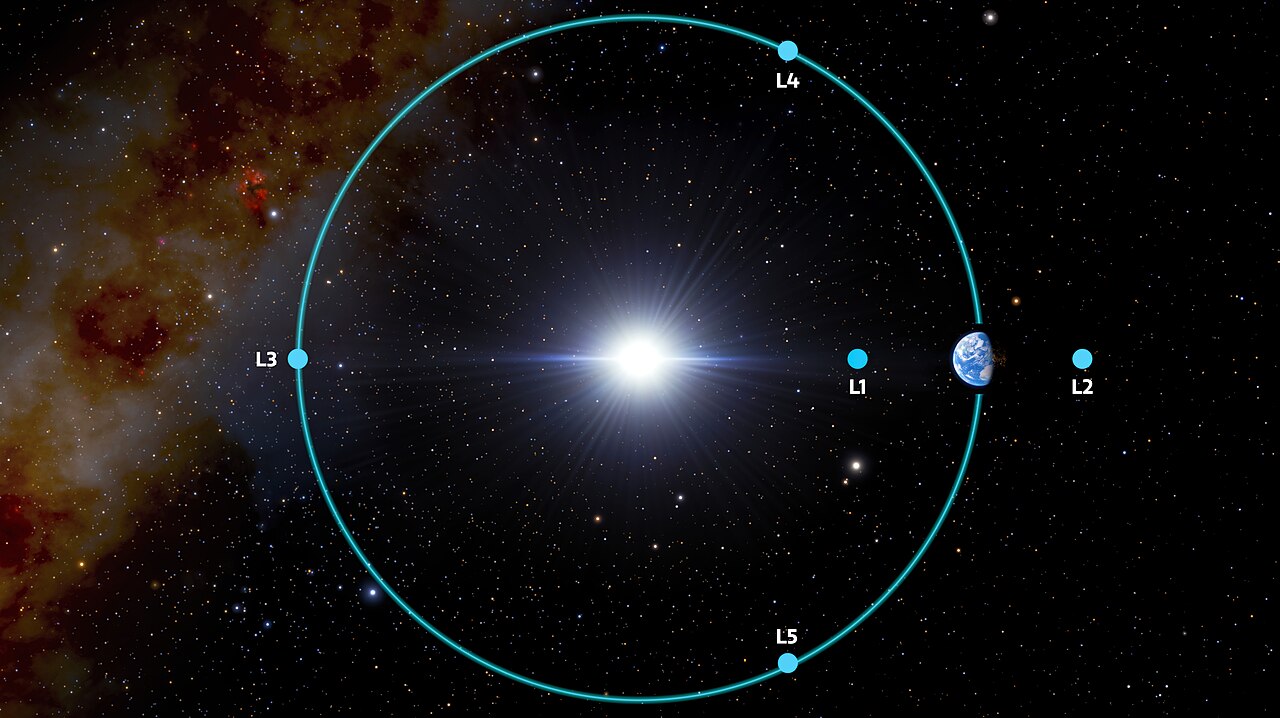
*Via Wikimedia Commons: [Earth-Sun Lagrange Points (noirlab2205b)](https://commons.wikimedia.org/wiki/File:Earth-Sun_Lagrange_Points_(noirlab2205b).jpg) by NOIRLab/NSF/AURA/J. da Silva Acknowledgment: M. Zamani (NSF’, [CC BY 4.0](https://creativecommons.org/licenses/by/4.0).*
7 unchanged paragraphs
## What they are
## What they are
NASA says Lagrange points are positions where the gravitational pull of two large masses precisely equals the centripetal force a small object needs to move with them. The problem was considered by the mathematician Joseph-Louis Lagrange in a prize-winning 1772 paper on the "general three-body problem".[1] There are five of them for any pair of bodies, named L1 to L5.[1]
NASA says Lagrange points are positions where the gravitational pull of two large masses precisely equals the centripetal force a small object needs to move with them. The problem was considered by the mathematician Joseph-Louis Lagrange in a prize-winning 1772 paper on the "general three-body problem".[1] There are five of them for any pair of bodies, named L1 to L5.[1]
- **L1, L2 and L3** lie along the line joining the two large bodies. NASA calls them unstable.[1]
- **L4 and L5** are the points of two equilateral triangles with the two large bodies at the other corners, and NASA calls them stable. L4 leads the smaller body's orbit and L5 follows. ESA says that, as seen from the Sun, they lie 60 degrees ahead of and behind Earth, close to its orbit.[1][3]
NASA says L4 and L5 are stable only if the mass ratio of the two large bodies exceeds 24.96, which holds for the Earth–Sun and Earth–Moon pairs and many other pairs in the solar system.[1]
NASA says L4 and L5 are stable only if the mass ratio of the two large bodies exceeds 24.96, which holds for the Earth–Sun and Earth–Moon pairs and many other pairs in the solar system.[1]
## Why L1, L2 and L3 need fuel
## Why L1, L2 and L3 need fuel
NASA says L1 and L2 are unstable on a time scale of about 23 days, so spacecraft there need regular course and attitude corrections.[1] ESA calls L1, L2 and L3 "meta-stable", like a ball sitting on top of a hill, and says a spacecraft needs frequent rocket firings to stay in "halo orbits" around them.[3] NASA gives a contour-map picture: L4 and L5 are hilltops and L1 to L3 are saddles, but a body that starts to roll off a hilltop speeds up and the Coriolis force sends it into a stable orbit around the point.[1] The two agencies describe the same thing in different words; both say the three on the line need continual correction.
NASA says L1 and L2 are unstable on a time scale of about 23 days, so spacecraft there need regular course and attitude corrections.[1] ESA calls L1, L2 and L3 "meta-stable", like a ball sitting on top of a hill, and says a spacecraft needs frequent rocket firings to stay in "halo orbits" around them.[3] NASA gives a contour-map picture: L4 and L5 are hilltops and L1 to L3 are saddles, but a body that starts to roll off a hilltop speeds up and the Coriolis force sends it into a stable orbit around the point.[1] The two agencies describe the same thing in different words; both say the three on the line need continual correction.
## The five Sun–Earth points
## The five Sun–Earth points
- **L1** lies between the Sun and Earth, about a hundredth of the way to the Sun, according to ESA, and NASA says it gives an uninterrupted view of the Sun. ESA says the solar wind reaches L1 about an hour before Earth.[1][3] NASA and ESA name the SOHO solar observatory there.[1][3] Newer arrivals at L1 reported by NASA and NOAA include IMAP, which reached L1 on 10 January 2026 to map the boundary of the [heliosphere](https://micwyn.com/t/3171/heliosphere), and NOAA's space weather satellite SWFO-L1, renamed SOLAR-1, which made its final engine burn on 23 January 2026.[4][5]
- **L2** lies about 1.5 million kilometres directly behind Earth as seen from the Sun, ESA says. A spacecraft there does not have to orbit Earth, so it is spared from sweeping in and out of Earth's shadow, and NASA says it can keep the Sun, Earth and Moon behind it for solar power with a clear view of deep space.[1][3] NASA's page names WMAP, Planck and the James Webb Space Telescope; ESA adds Herschel and Gaia.[1][3] NASA's page describes Webb as a "future home", which is out of date, since Webb has since launched.[1] A WMAP page puts its orbit at about one million miles beyond Earth.[6]
- **L3** is on the far side of the Sun and cannot be seen from Earth, so NASA says it is unlikely to find a use for it, and ESA says it could in principle let one observe the Sun's far side.[1][3] NASA notes a hidden "Planet X" at L3 is a science-fiction idea, and that such an orbit would be unstable on a time scale of about 150 years.[1]
- **L4 and L5** hold Trojans; see below.
- **L1** lies between the Sun and Earth, about a hundredth of the way to the Sun, according to ESA, and NASA says it gives an uninterrupted view of the Sun. ESA says the [solar wind](https://micwyn.com/t/3189/solar-wind) reaches L1 about an hour before Earth.[1][3] NASA and ESA name the SOHO solar observatory there.[1][3] Newer arrivals at L1 reported by NASA and NOAA include IMAP, which reached L1 on 10 January 2026 to map the boundary of the [heliosphere](https://micwyn.com/t/3171/heliosphere), and NOAA's space weather satellite SWFO-L1, renamed SOLAR-1, which made its final engine burn on 23 January 2026.[4][5]
- **L2** lies about 1.5 million kilometres directly behind Earth as seen from the Sun, ESA says. A spacecraft there does not have to orbit Earth, so it is spared from sweeping in and out of Earth's shadow, and NASA says it can keep the Sun, Earth and Moon behind it for solar power with a clear view of deep space.[1][3] NASA's page names WMAP, Planck and the James Webb Space Telescope; ESA adds Herschel and Gaia.[1][3] NASA's page describes Webb as a "future home", which is out of date, since Webb has since launched.[1] A WMAP page puts its orbit at about one million miles beyond Earth.[6]
- **L3** is on the far side of the Sun and cannot be seen from Earth, so NASA says it is unlikely to find a use for it, and ESA says it could in principle let one observe the Sun's far side.[1][3] NASA notes a hidden "Planet X" at L3 is a science-fiction idea, and that such an orbit would be unstable on a time scale of about 150 years.[1]
- **L4 and L5** hold Trojans; see below.
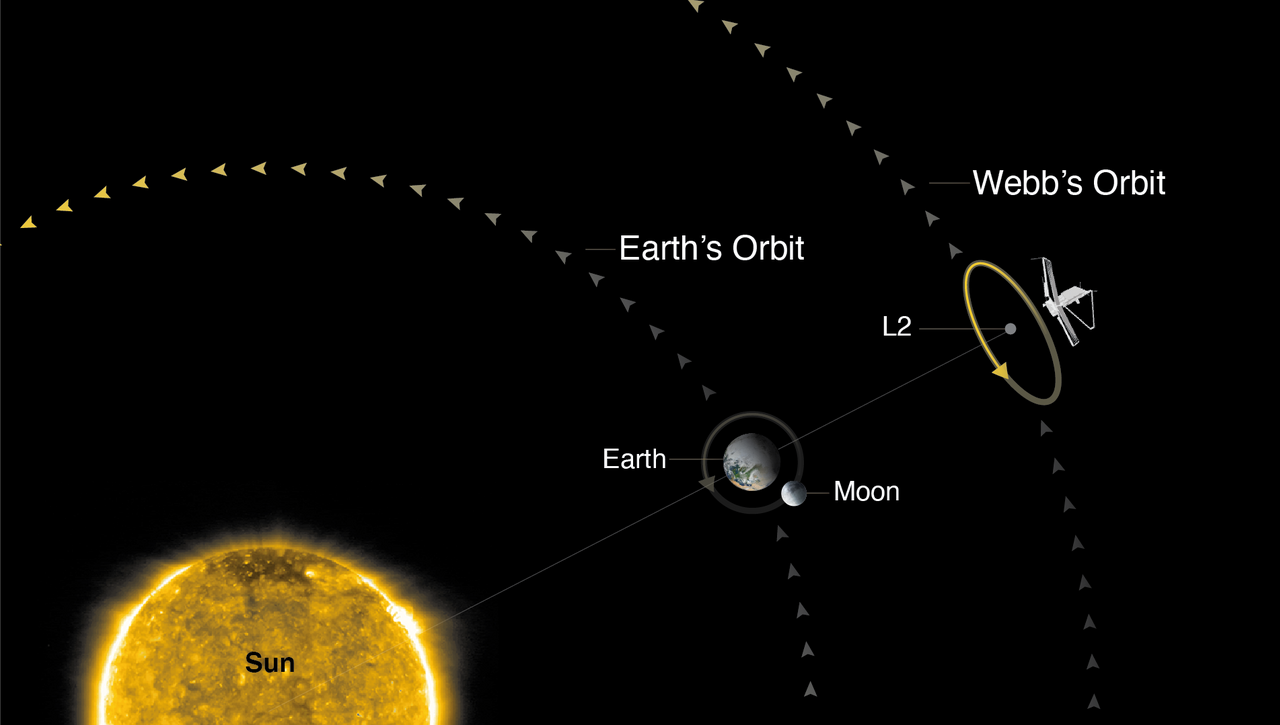
*Via Wikimedia Commons: [Webb's Orbit (4201-Image)](https://commons.wikimedia.org/wiki/File:Webb%27s_Orbit_(4201-Image).png) by IMAGE: STScI, public domain.*
6 unchanged paragraphs
## Trojans and other residents of L4 and L5
## Trojans and other residents of L4 and L5
NASA says objects at L4 and L5 are often called Trojans, after the large asteroids Agamemnon, Achilles and Hector at Jupiter–Sun L4 and L5. It says hundreds of Trojan asteroids exist in the solar system, most orbiting with [Jupiter](https://micwyn.com/t/3029/jupiter) but others with Mars, and several of Saturn's moons have Trojan companions.[1] See [Trojan asteroid](https://micwyn.com/t/3160/trojan-asteroid). NASA says that in 1956 the astronomer Kordylewski reported large concentrations of dust at the Earth–Moon Trojan points, and that in 2010 NASA's WISE telescope confirmed the first Earth Trojan asteroid, 2010 TK7, at Earth's leading Lagrange point.[1] The sources read give no later result on the Earth–Moon dust.
NASA says objects at L4 and L5 are often called Trojans, after the large asteroids Agamemnon, Achilles and Hector at Jupiter–Sun L4 and L5. It says hundreds of Trojan asteroids exist in the solar system, most orbiting with [Jupiter](https://micwyn.com/t/3029/jupiter) but others with Mars, and several of Saturn's moons have Trojan companions.[1] See [Trojan asteroid](https://micwyn.com/t/3160/trojan-asteroid). NASA says that in 1956 the astronomer Kordylewski reported large concentrations of dust at the Earth–Moon Trojan points, and that in 2010 NASA's WISE telescope confirmed the first Earth Trojan asteroid, 2010 TK7, at Earth's leading Lagrange point.[1] The sources read give no later result on the Earth–Moon dust.
## See also
## See also
[Hill sphere](https://micwyn.com/t/3187/hill-sphere), [Solar System](https://micwyn.com/t/3151/solar-system), [Asteroid](https://micwyn.com/t/3159/asteroid) and [Earth](https://micwyn.com/t/3024/earth).
[Hill sphere](https://micwyn.com/t/3187/hill-sphere), [Solar System](https://micwyn.com/t/3151/solar-system), [Asteroid](https://micwyn.com/t/3159/asteroid) and [Earth](https://micwyn.com/t/3024/earth).
## Sources
## Sources
1. NASA Science. "What are Lagrange Points?" https://science.nasa.gov/solar-system/resources/faq/what-are-lagrange-points (read 23 November 2026)
2. NASA Science. "What is a Lagrange Point?" https://science.nasa.gov/resource/what-is-a-lagrange-point (read 23 November 2026)
3. European Space Agency. "What are Lagrange points?" https://www.esa.int/Science_Exploration/Space_Science/What_are_Lagrange_points (read 23 November 2026)
4. NASA Scientific Visualization Studio. "IMAP Arrives at L1." https://svs.gsfc.nasa.gov/14957 (read 23 November 2026)
5. NOAA NESDIS. "SWFO-L1, Renamed SOLAR-1, Reaches Final Destination One Million Miles from Earth." https://www.nesdis.noaa.gov/news/swfo-l1-renamed-solar-1-reaches-final-destination-one-million-miles-earth (read 23 November 2026)
6. NASA. "WMAP Observatory: Orbit at L2." https://map.gsfc.nasa.gov/mission/observatory_l2.html (read 23 November 2026)
