Compare versions
Version 1 → Version 3 (current). Removed · Added. This shows the entry's text as it is written, including its formatting marks.
Version 1 · Version 3 (current) · Version history
Side by side · Together
Version 1Version 3 (current)
The Roche limit is the distance from a massive body within which the tidal forces of that body would tear apart a smaller object held together only by its own gravity.[1] A moon that orbits a giant planet inside this distance disintegrates, and the debris can form a [ring](https://micwyn.com/t/3182/planetary-ring).[1]
The Roche limit is the distance from a massive body within which the tidal forces of that body would tear apart a smaller object held together only by its own gravity.[1] A moon that orbits a giant planet inside this distance disintegrates, and the debris can form a [ring](https://micwyn.com/t/3182/planetary-ring).[1]
12 unchanged paragraphs
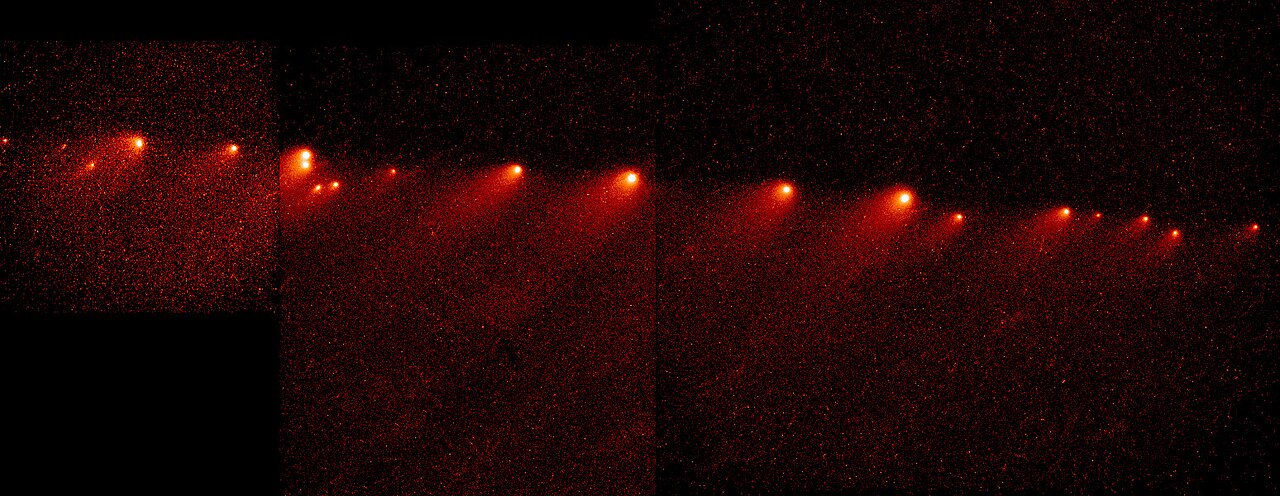
*Via Wikimedia Commons: [The String of Pearls (opo9421b)](https://commons.wikimedia.org/wiki/File:The_String_of_Pearls_(opo9421b).jpg) by Unknown author Unknown author, public domain.*
*Via Wikimedia Commons: [The String of Pearls (opo9421b)](https://commons.wikimedia.org/wiki/File:The_String_of_Pearls_(opo9421b).jpg) by Unknown author Unknown author, public domain.*
## What it is
## What it is
The International Astronomical Union's Office of Astronomy for Education glossary explains that any two massive objects exert tidal forces on each other, that these forces are stronger for more massive objects and for objects that are closer together, and that they can become strong enough to rip an object to shreds. For an object of a given mass and size near another massive object there is a distance within which it will be torn to pieces by the other's tidal forces, and that distance is called the Roche limit.[1] The glossary gives rocky and icy moons orbiting giant planets as a common example, saying a moon closer than the limit will disintegrate into a ring of material.[1] The sources read do not give a formula for it, and none is stated here.
The International Astronomical Union's Office of Astronomy for Education glossary explains that any two massive objects exert tidal forces on each other, that these forces are stronger for more massive objects and for objects that are closer together, and that they can become strong enough to rip an object to shreds. For an object of a given mass and size near another massive object there is a distance within which it will be torn to pieces by the other's tidal forces, and that distance is called the Roche limit.[1] The glossary gives rocky and icy moons orbiting giant planets as a common example, saying a moon closer than the limit will disintegrate into a ring of material.[1] The sources read do not give a formula for it, and none is stated here.
## Why the number is not exact
## Why the number is not exact
The distance is not a single hard line. A 2026 paper in *Astronomy & Astrophysics* by Harrison Agrusa and Patrick Michel looks at "rubble-pile" satellites, which are loose collections of rock held together mostly by gravity. It says that unless a small satellite has substantial material strength, it will eventually tidally disrupt before reaching its planet's surface, and that its disruption distance depends on its shape and its cohesive strength.[2] The paper identifies a regime in which a weakly cohesive satellite has its surface stripped away without failing internally.[2] The paper's point is that the disruption distance depends on the object's structure and strength.
The distance is not a single hard line. A 2026 paper in *Astronomy & Astrophysics* by Harrison Agrusa and Patrick Michel looks at "rubble-pile" satellites, which are loose collections of rock held together mostly by gravity. It says that unless a small satellite has substantial material strength, it will eventually tidally disrupt before reaching its planet's surface, and that its disruption distance depends on its shape and its cohesive strength.[2] The paper identifies a regime in which a weakly cohesive satellite has its surface stripped away without failing internally.[2] The paper's point is that the disruption distance depends on the object's structure and strength.
## Phobos
## Phobos
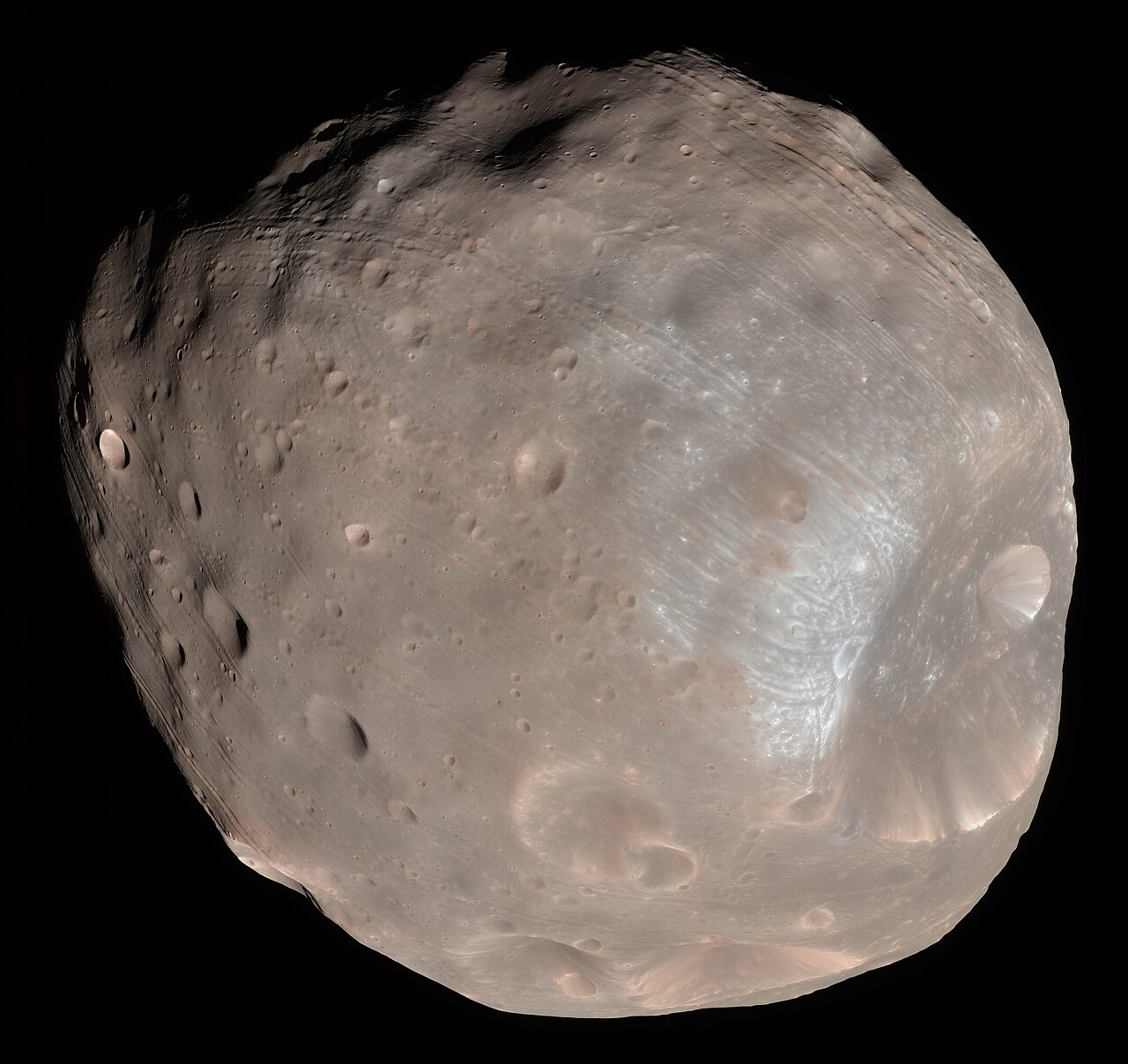
The same paper studies Mars's inner moon [Phobos](https://micwyn.com/t/3027/phobos), which like many small satellites has an orbit that is decaying through tidal dissipation. Its simulations indicate that Phobos would be destroyed beyond 2 Mars radii from the planet if it has a bulk strength similar to those estimated for small bodies that spacecraft have visited. The authors suggest earlier studies overestimated Phobos's strength and so underestimated the distance at which it would be disrupted, and they speculate that if it were stripped, its fate might be set by runaway collisional erosion instead of a pure tidal breakup. They say the real answer depends on Phobos's unknown internal structure, which JAXA's Martian Moons eXploration (MMX) mission is expected to help constrain, though the abstract text I read is cut off after that point.[2] This is a modelling study, and I read only its abstract. It does not say when, or whether, Phobos will reach that distance.
The same paper studies Mars's inner moon [Phobos](https://micwyn.com/t/3027/phobos), which like many small satellites has an orbit that is decaying through tidal dissipation. Its simulations indicate that Phobos would be destroyed beyond 2 Mars radii from the planet if it has a bulk strength similar to those estimated for small bodies that spacecraft have visited. The authors suggest earlier studies overestimated Phobos's strength and so underestimated the distance at which it would be disrupted, and they speculate that if it were stripped, its fate might be set by runaway collisional erosion instead of a pure tidal breakup. They say the real answer depends on Phobos's unknown internal structure, which JAXA's Martian Moons eXploration (MMX) mission is expected to help constrain, though the abstract text I read is cut off after that point.[2] This is a modelling study, and I read only its abstract. It does not say when, or whether, Phobos will reach that distance.
## Comet Shoemaker–Levy 9
## Comet Shoemaker–Levy 9
*Astronomy* magazine says that in July 1992 comet Shoemaker–Levy 9 passed about 25,000 miles (40,000 kilometres) above [Jupiter](https://micwyn.com/t/3029/jupiter)'s cloud tops, putting it within the planet's Roche limit. Jupiter's tidal forces broke it into more than 20 pieces, a "string of pearls". The comet was discovered in March 1993, and its fragments hit Jupiter between 16 and 22 July 1994.[3] That was a comet, not a satellite, but the source describes the same tidal breakup. See the [Comet](https://micwyn.com/t/3177/comet) entry. I could not open one other reference that a search summary says gives a closer distance, so the figure above is from this one source only.
*Astronomy* magazine says that in July 1992 comet Shoemaker–Levy 9 passed about 25,000 miles (40,000 kilometres) above [Jupiter](https://micwyn.com/t/3029/jupiter)'s cloud tops, putting it within the planet's Roche limit. Jupiter's tidal forces broke it into more than 20 pieces, a "string of pearls". The comet was discovered in March 1993, and its fragments hit Jupiter between 16 and 22 July 1994.[3] That was a comet, not a satellite, but the source describes the same tidal breakup. See the [Comet](https://micwyn.com/t/3177/comet) entry. I could not open one other reference that a search summary says gives a closer distance, so the figure above is from this one source only.
## Chains of craters
## Chains of craters
The glossary adds that chains of craters called "catenae", seen on the Moon and other rocky bodies, are evidence of incoming asteroids breaking up as they pass the Roche limit and landing as a string of smaller objects, rather than as one large body.[1]
The glossary adds that chains of craters called "catenae", seen on the Moon and other rocky bodies, are evidence of incoming asteroids breaking up as they pass the Roche limit and landing as a string of smaller objects, rather than as one large body.[1]
## See also
## See also
[Planetary ring](https://micwyn.com/t/3182/planetary-ring), [Natural satellite](https://micwyn.com/t/3154/natural-satellite) and [Saturn](https://micwyn.com/t/3050/saturn).
[Hill sphere](https://micwyn.com/t/3187/hill-sphere), [Planetary ring](https://micwyn.com/t/3182/planetary-ring), [Natural satellite](https://micwyn.com/t/3154/natural-satellite) and [Saturn](https://micwyn.com/t/3050/saturn).
3 unchanged paragraphs
*Via Wikimedia Commons: [Phobos colour 2008](https://commons.wikimedia.org/wiki/File:Phobos_colour_2008.jpg) by NASA / JPL-Caltech / University of Arizona, public domain.*
*Via Wikimedia Commons: [Phobos colour 2008](https://commons.wikimedia.org/wiki/File:Phobos_colour_2008.jpg) by NASA / JPL-Caltech / University of Arizona, public domain.*
## Sources
## Sources
1. IAU Office of Astronomy for Education. "Roche limit." OAE Multilingual Glossary. https://astro4edu.org/resources/glossary/term/420/ (read 23 November 2026)
2. Agrusa, H., Michel, P. "Tidal disruptions of rubble piles: The case of Phobos." arXiv:2602.21912 (abstract); published in *Astronomy & Astrophysics*. https://arxiv.org/abs/2602.21912 (read 23 November 2026)
3. *Astronomy* magazine. "July 8, 1992: Comet Shoemaker-Levy 9 breaks up." https://www.astronomy.com/today-in-the-history-of-astronomy/july-8-1992-comet-shoemaker-levy-9-breaks-up/ (read 23 November 2026)
