Compare versions
Version 1 → Version 2. Removed · Added. This shows the entry's text as it is written, including its formatting marks.
Version 1 · Version 2 · Version history
Side by side · Together
A magnetosphere is the region of space around a planet that is controlled by the planet's own magnetic field.[1] The solar wind, the stream of charged particles flowing out from the Sun, shapes it, and it keeps most of that wind away from the planet.[1][2]
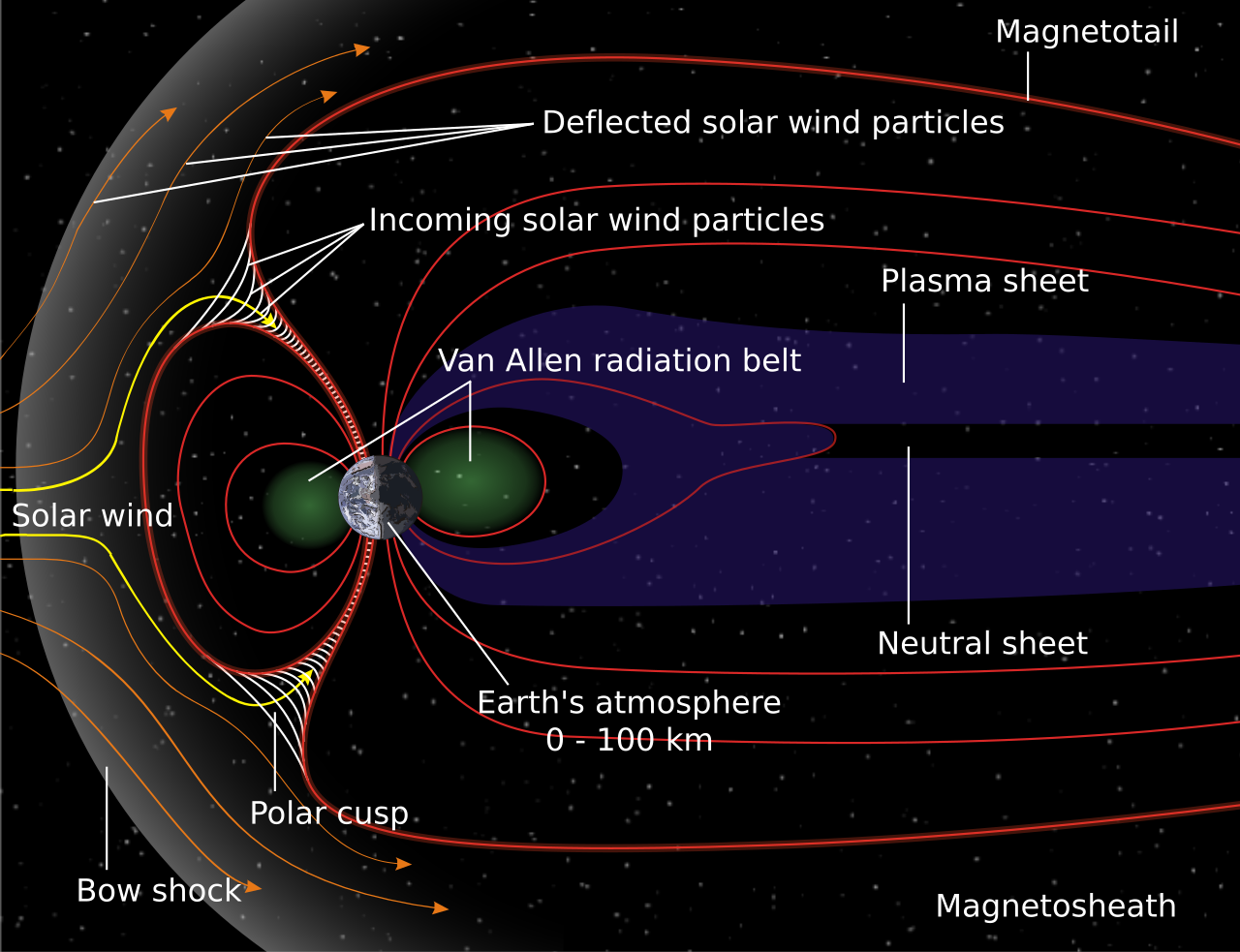labelled schematic of Earth's magnetosphere, not to scale: the solar wind arrives from the left at a curved bow shock, with the magnetosheath behind it, a magnetopause boundary enclosing red magnetic field lines, polar cusps, Van Allen radiation belts shown as green blobs around a small Earth, a plasma sheet and neutral sheet, and a long magnetotail stretching to the right; no credit is shown](/m/2026/11/WSpBhVimAoqVwnB6.png)
*Via Wikimedia Commons: [Structure of the magnetosphere LanguageSwitch](https://commons.wikimedia.org/wiki/File:Structure_of_the_magnetosphere_LanguageSwitch.svg) by Original: NASA Vector: Aaron Kaase , Medium69, public domain.*
## Earth's magnetosphere
NASA says the shape of Earth's magnetosphere is the direct result of being blasted by the solar wind, which compresses the sunward side to a distance of only 6 to 10 times Earth's radius. It adds a supersonic shock wave sunward of Earth, the bow shock, where most wind particles are heated and slowed and detour around Earth in a region called the magnetosheath. On the night side the wind drags the field out into a magnetotail that NASA says may reach about 1,000 Earth radii, its exact length being unknown. The outer boundary of the confined field is the magnetopause.[1]
A NASA Goddard explainer gives more detail. Charged particles in the solar wind are tied to their own magnetic field lines and cannot easily cross into Earth's field, so the two stay separate, the wind detours around, and Earth's field lines are enclosed in a bullet-shaped cavity that continues as a long tail on the night side.[2] It puts the magnetopause "nose" on average at 10 to 11 Earth radii from Earth's centre, moving out to about 13 when the solar wind is weak, and says fast plasma clouds from solar eruptions can push the boundary in to almost half its usual distance, as happens a few times a year. It puts the bow shock about 3 to 4 Earth radii outside the nose.[2] The two NASA descriptions differ, 6 to 10 against 10 to 11 Earth radii for the sunward side, and neither explains it. The Goddard text stresses that the distance varies with the solar wind, which may account for the range.
NASA also says a few weak spots let the wind in. The polar cusps are points where field lines are weak, and a larger link, proposed by James Dungey in 1961, is magnetic reconnection: when the interplanetary field points southward it can cancel Earth's field near the nose and connect the two, letting plasma and energy flow in. The explainer says that magnetic storminess was found in 1966 to increase when the interplanetary field had a southward slant.[2]
## Other planets
- **[Mercury](https://micwyn.com/t/3021/mercury-planet).** NASA says its field is offset from the equator and about 1% of Earth's strength at the surface, and sometimes interacts with the solar wind field to create "magnetic tornadoes" that funnel solar wind plasma to the surface.[3]
- **[Jupiter](https://micwyn.com/t/3029/jupiter).** NASA says the Jovian magnetosphere balloons 600,000 to 2 million miles (1 to 3 million kilometres) toward the Sun and tapers into a tail extending more than 600 million miles behind Jupiter, as far as Saturn's orbit. Its field is 16 to 54 times as strong as Earth's, rotates with the planet and traps charged particles at high energies, creating radiation that bombards the innermost moons and can damage spacecraft.[4]
- **[Saturn](https://micwyn.com/t/3050/saturn).** NASA says its field is smaller than Jupiter's but still 578 times as powerful as Earth's, and that the planet, its rings and many moons lie entirely within the magnetosphere.[5]
- **[Uranus](https://micwyn.com/t/3073/uranus).** See below.
## Uranus: a snapshot that may have been unusual
Voyager 2's 1986 flyby, the only close visit so far, found a strongly asymmetric magnetosphere with no plasma, called a "vacuum magnetosphere", and intense electron radiation belts, the second most intense after Jupiter's.[6] A study led by Jamie Jasinski of NASA's Jet Propulsion Laboratory, published in *Nature Astronomy* on 11 November 2024, reanalysed Voyager 2's solar wind data. It found that in the days before the flyby the solar wind's dynamic pressure rose by a factor of 20, squashing the magnetosphere to about 20% of its volume, and that conditions like those occur only about 4% of the time over eight months of data. So the flyby may have caught an atypical state.[6][7] The reports say this would explain the empty magnetosphere and the belts. EarthSky calls the mystery "now may be solved", and the sources read include no independent comment, so it is best treated as a strong proposal. I read press coverage of the paper, not the paper itself, whose host page asked me to pass a browser check, which I did not do.
## See also
[Heliosphere](https://micwyn.com/t/3171/heliosphere), [Solar System](https://micwyn.com/t/3151/solar-system) and [Earth](https://micwyn.com/t/3024/earth).
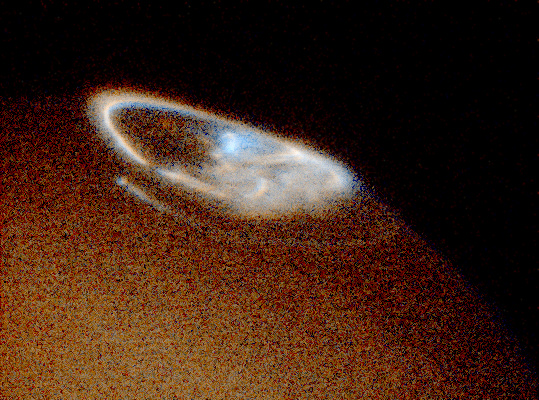
*Via Wikimedia Commons: [Ultraviolet Aurora borealis on Jupiter from Hubble 1998](https://commons.wikimedia.org/wiki/File:Ultraviolet_Aurora_borealis_on_Jupiter_from_Hubble_1998.jpg) by J. Clarke (Univ. Michigan), NASA, public domain.*
## Sources
1. NASA. "Earth's Magnetosphere." https://www.nasa.gov/mission_pages/sunearth/multimedia/magnetosphere.html (read 23 November 2026)
2. NASA Goddard Plasma Physics Group. "Exploration of the Earth's Magnetosphere." https://pwg.gsfc.nasa.gov/Education/Iexplore.html (read 23 November 2026)
3. NASA Science. "Mercury Facts." https://science.nasa.gov/mercury/facts/ (read 23 November 2026)
4. NASA Science. "Jupiter Facts." https://science.nasa.gov/jupiter/facts/ (read 23 November 2026)
5. NASA Science. "Saturn Facts." https://science.nasa.gov/saturn/facts/ (read 23 November 2026)
6. Physics World. "Solar wind squashed Uranus's magnetosphere during Voyager 2 flyby." https://physicsworld.com/a/solar-wind-squashed-uranuss-magnetosphere-during-voyager-2-flyby/ (read 23 November 2026)
7. EarthSky. "Uranus mysteries solved with Voyager 2 data." https://earthsky.org/space/uranus-mysteries-solved-voyager-data-magnetosphere/ (read 23 November 2026)
