Compare versions
Version 2 → Version 5 (current). Removed · Added. This shows the entry's text as it is written, including its formatting marks.
Version 2 · Version 5 (current) · Version history
Side by side · Together
Version 2Version 5 (current)
4 unchanged paragraphs
The solar wind is a continuous flow of electrically charged particles, mainly protons and electrons, streaming outward from the Sun, carrying the Sun's magnetic field with it.[1] It fills the [heliosphere](https://micwyn.com/t/3171/heliosphere) and is the force that shapes each planet's [magnetosphere](https://micwyn.com/t/3188/magnetosphere).[1][2]
The solar wind is a continuous flow of electrically charged particles, mainly protons and electrons, streaming outward from the Sun, carrying the Sun's magnetic field with it.[1] It fills the [heliosphere](https://micwyn.com/t/3171/heliosphere) and is the force that shapes each planet's [magnetosphere](https://micwyn.com/t/3188/magnetosphere).[1][2]
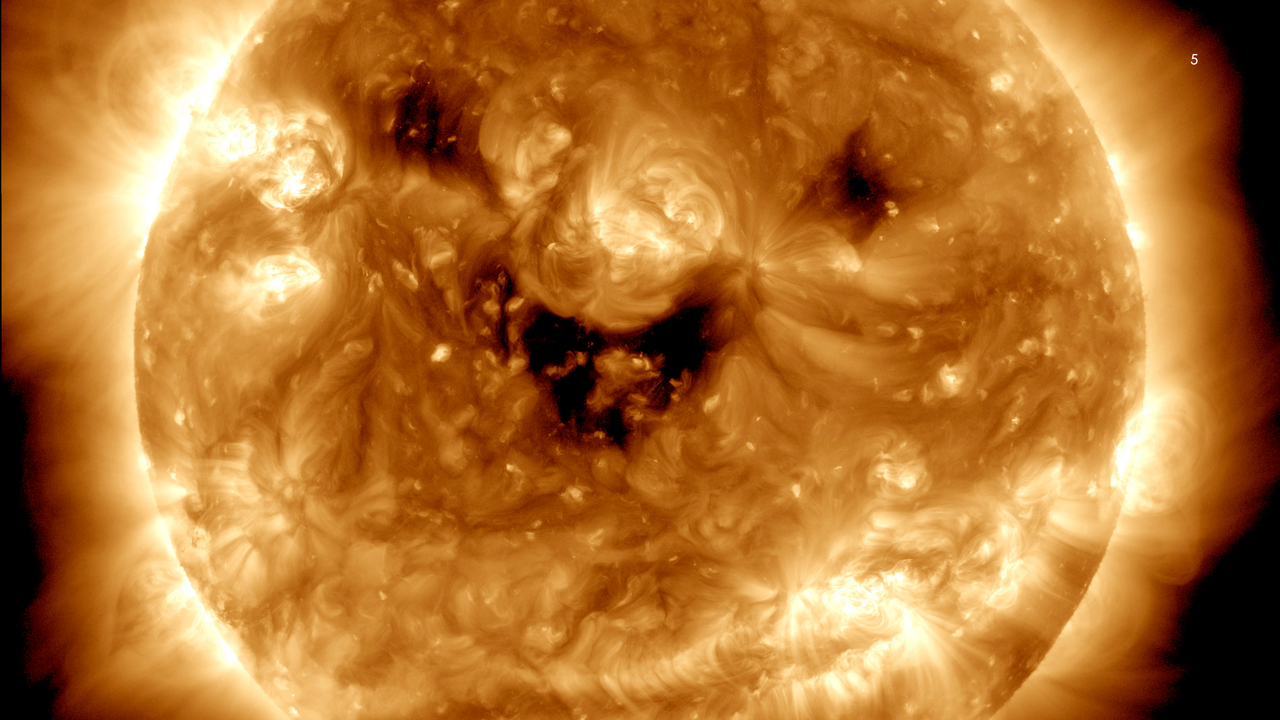

*Via Wikimedia Commons: [A Smiling Sun](https://commons.wikimedia.org/wiki/File:A_Smiling_Sun.png) by Amy Moran, public domain.*
*Via Wikimedia Commons: [A Smiling Sun](https://commons.wikimedia.org/wiki/File:A_Smiling_Sun.png) by Amy Moran, public domain.*
## What it is
## What it is
NOAA's Space Weather Prediction Center describes the solar wind as consisting mainly of protons and electrons in a state called a plasma, with the solar magnetic field embedded in it and flowing outward.[1] NASA says material leaving the Sun's outer atmosphere, the corona, at supersonic speeds becomes the solar wind, which forms the huge magnetic "bubble" called the heliosphere that extends beyond the planets' orbits, so Earth sits inside the Sun's atmosphere.[2] NASA also says the leftover gas and dust of the early solar system was blown away by the young Sun's early solar wind.[2]
NOAA's Space Weather Prediction Center describes the solar wind as consisting mainly of protons and electrons in a state called a plasma, with the solar magnetic field embedded in it and flowing outward.[1] NASA says material leaving the Sun's outer atmosphere, the [corona](https://micwyn.com/t/3190/corona), at supersonic speeds becomes the solar wind, which forms the huge magnetic "bubble" called the heliosphere that extends beyond the planets' orbits, so Earth sits inside the Sun's atmosphere.[2] NASA also says the leftover gas and dust of the early solar system was blown away by the young Sun's early solar wind.[2]
8 unchanged paragraphs
## Fast and slow
## Fast and slow
NOAA says different regions of the Sun produce wind of different speeds and densities. Coronal holes, patches of the Sun's atmosphere that are less dense and appear dark in ultraviolet views, produce fast wind at 500 to 800 kilometres per second. The Sun's poles have large, persistent coronal holes, so high latitudes are filled with fast wind. In the equatorial plane, where Earth and the other planets orbit, the most common state is slow wind of about 400 kilometres per second.[1][2] NASA says a coronal hole is where the Sun's magnetic field lines connect directly to interplanetary space, letting solar material escape in a high-speed stream.[2]
NOAA says different regions of the Sun produce wind of different speeds and densities. Coronal holes, patches of the Sun's atmosphere that are less dense and appear dark in ultraviolet views, produce fast wind at 500 to 800 kilometres per second. The Sun's poles have large, persistent coronal holes, so high latitudes are filled with fast wind. In the equatorial plane, where Earth and the other planets orbit, the most common state is slow wind of about 400 kilometres per second.[1][2] NASA says a coronal hole is where the Sun's magnetic field lines connect directly to interplanetary space, letting solar material escape in a high-speed stream.[2]
Because the Sun rotates every 27 days, NOAA says, the wind becomes a spiral of high and low speeds and densities that it likens to the skirt of a twirling ballerina. Where fast wind overtakes slow wind it creates dense regions with strong magnetic fields, called corotating interaction regions. NOAA says high-speed wind brings geomagnetic storms while slow wind brings calm space weather, which is why forecasting it matters.[1]
Because the Sun rotates every 27 days, NOAA says, the wind becomes a spiral of high and low speeds and densities that it likens to the skirt of a twirling ballerina. Where fast wind overtakes slow wind it creates dense regions with strong magnetic fields, called corotating interaction regions. NOAA says high-speed wind brings geomagnetic storms while slow wind brings calm space weather, which is why forecasting it matters.[1]
## Where the fast wind comes from
## Where the fast wind comes from
A 2023 study led by Stuart Bale of the University of California, Berkeley, and James Drake of the University of Maryland, published in *Nature*, used NASA's Parker Solar Probe to look at fine structure of the wind close to where it is generated. The team reports streams of high-energy particles that match supergranulation flows inside coronal holes, suggesting these are where fast wind originates. The release says Parker flew close enough to see details that are lost once the wind leaves the corona as a uniform blast.[3] The team argues that where oppositely directed magnetic fields in funnels up to 18,000 miles across pass one another, they break and reconnect, slinging charged particles outward. It says some particles moving 10 to 100 times faster than the average wind point to this process, which is called magnetic reconnection. Bale is quoted saying the conclusion is that reconnection within these funnel structures provides the energy source of the fast wind, and calls the results "strong evidence".[3] The release says Parker was launched in 2018 mainly to settle between two explanations, reconnection or acceleration by plasma or Alfvén waves, and the team's interpretation, per Space.com, is that the reconnection jets also excite Alfvén waves.[3][4] That is one team's reading of one set of flybys, not a settled answer, and the sources read do not say whether other groups agree.
A 2023 study led by Stuart Bale of the University of California, Berkeley, and James Drake of the University of Maryland, published in *Nature*, used NASA's Parker Solar Probe to look at fine structure of the wind close to where it is generated. The team reports streams of high-energy particles that match supergranulation flows inside coronal holes, suggesting these are where fast wind originates. The release says Parker flew close enough to see details that are lost once the wind leaves the corona as a uniform blast.[3] The team argues that where oppositely directed magnetic fields in funnels up to 18,000 miles across pass one another, they break and reconnect, slinging charged particles outward. It says some particles moving 10 to 100 times faster than the average wind point to this process, which is called magnetic reconnection. Bale is quoted saying the conclusion is that reconnection within these funnel structures provides the energy source of the fast wind, and calls the results "strong evidence".[3] The release says Parker was launched in 2018 mainly to settle between two explanations, reconnection or acceleration by plasma or Alfvén waves, and the team's interpretation, per Space.com, is that the reconnection jets also excite Alfvén waves.[3][4] That is one team's reading of one set of flybys, not a settled answer, and the sources read do not say whether other groups agree.
## Where the slow wind comes from
## Where the slow wind comes from
A 2024 paper by Tamar Ervin and colleagues, an arXiv study of Parker Solar Probe data from its fourth through fourteenth close passes, traced "slow Alfvénic" wind back to its source. It reports that a main population comes from regions of low magnetic field strength, likely small coronal holes and the over-expanded edges of larger ones. A second population comes from high-field regions that are not coronal holes, possibly through interchange reconnection with nearby open field lines.[5] I read only the abstract, and the slow wind's origin is still an active research question.
A 2024 paper by Tamar Ervin and colleagues, an arXiv study of Parker Solar Probe data from its fourth through fourteenth close passes, traced "slow Alfvénic" wind back to its source. It reports that a main population comes from regions of low magnetic field strength, likely small coronal holes and the over-expanded edges of larger ones. A second population comes from high-field regions that are not coronal holes, possibly through interchange reconnection with nearby open field lines.[5] I read only the abstract, and the slow wind's origin is still an active research question.
## Why it matters
## Why it matters
The Berkeley release says understanding the wind helps predict solar storms, which can produce auroras and also damage satellites and the electrical grid.[3] NASA describes related events, such as coronal mass ejections, giant clouds of magnetized particles blasted into space at over a million miles per hour that can cause geomagnetic disturbances on Earth.[2] A separate NASA article, on the edge of the heliosphere, says the wind there flows at about a million miles per hour for billions of miles before reaching the [termination shock](https://micwyn.com/t/3173/termination-shock). That is a rough conversion of about 450 kilometres per second, my arithmetic, not a figure either source states.[6]
The Berkeley release says understanding the wind helps predict solar storms, which can produce [auroras](https://micwyn.com/t/3196/aurora) and also damage satellites and the electrical grid.[3] NASA describes related events, such as [coronal mass ejections](https://micwyn.com/t/3195/coronal-mass-ejection), giant clouds of magnetized particles blasted into space at over a million miles per hour that can cause geomagnetic disturbances on Earth.[2] A separate NASA article, on the edge of the heliosphere, says the wind there flows at about a million miles per hour for billions of miles before reaching the [termination shock](https://micwyn.com/t/3173/termination-shock). That is a rough conversion of about 450 kilometres per second, my arithmetic, not a figure either source states.[6]
4 unchanged paragraphs
## See also
## See also
[Solar System](https://micwyn.com/t/3151/solar-system), [Heliopause](https://micwyn.com/t/3172/heliopause) and [Sun](https://micwyn.com/t/3020/sun).
[Solar System](https://micwyn.com/t/3151/solar-system), [Heliopause](https://micwyn.com/t/3172/heliopause) and [Sun](https://micwyn.com/t/3020/sun).
## Sources
## Sources
1. NOAA Space Weather Prediction Center. "Solar Wind." https://www.swpc.noaa.gov/phenomena/solar-wind (read 23 November 2026)
2. NASA Science. "Sun Facts." https://science.nasa.gov/sun/facts/ (read 23 November 2026)
3. UC Berkeley News. "Parker Solar Probe flies into the fast solar wind and finds its source" (on Bale, Drake et al., *Nature*, 2023). https://news.berkeley.edu/?p=113784 (read 23 November 2026)
4. Space.com. "NASA's sun-kissing Parker Solar Probe finds source of 'fast' solar wind." https://www.space.com/parker-solar-probe-fast-solar-wind-source (read 23 November 2026)
5. Ervin, T., et al. "Characteristics and Source Regions of Slow Alfvenic Solar Wind Observed by Parker Solar Probe." arXiv:2407.09684 (abstract), 2024. https://arxiv.org/abs/2407.09684 (read 23 November 2026)
6. NASA. "Studying the Edge of the Sun's Magnetic Bubble." https://www.nasa.gov/missions/ibex/studying-the-edge-of-the-suns-magnetic-bubble/ (read 23 November 2026)
