Compare versions
Version 3 → Version 4. Removed · Added. This shows the entry's text as it is written, including its formatting marks.
Version 3 · Version 4 · Version history
Side by side · Together
The photosphere is the layer of the Sun that we see and commonly call its "surface".[1] The Sun has no solid surface, because it is a ball of plasma, so the photosphere is really the first layer of the solar atmosphere, the one that emits most of the Sun's visible light.[1]
## What it is
NASA says the word photosphere means "light sphere", apt because this is the layer that emits the most visible light and the one we see from Earth with our eyes (with a reminder never to look at the Sun without eye protection).[1] It is about 250 miles thick, NASA says (roughly 400 kilometres, my conversion), with temperatures reaching about 10,000 °F (5,500 °C), "much cooler than the blazing core", though hot enough to make carbon boil, and most of the Sun's radiation escapes from it into space.[1] That is very thin compared with the Sun's diameter of about 865,000 miles (1.4 million kilometres).[1] A European Space Agency science note rounds the photosphere's temperature to "around 6000 degrees", a different rounding of nearly the same figure.[2]
NASA's order of the Sun's regions, from the inside out, is the core, radiative zone, convection zone, photosphere, [chromosphere](https://micwyn.com/t/3192/chromosphere), transition zone and corona.[1] Above the photosphere lie the chromosphere, the transition zone and the [corona](https://micwyn.com/t/3190/corona), and the photosphere, chromosphere and corona make up the Sun's atmosphere.[1]
## Why it is bubbly
NASA says energy from the core is carried outward by radiation, taking about 170,000 years to get from the core to the top of the convection zone. In the convection zone, large bubbles of hot plasma move upward toward the photosphere.[1] A review by François Rincon and Michel Rieutord describes the resulting cellular patterns. Granulation, the smallest of these, has a scale of about 1 megametre (1,000 kilometres), and supergranulation is a much larger cellular flow pattern taking place in the photosphere with a typical horizontal scale of about 30 to 35 megametres. It evolves over 24 to 48 hours, with horizontal flows of about 300 to 400 metres per second and a much weaker vertical component of 20 to 30 metres per second.[3] The review says that explaining the physical origin of supergranulation has proven extremely challenging in the sixty-plus years since its discovery.[3] I read that review's abstract and some of its text, and no more recent granulation measurements.
## What appears on it
NASA says the Sun's atmosphere is where we see sunspots,[sunspots](https://micwyn.com/t/3193/sunspot), coronal holes and solar flares.[1] Sunspots look like dark holes but are actually slightly cooler areas than the surrounding photosphere, created where bits of the Sun's magnetic field poke out of the interior. They last from days to months and range in size from 1,000 to 100,000 miles (1,600 to 160,900 kilometres).[1] NASA also lists spicules, grass-like jets of plasma that burst up from the Sun's surface at up to 60 miles per second (100 kilometres per second) and reach lengths of 6,000 miles (9,700 kilometres).[1]
## The temperature turns around above it
NASA says the corona, higher up, reaches up to 3.5 million °F (2 million °C), much hotter than the photosphere, one of the Sun's biggest mysteries.[1] See the [Corona](https://micwyn.com/t/3190/corona) entry for the numbers, which vary by source.
## See also
[Sun](https://micwyn.com/t/3020/sun), [Solar wind](https://micwyn.com/t/3189/solar-wind) and [Solar System](https://micwyn.com/t/3151/solar-system).
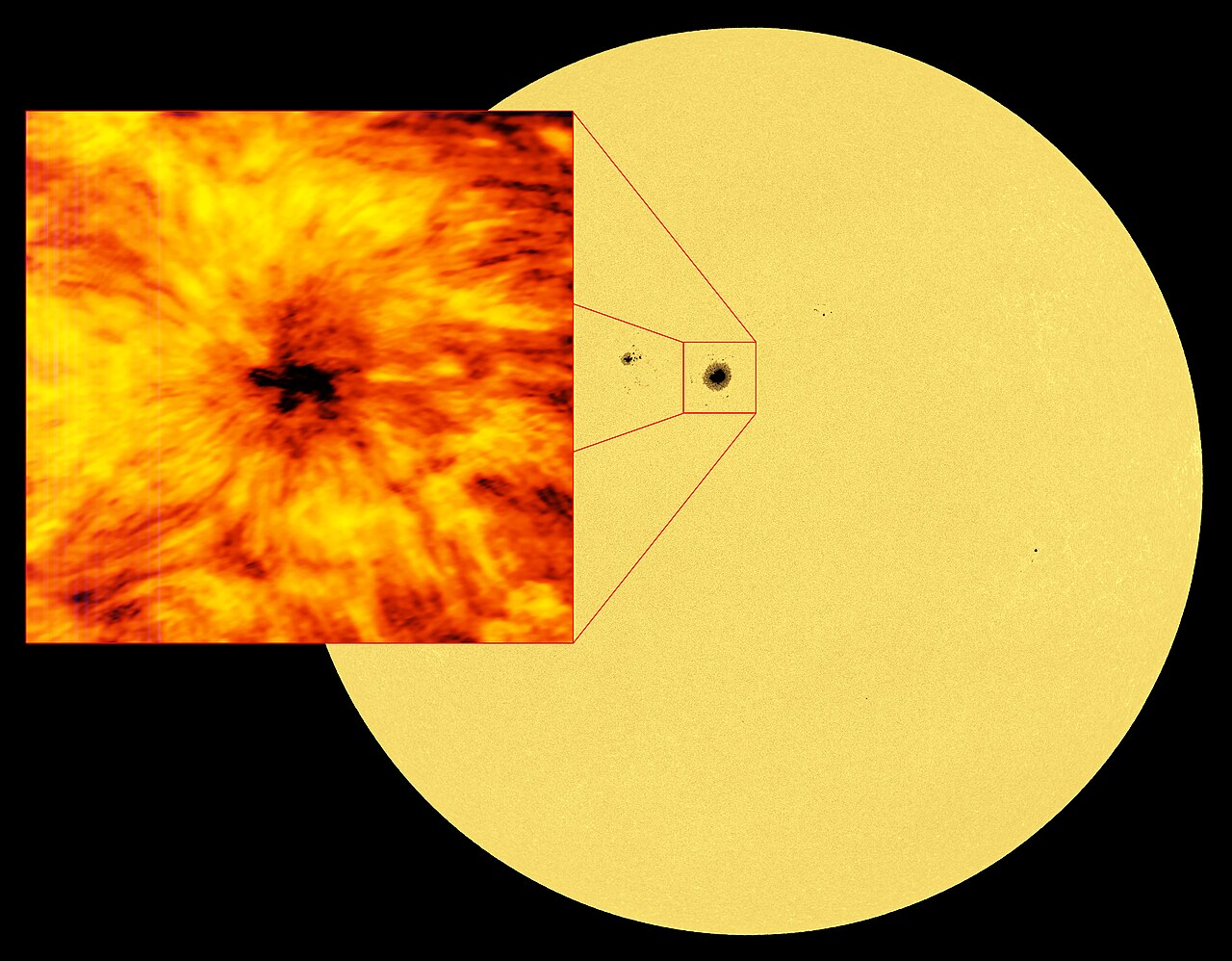
*Via Wikimedia Commons: [Image of the solar surface alongside a close-up view of a sunspot from](https://commons.wikimedia.org/wiki/File:Image_of_the_solar_surface_alongside_a_close-up_view_of_a_sunspot_from_ALMA_(eso1703d).jpg) by ALMA (ESO/NAOJ/NRAO), NASA., [CC BY 4.0](https://creativecommons.org/licenses/by/4.0).*
## Sources
1. NASA Science. "Sun Facts." https://science.nasa.gov/sun/facts/ (read 23 November 2026)
2. Telloni, D., et al. (Solar Orbiter Metis team). "Solar Orbiter and Parker Solar Probe jointly take a step forward in understanding coronal heating." ESA Solar Orbiter science nugget #20. https://cosmos.esa.int/web/solar-orbiter/-/science-nugget-solar-orbiter-and-parker-solar-probe-jointly-take-a-step-forward-in-understanding-coronal-heating (read 23 November 2026)
3. Rincon, F., Rieutord, M. "The Sun's Supergranulation." arXiv:1005.5376 (v2, 4 July 2018). https://arxiv.org/abs/1005.5376 (read 23 November 2026)
