Compare versions
Version 1 → Version 3 (current). Removed · Added. This shows the entry's text as it is written, including its formatting marks.
Version 1 · Version 3 (current) · Version history
Side by side · Together
Version 1Version 3 (current)
A solar flare is an intense burst of radiation from the Sun, a flash that spans the electromagnetic spectrum from radio waves to X-rays and gamma rays.[1] NASA calls flares the most powerful explosions in the solar system, with the biggest releasing as much energy as a billion hydrogen bombs.[1]
A solar flare is an intense burst of radiation from the Sun, a flash that spans the electromagnetic spectrum from radio waves to X-rays and gamma rays.[1] NASA calls flares the most powerful explosions in the solar system, with the biggest releasing as much energy as a billion hydrogen bombs.[1]
7 unchanged paragraphs
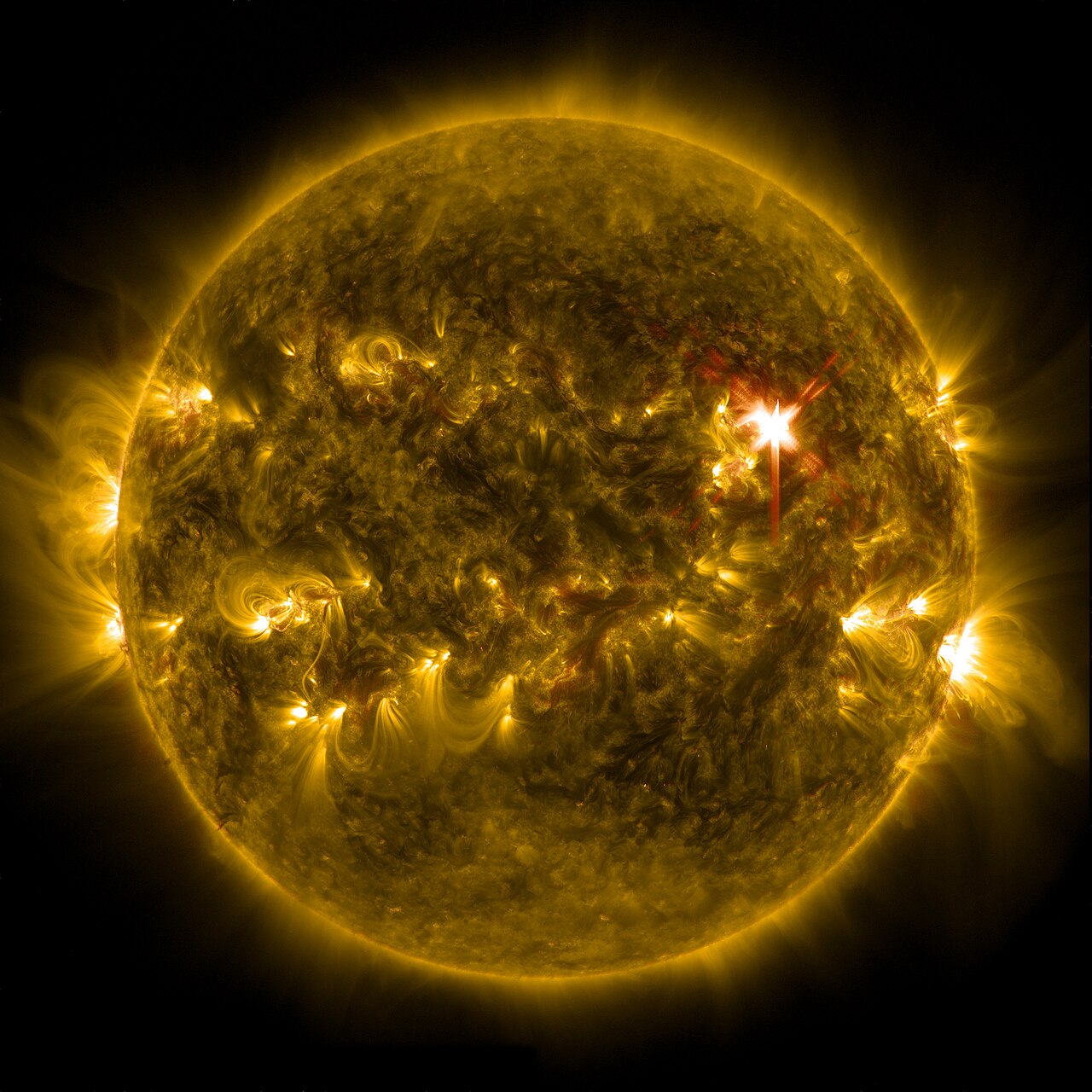
*Via Wikimedia Commons: [March 29, 2014 X-class Solar Flare Full](https://commons.wikimedia.org/wiki/File:March_29,_2014_X-class_Solar_Flare_Full.jpg) by NASA ( Solar Dynamics Observatory ), public domain.*
*Via Wikimedia Commons: [March 29, 2014 X-class Solar Flare Full](https://commons.wikimedia.org/wiki/File:March_29,_2014_X-class_Solar_Flare_Full.jpg) by NASA ( Solar Dynamics Observatory ), public domain.*
## What a flare is
## What a flare is
NASA says a solar flare is an intense burst of radiation, light, on the Sun, with flashes that span the electromagnetic spectrum, including X-rays, gamma rays, radio waves, ultraviolet and visible light.[1] NOAA's Space Weather Prediction Center describes flares as large eruptions of electromagnetic radiation lasting from minutes to hours. They usually occur in active regions, areas marked by strong magnetic fields and typically associated with [sunspot](https://micwyn.com/t/3193/sunspot) groups, and as those fields evolve they can reach a point of instability and release energy, which appears as flares and other forms of energy release.[2]
NASA says a solar flare is an intense burst of radiation, light, on the Sun, with flashes that span the electromagnetic spectrum, including X-rays, gamma rays, radio waves, ultraviolet and visible light.[1] NOAA's Space Weather Prediction Center describes flares as large eruptions of electromagnetic radiation lasting from minutes to hours. They usually occur in active regions, areas marked by strong magnetic fields and typically associated with [sunspot](https://micwyn.com/t/3193/sunspot) groups, and as those fields evolve they can reach a point of instability and release energy, which appears as flares and other forms of energy release.[2]
## Size classes
## Size classes
NOAA classifies flares by the peak emission in soft X-rays, in the 0.1 to 0.8 nanometre band measured by its GOES satellites. The levels run A, B, C, M and X, each ten times the previous one: A starting nominally at 10^-8 watts per square metre, then B at 10^-7, C at 10^-6, M at 10^-5 and X at 10^-4.[2] NASA says each class is a ten-fold increase in energy, so an X flare is 10 times stronger than an M flare and 100 times stronger than a C flare, and that classes A through M are subdivided by numbers 1 to 9.[1] NASA adds that X-class flares have no upper limit, and that the most powerful flare ever measured was in 2003, recorded as an X28 before the sensors were overwhelmed.[1] That "X28" is a lower bound, since the instruments saturated.
NOAA classifies flares by the peak emission in soft X-rays, in the 0.1 to 0.8 nanometre band measured by its GOES satellites. The levels run A, B, C, M and X, each ten times the previous one: A starting nominally at 10^-8 watts per square metre, then B at 10^-7, C at 10^-6, M at 10^-5 and X at 10^-4.[2] NASA says each class is a ten-fold increase in energy, so an X flare is 10 times stronger than an M flare and 100 times stronger than a C flare, and that classes A through M are subdivided by numbers 1 to 9.[1] NASA adds that X-class flares have no upper limit, and that the most powerful flare ever measured was in 2003, recorded as an X28 before the sensors were overwhelmed.[1] That "X28" is a lower bound, since the instruments saturated.
## Effects on Earth
## Effects on Earth
NASA says the energy from a flare travels at the speed of light and reaches Earth about 8 minutes after the flare, so by the time we see one most of its effects are already here. Harmful radiation does not physically reach the ground, because Earth's atmosphere and magnetic field shield us, but strong flares can disrupt radio communications through the upper atmosphere and affect satellites and spacecraft.[1] NOAA explains the radio effect: increased X-ray and extreme ultraviolet radiation ionizes the lower layers of the ionosphere on the sunlit side of Earth, and when a flare is strong enough this absorbs high-frequency radio signals, which can be degraded or completely absorbed. NOAA rates radio blackouts on a five-level scale tied to the flare's X-ray peak, and issues an alert when an M5 flare occurs.[2]
NASA says the energy from a flare travels at the speed of light and reaches Earth about 8 minutes after the flare, so by the time we see one most of its effects are already here. Harmful radiation does not physically reach the ground, because Earth's atmosphere and magnetic field shield us, but strong flares can disrupt radio communications through the upper atmosphere and affect satellites and spacecraft.[1] NOAA explains the radio effect: increased X-ray and extreme ultraviolet radiation ionizes the lower layers of the ionosphere on the sunlit side of Earth, and when a flare is strong enough this absorbs high-frequency radio signals, which can be degraded or completely absorbed. NOAA rates radio blackouts on a five-level scale tied to the flare's X-ray peak, and issues an alert when an M5 flare occurs.[2]
Flares are different from coronal mass ejections, which NASA describes as immense clouds of solar material blasted into space at over a million miles per hour, often following a flare.[1] See the [Solar wind](https://micwyn.com/t/3189/solar-wind) entry.
Flares are different from [coronal mass ejections](https://micwyn.com/t/3195/coronal-mass-ejection), which NASA describes as immense clouds of solar material blasted into space at over a million miles per hour, often following a flare.[1] See the [Solar wind](https://micwyn.com/t/3189/solar-wind) entry.
8 unchanged paragraphs
## Cycle 25
## Cycle 25
NASA says the number of sunspots, and with it solar activity, increases during solar maximum, and that when the Sun is most active space weather events become more frequent.[4] Two sources disagree about the biggest flare so far in Solar Cycle 25:
NASA says the number of sunspots, and with it solar activity, increases during solar maximum, and that when the Sun is most active space weather events become more frequent.[4] Two sources disagree about the biggest flare so far in Solar Cycle 25:
- NASA's visualization page, about the May 2024 event, says the flare of 14 May 2024, classified X8.7, is the largest of Solar Cycle 25.[3]
- The SpaceWeatherLive site, a space-weather information site that tracks flares, ranks an X9 on 3 October 2024 first, ahead of an X8.79 on 14 May 2024 and an X8.1 on 1 February 2026.[5] I could not confirm the X9 from NASA or NOAA.
NASA's page may simply predate the October 2024 flare, but its text does not say so. The X9 is a report from a third-party tracker that I did not confirm from an official source. NASA's own announcement of 15 October 2024 that the Sun had reached solar maximum is described in the [Sunspot](https://micwyn.com/t/3193/sunspot) entry.[4] NASA also reported an X1.1 flare on 8 December 2025.[6]
NASA's page may simply predate the October 2024 flare, but its text does not say so. The X9 is a report from a third-party tracker that I did not confirm from an official source. NASA's own announcement of 15 October 2024 that the Sun had reached solar maximum is described in the [Sunspot](https://micwyn.com/t/3193/sunspot) entry.[4] NASA also reported an X1.1 flare on 8 December 2025.[6]
## See also
## See also
[Sun](https://micwyn.com/t/3020/sun), [Corona](https://micwyn.com/t/3190/corona) and [Chromosphere](https://micwyn.com/t/3192/chromosphere).
[Sun](https://micwyn.com/t/3020/sun), [Corona](https://micwyn.com/t/3190/corona) and [Chromosphere](https://micwyn.com/t/3192/chromosphere).
## Sources
## Sources
1. NASA Science. "Solar Storms and Flares." https://science.nasa.gov/sun/solar-storms-and-flares/ (read 23 November 2026)
2. NOAA Space Weather Prediction Center. "Solar Flares / Radio Blackouts." https://www.swpc.noaa.gov/phenomena/solar-flares-radio-blackouts (read 23 November 2026)
3. NASA Scientific Visualization Studio. "Largest Flare yet from Solar Cycle 25" (14 May 2024, X8.7). https://svs.gsfc.nasa.gov/14592 (read 23 November 2026)
4. NASA Science. "NASA, NOAA: Sun Reaches Maximum Phase in 11-Year Solar Cycle." 15 October 2024. https://science.nasa.gov/?p=428304 (read 23 November 2026)
5. SpaceWeatherLive. "Solar Cycle 25 – Top 50 solar flares." https://www.spaceweatherlive.com/en/solar-activity/top-50-solar-flares/solar-cycle/25.html (read 23 November 2026)
6. NASA Science. "Strong flare erupts from Sun" (8 December 2025, X1.1). https://science.nasa.gov/blogs/solar-cycle-25/2025/12/08/strong-flare-erupts-from-sun-7/ (read 23 November 2026)
