Version 2
Nov 23, 2026. Compare with the current version · Version history
A coronal mass ejection, or CME, is a large expulsion of plasma and magnetic field from the Sun's corona.[1] It can send billions of tons of coronal material into space and, when aimed at Earth, can cause a geomagnetic storm.[1][2]
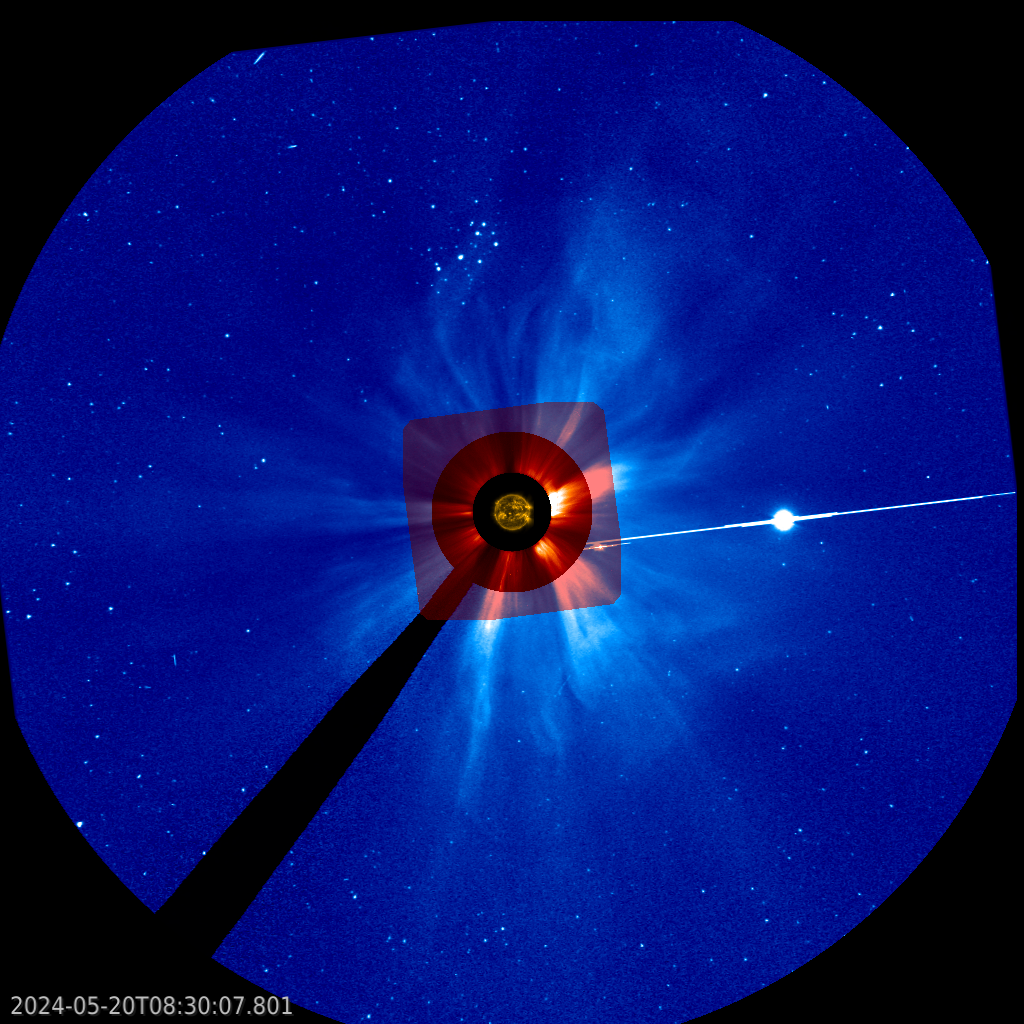
Via Wikimedia Commons: Coronal mass ejection on 20 May 2024 ESA498777 by European Space Agency, CC BY-SA 3.0 igo.
What it is
NOAA's Space Weather Prediction Center says CMEs eject billions of tons of coronal material carrying an embedded magnetic field stronger than the background interplanetary field. They travel outward at speeds from below 250 kilometres per second to nearly 3,000 kilometres per second, and expand as they go, with larger ones reaching nearly a quarter of the distance between Earth and the Sun by the time they get to Earth.[1] NASA describes them as immense clouds of magnetized particles blasted into space at over a million miles per hour, often following a flare, and often measuring millions of miles across.[2] NOAA says the fastest Earth-directed CMEs can arrive in as little as 15 to 18 hours and slower ones take several days.[1]
How they start
NOAA says the more explosive CMEs generally begin when highly twisted magnetic structures called flux ropes in the lower corona become too stressed and realign into a less tense configuration, a process called magnetic reconnection. That can release energy as a solar flare, which typically accompanies the explosive acceleration of the plasma, the CME. These usually come from active regions tied to sunspot groups, but CMEs can also come from filaments and prominences, relatively cool, dense plasma suspended by magnetic flux in the inner corona, which can either collapse back and be quietly reabsorbed or erupt.[1] NASA says a prominence can erupt when its magnetic structure becomes unstable, flinging plasma outward in a CME.[3] Flares and CMEs often happen together, but they are different: a flare is a burst of light and radiation, while a CME is a cloud of material.[1][2]
How forecasters watch them
NOAA says forecasters judge a CME's size, speed and direction from coronagraph images, which block the Sun's bright disk to show the corona. The main instrument is LASCO on NASA's SOHO spacecraft, with another on NASA's STEREO-A. NOAA's DSCOVR satellite at the Sun–Earth L1 point, described in the Lagrange point entry, is first to see an arriving CME's shock, which NOAA says often gives 15 to 60 minutes of warning.[1]
Effects on Earth
NOAA says the likelihood of a strong geomagnetic storm depends on the strength and direction of the magnetic field carried by the CME: storms are favoured when it points south for a long time. Most CMEs show changing field directions as they pass, and those that hit Earth's magnetosphere will generally at some point have an orientation that favours storms.[1] NASA says a CME aimed at Earth can produce geomagnetic disturbances that ignite bright auroras and short-circuit satellites and power grids, and at worst endanger astronauts in orbit.[3] NOAA classes geomagnetic storms on a five-level scale. For the top level, G5 "extreme", it lists possible widespread power-grid voltage problems, even complete collapse or blackouts in some grid systems, transformer damage, extensive satellite charging and aurora seen as low as Florida and southern Texas, and says such storms are expected about four times per solar cycle.[4]
May 2024
NASA says that in May 2024 a barrage of large flares and CMEs launched clouds of charged particles and magnetic fields toward Earth, creating the strongest geomagnetic storm in two decades and possibly among the strongest displays of auroras on record in the past 500 years.[5] The sources read give no further detail on that storm's effects. See the Solar wind entry.
See also
Sun, Corona and Solar System.
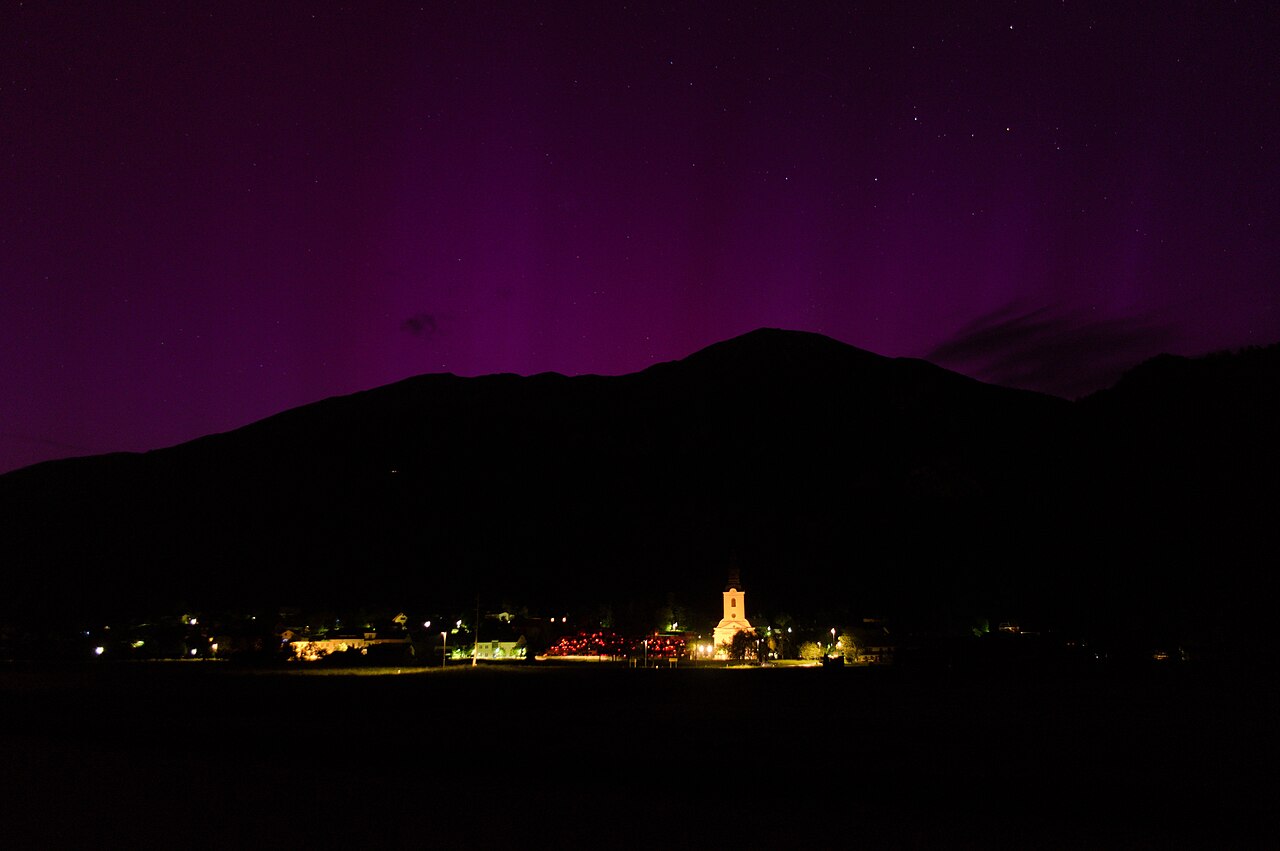
Via Wikimedia Commons: Geomagnetni vihar pri Žirovnici 11. maja 2024 - pogled nad Stol by Smihael, CC BY-SA 4.0.
Sources
- NOAA Space Weather Prediction Center. "Coronal Mass Ejections." swpc.noaa.gov/phenomena/coronal-mass-ejections (read 23 November 2026)
- NASA Science. "Solar Storms and Flares." science.nasa.gov/sun/solar-storms-and-flares/ (read 23 November 2026)
- NASA Science. "Sun Facts." science.nasa.gov/sun/facts/ (read 23 November 2026)
- NOAA Space Weather Prediction Center. "NOAA Space Weather Scales." swpc.noaa.gov/noaa-scales-explanation (read 23 November 2026)
- NASA Science. "NASA, NOAA: Sun Reaches Maximum Phase in 11-Year Solar Cycle." 15 October 2024. science.nasa.gov/?p=428304 (read 23 November 2026)
