Compare versions
Version 1 → Version 2. Removed · Added. This shows the entry's text as it is written, including its formatting marks.
Version 1 · Version 2 · Version history
Side by side · Together
A transit is when a smaller body passes in front of a larger one, as seen from the observer. The sources read here describe planets crossing in front of the Sun or another star.[1][3] From Earth, only Mercury and Venus can cross the Sun's disk, and astronomers also use transits to find planets around other stars.[1][3]
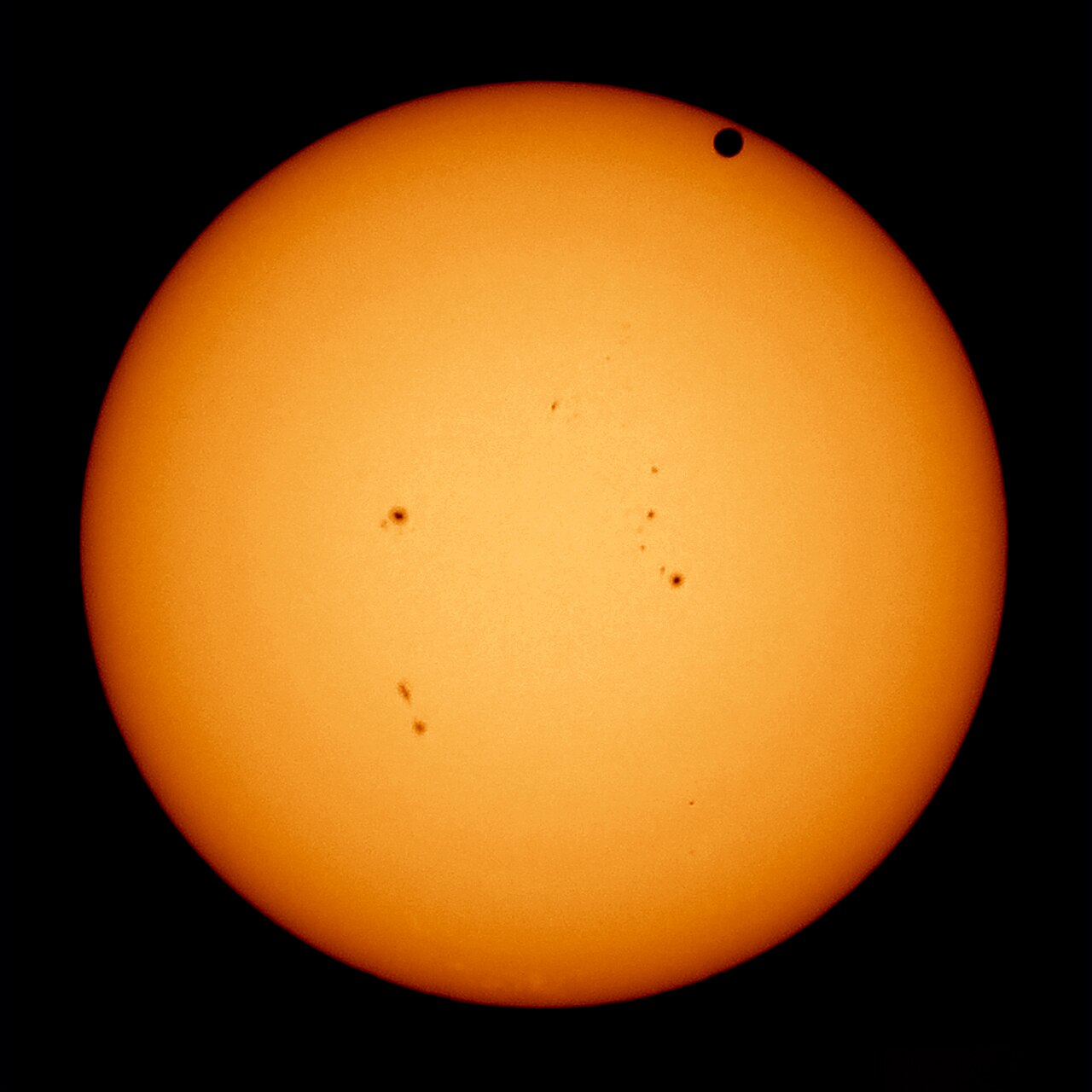the Sun's disc with several small dark sunspots and one small, perfectly round black dot just inside the upper-right edge, which is the sort of silhouette a transiting planet makes; the file has no caption, date or credit, so it is not confirmed to show Venus in 2012](/m/2026/11/mshnzqvFrVZ9TL_A.jpg)
*Via Wikimedia Commons: [2012 Transit of Venus from SF](https://commons.wikimedia.org/wiki/File:2012_Transit_of_Venus_from_SF.jpg) by Brocken Inaglory, [CC BY 2.5](https://creativecommons.org/licenses/by/2.5).*
## Transits of Mercury and Venus
Space.com says only Venus and Mercury can pass across the Sun in our sky, since they lie on the inner side of the solar system compared with Earth.[1] Mercury's orbit is inclined at 7 degrees to the [ecliptic](https://micwyn.com/t/3197/ecliptic), so from Earth it usually passes above or below the Sun and only crosses its disk 13 or 14 times a century. Mercury's transits tend to fall in either November or May.[1] The most recent, Space.com says, were on 11 November 2019, and the next is on 13 November 2032, followed by 2039, with neither visible from North America. U.S. skywatchers will next have a chance across the country in 2049 and from the West Coast in 2052.[1]
Venus's transits are far rarer. Space.com says they occur in pairs separated by eight years, with each pairing about a century apart.[1] A Live Science writer who travelled to see the 2012 transit says only six Venus transits had occurred since the 17th century, in 1761, 1769, 1874, 1882, 2004 and 2012, and that the next will not occur until 2117. The 2012 transit lasted over six and a half hours, beginning on 5 June and running into the next day.[2] Space.com, writing in 2019, says Venus's next transit was "still 92 years away", which does not match 2117; the sources do not explain the difference, and the 2117 date is from the article that gives a list of dates.[1][2]
## A history of two predicted transits
Live Science says Johannes Kepler's tables predicted transits of Mercury and Venus in 1631, and a Venus transit that December occurred on schedule, but weather and visibility were poor across Europe. It says Kepler also predicted a near miss in 1639, but the English astronomer Jeremiah Horrocks improved on the tables and predicted a transit with only a few weeks' notice, which sure enough occurred in December 1639. Horrocks was one of the only people to see it, per the article, and Galileo, still alive then, had lost almost all of his sight by 1638.[2] I read this only as a magazine writer's account.
## Transits and other worlds
NASA says the transit method looks for tiny dips in the amount of light from a star caused by a planet crossing in front of it. The NASA Kepler mission watched a patch of sky holding 150,000 stars for such dips, and once a transit is detected, the planet's orbital size can be worked out from the period, how long the planet takes to circle once, and the star's mass.[3] NASA says Kepler detected planets by observing transits and that, in April 2010, mission scientists announced Kepler-9, the first confirmed system with more than one planet transiting the same star. Kepler retired on 30 October 2018.[4] NASA's Transiting Exoplanet Survey Satellite, TESS, launched in 2018, uses the same method to survey whole swaths of sky.[3] NASA also describes "transit spectroscopy": when starlight passes through the atmosphere of a transiting planet on its way to our telescopes, it carries information about what is in that atmosphere.[3] See the [Habitable zone](https://micwyn.com/t/3184/habitable-zone) entry for a Webb telescope example, the TRAPPIST-1 planets.
## See also
[Mercury](https://micwyn.com/t/3021/mercury-planet), [Venus](https://micwyn.com/t/3022/venus) and [Solar System](https://micwyn.com/t/3151/solar-system).
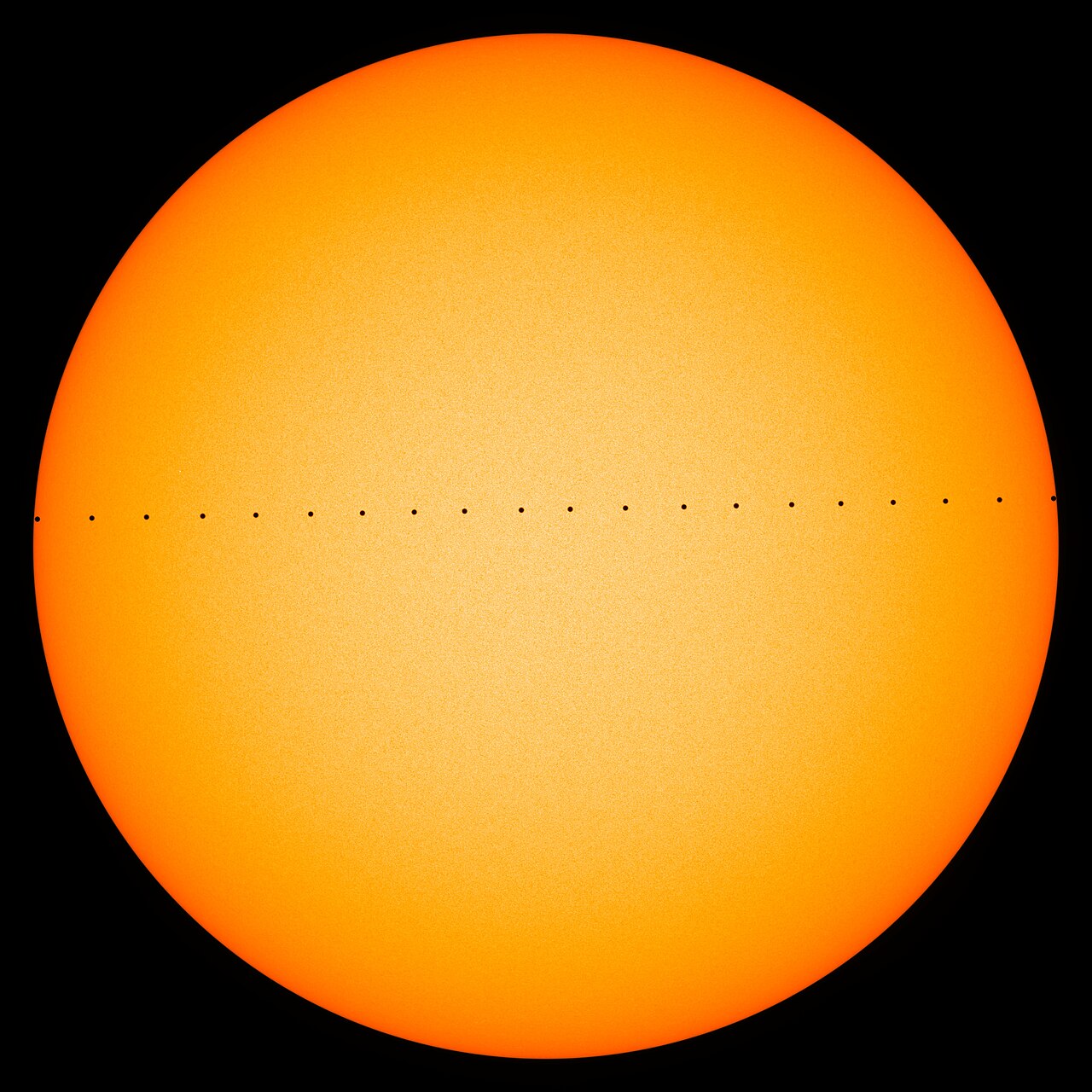the Sun's disc with a gently curving row of about twenty tiny black dots running from the left edge to the right edge, as if a small body had been photographed at regular intervals while crossing; the file has no caption, date or credit, so it is not confirmed to show Mercury in 2019, though it resembles such composites](/m/2026/11/jhJvvjIkZ43hru43.jpg)
*Via Wikimedia Commons: [Transit of Mercury on November 11, 2019](https://commons.wikimedia.org/wiki/File:Transit_of_Mercury_on_November_11,_2019.jpg) by Mbobra, [CC BY-SA 4.0](https://creativecommons.org/licenses/by-sa/4.0).*
## Sources
1. Space.com. "Miss the Mercury Transit of 2019? You'll Have to Wait 13 Years for the Next One." https://www.space.com/next-mercury-transit-when-2032.html (read 23 November 2026)
2. Live Science. Article on the 2012 transit of Venus, "Venus crossed the Sun 10 years ago" (headline as in the page address). https://www.livescience.com/venus-crossed-sun-10-years/ (read 23 November 2026)
3. NASA Science. "How We Find and Characterize" (exoplanets page). https://science.nasa.gov/exoplanets/how-we-find-and-characterize/ (read 23 November 2026)
4. NASA Science. "Kepler." https://science.nasa.gov/mission/kepler/ (read 23 November 2026)
