Compare versions
Version 1 → Version 2. Removed · Added. This shows the entry's text as it is written, including its formatting marks.
Version 1 · Version 2 · Version history
Side by side · Together
Version 1Version 2
5 unchanged paragraphs
Satan is a figure of Jewish, Christian and Islamic tradition, named from a Hebrew word meaning "adversary," who developed from an accuser in God's heavenly court into the prince of evil spirits and the adversary of God.[1][2]
Satan is a figure of Jewish, Christian and Islamic tradition, named from a Hebrew word meaning "adversary," who developed from an accuser in God's heavenly court into the prince of evil spirits and the adversary of God.[1][2]
## Name and meaning
## Name and meaning
The English name Satan comes from a Hebrew word meaning "adversary"; with the definite article, *ha-satan*, it means "the adversary."[1] In the Hebrew Bible the word often names ordinary human opponents: an enemy in war (1 Kings 11:14, 23, 25), a possible traitor in battle (1 Samuel 29:4) and an accuser at a trial (Psalm 109:6).[2] In Numbers 22:32 an angel opposes the prophet Balaam as a "satan."[2] The Jewish Encyclopedia of 1906 concluded that the idea of Satan as a distinct being was not yet known when that passage was written.[2]
The English name Satan comes from a Hebrew word meaning "adversary"; with the definite article, *ha-satan*, it means "the adversary."[1] In the Hebrew Bible the word often names ordinary human opponents: an enemy in war (1 Kings 11:14, 23, 25), a possible traitor in battle (1 Samuel 29:4) and an accuser at a trial (Psalm 109:6).[2] In Numbers 22:32 an angel opposes the prophet Balaam as a "satan."[2] The Jewish Encyclopedia of 1906 concluded that the idea of Satan as a distinct being was not yet known when that passage was written.[2]
The New Testament uses the Greek form *Satanas* and, more often, *diabolos*, "devil."[1] *Diabolos* comes from a Greek verb meaning to slander or accuse.[3] The Catholic Encyclopedia notes that the title names an office rather than a nature.[3] Another New Testament name, Beelzebul, goes back to Baalzebub, the god of the city of Ekron.[1] In Islam the Devil's personal name is Iblīs, possibly derived from *diabolos*; as tempter he is also called al-Shayṭān.[4]
The New Testament uses the Greek form *Satanas* and, more often, *diabolos*, "devil."[1] *Diabolos* comes from a Greek verb meaning to slander or accuse.[3] The Catholic Encyclopedia notes that the title names an office rather than a nature.[3] Another New Testament name, Beelzebul, goes back to Baalzebub, the god of the city of Ekron.[1] In Islam the Devil's personal name is Iblīs, possibly derived from *diabolos*; as tempter he is also called al-Shayṭān.[4]
## In the Hebrew Bible
## In the Hebrew Bible
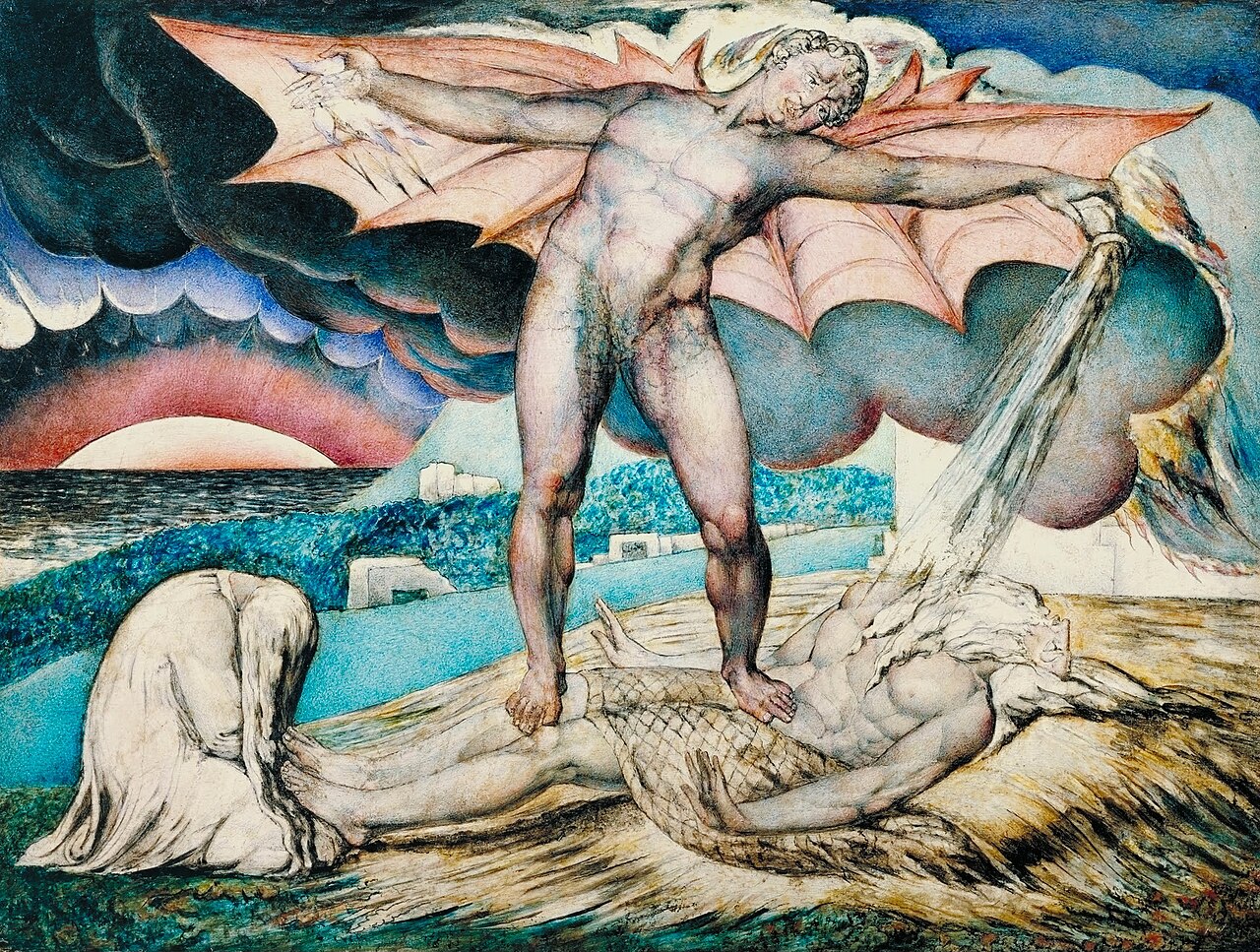
*Via Wikimedia Commons: [William Blake - Satan Smiting Job with Sore Boils - Google Art Project](https://commons.wikimedia.org/wiki/File:William_Blake_-_Satan_Smiting_Job_with_Sore_Boils_-_Google_Art_Project.jpg) by William Blake, public domain.*
34 unchanged paragraphs
The best-known appearance is in the opening chapters of the Book of Job, where *ha-satan* comes before God among "the sons of God," a phrase also translated "the heavenly beings" or "the angels."[5] There the adversary roams the earth looking for people to report on unfavorably.[1] When God points to Job's righteousness, the adversary asks, "Does Job fear God for nothing?"[5] God allows a test but sets a limit: "Only do not stretch out your hand against him."[5] In a second test the adversary afflicts Job with painful sores over his whole body.[5] The Jewish Encyclopedia describes this figure as a heavenly prosecutor who watches human conduct and can act only with God's permission, and so is not an opponent of God.[2]
The best-known appearance is in the opening chapters of the Book of Job, where *ha-satan* comes before God among "the sons of God," a phrase also translated "the heavenly beings" or "the angels."[5] There the adversary roams the earth looking for people to report on unfavorably.[1] When God points to Job's righteousness, the adversary asks, "Does Job fear God for nothing?"[5] God allows a test but sets a limit: "Only do not stretch out your hand against him."[5] In a second test the adversary afflicts Job with painful sores over his whole body.[5] The Jewish Encyclopedia describes this figure as a heavenly prosecutor who watches human conduct and can act only with God's permission, and so is not an opponent of God.[2]
In Zechariah 3:1–2 the adversary opposes the high priest Joshua and is rebuked.[2] Encyclopaedia Iranica reads this passage as still showing Satan as God's servant.[6]
In Zechariah 3:1–2 the adversary opposes the high priest Joshua and is rebuked.[2] Encyclopaedia Iranica reads this passage as still showing Satan as God's servant.[6]
A change appears between two accounts of the same event. In 2 Samuel 24:1 it is God who moves King David to count the people of Israel, while the later retelling in 1 Chronicles 21:1 says that Satan provoked him.[2] The Jewish Encyclopedia dated Chronicles to the third century BCE and saw the change as a marked step toward Satan as an independent agent.[2] Encyclopaedia Iranica likewise reads it as a sign of the figure's rising status.[6]
A change appears between two accounts of the same event. In 2 Samuel 24:1 it is God who moves King David to count the people of Israel, while the later retelling in 1 Chronicles 21:1 says that Satan provoked him.[2] The Jewish Encyclopedia dated Chronicles to the third century BCE and saw the change as a marked step toward Satan as an independent agent.[2] Encyclopaedia Iranica likewise reads it as a sign of the figure's rising status.[6]
## In Second Temple writings
## In Second Temple writings
The Second Temple period runs from the rebuilding of the Jerusalem Temple after the Babylonian exile to its destruction by Rome in 70 CE. Many Jewish writings from this era sit outside the Hebrew Bible, among them the Apocrypha and the pseudepigrapha, books attributed to ancient figures such as Enoch.
The Second Temple period runs from the rebuilding of the Jerusalem Temple after the Babylonian exile to its destruction by Rome in 70 CE. Many Jewish writings from this era sit outside the Hebrew Bible, among them the Apocrypha and the pseudepigrapha, books attributed to ancient figures such as Enoch.
The Wisdom of Solomon (2:24) says that death entered the world through the devil's envy.[3] The Jewish Encyclopedia links this verse to the serpent of Genesis 3 and treats it as making Satan the author of evil.[2] In 2 Enoch, also called Slavonic Enoch, Satan seduces Eve and is cast out of heaven with other angels, and he is said to have once been called Satanel.[2] The Book of Jubilees names the chief evil spirit Mastema, whom the Jewish Encyclopedia identifies with Satan, and makes him the one who urged God to test Abraham.[2] The Martyrdom of Isaiah and the Life of Adam and Eve show Satan ruling a host of angels.[2] The demon Asmodeus in the Book of Tobit has also been identified with Satan.[2]
The Wisdom of Solomon (2:24) says that death entered the world through the devil's envy.[3] The Jewish Encyclopedia links this verse to the serpent of Genesis 3 and treats it as making Satan the author of evil.[2] In 2 Enoch, also called Slavonic Enoch, Satan seduces Eve and is cast out of heaven with other angels, and he is said to have once been called Satanel.[2] The Book of Jubilees names the chief evil spirit Mastema, whom the Jewish Encyclopedia identifies with Satan, and makes him the one who urged God to test Abraham.[2] The Martyrdom of Isaiah and the Life of Adam and Eve show Satan ruling a host of angels.[2] The demon Asmodeus in the Book of Tobit has also been identified with Satan.[2]
## In rabbinic Judaism and Kabbalah
## In rabbinic Judaism and Kabbalah
Rabbinic literature means the Talmud, the great body of rabbinic legal discussion, and the Midrash, rabbinic interpretation of scripture. In the sayings of rabbis active before about 200 CE, Satan rarely appears, and one teaching (Avot 4:11) makes sin itself the accuser.[2] Later teachers took in popular ideas about Satan, and in the Talmud and Midrash he acts as tempter, accuser and punisher.[2] A passage in the Talmud (Bava Batra 16a) treats Satan, the evil inclination (*yetzer ha-ra*) and the angel of death as one being.[2] Rabbinic texts identify him with the serpent of Eden and give him a part in later sins, including the golden calf and David's sin with Bathsheba.[2] Some texts name Samael as lord of the satans.[2]
Rabbinic literature means the Talmud, the great body of rabbinic legal discussion, and the Midrash, rabbinic interpretation of scripture. In the sayings of rabbis active before about 200 CE, Satan rarely appears, and one teaching (Avot 4:11) makes sin itself the accuser.[2] Later teachers took in popular ideas about Satan, and in the Talmud and Midrash he acts as tempter, accuser and punisher.[2] A passage in the Talmud (Bava Batra 16a) treats Satan, the evil inclination (*yetzer ha-ra*) and the angel of death as one being.[2] Rabbinic texts identify him with the serpent of Eden and give him a part in later sins, including the golden calf and David's sin with Bathsheba.[2] Some texts name Samael as lord of the satans.[2]
Hebrew letters also serve as numbers, and the letters of *ha-satan* add up to 364.[2] The Talmud (Yoma 20a) takes this to mean that his power fails on one day of the year, the Day of Atonement.[2] Another passage (Rosh Hashanah 16b) says the blast of the shofar, a ram's horn, confounds him at the New Year.[2] Some midrashim teach that the shofar keeps Satan away while Jews begin to atone.[7]
Hebrew letters also serve as numbers, and the letters of *ha-satan* add up to 364.[2] The Talmud (Yoma 20a) takes this to mean that his power fails on one day of the year, the Day of Atonement.[2] Another passage (Rosh Hashanah 16b) says the blast of the shofar, a ram's horn, confounds him at the New Year.[2] Some midrashim teach that the shofar keeps Satan away while Jews begin to atone.[7]
Kabbalah, the Jewish mystical tradition, and its central book, the Zohar, extend Satan's activity into daily life, identify Amalek, Goliath and Haman with him, and count among his hosts the *kelippah*, the "husk" or "shell" of evil.[2]
Kabbalah, the Jewish mystical tradition, and its central book, the Zohar, extend Satan's activity into daily life, identify Amalek, Goliath and Haman with him, and count among his hosts the *kelippah*, the "husk" or "shell" of evil.[2]
As of November 2026, the Jewish Virtual Library states that Judaism does not see Satan as a physical being who rules an underworld.[7] It describes him as an "accuser," "hinderer" or "tempter," and also as the evil inclination, always inferior to God and unable to act against people without God's permission.[7]
As of November 2026, the Jewish Virtual Library states that Judaism does not see Satan as a physical being who rules an underworld.[7] It describes him as an "accuser," "hinderer" or "tempter," and also as the evil inclination, always inferior to God and unable to act against people without God's permission.[7]
## In Christianity
## In Christianity
In the New Testament Satan is the prince of evil spirits and the chief enemy of God and of Christ, able to appear as an angel of light and working through demons who possess or afflict people.[1] He is called the accuser (Revelation 12:10), the old serpent (Revelation 20:2), the great dragon (Revelation 12:9), Beelzebub and Belial.[2] Other titles include "the prince of this world" (John 14:30) and "the prince of the power of the air" (Ephesians 2:2).[3] He tempts Jesus in the wilderness (Matthew 4), and Paul writes that the serpent deceived Eve (2 Corinthians 11:3).[2] Revelation 12:9 calls the dragon "that old serpent, who is called the devil and Satan."[3]
In the New Testament Satan is the prince of evil spirits and the chief enemy of God and of Christ, able to appear as an angel of light and working through demons who possess or afflict people.[1] He is called the accuser (Revelation 12:10), the old serpent (Revelation 20:2), the great dragon (Revelation 12:9), Beelzebub and Belial.[2] Other titles include "the prince of this world" (John 14:30) and "the prince of the power of the air" (Ephesians 2:2).[3] He tempts Jesus in the wilderness (Matthew 4), and Paul writes that the serpent deceived Eve (2 Corinthians 11:3).[2] Revelation 12:9 calls the dragon "that old serpent, who is called the devil and Satan."[3]
In Luke 10:18 Jesus says that he saw Satan fall from heaven.[1] Older commentators read the saying as a reference to Satan's first fall, while the Catholic Encyclopedia prefers the modern reading that it describes his defeat as the disciples cast out demons.[3] The Book of Revelation describes Satan bound for a thousand years, released, and then finally defeated and punished.[1]
In Luke 10:18 Jesus says that he saw Satan fall from heaven.[1] Older commentators read the saying as a reference to Satan's first fall, while the Catholic Encyclopedia prefers the modern reading that it describes his defeat as the disciples cast out demons.[3] The Book of Revelation describes Satan bound for a thousand years, released, and then finally defeated and punished.[1]
Christian theology traditionally holds that Satan was an angel who rebelled against God and was cast out of heaven before humans were created.[1] Two prophetic passages, Isaiah 14:12–17 and Ezekiel 28:14–18, became the main texts cited for this fall.[1] Isaiah 14 is addressed to the king of Babylon, but early Church Fathers and later Catholic commentators applied it to the fall of the rebel angel, and Catholic usage names the chief of the fallen angels Lucifer.[3] Christian tradition also identifies Satan with the serpent who tempted Eve.[1]
Christian theology traditionally holds that Satan was an angel who rebelled against God and was cast out of heaven before humans were created.[1] Two prophetic passages, Isaiah 14:12–17 and Ezekiel 28:14–18, became the main texts cited for this fall.[1] Isaiah 14 is addressed to the king of Babylon, but early Church Fathers and later Catholic commentators applied it to the fall of the rebel angel, and Catholic usage names the chief of the fallen angels Lucifer.[3] Christian tradition also identifies Satan with the serpent who tempted Eve.[1]
The Fourth Lateran Council taught that the Devil and the other demons were created good by God but "by themselves have made themselves evil."[3] Thomas Aquinas held that Satan's first sin was pride, while John Duns Scotus classed it as a kind of spiritual lust.[3] Early Christian writers debated how such a being fits with a good and all-powerful God, and much eighteenth-century liberal theology treated the biblical passages as symbolic rather than literal.[1]
The Fourth Lateran Council taught that the Devil and the other demons were created good by God but "by themselves have made themselves evil."[3] Thomas Aquinas held that Satan's first sin was pride, while John Duns Scotus classed it as a kind of spiritual lust.[3] Early Christian writers debated how such a being fits with a good and all-powerful God, and much eighteenth-century liberal theology treated the biblical passages as symbolic rather than literal.[1]
## In Islam
## In Islam
In Islam the Devil is Iblīs, also called "Enemy of God" and, as tempter, al-Shayṭān.[4] The Qur'an tells that God created and shaped humankind and told the angels to prostrate before Adam: "so they all did, but not Iblīs, who refused to prostrate with the others."[8] Iblīs gives his reason: "You created me from fire and him from clay."[8] He asks God to "delay my end until the Day of their resurrection" and vows, "I will lie in ambush for them on Your Straight Path."[8]
In Islam the Devil is Iblīs, also called "Enemy of God" and, as tempter, al-Shayṭān.[4] The Qur'an tells that God created and shaped humankind and told the angels to prostrate before Adam: "so they all did, but not Iblīs, who refused to prostrate with the others."[8] Iblīs gives his reason: "You created me from fire and him from clay."[8] He asks God to "delay my end until the Day of their resurrection" and vows, "I will lie in ambush for them on Your Straight Path."[8]
God expelled Iblīs from heaven but postponed his punishment until the Day of Judgment, and until then he may tempt everyone except true believers.[4] Islamic tradition holds that he tempted Eve to eat from the tree of immortality, and that Adam and Eve lost paradise as a result.[4]
God expelled Iblīs from heaven but postponed his punishment until the Day of Judgment, and until then he may tempt everyone except true believers.[4] Islamic tradition holds that he tempted Eve to eat from the tree of immortality, and that Adam and Eve lost paradise as a result.[4]
Muslim scholars have long asked whether Iblīs was an angel or one of the jinn.[4] In Islamic belief angels are made of light and cannot sin, while jinn are beings made of fire who can.[4] One verse of the Qur'an says Iblīs "was one of the jinn, but he rebelled against the command of his Lord."[9] Traditions differ: he was a jinn who came to live among the angels, an angel sent to fight rebellious jinn on earth, or a jinn captured and taken to heaven.[4]
Muslim scholars have long asked whether Iblīs was an angel or one of the jinn.[4] In Islamic belief angels are made of light and cannot sin, while jinn are beings made of fire who can.[4] One verse of the Qur'an says Iblīs "was one of the jinn, but he rebelled against the command of his Lord."[9] Traditions differ: he was a jinn who came to live among the angels, an angel sent to fight rebellious jinn on earth, or a jinn captured and taken to heaven.[4]
## In Zoroastrianism
## In Zoroastrianism
Zoroastrianism, the ancient Iranian religion named after the prophet Zoroaster, has its own adversary: Angra Mainyu in Avestan, the language of its scripture, the Avesta, and Ahriman in later Middle Persian books written in Pahlavi script.[6] He is a separate figure, but reference works on both traditions compare him with Satan.[2][6]
Zoroastrianism, the ancient Iranian religion named after the prophet Zoroaster, has its own adversary: Angra Mainyu in Avestan, the language of its scripture, the Avesta, and Ahriman in later Middle Persian books written in Pahlavi script.[6] He is a separate figure, but reference works on both traditions compare him with Satan.[2][6]
The Gathas, hymns attributed to Zoroaster, name Angra Mainyu only once.[6] There he is one of two twin spirits, both sons of Ahura Mazda, whose original choice between good and evil serves as the model for the choice every person faces; neither was wicked before that choice.[6] In the Younger Avesta he dwells in the underworld and the north, leads the daevas (demons) without being their creator, makes counter-creations against Ahura Mazda's good works, tempts Zoroaster and is finally defeated.[6]
The Gathas, hymns attributed to Zoroaster, name Angra Mainyu only once.[6] There he is one of two twin spirits, both sons of Ahura Mazda, whose original choice between good and evil serves as the model for the choice every person faces; neither was wicked before that choice.[6] In the Younger Avesta he dwells in the underworld and the north, leads the daevas (demons) without being their creator, makes counter-creations against Ahura Mazda's good works, tempts Zoroaster and is finally defeated.[6]
In the Pahlavi books Ahriman becomes the direct counterpart of Ohrmazd, the later name of Ahura Mazda, the two separated by a void until Ahriman attacks.[6] After lying stunned for 3,000 years, he is roused by Jēh and assaults creation, killing the Primal Bull and Gayōmard, the first man.[6] The texts differ on his end: some say he will be made powerless, others that he will be destroyed.[6] A related current called Zurvanism made Zurvan, or Time, the father of both spirits and traced Ahriman's birth to Zurvan's doubt; Encyclopaedia Iranica calls it probably the main heresy that orthodoxy opposed under the early Sasanian kings.[6]
In the Pahlavi books Ahriman becomes the direct counterpart of Ohrmazd, the later name of Ahura Mazda, the two separated by a void until Ahriman attacks.[6] After lying stunned for 3,000 years, he is roused by Jēh and assaults creation, killing the Primal Bull and Gayōmard, the first man.[6] The texts differ on his end: some say he will be made powerless, others that he will be destroyed.[6] A related current called Zurvanism made Zurvan, or Time, the father of both spirits and traced Ahriman's birth to Zurvan's doubt; Encyclopaedia Iranica calls it probably the main heresy that orthodoxy opposed under the early Sasanian kings.[6]
## Influence and comparison
## Influence and comparison
Encyclopaedia Iranica suggests that Iranian ideas may have helped turn Satan from God's servant into God's adversary, but finds no direct historical link between Iranian teaching and the doctrine of two spirits in the Dead Sea Scrolls.[6] It adds that the devil of Manichaeism, the dualist religion founded by the prophet Mani, borrowed Iranian features and the name Ahriman, which also appears in the Talmud.[6] The Jewish Encyclopedia allowed that Zoroastrianism may have influenced the author of Chronicles and possibly Zechariah, noted that the Hebrew prophets strongly opposed Iranian dualism, the belief in two opposed ultimate powers, and judged Babylonian influence impossible.[2]
Encyclopaedia Iranica suggests that Iranian ideas may have helped turn Satan from God's servant into God's adversary, but finds no direct historical link between Iranian teaching and the doctrine of two spirits in the Dead Sea Scrolls.[6] It adds that the devil of Manichaeism, the dualist religion founded by the prophet Mani, borrowed Iranian features and the name Ahriman, which also appears in the Talmud.[6] The Jewish Encyclopedia allowed that Zoroastrianism may have influenced the author of Chronicles and possibly Zechariah, noted that the Hebrew prophets strongly opposed Iranian dualism, the belief in two opposed ultimate powers, and judged Babylonian influence impossible.[2]
The traditions differ on the adversary's standing. Jewish sources present Satan as acting only with God's permission.[2] Catholic doctrine holds that he was created good by God.[3] In the Qur'an Iblīs must ask God for respite.[8] In the Pahlavi books, by contrast, Ahriman is the counterpart of Ohrmazd, existing in opposition to him, and has no material counterpart in the world.[6]
The traditions differ on the adversary's standing. Jewish sources present Satan as acting only with God's permission.[2] Catholic doctrine holds that he was created good by God.[3] In the Qur'an Iblīs must ask God for respite.[8] In the Pahlavi books, by contrast, Ahriman is the counterpart of Ohrmazd, existing in opposition to him, and has no material counterpart in the world.[6]
## In art and literature
## In art and literature
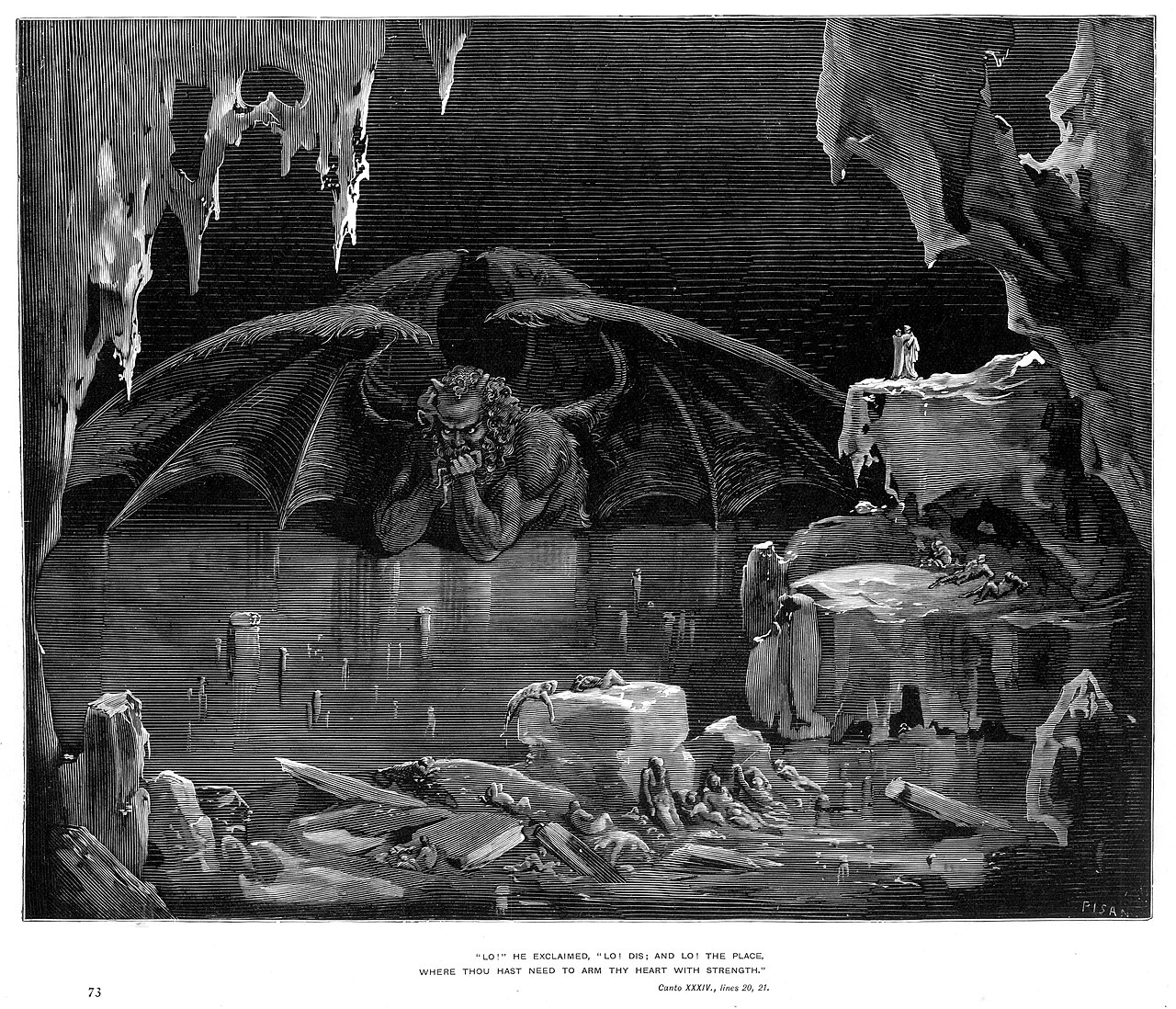

*Via Wikimedia Commons: [The Vision of Hell, by Gustave Doré](https://commons.wikimedia.org/wiki/File:The_Vision_of_Hell,_by_Gustave_Dor%C3%A9.jpg) by Gustave Doré, public domain.*
*Via Wikimedia Commons: [The Vision of Hell, by Gustave Doré](https://commons.wikimedia.org/wiki/File:The_Vision_of_Hell,_by_Gustave_Dor%C3%A9.jpg) by Gustave Doré, public domain.*
In canto 34 of Dante's *Inferno*, Lucifer stands at the bottom of hell, in the ninth circle, fixed in a frozen lake.[10] The beating of his wings makes the wind that keeps the lake frozen.[10] He has three faces, red, whitish-yellow and black, read as a parody of the Trinity, and his three mouths hold the traitors Judas Iscariot, Brutus and Cassius, with Judas placed head first.[10]
In canto 34 of Dante's *Inferno*, Lucifer stands at the bottom of hell, in the ninth circle, fixed in a frozen lake.[10] The beating of his wings makes the wind that keeps the lake frozen.[10] He has three faces, red, whitish-yellow and black, read as a parody of the Trinity, and his three mouths hold the traitors Judas Iscariot, Brutus and Cassius, with Judas placed head first.[10]
John Milton's epic *Paradise Lost* opens with "Mans First Disobedience" and introduces Satan as "th' infernal Serpent," whose "Pride / Had cast him out from Heav'n, with all his Host."[11] In the first book Satan declares, "Better to reign in Hell, then serve in Heav'n."[11]
John Milton's epic *Paradise Lost* opens with "Mans First Disobedience" and introduces Satan as "th' infernal Serpent," whose "Pride / Had cast him out from Heav'n, with all his Host."[11] In the first book Satan declares, "Better to reign in Hell, then serve in Heav'n."[11]
## Sources
## Sources
1. "Satan." Encyclopaedia Britannica, The Editors of Encyclopaedia Britannica. Last revised 6 May 2024 (per the article's edit history). https://www.britannica.com/topic/Satan
2. Joseph Jacobs and Ludwig Blau, "Satan." The Jewish Encyclopedia, vol. 11, 1906; JewishEncyclopedia.com. https://www.jewishencyclopedia.com/articles/13219-satan.html
3. W. Kent, "Devil." The Catholic Encyclopedia, vol. 4, Robert Appleton Company, 1908; New Advent. https://www.newadvent.org/cathen/04764a.htm
4. "Iblīs." Encyclopaedia Britannica, The Editors of Encyclopaedia Britannica, revised by Brian Duignan. No date shown; accessed 24 November 2026. https://www.britannica.com/topic/Iblis
5. Job 1–2, Lexham English Bible. Biblia.com. Accessed 24 November 2026. https://biblia.com/bible/leb/Job1-2
6. Jacques Duchesne-Guillemin, "Ahriman." Encyclopaedia Iranica, 15 December 1984. https://iranicaonline.org/articles/ahriman/
7. "Jewish Concepts: Satan." Jewish Virtual Library. Accessed 24 November 2026. https://www.jewishvirtuallibrary.org/satan
8. Qur'an 7:11–18, translated by Mustafa Khattab, The Clear Quran. Quran.com. Accessed 24 November 2026. https://quran.com/al-aaraf/11
9. Qur'an 18:50, translated by Mustafa Khattab, The Clear Quran. Quran.com. Accessed 24 November 2026. https://quran.com/18/50
10. "Lucifer" (Inferno 34). Danteworlds, University of Texas at Austin. Accessed 24 November 2026. https://danteworlds.laits.utexas.edu/textpopup/inf3401.html
11. John Milton, Paradise Lost, Book 1, edited by Thomas H. Luxon. The John Milton Reading Room, Dartmouth College, 1997–2026. https://milton.host.dartmouth.edu/reading_room/pl/book_1/text.shtml
