Pope Francis (Jorge Mario Bergoglio, 1936–2025) was an Argentine Jesuit priest who served as Archbishop of Buenos Aires and then, from 13 March 2013 until his death on 21 April 2025, as the 266th pope of the Catholic Church.[1]
Early life and education
Jorge Mario Bergoglio was born in Buenos Aires, Argentina, on 17 December 1936, the son of immigrants from the Piedmont region of northern Italy.[1] He trained as a chemical technician before deciding to study for the priesthood, first entering the diocesan seminary.[1] Encyclopaedia Britannica adds that he worked briefly in the food-processing industry before turning to the Church.[2]
On 11 March 1958 he was accepted into the novitiate of the Society of Jesus (the Jesuits, a Catholic religious order of priests and brothers); a novitiate is the first stage of training in a religious order.[1] He completed humanities studies in Chile, then returned to Argentina, where he graduated in philosophy in 1963 and in theology in 1970.[1] According to Britannica, he taught literature and psychology during this period while continuing his theological studies.[2]
Jesuit and episcopal career
Bergoglio was ordained a priest on 13 December 1969, while studying at the Theological Faculty of San Miguel.[1][3] He made his perpetual vows as a Jesuit in 1973.[1] He served as master of novices in San Miguel, where he also taught theology, and was the Jesuits' provincial (the head of the order in a region) for Argentina from 1973 to 1979.[3] From 1980 to 1986 he was rector of the Philosophical and Theological Faculty of San Miguel.[3] He later went to Germany to complete a doctoral dissertation and afterwards worked as a confessor and spiritual director in Córdoba, Argentina.[3]
On 20 May 1992 Pope John Paul II named him titular Bishop of Auca and auxiliary bishop of Buenos Aires; he received episcopal consecration on 27 June that year.[3] (A titular bishop holds the title of a former diocese that no longer functions, and an auxiliary bishop assists the bishop of a diocese.) He was appointed coadjutor archbishop of Buenos Aires, which gave him the right to succeed the sitting archbishop, on 3 June 1997, and on 28 February 1998 he succeeded Cardinal Antonio Quarracino as Archbishop of Buenos Aires.[3] As archbishop he was also primate of Argentina, ordinary (the bishop with authority) for Eastern-rite Catholics in Argentina who had no bishop of their own rite, and grand chancellor of the Catholic University.[1][3]
John Paul II made him a cardinal in the consistory of 21 February 2001, assigning him the title church of Saint Robert Bellarmine.[3] In October 2001 he served as adjunct general relator of the tenth ordinary general assembly of the Synod of Bishops in Rome.[3] He was president of the Argentine Bishops' Conference from 8 November 2005 to 8 November 2011.[3] In the Roman Curia, the central administration of the Catholic Church, he was a member of the congregations for divine worship, for the clergy and for consecrated life, of the Pontifical Council for the Family and of the Pontifical Commission for Latin America.[3] He took part in the April 2005 conclave that elected Pope Benedict XVI.[1]
Election
After Benedict XVI resigned, the cardinals meeting in conclave (the closed assembly of cardinals that elects a pope) chose Bergoglio on 13 March 2013, when he was 76 years old.[1] He was the first pope from the Americas and, according to the Associated Press, the first Jesuit pope.[1][4] He formally began his ministry as pope on 19 March 2013.[1]
He took the name Francis after Saint Francis of Assisi.[1] Speaking to journalists on 16 March 2013, he said that Cardinal Cláudio Hummes, who sat beside him in the conclave, embraced him once the required two-thirds majority had been reached and urged him not to forget the poor; this, he said, led him to think of Francis of Assisi, whom he described as a man of poverty and of peace who loved and protected creation.[5]
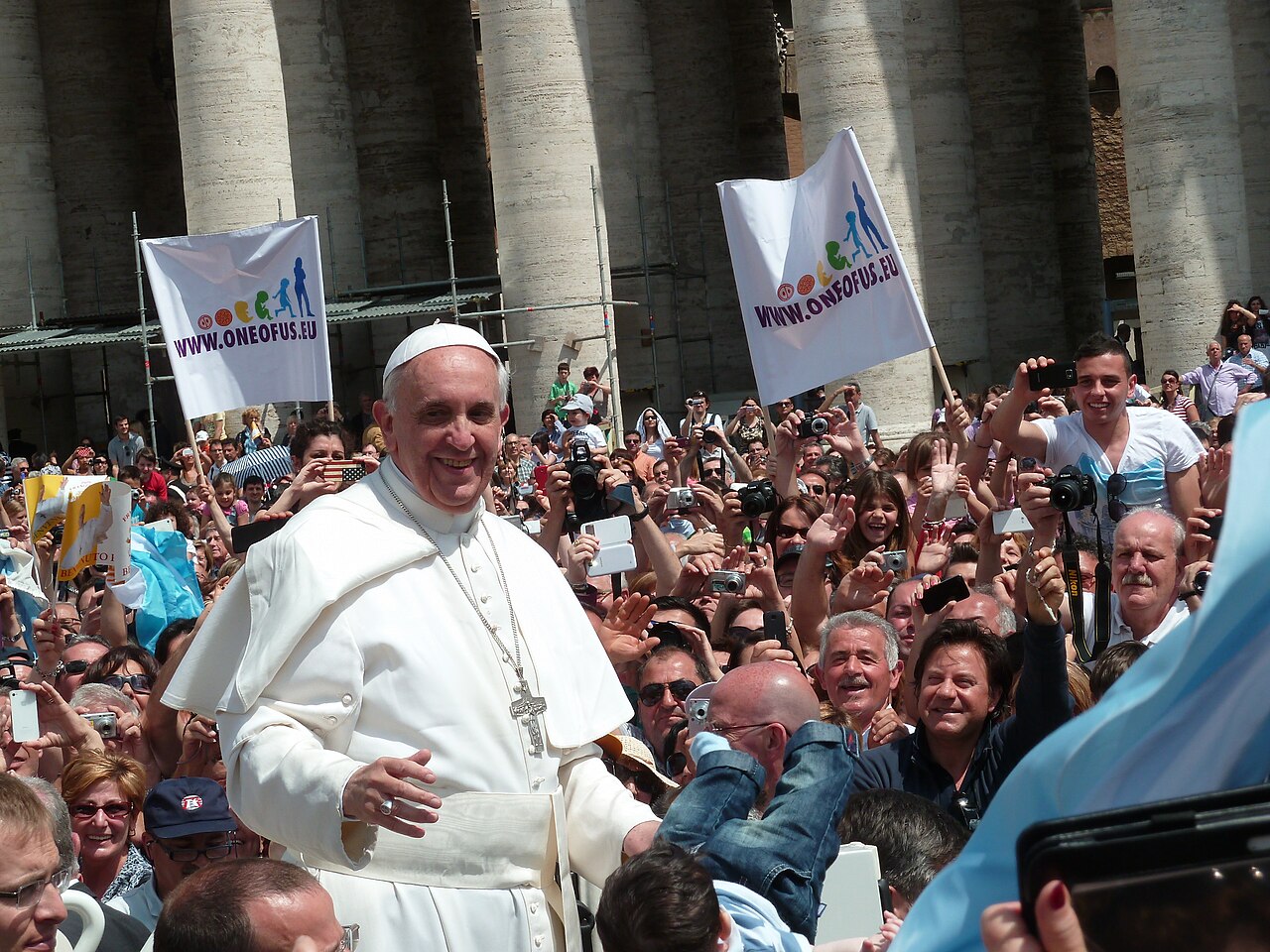
Pope Francis greeting the crowd in St Peter's Square in the first year of his papacy.
Francis published four encyclicals (formal papal letters on major questions of teaching): Lumen fidei (29 June 2013), Laudato si' (24 May 2015), Fratelli tutti (3 October 2020) and Dilexit nos (24 October 2024).[6] Laudato si' was addressed to every person on the planet and called for a broad dialogue about the future of the Earth; Britannica notes that it dealt with climate change and treated damage to the environment as a moral question.[7][2] Fratelli tutti called for universal fraternity and a global society built on justice and the common good, and Dilexit nos was a reflection on devotion to the heart of Jesus.[7]
He also issued seven apostolic exhortations (papal documents encouraging the faithful on a particular subject): Evangelii gaudium on proclaiming the Gospel (24 November 2013); Amoris laetitia on love in the family (19 March 2016); Gaudete et exsultate on the call to holiness (19 March 2018); Christus vivit, addressed to young people (25 March 2019); Querida Amazonia (2 February 2020); Laudate Deum on the climate crisis (4 October 2023); and C'est la confiance on Saint Thérèse of Lisieux (15 October 2023).[8] Amoris laetitia, Christus vivit and Querida Amazonia followed meetings of the Synod of Bishops.[8]
On 11 April 2015 he issued the bull Misericordiae vultus, proclaiming an Extraordinary Jubilee of Mercy, a special holy year that ran from 8 December 2015 to 20 November 2016.[9]
Reform of the Curia
On 19 March 2022 Francis promulgated the apostolic constitution Praedicate evangelium, which reorganised the Roman Curia and took effect on 5 June 2022, replacing John Paul II's constitution Pastor bonus of 1988.[10] According to Vatican News, the text grew out of discussions among cardinals before the 2013 conclave and was drafted by the Council of Cardinals, an advisory body, between October 2013 and February 2022.[10] It merged two offices into a new Dicastery for Evangelization headed directly by the pope, created a Dicastery for the Service of Charity, and placed the Pontifical Commission for the Protection of Minors within the Dicastery for the Doctrine of the Faith.[10] It also opened governing posts in the Curia to lay men and women and limited clergy and religious working there to five-year terms, renewable once.[10]
Synodality
In October 2021 Francis opened a worldwide consultation, the Synod on Synodality, on how the Church can make decisions through listening and shared discernment ("synodality" means the members of the Church journeying and deciding together).[11] It ended in October 2024 with a final document of its general assembly.[11] Francis then issued a note, reported by Vatican News on 25 November 2024, stating that the final document belonged to the ordinary teaching of the pope, that it was not strictly binding, and that local churches should now put its guidance into practice.[11]
Journeys and diplomacy
According to the Holy See, he made 47 apostolic journeys and visited 66 countries during his pontificate.[1] The earliest visit listed for his papacy was to the Italian island of Lampedusa on 8 July 2013, and his first journey outside Italy was to World Youth Day in Rio de Janeiro from 22 to 29 July 2013.[12] Later journeys included a pilgrimage to the Holy Land (24–26 May 2014) and visits to South Korea, Albania, the European Parliament and Council of Europe, and Turkey in the same year.[13] In 2019 he travelled to Panama, the United Arab Emirates, Morocco, Bulgaria and North Macedonia, Romania, Mozambique, Madagascar and Mauritius, and Thailand and Japan.[14] He visited Iraq from 5 to 8 March 2021, and from 2 to 13 September 2024 he travelled to Indonesia, Papua New Guinea, Timor-Leste and Singapore.[15][16] During the visit to the United Arab Emirates, on 4 February 2019 in Abu Dhabi, he and the Grand Imam of Al-Azhar, Ahmad al-Tayyib, signed a joint document on "Human Fraternity for World Peace and Living Together".[17]
On 22 September 2018 the Holy See and the People's Republic of China signed in Beijing a provisional agreement on the appointment of Catholic bishops in China, subject to periodic review.[18]
Other acts
On 9 May 2019 the Holy See announced the motu proprio (a legal document issued on the pope's own initiative) Vos estis lux mundi, which required every diocese to set up, within a year, public systems for reporting sexual abuse and its cover-up, and obliged clergy and members of religious orders to report abuse they learned of to Church authorities.[19] In an audience on 11 May 2018 he approved a revision of paragraph 2267 of the Catechism of the Catholic Church, published by the Congregation for the Doctrine of the Faith in a document dated 1 August 2018, which declared the death penalty inadmissible as an attack on the inviolability and dignity of the person.[20]
On 16 July 2021 he issued Traditionis custodes, which gave each diocesan bishop exclusive authority to permit celebration of Mass with the 1962 Roman Missal (the form of the Mass in use before the liturgical reform of 1970) and directed that the places set aside for groups using it should not be parish churches.[21] On 18 December 2023 the Dicastery for the Doctrine of the Faith published, with his approval, the declaration Fiducia supplicans, which allowed ordained ministers to give non-liturgical blessings to couples in irregular situations, including same-sex couples, while stating that such blessings must not resemble a wedding and that Church teaching on marriage was unchanged.[22]
According to the Holy See, his pontificate saw 942 canonizations and more than 1,500 beatifications, and he created 163 cardinals in ten consistories.[1] The Holy See's biography also records that Francis met his predecessor, Benedict XVI, periodically until two days before Benedict's death in 2022.[1]
Assessments
Francis drew strong and divided reactions inside and outside the Catholic Church. The Associated Press, in its obituary of 21 April 2025, wrote that his humble style and concern for the poor won wide admiration but that his criticism of capitalism and his positions on climate change alienated conservatives.[4]
Supporters praised his emphasis on mercy and inclusion. As quoted by the AP, Cardinal Kevin Farrell said that Francis sought to open the Church's arms to all people and exclude no one, and Sister Nathalie Becquart, whom he appointed to a senior Vatican post, described his legacy as a turn towards cooperation.[4] Britannica lists among his achievements Laudato si', his outreach to non-Catholics and non-Christians, and his apologies to survivors of clergy sexual abuse; it also records that during a "penitential pilgrimage" to Canada in July 2022 he asked forgiveness for the evil committed by many Christians against Indigenous peoples.[2] After his death, United Nations Secretary-General António Guterres called him a messenger of hope, humility and humanity, and European Commission President Ursula von der Leyen said he had inspired millions beyond the Catholic Church.[23]
Critics within the Church argued that he weakened Catholic teaching. In November 2016 four cardinals, Walter Brandmüller, Raymond Burke, Carlo Caffarra and Joachim Meisner, made public a letter of questions ("dubia") asking him to clarify chapter 8 of Amoris laetitia, on the divorced and civilly remarried, after receiving no reply; they said even bishops interpreted it in contrasting ways.[24] The AP reported that Burke later said the Church had become like a ship without a rudder, and that Francis eventually imposed financial sanctions on him.[4] According to the AP, conservatives also objected to his outreach to LGBTQ+ Catholics, to the approval of blessings for same-sex couples, and to the agreement with China, which some critics called a sellout; some in the United States labelled him a Marxist for his economic views.[4] Britannica notes that traditionalists objected to his simple papal dress and to his washing the feet of women in the Holy Thursday rite, and that Laudato si' polarised many Catholics, especially in the United States.[2]
Fiducia supplicans met organised resistance from some bishops. On 11 January 2024 the Symposium of Episcopal Conferences of Africa and Madagascar (SECAM), led by Cardinal Fridolin Ambongo Besungu, said it would not bless same-sex couples in Africa, arguing that doing so would cause confusion and conflict with African cultural values, while reaffirming its communion with Francis; Ambongo said the pope and Cardinal Víctor Manuel Fernández had agreed to the statement.[25]
Others criticised him from a different direction. Britannica records that in Querida Amazonia he did not grant, by leaving them unmentioned, the requests of the synod bishops for reform on the ordination of married men and of women, and that this drew disappointment and criticism from some Catholics.[2] The AP noted that he did not allow women to be ordained, although he appointed women to decision-making posts.[4]
His record on clergy sexual abuse was a recurring point of criticism. The AP described his handling of a Chilean abuse case in 2018 as a serious failure in which he initially discredited victims.[4] In a letter released in April 2018 he acknowledged "serious mistakes" in his assessment of the Chilean situation, asked forgiveness and said he would call Chile's bishops to Rome.[26] According to the AP, he later invited victims to the Vatican to apologise in person and summoned the leadership of the Chilean church to resign together.[4] Chilean abuse survivor Juan Carlos Cruz was quoted by the AP as saying that Francis sincerely wanted to do something.[4] Britannica reports that critics also said the Vatican was slow to punish abusive priests.[2]
His conduct in Argentina during the military dictatorship was also disputed. Britannica reports that critics faulted him for failing to protect two Jesuit priests kidnapped in 1976, and some accused him of handing them over to the regime, while others accepted his account that he worked secretly for their release; a lawsuit against him was dismissed.[2]
Death and succession
Francis was admitted to the Agostino Gemelli Polyclinic in Rome on 14 February 2025 after several days of bronchitis, was diagnosed with bilateral pneumonia on 18 February, and returned to his residence, the Casa Santa Marta in the Vatican, after 38 days in hospital.[27]
He died at 7:35 a.m. on Easter Monday, 21 April 2025, at the Casa Santa Marta, aged 88.[27][1] Cardinal Kevin Farrell, the camerlengo (the cardinal who administers the Holy See between popes), announced the death in a statement the Holy See Press Office published that morning.[28] The Vatican's death certificate, signed by Andrea Arcangeli, director of health and hygiene of Vatican City State, and released by the Holy See Press Office on the evening of 21 April 2025, gave the cause of death as a stroke, followed by a coma and irreversible cardiocirculatory collapse.[29]
His coffin was moved to St Peter's Basilica on 23 April and closed on 25 April.[30] The funeral Mass was held in St Peter's Square on Saturday 26 April 2025, with a homily by Cardinal Giovanni Battista Re, Dean of the College of Cardinals.[31] On the same day he was buried in the Basilica of St Mary Major in Rome, in a rite led by Cardinal Farrell.[32] Nine days of mourning rites, the novemdiales, followed, ending on 4 May 2025.[30]
During the vacancy of the Holy See, the cardinal electors entered the conclave on 7 May 2025.[30] On 8 May 2025 they elected Cardinal Robert Francis Prevost, who took the name Leo XIV and became the 267th Bishop of Rome.[33]
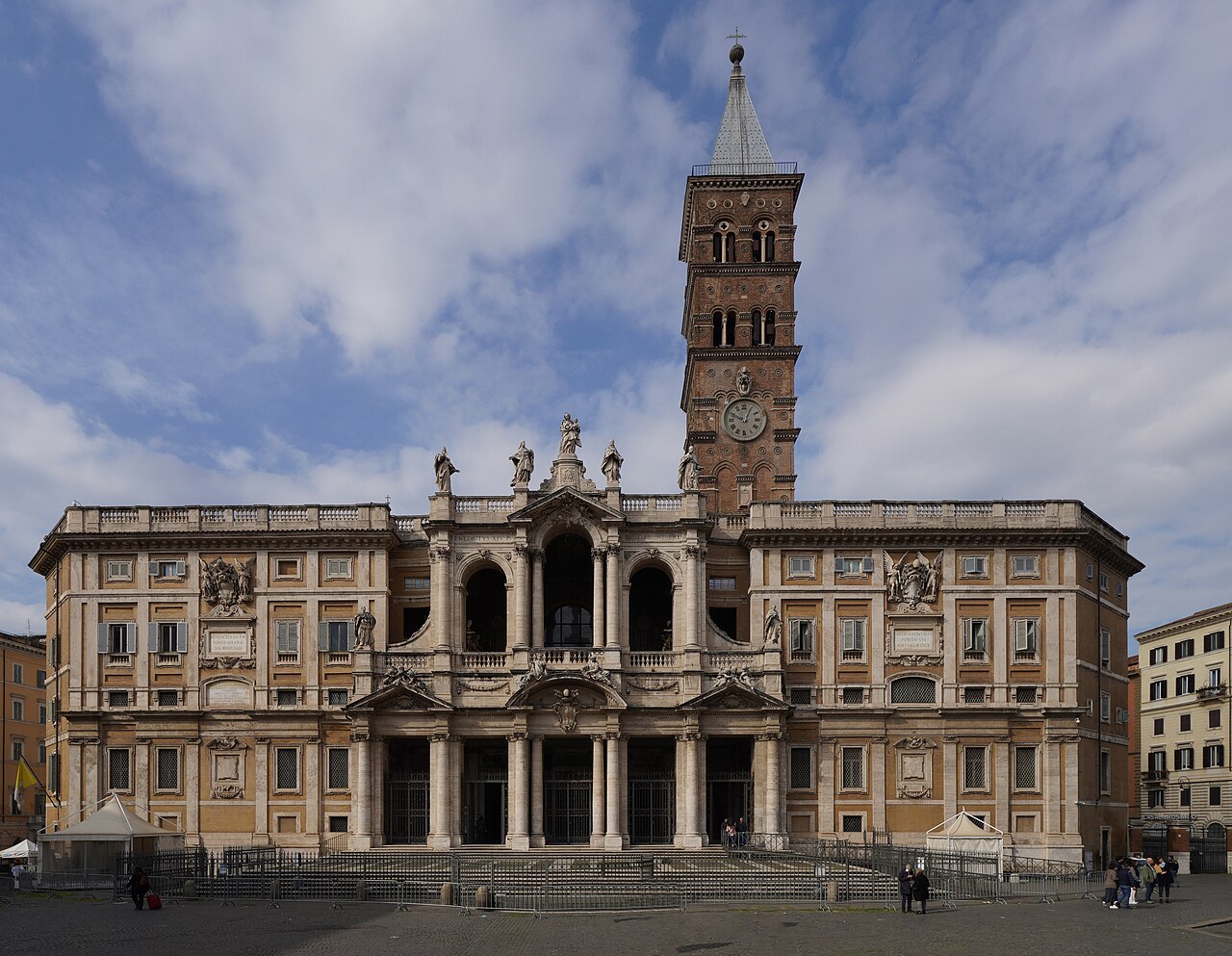
The Basilica of St Mary Major in Rome, where Pope Francis was buried in April 2025.
Matt Stefon and the Editors of Encyclopaedia Britannica. "Pope Francis." Encyclopaedia Britannica. No date shown; accessed 24 November 2026. britannica.com/biography/Francis-I-pope