Version 3 (current)
Nov 24, 2026. Version history
Elizabeth II (Elizabeth Alexandra Mary, 1926–2022) was Queen of the United Kingdom and other Commonwealth realms, and Head of the Commonwealth, from 6 February 1952 until her death on 8 September 2022, a reign longer than that of any other British monarch.[1][3]
Birth and early life
Elizabeth was born at 2.40 a.m. on 21 April 1926 at 17 Bruton Street in Mayfair, London, the home of her mother's parents, the Earl and Countess of Strathmore.[2] She was the elder daughter of Prince Albert, Duke of York (later King George VI), and his wife, Lady Elizabeth Bowes-Lyon.[3] She was christened Elizabeth Alexandra Mary at Buckingham Palace on 29 May 1926.[2] Her sister, Princess Margaret, was born in 1930.[2]
At her birth she was third in line to the throne, after her uncle Edward, Prince of Wales, and her father.[2] Her early years were spent at 145 Piccadilly in London and at White Lodge in Richmond Park.[2]
She was educated at home.[2] According to the Royal Family's website, her studies included constitutional history and law, she was taught religion by the Archbishop of Canterbury, and she learned French from French and Belgian governesses.[2] Encyclopaedia Britannica records that her mother supervised her education, that a governess, Marion Crawford, was engaged, and that C. H. K. Marten, later provost of Eton College, taught her history.[3] She joined the Girl Guides at the age of eleven and later became a Sea Ranger.[2]
The abdication of 1936
Her position changed in December 1936, when her uncle, King Edward VIII, gave up the throne.[2][3] An instrument of abdication (the formal written document by which a monarch renounces the throne) was signed on 10 December 1936, and Parliament gave it legal effect through His Majesty's Declaration of Abdication Act 1936, dated 11 December 1936.[4] Section 1 of the Act provided that, once it received Royal Assent, Edward ceased to be king, the crown passed to the next member of the royal family in the line of succession, and Edward and his descendants lost any right to the throne.[4]
Her father therefore became King George VI, and Elizabeth, at the age of ten, became heir presumptive (the person first in line to the throne whose place could in principle be displaced by the birth of a nearer heir).[2][3] She and her sister attended their parents' coronation in Westminster Abbey in May 1937.[2]
Second World War
In 1940, during the Blitz (the German bombing campaign against British cities), the two princesses were moved to Windsor Castle, where they spent most of the war.[2] There they continued their lessons, took part in air raid drills and lived with food rationing, while the King and Queen remained in London.[2] Britannica notes that the sisters also stayed at Balmoral and Royal Lodge during the war years.[3]
In early 1945, at the age of 18, she joined the Auxiliary Territorial Service (ATS).[5][6] The Royal Collection Trust records that she was registered as No. 230873 Second Subaltern Elizabeth Alexandra Mary Windsor, completed a driving and vehicle maintenance course on 14 April, and was promoted to Junior Commander on 27 July 1945.[6] According to the Imperial War Museums, her training covered driving, vehicle maintenance, mechanics and map reading, and she qualified as a driver, although the war ended before she put the skills to practical use.[5] On VE Day, 8 May 1945, she appeared on the balcony of Buckingham Palace with her parents, her sister and the Prime Minister, Winston Churchill.[5]
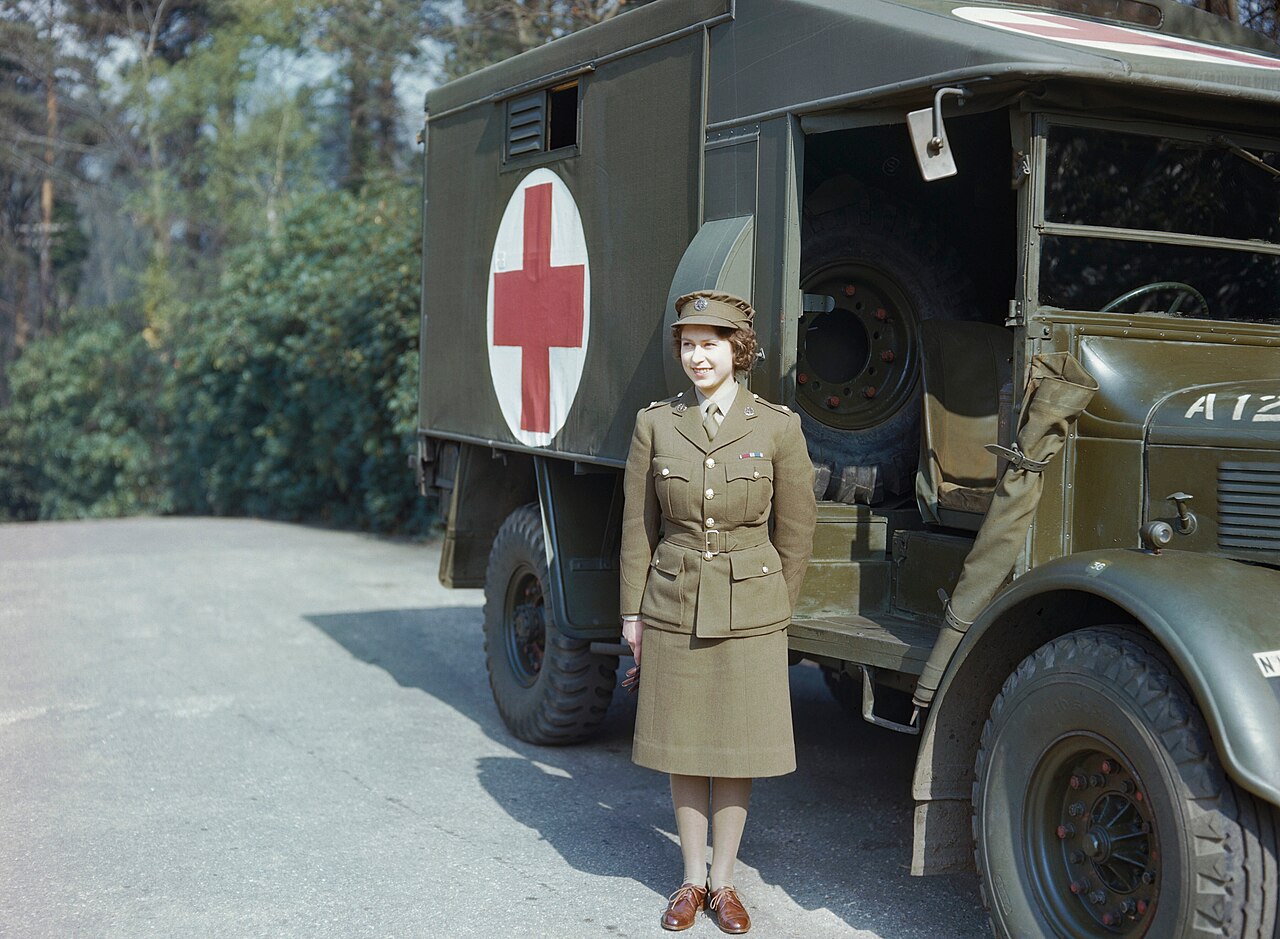
Via Wikimedia Commons: Hrh Princess Elizabeth in the Auxiliary Territorial Service, April 194 by Ministry of Information official photographer, public domain.
Marriage and the 1947 tour
In 1947 she toured South Africa with her parents; this was her first official overseas visit, and the tour also took in what are now Zimbabwe and Botswana.[7] On her 21st birthday, 21 April 1947, she gave a broadcast from Cape Town, heard across the Commonwealth, in which she pledged her life to the service of the Commonwealth.[7][8]
On 20 November 1947 she married Lieutenant Philip Mountbatten of the Royal Navy, formerly Prince Philip of Greece and Denmark, at Westminster Abbey; her father created him Duke of Edinburgh.[3] The couple had four children, and the Duke of Edinburgh supported her in her public role for most of her reign until his retirement from public life in 2017; he died in April 2021.[1][3] Their eldest child, Charles, was born on 14 November 1948.[3]
Accession and coronation
As King George VI's health declined from 1951, Elizabeth increasingly represented him at public events.[3] Illness forced the King to give up a planned tour of the Commonwealth, and Elizabeth and the Duke of Edinburgh left London Airport in his place on 31 January 1952.[9] George VI died on 6 February 1952, and Elizabeth, then 25, became queen at once; she received the news of her father's death and her own accession while on an official visit to Kenya, the first stop of the tour.[9][1] The tour was cancelled and she returned to London, where she was met by the Prime Minister, Winston Churchill.[9]
Her accession was proclaimed by the Accession Council, the body of Privy Counsellors and other dignitaries that formally proclaims a new sovereign.[10] Part I of that council met at 5 p.m. on 6 February 1952, and the principal proclamation was read at St James's Palace at 11 a.m. on 8 February 1952.[10]
She was crowned in Westminster Abbey on 2 June 1953 by the Archbishop of Canterbury, Geoffrey Fisher.[9] The Commonwealth Secretariat describes her as the thirty-ninth sovereign to be crowned there.[8] The ceremony was broadcast on radio around the world and, at her request, was televised for the first time; the Royal Family's website estimates that 27 million people in Britain watched on television and about 11 million listened on the radio, out of a population of just over 36 million.[9] The procession route through London was 7.2 kilometres long and took about two hours for some 16,000 participants.[9]
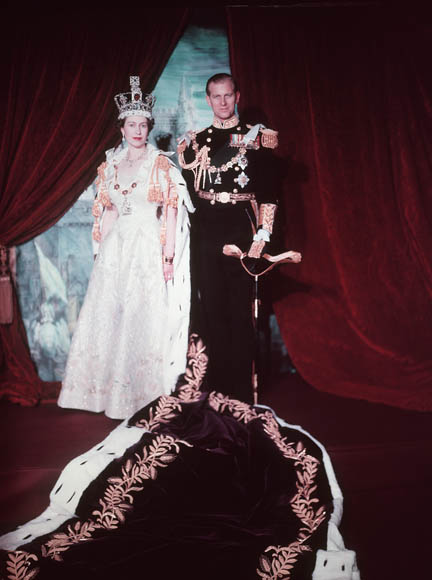
Via Wikimedia Commons: Coronation of Queen Elizabeth II 5 by Cecil Beaton, public domain.
Constitutional role
As sovereign she was head of state of the United Kingdom, which is a constitutional monarchy: the monarch is head of state, but the power to make and pass laws rests with an elected Parliament, and the sovereign no longer has a political or executive role.[11] The Royal Family's website distinguishes this formal role from a less formal one as "Head of Nation", a focus for national identity, stability and continuity.[11] In tributes after her death, the Speaker of the House of Commons, Sir Lindsay Hoyle, listed her roles as head of state, Head of the Commonwealth, head of the armed forces and Supreme Governor of the Church of England.[12]
Britannica describes her as taking a serious and informed interest in government business beyond her ceremonial duties.[3] She first opened Parliament on 4 November 1952.[3] According to the Speaker, she opened 57 complete sessions of Parliament, all but three of those held during her reign, and during her reign the House of Commons had ten Speakers and the country held 18 general elections.[12]
Fifteen United Kingdom prime ministers served during her reign, beginning with Winston Churchill in 1952.[1] The last, Liz Truss, was appointed on 6 September 2022, when, according to a Buckingham Palace statement reported by ITV News, the Queen accepted the resignation of Boris Johnson and asked Truss to form a new administration at Balmoral Castle.[13] Britannica notes that holding the appointment at Balmoral rather than at Buckingham Palace was a break with tradition.[3] The Royal Family's website also records that she welcomed more than 110 presidents and prime ministers on official visits during her reign.[1]
The Commonwealth and the realms
From Empire to Commonwealth
The modern Commonwealth took shape in the years just before her accession. At a conference of prime ministers in London in April 1949, attended by leaders of Australia, Britain, Canada, Ceylon (now Sri Lanka), India, New Zealand, Pakistan and South Africa, the London Declaration of 26 April 1949 allowed India to become a republic and stay in the association, no longer recognising the King as its head of state but recognising him as "Head of the Commonwealth".[14] The Royal Family's website notes that the title of Head of the Commonwealth is not vested in the Crown, meaning it does not pass automatically with the throne.[7]
During her reign the Commonwealth grew from seven nations to 56 members, representing more than 2.5 billion people.[7] Many former territories became independent during these years, and she and other members of the royal family often attended their independence celebrations.[7] The Commonwealth Secretariat recalls that in 1953 she described the Commonwealth as a partnership of nations bearing no resemblance to the empires of the past.[8]
She made more than 200 visits to Commonwealth countries, and visits to Commonwealth countries made up about a third of all her overseas visits.[7] From November 1953 she and the Duke of Edinburgh made a six-month tour of the Commonwealth, the first visit to Australia and New Zealand by a reigning British monarch.[3] She visited Canada 12 times and opened the Sydney Opera House in 1973.[7] She attended 22 Commonwealth Heads of Government Meetings (CHOGMs, the regular summits of Commonwealth leaders), and, according to the Commonwealth Secretariat, missed only one between 1971 and 2018.[7][8] Her last visit to a Commonwealth country, which was also her last overseas visit, was to Malta for CHOGM in 2015.[7] At the 2018 CHOGM in London, member countries agreed that her son, then Prince of Wales, would succeed her as Head of the Commonwealth.[7]
Her realms
The countries of which she was queen are known as Commonwealth realms; outside the United Kingdom she was represented in each by a governor-general.[7] The number changed over the reign. According to an Agence France-Presse (AFP) count published on 9 September 2022, she was queen of seven countries at her coronation in 1953, reached a peak of 18 at the same time between 1983 and 1987, and was head of state of 32 countries over the whole reign; 17 countries ended their ties with the monarchy after independence, most recently Barbados in 2021.[15] At her death she reigned over 15 realms: the United Kingdom, Antigua and Barbuda, Australia, the Bahamas, Belize, Canada, Grenada, Jamaica, New Zealand, Papua New Guinea, Saint Kitts and Nevis, Saint Lucia, Saint Vincent and the Grenadines, Solomon Islands and Tuvalu.[15] The Royal Family's website likewise refers to 14 Commonwealth realms outside the United Kingdom.[7]
Public events and milestones
Her reign included many overseas journeys beyond the Commonwealth. Britannica records that in 1961 she made the first royal British tour of the Indian subcontinent in 50 years, that she was the first reigning British monarch to visit South America (1968) and the Persian Gulf states (1979), and that in May 2011 she became the first British monarch to visit the Republic of Ireland and the first to set foot in Ireland since 1911.[3]
Britannica also records changes in how the monarchy presented itself: she allowed the royal family's domestic life to be televised in 1970 and agreed in 1992 to pay tax on her private income.[3] She called 1992 her "annus horribilis" (Latin for "horrible year"), a year in which, among other events, a fire damaged Windsor Castle.[3]
Jubilees
Her Silver Jubilee in 1977 marked 25 years on the throne.[16] On 4 May 1977 both Houses of Parliament presented loyal addresses to her at the Palace of Westminster, and six tours that year took her to 36 counties of the United Kingdom.[16] On 7 June she rode in the Gold State Coach to a service of thanksgiving at St Paul's Cathedral, and the Royal Family's website estimates that 500 million people watched on television.[16] The Silver Jubilee Appeal was set up that year to help young people serve their communities.[16]
The Golden Jubilee of 2002 marked 50 years of her reign; it included tours of Jamaica, New Zealand, Australia and Canada and of every region of the United Kingdom, an address to both Houses of Parliament in Westminster Hall, and concerts at Buckingham Palace; she also lit the National Beacon, the last of 2,006 beacons across the Commonwealth.[16] Britannica notes that the celebrations were dimmed by the deaths of her mother and sister earlier that year.[3]
The Diamond Jubilee of 2012 marked 60 years.[16] She and the Duke of Edinburgh visited every region of the United Kingdom that year, other members of the royal family visited every Commonwealth realm, and the celebrations included a pageant of up to 1,000 boats on the River Thames.[16] On 6 February 2017 she became the first British monarch to mark a Sapphire Jubilee, 65 years after her accession.[16]
On 6 February 2022 she became the first British monarch to celebrate a Platinum Jubilee, marking 70 years of service.[17] Its central celebrations took place over a four-day bank holiday weekend from 2 to 5 June 2022 and included Trooping the Colour, the lighting of more than 1,500 beacons, a service of thanksgiving at St Paul's Cathedral, a concert at Buckingham Palace and a pageant.[17]
Longest reign
On 9 September 2015 she passed the record reign of Queen Victoria, 63 years and 216 days, and became the longest-reigning monarch in British history.[3][16] She spent the day in an ordinary way, travelling by steam train to open the Scottish Borders Railway, and said in her speech there that it was a milestone "not one to which I have ever aspired".[16]
Assessments
Supporters and official bodies stressed her sense of duty and continuity. The Commonwealth Secretariat, in a tribute by its Secretary-General, Patricia Scotland, on 8 September 2022, credited her with duty, stability, wisdom and grace across seven decades of change, and said she had travelled more than any monarch in history.[8] In the House of Commons on 9 September 2022, the Speaker described a reign that saw great social, cultural and technological change.[12] The Royal Family's website records her links, as royal patron or president, with more than 500 charities, professional bodies and public service organisations.[1]
The monarchy also faced criticism during her reign. Britannica records that resentment of the royal family's lifestyle grew during the recession of the early 1990s, that criticism sharpened after the death of Diana, Princess of Wales, in 1997, particularly because the Queen at first declined to have the national flag flown at half-mast over Buckingham Palace, and that some came to see the monarchy as antiquated and unfeeling; it adds that her later efforts to present a less formal image met with mixed success.[3]
Death and succession
The Queen died at Balmoral Castle in Aberdeenshire, Scotland, on the afternoon of Thursday 8 September 2022, aged 96.[18][3][10] Royal Communications announced that she had "died peacefully at Balmoral this afternoon".[18] The announcement was made at 6.30 p.m., after both Houses of Parliament had risen for the day.[19] Her reign had lasted just over 70 years.[1][8]
Her eldest son succeeded immediately as King Charles III.[3][10][21] The Accession Council met at St James's Palace at 10 a.m. on Saturday 10 September 2022, and the principal proclamation was read there at 11 a.m.[10] Both Houses of Parliament met on 9 and 10 September to pay tribute, and their addresses of condolence were presented to the King in Westminster Hall on 12 September 2022.[19][12]
Her coffin lay at St Giles' Cathedral in Edinburgh from 11 to 13 September 2022, and then lay in state in Westminster Hall, London, from the late afternoon of 14 September until the early hours of 19 September.[19] About 250,000 people filed past the coffin in Westminster Hall, and at its longest the queue stretched for 10 miles.[19] The state funeral was held at Westminster Abbey at 11 a.m. on Monday 19 September 2022, with about 2,000 people attending, including heads of state and government; Britannica puts the number of foreign heads of government present at about 100.[20][19][3] A committal service followed at St George's Chapel, Windsor, at 4 p.m., and she was buried privately that evening in the King George VI Memorial Chapel there.[20][3]
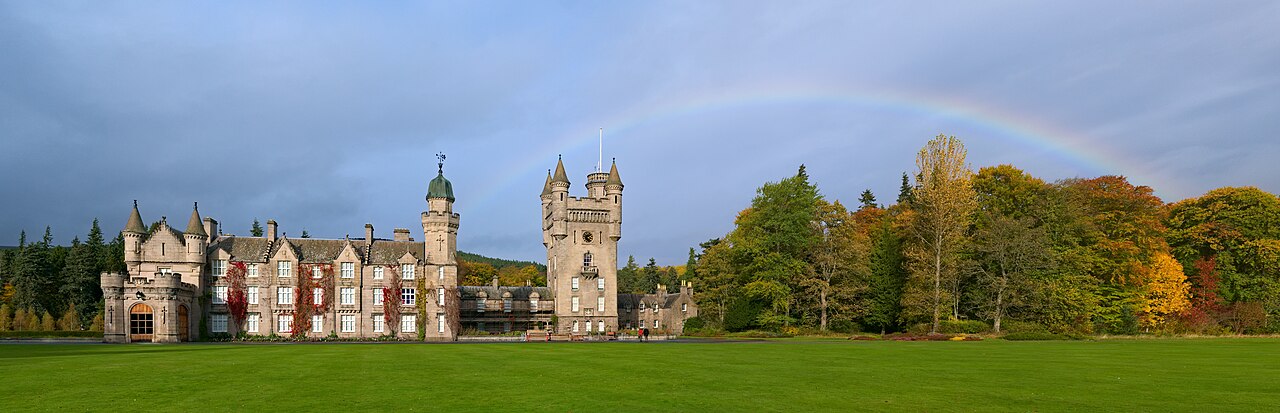
Via Wikimedia Commons: Balmoral Castle panorama 20211026 by Daniel Kraft, CC BY-SA 3.0.
Sources
1. The Royal Family. "Queen Elizabeth II's Life and Reign." royal.uk. No date shown; accessed 24 November 2026. royal.uk/queen-elizabeth-iis-life-and-reign
2. The Royal Family. "Early life and education." royal.uk. No date shown; accessed 24 November 2026. royal.uk/the-queens-early-life-and-education
3. The Editors of Encyclopaedia Britannica. "Elizabeth II." Encyclopaedia Britannica. Page dated 5 June 2025; accessed 24 November 2026. britannica.com/biography/Elizabeth-II
4. UK Parliament. His Majesty's Declaration of Abdication Act 1936 (1 Edw. 8 & 1 Geo. 6 c. 3), introduction and section 1. legislation.gov.uk (The National Archives). 11 December 1936. legislation.gov.uk/ukpga/Edw8and1Geo6/1/3/introduction?view=plain and legislation.gov.uk/ukpga/Edw8and1Geo6/1/3/section/1
5. Imperial War Museums. "Why Queen Elizabeth Signed Up In The Second World War." IWM. No date shown; accessed 24 November 2026. iwm.org.uk/history/why-queen-elizabeth-signed-up-in-the-second-worl…
6. Royal Collection Trust. "HM Queen Elizabeth II (b. 1926) when Princess, as a member of the Auxiliary Territorial Service, April 1945" (RCIN 2999896), from An Exhibition of Photographs to Celebrate the 80th Birthday of HM The Queen. rct.uk. No date shown; accessed 24 November 2026. rct.uk/collection/exhibitions/an-exhibition-of-photographs-to-celeb…
7. The Royal Family. "Queen Elizabeth II and the Commonwealth." royal.uk. No date shown; accessed 24 November 2026. royal.uk/queen-elizabeth-ii-and-the-commonwealth
8. Patricia Scotland, Commonwealth Secretary-General. "Her Late Majesty Queen Elizabeth II." Commonwealth Secretariat, 8 September 2022. thecommonwealth.org/her-late-majesty-queen-elizabeth-ii
9. The Royal Family. "Queen Elizabeth II's Accession and Coronation." royal.uk. No date shown; accessed 24 November 2026. royal.uk/queen-elizabeth-iis-accession-and-coronation
10. Privy Council Office. "The Accession Council." privycouncil.independent.gov.uk. Last modified 12 May 2026; accessed 24 November 2026. privycouncil.independent.gov.uk/privy-council/the-accession-council/
11. The Royal Family. "The role of the Monarchy." royal.uk. No date shown; accessed 24 November 2026. royal.uk/the-role-of-the-monarchy
12. UK Parliament. "MPs pay tribute to Her Majesty Queen Elizabeth II." parliament.uk, 9 September 2022. parliament.uk/business/news/2022/september-2022/mps-pay-tribute-to-…
13
