Compare versions
Version 1 → Version 2. Removed · Added. This shows the entry's text as it is written, including its formatting marks.
Version 1 · Version 2 · Version history
Side by side · Together
Elvis Aaron Presley (1935–1977) was an American singer and film actor whose blend of country music and rhythm and blues made him a central figure in the birth of rock and roll in the 1950s.[1][7]
## Early life in Tupelo
Presley was born on 8 January 1935 in East Tupelo, Mississippi, in a two-room house that his father, Vernon Presley, had built with an uncle.[3][4] His parents were Vernon and Gladys Presley.[2][3] He was a twin, but his brother, Jesse Garon, was stillborn, and Elvis grew up as an only child.[2][3] The Mississippi Department of Archives and History notes that he later changed the spelling of his middle name from Aaron to Aron to match his twin's middle name more closely.[3] Encyclopaedia Britannica records both spellings among the names by which he is known.[1]
The family was poor.[1][4] In 1938 they lost the house when Vernon was sent to the Parchman state prison farm for about eight months for altering a four-dollar check, and they then rented a series of homes around Tupelo.[3] The family attended the Assembly of God church, where Elvis's interest in music grew.[3][4] He also heard Black blues musicians in his neighbourhood and the country music that his family listened to on the radio.[4]
On 3 October 1945, aged ten, he sang "Old Shep" in a youth talent contest at the Mississippi-Alabama Fair and Dairy Show in Tupelo, which was broadcast on the local radio station WELO; he won fifth prize, five dollars' worth of ride tickets.[4] The following year his mother persuaded him to accept a guitar, bought for $12.95 at the Tupelo Hardware Company, instead of the bicycle he had wanted.[3][4]
## Memphis and Sun Records
In November 1948 the family moved to Memphis, Tennessee, carrying their belongings in their car.[3][4] They lived in public housing and low-rent homes in north Memphis, and Elvis took jobs to help support the household.[4] He attended L.C. Humes High School, where he won the most applause at a student talent show, and graduated on 3 June 1953.[2][4] In Memphis he also absorbed the blues and gospel he heard on Beale Street and at all-night gospel sings.[2][4] After school he worked at a machinist's shop and then drove a truck for Crown Electric.[3][4]
In the summer of 1953 he paid a few dollars to record "My Happiness" and "That's When Your Heartaches Begin" at the Memphis Recording Service, the studio that was home to Sam Phillips's Sun Records label; Phillips's assistant, Marion Keisker, noted him as a "good ballad singer".[3][4] On 5 July 1954 Presley returned to the studio and, with the guitarist Scotty Moore and the bassist Bill Black, recorded a fast version of Arthur Crudup's blues song "That's All Right".[1][5] When the Memphis disc jockey Dewey Phillips first played it on WHBQ radio on 8 July 1954, listeners demanded it again and again.[5] Sun released five Presley singles over the following year, ending with "Mystery Train" in August 1955.[1] The Sun recordings also included his version of Bill Monroe's bluegrass song "Blue Moon of Kentucky".[6]
Presley first appeared on the Louisiana Hayride, a country music radio show, on 16 October 1954.[1][3] In 2002 the Library of Congress chose his Sun Records sessions of 1954–1955 for the first group of recordings in its National Recording Registry, describing them as the recordings that launched his career and helped to create the rock and roll era.[6]
## RCA and national fame
"Colonel" Tom Parker became Presley's manager, and in late 1955 his recording contract was sold to RCA Victor.[1][2][7] Britannica reports that Sun received $35,000 and Presley $5,000 in the deal, which also sold his song catalogue to the publisher Hill and Range.[1] He then recorded at RCA's studios in Nashville.[1]
"Heartbreak Hotel", released in 1956, was the first of many million-selling hits, and it was followed that year by "Don't Be Cruel" and "Love Me Tender", and in 1957 by "All Shook Up".[1][7] By 1956, according to Graceland, he was "an international sensation".[2] His television appearances drew very large audiences: he appeared six times on the variety programme *Stage Show* in 1956, and Ed Sullivan paid him $50,000 for three appearances on his Sunday night show.[8] His first Sullivan appearance, on 9 September 1956, was watched by about 60 million people.[3] His stage manner, including the movement of his hips, drew intense devotion from young fans, particularly young women.[7]
In March 1957 he bought Graceland, a house in Memphis, for $102,500.[17]
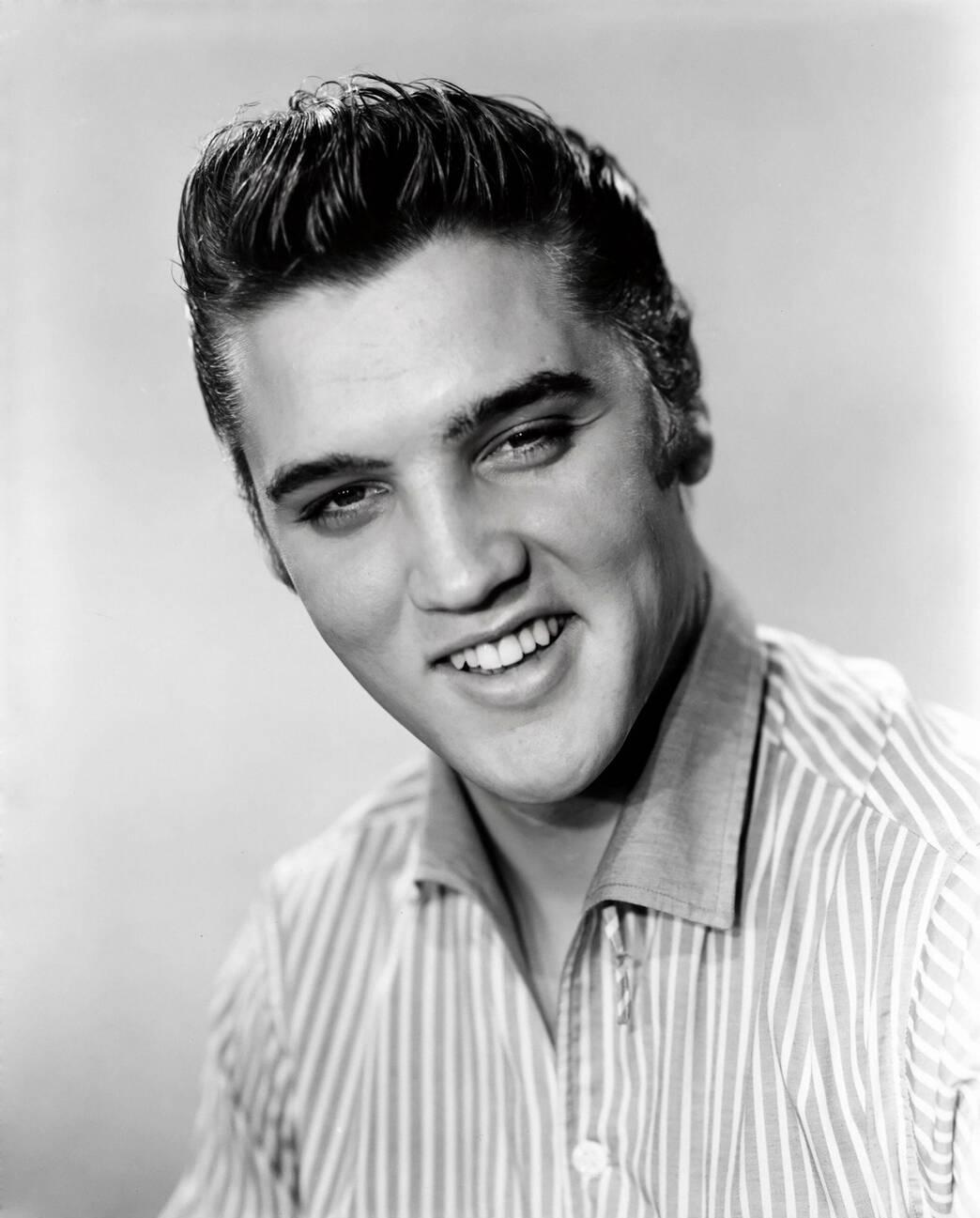
*Via Wikimedia Commons: [Elvis Presley Publicity Photo, 1956](https://commons.wikimedia.org/wiki/File:Elvis_Presley_Publicity_Photo,_1956.jpg) by Edward Roth, public domain.*
## Army service
Presley received his draft notice at home in Memphis on 20 December 1957 and was granted a deferment of about two months so that he could finish the film *King Creole*.[10] He was sworn into the United States Army at Memphis on 24 March 1958 and spent three days at the reception station at Fort Chaffee, Arkansas.[9][10] He chose to serve as a regular soldier rather than join the Special Services, the Army's entertainment branch.[13]
From 28 March to 17 September 1958 he served with Company A, 2nd Medium Tank Battalion, 37th Armor, at Fort Hood, Texas, where he completed his basic and advanced training.[9] From 1 October 1958 to 2 March 1960 he served in West Germany with the 1st Medium Tank Battalion, 32nd Armor, mostly in its headquarters company at Friedberg, wearing the insignia of the 3rd Armored Division.[9][12] The Army News Service describes him as an armor intelligence specialist who was promoted to sergeant before his discharge.[11] In Germany he met Priscilla Beaulieu, the daughter of a US Air Force officer.[1][13] He left active duty at Fort Dix, New Jersey, on 5 March 1960, and his discharge from the Army Reserve followed on 23 March 1964.[9][12]
## Film career
Presley's first film, *Love Me Tender*, in which he played Clint Reno, the younger brother of a Confederate soldier, premiered at the Paramount Theater in New York on 15 November 1956.[14] Altogether he starred in 31 feature films and appeared in two theatrically released concert documentaries.[8][14][17] After his return from the Army he resumed both recording and acting, and his films of the 1960s ran from *Blue Hawaii* (1961) to his last feature, *Change of Habit*.[1][7][14] Eleven of his soundtrack albums reached the top ten, and four reached number one; *Blue Hawaii* spent 20 weeks at number one.[8] Britannica's summary describes most of the films as mediocre, while Graceland singles out *Jailhouse Rock* and *King Creole* as critically acclaimed.[7][8]
## Marriage and family
Presley married Priscilla Beaulieu in 1967, and their daughter, Lisa Marie Presley, was born in 1968.[1][13] The couple separated in 1972 and divorced the following year.[1]
## Television comeback and Las Vegas
In December 1968 he starred in a one-man Christmas television special, *Elvis*, which Graceland lists among the most highly rated specials of its time.[1][8] In 1969 he played a 57-show engagement at the International Hotel in Las Vegas that broke the city's attendance records, and "Suspicious Minds" became that year his last number-one single.[1][8] Britannica's summary describes the act he built from Las Vegas, backed by an orchestra and a gospel-style choir.[7] Between 1969 and 1977 he gave nearly 1,100 concerts, including six shows at the Houston Astrodome in 1970 seen by 207,494 people and four sold-out shows at Madison Square Garden in New York in 1972.[8] His 1973 television special *Aloha from Hawaii*, transmitted by satellite, was reported to have been seen by more than a billion people in some 40 countries.[8][24]
On 21 December 1970 he delivered a handwritten letter at the northwest gate of the White House asking to meet President Richard Nixon and to receive the credentials of a federal agent in the campaign against drugs; Nixon met him in the Oval Office the same day.[15][16] The National Archives, which holds the photographs, letters and memos from the visit, has made them the subject of an online exhibit.[15]
## Death
On 16 August 1977, the night before he was due to begin another concert tour, Presley was found unresponsive at Graceland at about 2:30 p.m.[1][20][21] He was taken to Baptist Memorial Hospital in Memphis, where he was pronounced dead at about 3:30 p.m.; he was 42.[2][20][21] The Shelby County medical examiner, Dr. Jerry Francisco, announced that evening that early tests pointed to cardiac arrhythmia (an irregular heartbeat), and this was recorded as the official cause.[20][21] Graceland's own account gives the cause as heart failure.[17] Toxicology tests later found a number of prescription drugs in his body, and Britannica states that the heart attack that killed him was brought on largely by drug abuse.[1][20][21]
His body lay in state at Graceland, where more than 20,000 people came to pay their respects.[22] After the funeral on 18 August 1977 he was entombed beside his mother at Forest Hill Cemetery in Memphis, but after an attempt to steal his coffin was foiled, his remains and his mother's were moved to Graceland.[21] He is buried in the garden behind the house, where his parents also lie.[22]
## Graceland
Graceland was Presley's main home for 20 of the 23 years of his career.[19] It opened to the public for tours in 1982.[1][18][19] It was listed on the National Register of Historic Places in 1991, and on 27 March 2006 the Secretary of the Interior, Gale Norton, designated it a National Historic Landmark; the Department of the Interior then described it as one of the five most visited home museums in the United States.[8][19] Fans gather there every August to mark the anniversary of his death.[1]
## Recordings and honours
Presley's music drew on pop and country music, gospel, and rhythm and blues.[2][7] He received 14 Grammy nominations and won three Grammy Awards, all for gospel recordings: the album *How Great Thou Art* (1967), the album *He Touched Me* (1972) and a live recording of "How Great Thou Art" made in Memphis in 1974.[8] The National Academy of Recording Arts and Sciences gave him its Lifetime Achievement Award (then called the Bing Crosby Award) in 1971, when he was 36.[2][8] Six of his recordings, including "That's All Right", "Heartbreak Hotel", "Hound Dog" and "Suspicious Minds", have been inducted into the Grammy Hall of Fame.[8]
Graceland states that he has sold more than a billion records worldwide, more than any other artist; no date is given for this estimate.[2][8][17] In 2018, on the 60th anniversary of its Gold and Platinum awards programme, the Recording Industry Association of America (RIAA), which certifies US sales, listed him as the second most certified solo artist in the programme's history, with 101 albums certified gold or higher, 146.5 million album units, and more gold album awards than any other artist; his first gold award was for "Hard Headed Woman" in 1958.[23]
He was among the first group of performers inducted into the Rock and Roll Hall of Fame in 1986, presented by Sean and Julian Lennon.[8][12] He was later inducted into the Country Music Hall of Fame (1998) and the Gospel Music Hall of Fame (2001), becoming, according to Graceland, the first artist in all three.[8] The US Postal Service issued an Elvis Presley stamp on 8 January 1993.[8]
On 16 November 2018 President Donald Trump awarded him the Presidential Medal of Freedom, posthumously, at a ceremony in the East Room of the White House.[24][25] The White House citation credited him with fusing gospel, country and rhythm and blues into a sound of his own and noted his nearly two years of Army service.[25]
## Legacy
The Rock and Roll Hall of Fame calls Presley "the first anointed King of Rock & Roll" and credits him with bringing Black-influenced music to a mass mainstream audience.[12] It quotes John Lennon as saying, "Without Elvis, there would be no Beatles."[12] Britannica describes him as a central figure in the mid-1950s merging of country music and rhythm and blues that created rock.[7]
## Sources
1. Dave Marsh and the Editors of Encyclopaedia Britannica. "Elvis Presley." Encyclopaedia Britannica. No date shown; accessed 24 November 2026. https://www.britannica.com/biography/Elvis-Presley
2. "Elvis Biography." Elvis Presley's Graceland (Elvis Presley Enterprises). No date shown; accessed 24 November 2026. https://www.graceland.com/biography
3. Christine Wilson. "Elvis Presley: The Early Years." Mississippi History Now, Mississippi Department of Archives and History. No date shown; accessed 24 November 2026. https://www.mshistorynow.mdah.ms.gov/articles/32/elvis-presley-the-early-years
4. "Elvis: Early Childhood" (1935–1953 timeline). Elvis Presley's Graceland. No date shown; accessed 24 November 2026. https://www.graceland.com/early-childhood
5. "Special Events and Exhibits Planned to Celebrate 60 Years of Rock 'n' Roll on July 5." Elvis Presley's Graceland. 24 June 2014. https://www.graceland.com/elvis-news/posts/special-events-and-exhibits-planned-to-celebrate-60-years-of-rock-n-roll-on-july-5
6. "National Recording Registry: 2002." National Recording Preservation Board, Library of Congress. No date shown; accessed 24 November 2026. https://www.loc.gov/programs/national-recording-preservation-board/recording-registry/registry-by-induction-years/2002/
7. "Elvis Presley summary." Encyclopaedia Britannica. No date shown; accessed 24 November 2026. https://www.britannica.com/summary/Elvis-Presley
8. "Elvis' Achievements." Elvis Presley's Graceland. No date shown; accessed 24 November 2026. https://www.graceland.com/achievements
9. "What is the history of Elvis Presley's military career?" US Army Center of Military History. No date shown; accessed 24 November 2026. https://www.history.army.mil/faq/elvis.htm
10. Gideon Rogers. "'Soldier for Life' jumped out of airplanes before Elvis Presley received his draft notice." US Army (army.mil). 14 December 2022. https://www.army.mil/article/261830/soldier_for_life_jumped_out_of_airplanes_before_elvis_presley_received_his_draft_notice
11. Sgt. Woodlyne Escarne. "The Army at 250: Fame and valor." Army News Service (army.mil). 3 July 2025. https://www.army.mil/article/286833/the_army_at_250_fame_and_valor
12. "Elvis Presley." Rock & Roll Hall of Fame (inductee page, with 1986 essay by Lenny Kaye). No date shown; accessed 24 November 2026. https://rockhall.com/inductees/elvis-presley/
13. The Editors of Encyclopaedia Britannica. "Did Elvis Presley Join the Army?" Encyclopaedia Britannica. No date shown; accessed 24 November 2026. https://britannica.com/topic/Did-Elvis-Presley-Join-the-Army
14. HISTORY.com Editors. "Elvis makes movie debut in 'Love Me Tender'." HISTORY (A&E Television Networks). 13 November 2009, updated 10 November 2026. https://www.history.com/this-day-in-history/november-15/elvis-makes-movie-debut-in-love-me-tender
15. "When Nixon Met Elvis." US National Archives and Records Administration (online exhibit). No date shown; accessed 24 November 2026. https://www.archives.gov/exhibits/nixon-met-elvis/main.php
16. "When Nixon Met Elvis: The Letter" (exhibit page 1). US National Archives and Records Administration. No date shown; accessed 24 November 2026. https://www.archives.gov/exhibits/nixon-met-elvis/page-1.html
17. "Elvis Presley FAQ." Elvis Presley's Graceland. No date shown; accessed 24 November 2026. https://www.graceland.com/elvis-faq
18. "Graceland." Encyclopaedia Britannica. No date shown; accessed 24 November 2026. https://www.britannica.com/topic/Graceland-building-Memphis-Tennessee
19. "Secretary Norton Designates Elvis Presley's Graceland Mansion National Historic Landmark." US Department of the Interior (news release). 27 March 2006. https://www.doi.gov/sites/default/files/archive/news/archive/06_News_Releases/060327.htm
20. Gregory Wakeman. "How Did Elvis Presley Die?" HISTORY (A&E Television Networks). 19 February 2026. https://www.history.com/articles/elvis-presley-death-cause
21. "Elvis Presley's death, 40 years later" (headline as shown in search results). Biography.com. No date or byline shown; accessed 24 November 2026. https://www.biography.com/news/elvis-presley-death-40-years-later
22. Cydney Adams. "August 16, 1977: Elvis Presley dies in Graceland bathroom." CBS News. 16 August 2016. https://www.cbsnews.com/news/on-this-day-august-16-1977-elvis-presley-drops-dead-in-graceland-memphis-bathroom
23. "Gold & Platinum Turns 60!" Recording Industry Association of America. 2018 (copyright date shown); accessed 24 November 2026. https://www.riaa.com/goldandplatinum60/
24. "Remarks on Presenting the Presidential Medal of Freedom." Daily Compilation of Presidential Documents, DCPD-201800792, US Government Publishing Office. 16 November 2018. https://www.govinfo.gov/content/pkg/DCPD-201800792/html/DCPD-201800792.htm
25. "President Donald J. Trump Names Recipients of the Presidential Medal of Freedom." The White House (archived). 10 November 2018. https://trumpwhitehouse.archives.gov/briefings-statements/president-donald-j-trump-names-recipients-presidential-medal-freedom/
