The September 11 attacks were four coordinated suicide hijackings of American airliners on 11 September 2001, in which al-Qaeda operatives struck the World Trade Center in New York and the Pentagon near Washington, D.C., while a fourth plane crashed in Pennsylvania.[1][2][8]
Overview
On the morning of 11 September 2001, 19 hijackers took control of four commercial airliners that had left airports in Boston, Newark and the Washington area.[1][2] Two of the aircraft were flown into the twin towers of the World Trade Center in New York City, one into the Pentagon in Arlington, Virginia, and the fourth crashed near Shanksville, Pennsylvania, after its passengers tried to retake it.[1][2] The National September 11 Memorial & Museum counts 2,977 people killed at the three sites: 2,753 in New York, 184 at the Pentagon and 40 on Flight 93.[8] The final report of the National Commission on Terrorist Attacks Upon the United States, known as the 9/11 Commission, opens by describing the attacks as the moment when "the United States became a nation transformed".[2]
The four flights
The 9/11 Commission's report gives a minute-by-minute account of the four flights, and the times below are taken from it.[1]
American Airlines Flight 11. The flight, a nonstop service from Boston to Los Angeles, took off from Boston at 7:59 a.m. with two pilots, nine flight attendants and 81 passengers, five of whom were hijackers.[1] The Commission places the start of the hijacking at about 8:14, and at 8:46:40 the aircraft was flown into the North Tower of the World Trade Center.[1]
United Airlines Flight 175. Also bound for Los Angeles, Flight 175 left Boston at 8:14 with two pilots, seven flight attendants and 56 passengers; five hijackers were on board.[1] The Commission concludes that the hijacking took place between 8:42 and 8:46, and the plane struck the South Tower at 9:03:11.[1]
American Airlines Flight 77. This flight took off from Washington Dulles International Airport for Los Angeles at 8:20 with two pilots, four flight attendants and 58 passengers; five hijackers were on board.[1] It was taken over between 8:51 and 8:54 and was flown into the Pentagon at 9:37:46.[1]
United Airlines Flight 93. Flight 93, bound for San Francisco, left Newark at 8:42, later than scheduled, with two pilots and five flight attendants; four hijackers were on board.[1] The National Park Service, which manages the crash site, records 33 passengers and seven crew members among those killed, in addition to the four hijackers.[10] The Commission dates the hijacking to 9:28.[1] According to the National Park Service, the passengers and crew learned through telephone calls that their plane was part of a wider attack and reached a "collective decision" to try to stop the hijackers.[10] According to the Commission, the passengers' assault began at 9:57, and the plane crashed at Shanksville at 10:03:11, about 20 minutes' flying time from Washington.[1] The Commission concluded that the hijackers had intended to strike "the Capitol or the White House".[1]
Collapse of the towers
The South Tower, the second to be hit, was the first to fall: it collapsed at 9:58:59, in about ten seconds.[3] The North Tower collapsed at 10:28:25.[3] The Commission notes that up to 50,000 office workers could occupy the towers on a working day, and that one chief estimated between 25,000 and 50,000 civilians were in them that morning.[3] It describes the evacuation as relatively calm and orderly, with first responders helping thousands of civilians out of the buildings.[3]
The National Institute of Standards and Technology (NIST), a federal agency, investigated the collapses.[22][24] Its final report on the towers, released in 2005, explains how the aircraft impacts and the fires that followed led to their collapse, and ends with 30 recommendations on matters such as structural integrity, fire resistance, evacuation and emergency response.[22][24] A separate NIST report, published on 20 November 2008, found that 7 World Trade Center, another building in the complex, collapsed because of fires that followed the impact of debris from the North Tower's collapse.[23][24]
Perpetrators
The 9/11 Commission found that the attacks were carried out by 19 young Arabs acting for Islamist extremists based in Afghanistan, that they were "driven by Usama Bin Ladin", and that the organisation behind them was al-Qaeda.[2] According to the Commission, Khalid Sheikh Mohammed brought Bin Ladin the idea for what was called the "planes operation", which Bin Ladin and his advisers later agreed to pursue.[2] The Commission estimated that the plot cost between $400,000 and $500,000 to carry out.[2]
The Federal Bureau of Investigation (FBI) named its investigation PENTTBOM, short for "Pennsylvania, Pentagon, and Twin Towers Bombing".[7] The FBI states that all 19 hijackers were trained by al-Qaeda, and that three of the suspected pilots, Mohamed Atta, Marwan al-Shehhi and Ziad Jarrah, belonged to an al-Qaeda cell in Hamburg, Germany.[7] Fifteen of the hijackers came from Saudi Arabia, two from the United Arab Emirates, one from Egypt and one from Lebanon.[7] The hijackers began entering the United States in January 2000, and all 19 were in the country by early July 2001.[7] The FBI reports that it followed up more than 500,000 leads and carried out more than 167,000 interviews, with more than 4,000 special agents and 3,000 other employees taking part in the recovery and investigation.[7]
Casualties
The July 2021 media backgrounder of the National September 11 Memorial & Museum states that the attacks killed 2,977 people: 2,753 in New York, 184 at the Pentagon and 40 on Flight 93.[8] The memorial in New York bears 2,983 names, because it also honours the six people killed in the bombing of the World Trade Center on 26 February 1993.[8]
The 9/11 Commission's account of the Pentagon gives a breakdown: all 64 people aboard Flight 77 were killed, as were 125 people inside the building, 70 of them civilians and 55 military service members.[3] The 64 aboard included the five hijackers, which accounts for the difference from the Memorial's figure of 184.[1][3][8] In the same way, the Memorial's figure of 40 for Flight 93 matches the 33 passengers and seven crew members whom the National Park Service lists separately from the four hijackers.[8][10]
Emergency response and losses among first responders
In New York the main responding agencies were the Fire Department of the City of New York (FDNY), the New York City Police Department (NYPD) and the Port Authority Police Department (PAPD).[3] The Commission records that the FDNY lost 343 members, the PAPD 37 and the NYPD 23.[3] The 9/11 Memorial & Museum counts 441 first responders, from more than 30 agencies, who died on 11 September.[8] At the Pentagon, the Arlington County Fire Department served as incident commander, the official in overall charge of the response at the scene.[3] The FBI sent more than 1,000 employees to the New York sites, 155 to the Pentagon and 152 to Pennsylvania.[7]
The Commission found that the Federal Aviation Administration (FAA) and the North American Aerospace Defense Command (NORAD), which is responsible for defending North American airspace, were unprepared for this kind of attack.[1] Their procedures assumed that a hijacked aircraft would be identifiable, that there would be time to respond through normal chains of command, and that a hijacking would follow the traditional pattern rather than be a suicide attack.[1] The Commission describes the air defence response that morning as improvised.[1]
Immediate aftermath
At 9:42 a.m. the FAA's Command Center ordered all its facilities to instruct every aircraft to land at the nearest airport, and about 4,500 aircraft then landed without incident.[1] According to the Commission, the national airspace reopened on 13 September for airports that met newly improvised security standards.[4] That morning President George W. Bush was at the Emma E. Booker Elementary School in Sarasota, Florida, where he was to read to a class.[1]
On 18 September 2001 the Authorization for Use of Military Force (Public Law 107-40), a joint resolution of Congress, became law.[13] It authorised the President to use force against nations, organisations or persons he determined had "planned, authorized, committed, or aided" the attacks, or had harboured them, in order to prevent future acts of international terrorism against the United States.[13] Addressing Congress on 20 September, Bush said that the country had been "awakened to danger".[4] Strikes and raids in Afghanistan began on 7 October 2001, in an operation that became known as Enduring Freedom; after the fall of Mazar-e-Sharif on 9 November, the Taliban fled Kabul four days later.[4]
The 9/11 Commission
The National Commission on Terrorist Attacks Upon the United States was created by Congress and the President under Public Law 107-306 of 27 November 2002.[5] It was chaired by Thomas H. Kean, with Lee H. Hamilton as vice chair, and its ten members were five Republicans and five Democrats.[2][5] Its mandate was to investigate the "facts and circumstances relating to the terrorist attacks of September 11, 2001", including intelligence and law enforcement, diplomacy, immigration and border control, terrorist financing and commercial aviation.[5]
The Commission's final report is dated 22 July 2004, and GovInfo, the Government Publishing Office's website, states that its edition is the only official U.S. Government edition.[6] The commissioners presented the report without dissent.[2] It found failures of policy, capabilities and management, but judged that "the most important failure was one of imagination".[2] Among its recommendations were a National Counterterrorism Center to bring together intelligence and planning against Islamist terrorism, and a National Intelligence Director to oversee the intelligence agencies.[2] The Commission closed on 21 August 2004.[2]
Department of Homeland Security
On 25 November 2002 President Bush signed the Homeland Security Act of 2002 (Public Law 107-296), which created the Department of Homeland Security.[14] At the signing he said that dozens of agencies with homeland security duties would be brought into one Cabinet department of nearly 170,000 employees, and called it the most extensive reorganisation of the federal government since Harry Truman signed the National Security Act.[14] According to the department, it began operating on 24 January 2003, most of its component agencies moved into it on 1 March 2003, and at least 22 agencies were combined to form it.[15]
Compensation and health programmes
The September 11th Victim Compensation Fund (VCF) was first set up to compensate people who were physically harmed or killed in the aircraft crashes or in the debris removal that followed, and operated from 2001 to 2004.[16] The James Zadroga 9/11 Health and Compensation Act of 2010, signed on 2 January 2011, reactivated the fund, which reopened in October 2011.[16] A reauthorisation signed on 18 December 2015 extended the period for claims to December 2020 and added $4.6 billion.[16] The Never Forget the Heroes Act (Public Law 116-34), approved on 29 July 2019, set a new deadline for claims of 1 October 2090 and authorised funding through fiscal year 2092.[17] In its 2025 annual report the VCF stated that it had awarded more than $16.8 billion to over 71,000 claimants since reopening, including nearly $2 billion in 2025.[18] As of 31 October 2026, the VCF's monthly report counted 114,415 claims submitted, 78,696 initial compensation decisions, and $18.95 billion awarded in total.[19]
The World Trade Center Health Program, run by the National Institute for Occupational Safety and Health (NIOSH), part of the Centers for Disease Control and Prevention, was established by the Zadroga Act, extended in 2015 and is authorised until 2090.[20] It serves responders and survivors from the World Trade Center and related sites in New York, and responders from the Pentagon and Shanksville sites.[20] As of 30 September 2026, the programme's quarterly summary counted 147,137 living members enrolled.[21]
Memorials
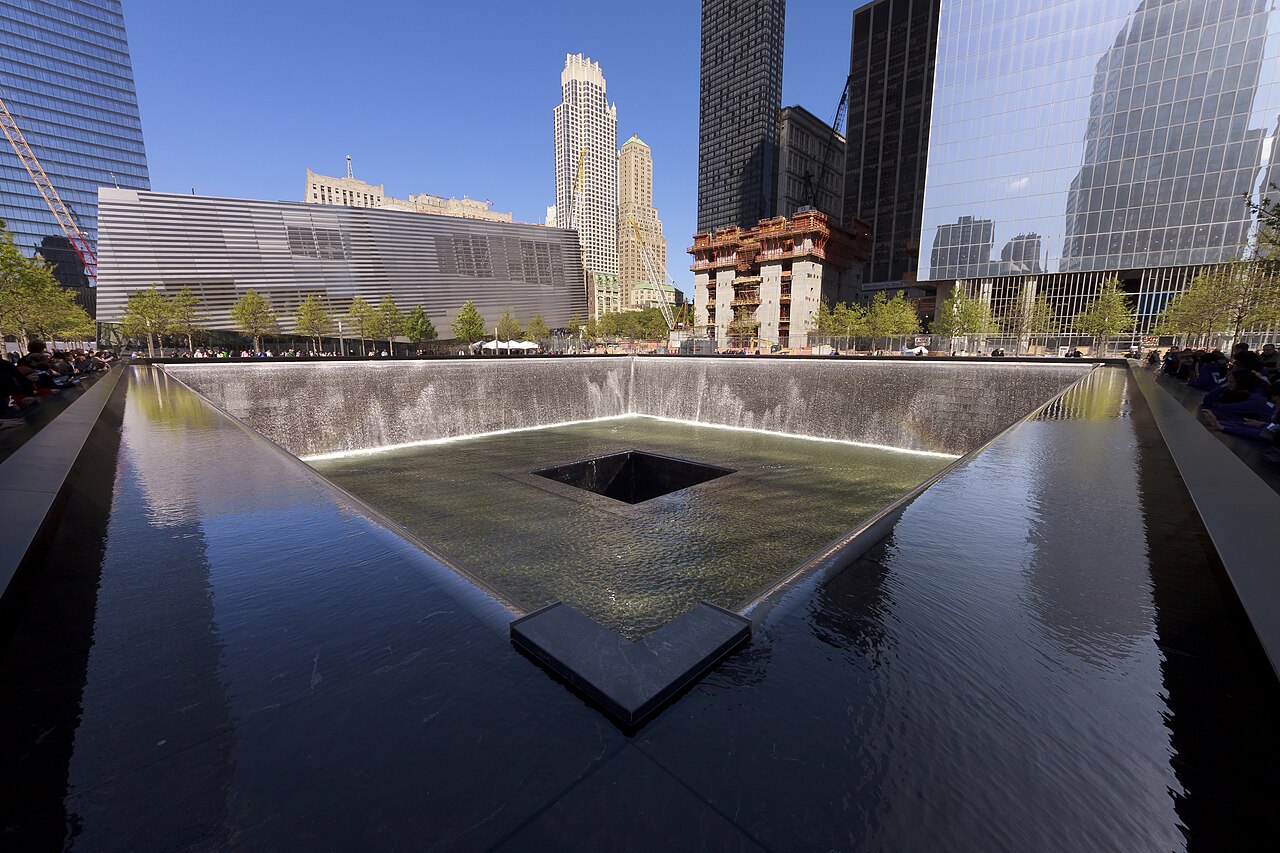
One of the two reflecting pools of the National September 11 Memorial in New York, set in the footprint of a twin tower and edged with the victims' names.
The National September 11 Memorial, designed by Michael Arad and Peter Walker, consists of two reflecting pools, each about an acre in size, set in the footprints of the twin towers and surrounded by waterfalls about 30 feet high.[8] It was dedicated to victims' families on the tenth anniversary, 11 September 2011, and opened to the public the next day.[8] The memorial also includes the "Survivor Tree", a callery pear found badly damaged at the site in October 2001, which was restored by the city's parks department and returned to the memorial in 2010.[8] The 9/11 Memorial Museum was dedicated on 15 May 2014, at a ceremony at which President Barack Obama spoke, and opened to the general public on 21 May 2014.[9]
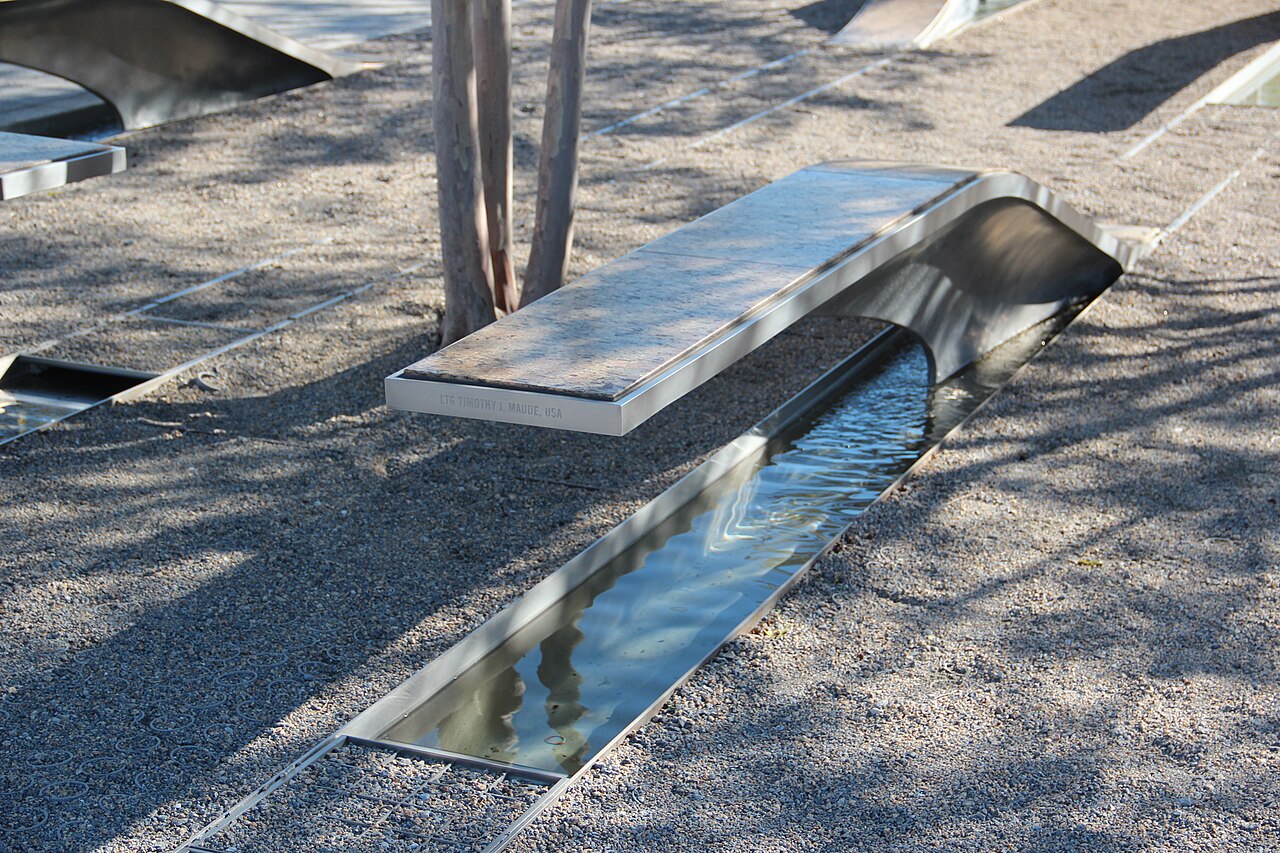
Rows of memorial benches at the Pentagon Memorial in Arlington, Virginia, each bearing the name of a person killed in the attack on the Pentagon.
The Pentagon Memorial was dedicated on 11 September 2008, the seventh anniversary of the attacks, with President Bush attending.[12] It consists of 184 benches, each bearing the name of one of the people killed when Flight 77 struck the Pentagon.[12]
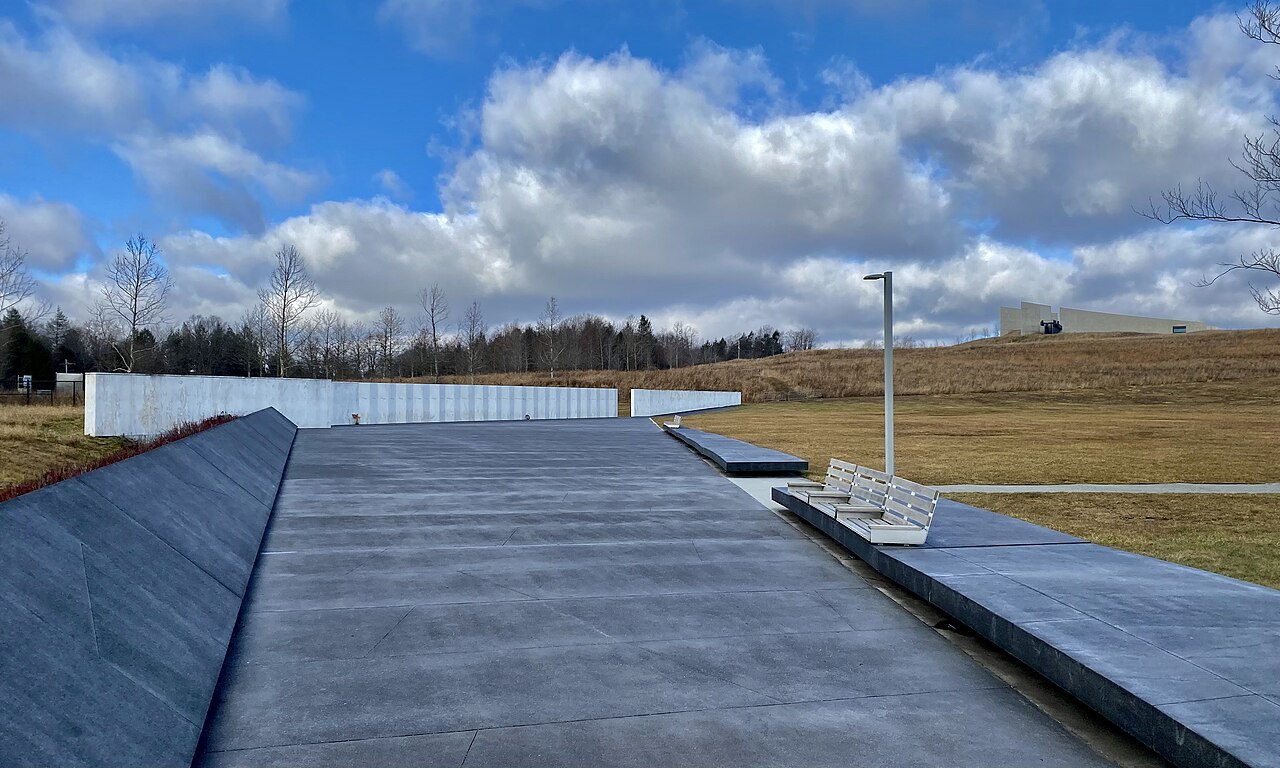
The Wall of Names at the Flight 93 National Memorial near Shanksville, Pennsylvania.
The Flight 93 National Memorial near Shanksville was created by the Flight 93 National Memorial Act, which Congress passed on 24 September 2002 and President Bush signed.[10] It is managed by the National Park Service to honour the passengers and crew and to mark the crash site as their final resting place.[10] Its first features, including the Memorial Plaza, were dedicated on 10 September 2011, the visitor centre complex on 10 September 2015, and the Tower of Voices on 9 September 2018.[11]
Later developments
Osama bin Laden was killed in a raid led by U.S. Navy SEALs at Abbottabad, Pakistan, which the Barack Obama Presidential Library dates to 2 May 2011; President Obama announced the operation in a statement to the nation at 11:35 p.m. Eastern Time.[25]
The case against Khalid Sheikh Mohammed and co-defendants before a U.S. military commission (a form of military court) is listed by the Office of Military Commissions as "KSM et al. (2)".[26] As of 24 November 2026, the Office of Military Commissions' news page still listed pretrial filings in the case, including a docket order for hearings from 14 to 18 December 2026 and a defence reply, posted on 12 November 2026, in support of its request to suspend the military commission hearings.[26]
Sources
National Commission on Terrorist Attacks Upon the United States. "Chapter 1: 'We Have Some Planes'", The 9/11 Commission Report. 22 July 2004 (copy of the GovInfo edition kept by the University of North Texas CyberCemetery). govinfo.library.unt.edu/911/report/911Report_Ch1.htm
National Commission on Terrorist Attacks Upon the United States. "Executive Summary", The 9/11 Commission Report. 22 July 2004 (University of North Texas CyberCemetery copy). govinfo.library.unt.edu/911/report/911Report_Exec.htm
National Commission on Terrorist Attacks Upon the United States. "Chapter 9: Heroism and Horror", The 9/11 Commission Report. 22 July 2004 (University of North Texas CyberCemetery copy). govinfo.library.unt.edu/911/report/911Report_Ch9.htm
National Commission on Terrorist Attacks Upon the United States. "Chapter 10: Wartime", The 9/11 Commission Report. 22 July 2004 (University of North Texas CyberCemetery copy). govinfo.library.unt.edu/911/report/911Report_Ch10.htm
Jordan Friedman. "A Look Back at 2014". National September 11 Memorial & Museum. No date shown; accessed 24 November 2026. 911memorial.org/blog/look-back-2014
George W. Bush. "Remarks on Signing the Homeland Security Act of 2002", Public Papers of the Presidents of the United States: George W. Bush (2002, Book II). U.S. Government Publishing Office, GovInfo. 25 November 2002. govinfo.gov/content/pkg/PPP-2002-book2/html/PPP-2002-book2-doc-pg21…
"Never Forget the Heroes: James Zadroga, Ray Pfeifer, and Luis Alvarez Permanent Authorization of the September 11th Victim Compensation Fund Act", Public Law 116-34. U.S. Government Publishing Office, GovInfo. 29 July 2019. govinfo.gov/bulkdata/PLAW/116/public/PLAW-116publ34.xml
"About the Program". World Trade Center Health Program, Centers for Disease Control and Prevention. Last updated 9 September 2026. cdc.gov/WTC/about.html
Sivaraj Shyam-Sunder and others. "Federal Building and Fire Safety Investigation of the World Trade Center Disaster: Final Report of the National Construction Safety Team on the Collapses of the World Trade Center Towers (NIST NCSTAR 1)". National Institute of Standards and Technology. 1 December 2005. nist.gov/publications/federal-building-and-fire-safety-investigatio…
"Final Report on the Collapse of World Trade Center Building 7, Federal Building and Fire Safety Investigation of the World Trade Center Disaster (NIST NCSTAR 1A)". National Institute of Standards and Technology. 20 November 2008. nist.gov/publications/final-report-collapse-world-trade-center-buil…
"Commissions News". Office of Military Commissions, U.S. Department of Defense. Entries to 24 November 2026; accessed 24 November 2026. mc.mil/News-Media-Resources/Commissions-News