Compare versions
Version 1 → Version 2 (current). Removed · Added. This shows the entry's text as it is written, including its formatting marks.
Version 1 · Version 2 (current) · Version history
Side by side · Together
Version 1Version 2 (current)
9 unchanged paragraphs
John Fitzgerald Kennedy (1917–1963) was the 35th President of the United States, serving from January 1961 until he was shot and killed in Dallas, Texas, on 22 November 1963.[1][3]
John Fitzgerald Kennedy (1917–1963) was the 35th President of the United States, serving from January 1961 until he was shot and killed in Dallas, Texas, on 22 November 1963.[1][3]
## Early life and family
## Early life and family
Kennedy was born on 29 May 1917 at 83 Beals Street in Brookline, Massachusetts, the second of nine children of Joseph P. Kennedy and Rose Fitzgerald Kennedy; his family called him "Jack".[1][2] His mother was a daughter of John F. "Honey Fitz" Fitzgerald, a former mayor of Boston.[3] His father made a fortune in business, later chaired the Securities and Exchange Commission, and became U.S. ambassador to Great Britain late in 1937.[1][3]
Kennedy was born on 29 May 1917 at 83 Beals Street in Brookline, Massachusetts, the second of nine children of Joseph P. Kennedy and Rose Fitzgerald Kennedy; his family called him "Jack".[1][2] His mother was a daughter of John F. "Honey Fitz" Fitzgerald, a former mayor of Boston.[3] His father made a fortune in business, later chaired the Securities and Exchange Commission, and became U.S. ambassador to Great Britain late in 1937.[1][3]
He was often ill as a child, and in February 1920 he nearly died of scarlet fever.[1] At Choate, a boarding school in Connecticut, he did best in history and English.[1] He entered Harvard in 1936, where a football injury damaged his spine and left him with back trouble for the rest of his life.[1] His father's posting to London stirred his interest in European affairs, and his senior thesis on Britain's lack of preparation for war with Germany was published in 1940 as *Why England Slept*, which became a best-seller.[1][3] He graduated from Harvard on 20 June 1940 with a bachelor of science degree, cum laude, in government.[2]
He was often ill as a child, and in February 1920 he nearly died of scarlet fever.[1] At Choate, a boarding school in Connecticut, he did best in history and English.[1] He entered Harvard in 1936, where a football injury damaged his spine and left him with back trouble for the rest of his life.[1] His father's posting to London stirred his interest in European affairs, and his senior thesis on Britain's lack of preparation for war with Germany was published in 1940 as *Why England Slept*, which became a best-seller.[1][3] He graduated from Harvard on 20 June 1940 with a bachelor of science degree, cum laude, in government.[2]
Britannica records operations on his back in 1944, 1954 and 1955, and notes that he also had Addison disease (a disorder of the adrenal glands), a fact that was kept from the public.[3]
Britannica records operations on his back in 1944, 1954 and 1955, and notes that he also had Addison disease (a disorder of the adrenal glands), a fact that was kept from the public.[3]
## Naval service and PT-109
## Naval service and PT-109
Kennedy was commissioned an ensign in the U.S. Naval Reserve in October 1941 and served first on the staff of the Office of Naval Intelligence.[4] After officer training at Northwestern University and at the Motor Torpedo Boat Squadron Training Center in Melville, Rhode Island, he was promoted to lieutenant (junior grade) in October 1942 and in December was given command of PT 101, a patrol torpedo (PT) boat.[4] He was transferred to a squadron based at Tulagi in the Solomon Islands, arrived there on 14 April 1943, and took command of PT-109 on 23 April 1943.[4]
Kennedy was commissioned an ensign in the U.S. Naval Reserve in October 1941 and served first on the staff of the Office of Naval Intelligence.[4] After officer training at Northwestern University and at the Motor Torpedo Boat Squadron Training Center in Melville, Rhode Island, he was promoted to lieutenant (junior grade) in October 1942 and in December was given command of PT 101, a patrol torpedo (PT) boat.[4] He was transferred to a squadron based at Tulagi in the Solomon Islands, arrived there on 14 April 1943, and took command of PT-109 on 23 April 1943.[4]
On the night of 1–2 August 1943, PT-109 was one of several boats trying to intercept a Japanese supply convoy in Blackett Strait, south of Kolombangara, when the Japanese destroyer *Amagiri* struck it in the dark and cut it in two.[4][5] Two crewmen, Harold Marney and Andrew Jackson Kirksey, were killed, most likely at the moment of impact; the other eleven survived.[5] The survivors swam about 3.5 miles to a small island, with Kennedy towing the badly burned engineer Patrick McMahon by a strap of his life vest.[5] Kennedy and his crew made contact with Allied coastwatchers through local islanders, who carried a message he had scratched on a coconut shell.[1][5] Boats PT-157 and PT-171 picked up the crew from Olasana Island, and the survivors reached the American base at Rendova early on 8 August 1943.[4][5]
On the night of 1–2 August 1943, PT-109 was one of several boats trying to intercept a Japanese supply convoy in Blackett Strait, south of Kolombangara, when the Japanese destroyer *Amagiri* struck it in the dark and cut it in two.[4][5] Two crewmen, Harold Marney and Andrew Jackson Kirksey, were killed, most likely at the moment of impact; the other eleven survived.[5] The survivors swam about 3.5 miles to a small island, with Kennedy towing the badly burned engineer Patrick McMahon by a strap of his life vest.[5] Kennedy and his crew made contact with Allied coastwatchers through local islanders, who carried a message he had scratched on a coconut shell.[1][5] Boats PT-157 and PT-171 picked up the crew from Olasana Island, and the survivors reached the American base at Rendova early on 8 August 1943.[4][5]
Kennedy received the Navy and Marine Corps Medal for his part in rescuing the crew, and the Purple Heart for his injuries.[2][4] The writer John Hersey told the story in *The New Yorker* and *Reader's Digest*, and the JFK Library says the episode helped build his later political appeal.[5] His elder brother, Joseph P. Kennedy Jr., was killed when his plane exploded during a mission over Europe, and Kennedy was discharged from the Navy in 1945.[1][3]
Kennedy received the Navy and Marine Corps Medal for his part in rescuing the crew, and the Purple Heart for his injuries.[2][4] The writer John Hersey told the story in *The New Yorker* and *Reader's Digest*, and the JFK Library says the episode helped build his later political appeal.[5] His elder brother, Joseph P. Kennedy Jr., was killed when his plane exploded during a mission over Europe, and Kennedy was discharged from the Navy in 1945.[1][3]
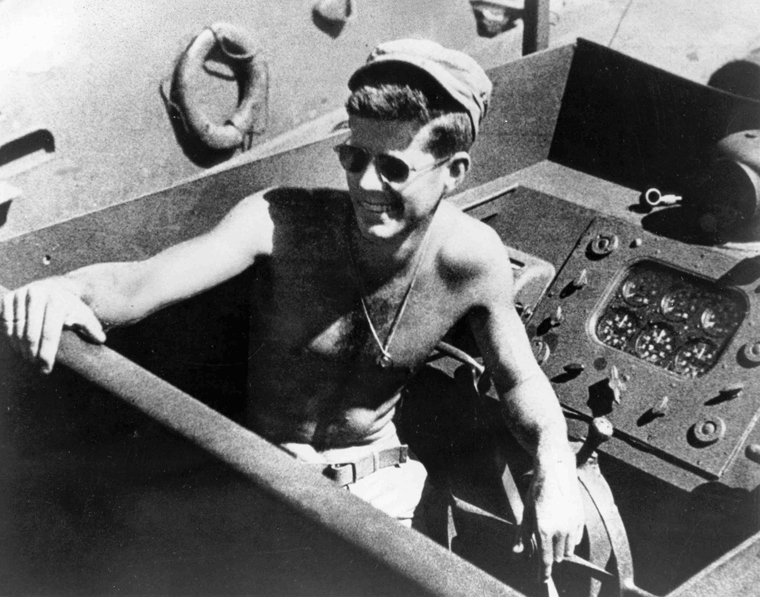
*Via Wikimedia Commons: [Lt. John F. Kennedy skipper aboard the PT-109](https://commons.wikimedia.org/wiki/File:Lt._John_F._Kennedy_skipper_aboard_the_PT-109.jpg), public domain.*
47 unchanged paragraphs
## House and Senate
## House and Senate
Kennedy had thought of becoming a teacher or writer, but after his brother's death, and at his father's urging, he ran for Congress.[1] He entered the race for the seat of Massachusetts's 11th congressional district on 25 April 1946 and won that year.[1][2] He served three terms in the House of Representatives, from 1947 to 1953.[1][3]
Kennedy had thought of becoming a teacher or writer, but after his brother's death, and at his father's urging, he ran for Congress.[1] He entered the race for the seat of Massachusetts's 11th congressional district on 25 April 1946 and won that year.[1][2] He served three terms in the House of Representatives, from 1947 to 1953.[1][3]
In 1952 he was elected to the U.S. Senate, defeating the Republican incumbent, Henry Cabot Lodge Jr., by about 70,000 votes.[3] On 12 September 1953 he married Jacqueline Lee Bouvier.[3] In the Senate he served on the Select Committee on Improper Activities in the Labor and Management Field, which held public hearings on corruption in labor unions, and in 1957 he chaired a special committee that chose the Senate's "Famous Five", five notable senators of the past.[6]
In 1952 he was elected to the U.S. Senate, defeating the Republican incumbent, Henry Cabot Lodge Jr., by about 70,000 votes.[3] On 12 September 1953 he married Jacqueline Lee Bouvier.[3] In the Senate he served on the Select Committee on Improper Activities in the Labor and Management Field, which held public hearings on corruption in labor unions, and in 1957 he chaired a special committee that chose the Senate's "Famous Five", five notable senators of the past.[6]
While recovering from back surgery he wrote *Profiles in Courage*, a book about senators who risked their careers for their convictions; it won the Pulitzer Prize for biography in 1957.[1][6] Britannica notes that his aide Theodore Sorensen did much of the research and writing, which became known later.[3] At the 1956 Democratic convention Kennedy came close to being chosen as the vice-presidential candidate, and he then set his sights on the presidency.[1] The couple's first child, a daughter, was stillborn on 23 August 1956.[2]
While recovering from back surgery he wrote *Profiles in Courage*, a book about senators who risked their careers for their convictions; it won the Pulitzer Prize for biography in 1957.[1][6] Britannica notes that his aide Theodore Sorensen did much of the research and writing, which became known later.[3] At the 1956 Democratic convention Kennedy came close to being chosen as the vice-presidential candidate, and he then set his sights on the presidency.[1] The couple's first child, a daughter, was stillborn on 23 August 1956.[2]
## The 1960 election
## The 1960 election
Kennedy announced his candidacy on 2 January 1960.[2] The Democratic Party nominated him on 13 July 1960, and he chose Senator Lyndon B. Johnson of Texas, the Senate majority leader, as his running mate.[1][6] His Republican opponent was Vice President Richard M. Nixon.[1] The two candidates held four debates, on 26 September and on 7, 13 and 21 October 1960.[2]
Kennedy announced his candidacy on 2 January 1960.[2] The Democratic Party nominated him on 13 July 1960, and he chose Senator Lyndon B. Johnson of Texas, the Senate majority leader, as his running mate.[1][6] His Republican opponent was Vice President Richard M. Nixon.[1] The two candidates held four debates, on 26 September and on 7, 13 and 21 October 1960.[2]
In the election of 8 November 1960 Kennedy won a very close race: a National Archives record gives him 49.72 per cent of the popular vote to Nixon's 49.55 per cent.[7][8] In the Electoral College he received 303 votes, Nixon 219, and Harry F. Byrd 15.[9] At 43 he was the youngest man ever elected president, and he was the first Roman Catholic to hold the office.[1] He kept his Senate seat until the Electoral College had confirmed his victory, resigning shortly before Christmas 1960.[7]
In the election of 8 November 1960 Kennedy won a very close race: a National Archives record gives him 49.72 per cent of the popular vote to Nixon's 49.55 per cent.[7][8] In the Electoral College he received 303 votes, Nixon 219, and Harry F. Byrd 15.[9] At 43 he was the youngest man ever elected president, and he was the first Roman Catholic to hold the office.[1] He kept his Senate seat until the Electoral College had confirmed his victory, resigning shortly before Christmas 1960.[7]
## Presidency
## Presidency
Kennedy was sworn in as the 35th president on 20 January 1961; the oath was administered by Chief Justice Earl Warren.[1][2] In his inaugural address he told Americans: "Ask not what your country can do for you, ask what you can do for your country."[1]
Kennedy was sworn in as the 35th president on 20 January 1961; the oath was administered by Chief Justice Earl Warren.[1][2] In his inaugural address he told Americans: "Ask not what your country can do for you, ask what you can do for your country."[1]
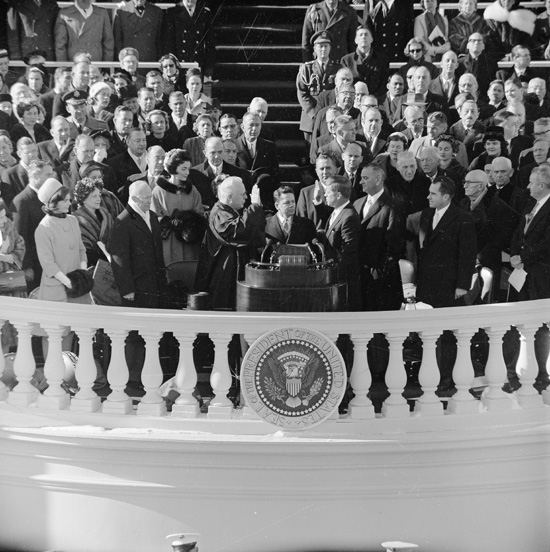

*Via Wikimedia Commons: [Jfk inauguration](https://commons.wikimedia.org/wiki/File:Jfk_inauguration.jpg) by Record Group 111, Records of the Office of the Chief Signal, public domain.*
*Via Wikimedia Commons: [Jfk inauguration](https://commons.wikimedia.org/wiki/File:Jfk_inauguration.jpg) by Record Group 111, Records of the Office of the Chief Signal, public domain.*
### Domestic agenda
### Domestic agenda
He outlined his domestic agenda in accepting the Democratic nomination in July 1960; the JFK Library describes this "New Frontier" programme as a call for progress in science, education and employment.[1][10] He took office during a recession in which 5.5 million Americans were looking for work; the downturn had faded by the end of 1961.[10] Congress approved an increase in the minimum wage, but his plan for medical care for the elderly made no headway, his proposed tax cuts were watered down, his education bill foundered over the question of aid to church schools, and Southern Democrats blocked his proposal for a Department of Urban Affairs.[10] The government did begin a programme of regional development in Appalachia.[10] He also created the Peace Corps, which sends American volunteers to work in other countries.[1]
He outlined his domestic agenda in accepting the Democratic nomination in July 1960; the JFK Library describes this "New Frontier" programme as a call for progress in science, education and employment.[1][10] He took office during a recession in which 5.5 million Americans were looking for work; the downturn had faded by the end of 1961.[10] Congress approved an increase in the minimum wage, but his plan for medical care for the elderly made no headway, his proposed tax cuts were watered down, his education bill foundered over the question of aid to church schools, and Southern Democrats blocked his proposal for a Department of Urban Affairs.[10] The government did begin a programme of regional development in Appalachia.[10] He also created the Peace Corps, which sends American volunteers to work in other countries.[1]
### Bay of Pigs
### Bay of Pigs
A Central Intelligence Agency (CIA) plan to train Cuban exiles for an invasion of Cuba had been prepared under President Dwight D. Eisenhower, who approved the training in March 1960.[11] Kennedy authorised the plan in February 1961.[11] On 17 April 1961 about 1,400 exiles, known as Brigade 2506, landed at the Bay of Pigs; the invasion was defeated by 19 April, with almost 1,200 members of the brigade captured and more than 100 killed.[11] The prisoners were held for 20 months until Castro agreed to free them in exchange for $53 million worth of baby food and medicine, in talks in which Attorney General Robert F. Kennedy took part; the first freed prisoners reached the United States on 23 December 1962.[11] The failure led to Operation Mongoose, a covert campaign to sabotage and destabilise the Cuban government.[11]
A Central Intelligence Agency (CIA) plan to train Cuban exiles for an invasion of Cuba had been prepared under President Dwight D. Eisenhower, who approved the training in March 1960.[11] Kennedy authorised the plan in February 1961.[11] On 17 April 1961 about 1,400 exiles, known as Brigade 2506, landed at the Bay of Pigs; the invasion was defeated by 19 April, with almost 1,200 members of the brigade captured and more than 100 killed.[11] The prisoners were held for 20 months until Castro agreed to free them in exchange for $53 million worth of baby food and medicine, in talks in which Attorney General Robert F. Kennedy took part; the first freed prisoners reached the United States on 23 December 1962.[11] The failure led to Operation Mongoose, a covert campaign to sabotage and destabilise the Cuban government.[11]
### Berlin and the Cold War
### Berlin and the Cold War
In June 1961 Kennedy met the Soviet leader Nikita Khrushchev in Vienna, where Khrushchev threatened to cut off the Western Allies' access to Berlin.[12] About two months later Khrushchev ordered the building of the Berlin Wall to stop East Germans from leaving for the West.[12] Kennedy ordered large increases in intercontinental ballistic missiles, five new army divisions, and more air power and reserves, and after the Soviet Union resumed nuclear testing he reluctantly restarted American tests in early 1962.[12] On 26 June 1963 he visited West Berlin, where he was welcomed by Chancellor Konrad Adenauer and Mayor Willy Brandt, looked over the Wall, visited Checkpoint Charlie, and in a speech at Rathaus Schöneberg declared "Ich bin ein Berliner" ("I am a Berliner").[13]
In June 1961 Kennedy met the Soviet leader Nikita Khrushchev in Vienna, where Khrushchev threatened to cut off the Western Allies' access to Berlin.[12] About two months later Khrushchev ordered the building of the Berlin Wall to stop East Germans from leaving for the West.[12] Kennedy ordered large increases in intercontinental ballistic missiles, five new army divisions, and more air power and reserves, and after the Soviet Union resumed nuclear testing he reluctantly restarted American tests in early 1962.[12] On 26 June 1963 he visited West Berlin, where he was welcomed by Chancellor Konrad Adenauer and Mayor Willy Brandt, looked over the Wall, visited Checkpoint Charlie, and in a speech at Rathaus Schöneberg declared "Ich bin ein Berliner" ("I am a Berliner").[13]
### Cuban Missile Crisis
### Cuban Missile Crisis
On 14 October 1962 an American U-2 reconnaissance aircraft photographed Soviet missile sites under construction in Cuba.[14] The Joint Chiefs of Staff favoured an air strike followed by an invasion; Kennedy chose a middle course, and on 22 October he ordered a naval "quarantine" (a blockade) of Cuba and explained the crisis to the public on national television.[14] After an exchange of messages, Khrushchev announced on 28 October that the Soviet missiles would be dismantled and removed.[14] In return the United States pledged not to invade Cuba, and Robert Kennedy privately told the Soviet ambassador, Dobrynin, that American Jupiter missiles would be withdrawn from Turkey, though not as part of a public deal.[14] The quarantine ended on 20 November 1962, and the Jupiter missiles left Turkey in April 1963.[14] The crisis led to a direct communication link between Washington and Moscow, the "Hotline", and to the first steps towards a nuclear test ban.[12][14]
On 14 October 1962 an American U-2 reconnaissance aircraft photographed Soviet missile sites under construction in Cuba.[14] The Joint Chiefs of Staff favoured an air strike followed by an invasion; Kennedy chose a middle course, and on 22 October he ordered a naval "quarantine" (a blockade) of Cuba and explained the crisis to the public on national television.[14] After an exchange of messages, Khrushchev announced on 28 October that the Soviet missiles would be dismantled and removed.[14] In return the United States pledged not to invade Cuba, and Robert Kennedy privately told the Soviet ambassador, Dobrynin, that American Jupiter missiles would be withdrawn from Turkey, though not as part of a public deal.[14] The quarantine ended on 20 November 1962, and the Jupiter missiles left Turkey in April 1963.[14] The crisis led to a direct communication link between Washington and Moscow, the "Hotline", and to the first steps towards a nuclear test ban.[12][14]
### Test Ban Treaty
### Test Ban Treaty
In a speech at American University in June 1963 Kennedy urged Americans to rethink Cold War assumptions and to pursue a strategy of peace.[12] In the final months of his presidency the United States, the Soviet Union and Britain negotiated and signed the Limited Test Ban Treaty, which banned nuclear tests in the atmosphere, in outer space and under water, but not underground.[12][15] The State Department's Office of the Historian judges that the treaty did little to slow the development and spread of nuclear weapons but set an important precedent for later arms control.[15]
In a speech at American University in June 1963 Kennedy urged Americans to rethink Cold War assumptions and to pursue a strategy of peace.[12] In the final months of his presidency the United States, the Soviet Union and Britain negotiated and signed the Limited Test Ban Treaty, which banned nuclear tests in the atmosphere, in outer space and under water, but not underground.[12][15] The State Department's Office of the Historian judges that the treaty did little to slow the development and spread of nuclear weapons but set an important precedent for later arms control.[15]
### Space programme
### Space programme
The Soviet Union had led the early space race, launching the first satellite and putting the first man into orbit.[16] On 25 May 1961, less than three weeks after Alan Shepard's 15-minute suborbital flight, Kennedy told a joint session of Congress that the nation should commit itself, before the decade was out, to "landing a man on the moon and returning him safely to the earth".[16] On 12 September 1962, before a crowd of about 40,000 at Rice University's football stadium in Houston, he restated the goal, saying the nation chose to go to the Moon "not because they are easy but because they are hard".[17] The goal was met on 20 July 1969, when Apollo 11 landed on the Moon.[16]
The Soviet Union had led the early space race, launching the first satellite and putting the first man into orbit.[16] On 25 May 1961, less than three weeks after Alan Shepard's 15-minute suborbital flight, Kennedy told a joint session of Congress that the nation should commit itself, before the decade was out, to "landing a man on the moon and returning him safely to the earth".[16] On 12 September 1962, before a crowd of about 40,000 at Rice University's football stadium in Houston, he restated the goal, saying the nation chose to go to the Moon "not because they are easy but because they are hard".[17] The goal was met on 20 July 1969, when Apollo 11 landed on the Moon.[16]
### Civil rights
### Civil rights
The JFK Library notes that many civil rights leaders thought him insufficiently supportive before 1963.[1] In 1961 activists known as Freedom Riders rode interstate buses through the South to challenge segregation.[10] In 1962 Mississippi's governor, Ross Barnett, defied federal court orders to admit James Meredith, a Black student, to the University of Mississippi; Kennedy federalised the Mississippi National Guard, and Meredith enrolled on 1 October 1962 after a riot in which two people died.[10]
The JFK Library notes that many civil rights leaders thought him insufficiently supportive before 1963.[1] In 1961 activists known as Freedom Riders rode interstate buses through the South to challenge segregation.[10] In 1962 Mississippi's governor, Ross Barnett, defied federal court orders to admit James Meredith, a Black student, to the University of Mississippi; Kennedy federalised the Mississippi National Guard, and Meredith enrolled on 1 October 1962 after a riot in which two people died.[10]
On 11 June 1963, after a confrontation with Alabama's governor, George C. Wallace, over the desegregation of the state's university, Kennedy gave a televised address arguing that all Americans were entitled to attend public institutions regardless of race and asking Congress to protect voting rights, educational opportunity and access to public facilities.[10][18] Early the next morning Medgar Evers, field director of the Mississippi NAACP, was murdered.[10] Kennedy then sent a civil rights bill to Congress; it became law after his death.[10] In August 1963 about 250,000 people took part in the March on Washington, at which Martin Luther King Jr. gave his "I Have a Dream" speech.[10]
On 11 June 1963, after a confrontation with Alabama's governor, George C. Wallace, over the desegregation of the state's university, Kennedy gave a televised address arguing that all Americans were entitled to attend public institutions regardless of race and asking Congress to protect voting rights, educational opportunity and access to public facilities.[10][18] Early the next morning Medgar Evers, field director of the Mississippi NAACP, was murdered.[10] Kennedy then sent a civil rights bill to Congress; it became law after his death.[10] In August 1963 about 250,000 people took part in the March on Washington, at which Martin Luther King Jr. gave his "I Have a Dream" speech.[10]
### Vietnam
### Vietnam
Kennedy expanded the American advisory role in South Vietnam.[12] In May 1961 he sent 500 Special Forces troops and advisers to join about 700 Americans sent under Eisenhower; a further 12,000 advisers followed in February 1962, and by early November 1963 the number had reached 16,000.[12]
Kennedy expanded the American advisory role in South Vietnam.[12] In May 1961 he sent 500 Special Forces troops and advisers to join about 700 Americans sent under Eisenhower; a further 12,000 advisers followed in February 1962, and by early November 1963 the number had reached 16,000.[12]
On 9 August 1963 the Kennedys' infant son, Patrick Bouvier Kennedy, died two days after his birth.[2]
On 9 August 1963 the Kennedys' infant son, Patrick Bouvier Kennedy, died two days after his birth.[2]
## Assassination
## Assassination
The decision to visit Texas was taken on 5 June 1963 at a meeting in El Paso between Kennedy, Vice President Johnson and Governor John Connally of Texas; one aim was to settle a dispute within the state's Democratic Party before the 1964 election.[19] On 21 November Kennedy visited San Antonio and Houston and spent the night in Fort Worth, and on 22 November he flew to Love Field in Dallas.[19] He rode in the presidential car with his wife, Jacqueline, and Governor and Mrs Connally, in a motorcade bound for a luncheon at the Trade Mart.[19]
The decision to visit Texas was taken on 5 June 1963 at a meeting in El Paso between Kennedy, Vice President Johnson and Governor John Connally of Texas; one aim was to settle a dispute within the state's Democratic Party before the 1964 election.[19] On 21 November Kennedy visited San Antonio and Houston and spent the night in Fort Worth, and on 22 November he flew to Love Field in Dallas.[19] He rode in the presidential car with his wife, Jacqueline, and Governor and Mrs Connally, in a motorcade bound for a luncheon at the Trade Mart.[19]
At about 12:30 p.m. local time, as the car passed along Elm Street in Dealey Plaza, shots were fired, striking the President and wounding Governor Connally.[2][19][20] Kennedy was taken to Parkland Memorial Hospital, where he was pronounced dead at about 1 p.m.[2][19] Aboard Air Force One in Dallas, Federal Judge Sarah T. Hughes administered the oath of office to Lyndon B. Johnson as the 36th president, and the plane left for Washington soon afterwards.[19] Police arrested Lee Harvey Oswald within hours; on 24 November Oswald was shot and killed by Jack Ruby in the basement of Dallas police headquarters.[1][20]
At about 12:30 p.m. local time, as the car passed along Elm Street in Dealey Plaza, shots were fired, striking the President and wounding Governor Connally.[2][19][20] Kennedy was taken to Parkland Memorial Hospital, where he was pronounced dead at about 1 p.m.[2][19] Aboard Air Force One in Dallas, Federal Judge Sarah T. Hughes administered the oath of office to Lyndon B. Johnson as the 36th president, and the plane left for Washington soon afterwards.[19] Police arrested Lee Harvey Oswald within hours; on 24 November Oswald was shot and killed by Jack Ruby in the basement of Dallas police headquarters.[1][20]
Kennedy's state funeral began at 3 p.m. on 25 November 1963, and he was buried at Arlington National Cemetery; foreign mourners included President Charles de Gaulle of France, Chancellor Ludwig Erhard of West Germany, Emperor Haile Selassie of Ethiopia and Prince Philip of the United Kingdom.[21] Jacqueline Kennedy lit an eternal flame at the grave.[21] The couple's two children who had died were interred on either side of his grave on 4 December 1963, and a permanent gravesite was completed in 1967.[2][21]
Kennedy's state funeral began at 3 p.m. on 25 November 1963, and he was buried at Arlington National Cemetery; foreign mourners included President Charles de Gaulle of France, Chancellor Ludwig Erhard of West Germany, Emperor Haile Selassie of Ethiopia and Prince Philip of the United Kingdom.[21] Jacqueline Kennedy lit an eternal flame at the grave.[21] The couple's two children who had died were interred on either side of his grave on 4 December 1963, and a permanent gravesite was completed in 1967.[2][21]
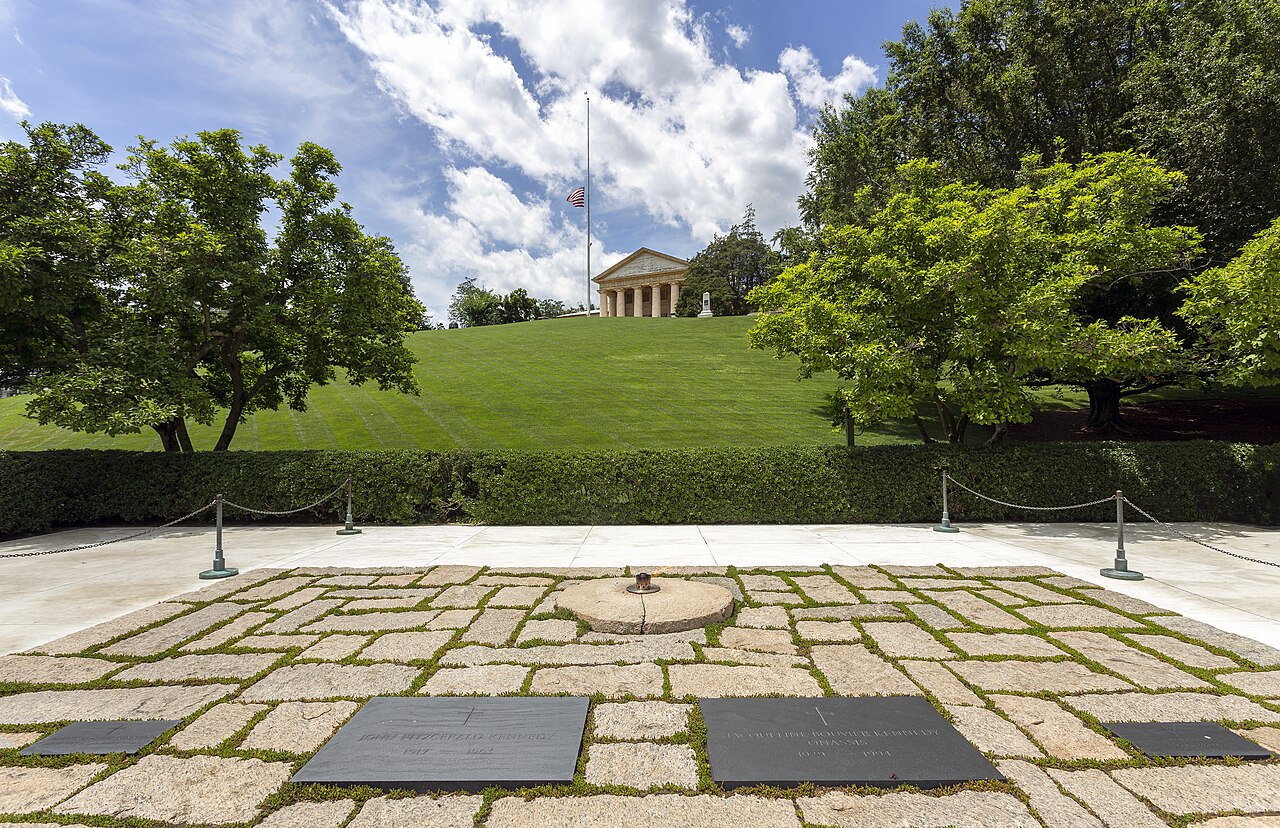

*Via Wikimedia Commons: [John F. Kennedy grave Arlington VA1](https://commons.wikimedia.org/wiki/File:John_F._Kennedy_grave_Arlington_VA1.jpg) by Acroterion, [CC BY-SA 4.0](https://creativecommons.org/licenses/by-sa/4.0).*
*Via Wikimedia Commons: [John F. Kennedy grave Arlington VA1](https://commons.wikimedia.org/wiki/File:John_F._Kennedy_grave_Arlington_VA1.jpg) by Acroterion, [CC BY-SA 4.0](https://creativecommons.org/licenses/by-sa/4.0).*
## Official investigations
## Official investigations
### Warren Commission
### Warren Commission
The investigating commission known as the Warren Commission was created on 29 November 1963.[1][20] Its report, titled *Report of the President's Commission on the Assassination of President John F. Kennedy*, was published by the Government Printing Office in 1964 in one volume of 888 pages.[22] The commission concluded that the weight of the evidence showed three shots had been fired, all from the sixth-floor window at the south-east corner of the Texas School Book Depository; that Lee Harvey Oswald fired them; that Oswald also killed Dallas police officer J. D. Tippit about 45 minutes after the assassination; and that it had found no evidence that either Oswald or Ruby was part of any conspiracy, domestic or foreign.[20]
The investigating commission known as the Warren Commission was created on 29 November 1963.[1][20] Its report, titled *Report of the President's Commission on the Assassination of President John F. Kennedy*, was published by the Government Printing Office in 1964 in one volume of 888 pages.[22] The commission concluded that the weight of the evidence showed three shots had been fired, all from the sixth-floor window at the south-east corner of the Texas School Book Depository; that Lee Harvey Oswald fired them; that Oswald also killed Dallas police officer J. D. Tippit about 45 minutes after the assassination; and that it had found no evidence that either Oswald or Ruby was part of any conspiracy, domestic or foreign.[20]
### House Select Committee on Assassinations
### House Select Committee on Assassinations
The House of Representatives set up the Select Committee on Assassinations in September 1976, by House Resolution 1540, to investigate the deaths of President Kennedy and Martin Luther King Jr.; Representative Louis Stokes of Ohio became its chairman in March 1977.[23] It submitted its report on 29 March 1979.[23] The committee found that Oswald fired three shots at the President from behind, from the sixth floor of the Book Depository, and that the second and third struck him.[24] It also found that "scientific acoustical evidence" (analysis of sounds recorded by the Dallas police from an open microphone at the time of the shooting) established a high probability that two gunmen had fired at the President.[24][25] On that basis, among others, the committee concluded that Kennedy was "probably assassinated as a result of a conspiracy", though it could not identify the other gunman or the extent of any conspiracy.[24] It found that the Soviet and Cuban governments, anti-Castro Cuban groups and the national organised-crime syndicate, as groups, and the Secret Service, FBI and CIA were not involved, while leaving open the possibility that individual members of some of those groups were.[24] It also found that the President had not been adequately protected, and that the Warren Commission had investigated Oswald thoroughly but had not adequately investigated the possibility of a conspiracy and had presented its conclusions too definitively.[24]
The House of Representatives set up the Select Committee on Assassinations in September 1976, by House Resolution 1540, to investigate the deaths of President Kennedy and Martin Luther King Jr.; Representative Louis Stokes of Ohio became its chairman in March 1977.[23] It submitted its report on 29 March 1979.[23] The committee found that Oswald fired three shots at the President from behind, from the sixth floor of the Book Depository, and that the second and third struck him.[24] It also found that "scientific acoustical evidence" (analysis of sounds recorded by the Dallas police from an open microphone at the time of the shooting) established a high probability that two gunmen had fired at the President.[24][25] On that basis, among others, the committee concluded that Kennedy was "probably assassinated as a result of a conspiracy", though it could not identify the other gunman or the extent of any conspiracy.[24] It found that the Soviet and Cuban governments, anti-Castro Cuban groups and the national organised-crime syndicate, as groups, and the Secret Service, FBI and CIA were not involved, while leaving open the possibility that individual members of some of those groups were.[24] It also found that the President had not been adequately protected, and that the Warren Commission had investigated Oswald thoroughly but had not adequately investigated the possibility of a conspiracy and had presented its conclusions too definitively.[24]
The acoustic evidence was later disputed. A 1982 report by the National Research Council's Committee on Ballistic Acoustics reviewed the two analyses done for the House committee and concluded that they did not show that a shot had been fired from the grassy knoll, that there was no acoustic basis for the claimed 95 per cent probability of such a shot, and that reliable acoustic data did not support a conclusion that there was a second gunman; it found that the sounds in question had been recorded about one minute after the President was shot.[25]
The acoustic evidence was later disputed. A 1982 report by the National Research Council's Committee on Ballistic Acoustics reviewed the two analyses done for the House committee and concluded that they did not show that a shot had been fired from the grassy knoll, that there was no acoustic basis for the claimed 95 per cent probability of such a shot, and that reliable acoustic data did not support a conclusion that there was a second gunman; it found that the sounds in question had been recorded about one minute after the President was shot.[25]
## Assassination records
## Assassination records
Public interest in the government's assassination files grew after Oliver Stone's 1991 film *JFK*, which noted that the House committee's records were closed until 2029.[26] The President John F. Kennedy Assassination Records Collection Act was signed by President George H. W. Bush on 26 October 1992 (Public Law 102-526).[26][27] It created the JFK Assassination Records Collection at the National Archives and an independent Assassination Records Review Board, which worked from 1994 to 1998; when the board closed, about 88 per cent of the documents were open in full, 11 per cent were open with some parts withheld, and 1 per cent were withheld in full.[26][27] The Act required all remaining records to be released in full by 26 October 2017 unless the President certified that withholding them was needed to prevent an identifiable harm that outweighed the public interest.[27][28]
Public interest in the government's assassination files grew after Oliver Stone's 1991 film *JFK*, which noted that the House committee's records were closed until 2029.[26] The President John F. Kennedy Assassination Records Collection Act was signed by President George H. W. Bush on 26 October 1992 (Public Law 102-526).[26][27] It created the JFK Assassination Records Collection at the National Archives and an independent Assassination Records Review Board, which worked from 1994 to 1998; when the board closed, about 88 per cent of the documents were open in full, 11 per cent were open with some parts withheld, and 1 per cent were withheld in full.[26][27] The Act required all remaining records to be released in full by 26 October 2017 unless the President certified that withholding them was needed to prevent an identifiable harm that outweighed the public interest.[27][28]
In October 2017 the President allowed the withholdings agencies had requested on a temporary basis and ordered them to re-review the documents; tens of thousands of documents were released in 2017 and 2018.[27][28] Further presidential certifications in 2021, 2022 and 2023 extended the review, and under a deadline of 30 June 2023 the National Archives posted 2,672 documents with newly released information between April and June 2023.[28][29] On 23 January 2025 President Donald Trump signed Executive Order 14176, which declared continued redaction of the Kennedy records contrary to the public interest and ordered a plan for their full release.[28] Beginning on 18 March 2025 the National Archives released all records in the collection that had previously been withheld for classification, without redactions, in several batches; as of the page's last update on 30 January 2026, the latest batch had been posted that day.[30]
In October 2017 the President allowed the withholdings agencies had requested on a temporary basis and ordered them to re-review the documents; tens of thousands of documents were released in 2017 and 2018.[27][28] Further presidential certifications in 2021, 2022 and 2023 extended the review, and under a deadline of 30 June 2023 the National Archives posted 2,672 documents with newly released information between April and June 2023.[28][29] On 23 January 2025 President Donald Trump signed Executive Order 14176, which declared continued redaction of the Kennedy records contrary to the public interest and ordered a plan for their full release.[28] Beginning on 18 March 2025 the National Archives released all records in the collection that had previously been withheld for classification, without redactions, in several batches; as of the page's last update on 30 January 2026, the latest batch had been posted that day.[30]
As of March 2025, the National Archives described the collection as more than six million pages of records, photographs, films, sound recordings and artefacts, said that the vast majority had been declassified, and reported that it was digitising the whole collection, a project begun in 2023.[31]
As of March 2025, the National Archives described the collection as more than six million pages of records, photographs, films, sound recordings and artefacts, said that the vast majority had been declassified, and reported that it was digitising the whole collection, a project begun in 2023.[31]
## Sources
## Sources
1. John F. Kennedy Presidential Library and Museum. "Life of John F. Kennedy". jfklibrary.org. No date shown; accessed 25 November 2026. https://www.jfklibrary.org/learn/about-jfk/life-of-john-f-kennedy
2. John F. Kennedy Presidential Library and Museum. "Fast Facts about John F. Kennedy". jfklibrary.org. No date shown; accessed 25 November 2026. https://www.jfklibrary.org/learn/about-jfk/life-of-john-f-kennedy/fast-facts-john-f-kennedy
3. The Editors of Encyclopaedia Britannica. "John F. Kennedy". Encyclopaedia Britannica. No date shown; accessed 25 November 2026. https://britannica.com/biography/John-F-Kennedy/Introduction
4. Naval History and Heritage Command. "Lieutenant John F. Kennedy, USNR". U.S. Navy. No date shown; accessed 25 November 2026. https://www.history.navy.mil/browse-by-topic/people/presidents/kennedy.html
5. John F. Kennedy Presidential Library and Museum. "John F. Kennedy and PT-109". jfklibrary.org. No date shown; accessed 25 November 2026. https://www.jfklibrary.org/learn/about-jfk/jfk-in-history/john-f-kennedy-and-pt-109
6. United States Senate. "John F. Kennedy: A Featured Biography". senate.gov. No date shown; accessed 25 November 2026. https://www.senate.gov/senators/FeaturedBios/Featured_Bio_KennedyJohnF.htm
7. United States Senate Historical Office. "Two Senators to the White House". senate.gov. No date shown; accessed 25 November 2026. https://www.senate.gov/artandhistory/history/minute/Two_Senators_to_the_White_House.htm
8. National Archives at Boston. "Featured Documents of the Month from NARA at Boston" (page on Kennedy and the 1960 election). archives.gov. No date shown; accessed 25 November 2026. https://www.archives.gov/boston/featured-documents/kennedy-1960.html
9. National Archives. "1960 Electoral College Results". archives.gov. No date shown; accessed 25 November 2026. https://www.archives.gov/electoral-college/1960
10. Marc J. Selverstone. "John F. Kennedy: Domestic Affairs". Miller Center, University of Virginia, 4 October 2016 (last modified 29 January 2025). https://millercenter.org/president/kennedy/domestic-affairs
11. John F. Kennedy Presidential Library and Museum. "The Bay of Pigs". jfklibrary.org. No date shown; accessed 25 November 2026. https://www.jfklibrary.org/learn/about-jfk/jfk-in-history/the-bay-of-pigs
12. John F. Kennedy Presidential Library and Museum. "The Cold War". jfklibrary.org. No date shown; accessed 25 November 2026. https://www.jfklibrary.org/learn/about-jfk/jfk-in-history/the-cold-war
13. John F. Kennedy Presidential Library and Museum. "Remarks at the Rudolph Wilde Platz, Berlin". jfklibrary.org. No date shown; accessed 25 November 2026. https://www.jfklibrary.org/learn/about-jfk/historic-speeches/remarks-at-the-rudolph-wilde-platz-berlin
14. Office of the Historian, U.S. Department of State. "The Cuban Missile Crisis, October 1962". Milestones in the History of U.S. Foreign Relations. No date shown; accessed 25 November 2026. https://history.state.gov/milestones/1961-1968/cuban-missile-crisis
15. Office of the Historian, U.S. Department of State. "The Limited Test Ban Treaty, 1963". Milestones in the History of U.S. Foreign Relations. No date shown; accessed 25 November 2026. https://history.state.gov/milestones/1961-1968/limited-ban
16. John Uri. "60 Years Ago: President Kennedy Proposes Moon Landing Goal in Speech to Congress". NASA, 25 May 2021 (updated 22 August 2024). https://www.nasa.gov/history/60-years-ago-president-kennedy-proposes-moon-landing-goal-in-speech-to-congress/
17. John Uri. "60 Years Ago: President Kennedy Reaffirms Moon Landing Goal in Rice University Speech". NASA, 7 September 2022 (updated 21 September 2023). https://www.nasa.gov/history/60-years-ago-president-kennedy-reaffirms-moon-landing-goal-in-rice-university-speech/
18. John F. Kennedy Presidential Library and Museum. "Televised Address to the Nation on Civil Rights". jfklibrary.org. No date shown; accessed 25 November 2026. https://www.jfklibrary.org/learn/about-jfk/historic-speeches/televised-address-to-the-nation-on-civil-rights
19. President's Commission on the Assassination of President Kennedy. "Report", Chapter 2: "The Assassination" (1964). Web edition, National Archives. Accessed 25 November 2026. https://www.archives.gov/research/jfk/warren-commission-report/chapter-2.html
20. President's Commission on the Assassination of President Kennedy. "Report", Chapter 1: "Summary and Conclusions" (1964). Web edition, National Archives. Accessed 25 November 2026. https://www.archives.gov/research/jfk/warren-commission-report/chapter-1.html
21. Arlington National Cemetery. "President John F. Kennedy Gravesite". arlingtoncemetery.mil. No date shown; accessed 25 November 2026. https://www.arlingtoncemetery.mil/Explore/Monuments-and-Memorials/President-John-F-Kennedy-Gravesite
22. National Archives. "Warren Commission Report: Table of Contents". archives.gov, web page published 15 August 2016. Accessed 25 November 2026. https://www.archives.gov/research/jfk/warren-commission-report/toc
23. House Select Committee on Assassinations. "Report", Introduction (1979). Web edition, National Archives. Accessed 25 November 2026. https://www.archives.gov/research/jfk/select-committee-report/intro.html
24. House Select Committee on Assassinations. "Report", Summary of Findings and Recommendations (1979). Web edition, National Archives. Accessed 25 November 2026. https://www.archives.gov/research/jfk/select-committee-report/summary.html
25. National Research Council. "Report of the Committee on Ballistic Acoustics". The National Academies Press, 1982. Accessed 25 November 2026. https://www.nationalacademies.org/publications/10264
26. James Mathis and Martha Wagner Murphy. "Documenting the Death of a President". Prologue (National Archives), Vol. 49, No. 3, Fall 2017. https://www.archives.gov/publications/prologue/2017/fall/jfk-records
27. National Archives. "JFK Assassination Records Processing Project - 2017 Update". archives.gov. No date shown; accessed 25 November 2026. https://www.archives.gov/research/jfk/processing-project-2017
28. Executive Office of the President. "Declassification of Records Concerning the Assassinations of President John F. Kennedy, Senator Robert F. Kennedy, and the Reverend Dr. Martin Luther King, Jr." Executive Order 14176, signed 23 January 2025. Federal Register 90 FR 8641, 31 January 2025. https://www.federalregister.gov/documents/2025/01/31/2025-02116/declassification-of-records-concerning-the-assassinations-of-president-john-f-kennedy-senator-robert
29. National Archives. "JFK Assassination Records - 2023 Additional Documents Release". archives.gov. No date shown; accessed 25 November 2026. https://www.archives.gov/research/jfk/release-2023
30. National Archives. "JFK Assassination Records - 2025 Documents Release". archives.gov, published 17 March 2025, last updated 30 January 2026. https://www.archives.gov/research/jfk/release-2025
31. National Archives. "The President John F. Kennedy Assassination Records Collection". archives.gov, last reviewed 19 March 2025. https://www.archives.gov/research/jfk
