Compare versions
Version 1 → Version 3 (current). Removed · Added. This shows the entry's text as it is written, including its formatting marks.
Version 1 · Version 3 (current) · Version history
Side by side · Together
Muhammad Ali (1942–2016), born Cassius Marcellus Clay Jr., was an American professional boxer and social activist who won the world heavyweight championship three times and whose 1967 conviction for refusing induction into the armed forces the Supreme Court overturned in 1971.[1][9][10][12]
## Early life and amateur career
He was born Cassius Marcellus Clay Jr. on 17 January 1942 in Louisville, Kentucky, and grew up in the segregated American South.[1] His father, Cassius Marcellus Clay Sr., supported the family by painting billboards and signs, and his mother, Odessa Grady Clay, worked as a household domestic.[1] According to the Muhammad Ali Center, his father was a Methodist and his mother a Baptist, and he was raised in his mother's Baptist church.[9]
He took up boxing at the age of 12.[1][5] A PBS NewsHour obituary relates that he started after his bicycle was stolen, when a Louisville police officer, Joe Martin, told him he should learn to fight first; he trained with Martin for six months before winning his first bout.[2] As an amateur he won six Kentucky Golden Gloves tournaments and two National Golden Gloves tournaments, and he took the national Amateur Athletic Union (AAU) light heavyweight titles in 1959 and 1960.[3][5] Accounts of his full amateur record vary widely; BoxRec, a boxing records database, lists claims ranging from 99–8 to 137–3 and considers 99 wins and 8 losses the most likely.[6]
## 1960 Rome Olympics
At 18, while still a high school student, Clay went to the 1960 Olympic Games in Rome, where he won the gold medal in the light heavyweight division.[3][10] In the final he defeated Zbigniew Pietrzykowski of Poland, a 25-year-old who had won bronze at the 1956 Games, by a unanimous 5–0 decision of the judges.[3] BoxRec lists his four Olympic bouts: a stoppage of Yvon Becaus of Belgium in the second round, followed by 5–0 decisions over Gennady Shatkov of the Soviet Union, Tony Madigan of Australia and Pietrzykowski.[6]
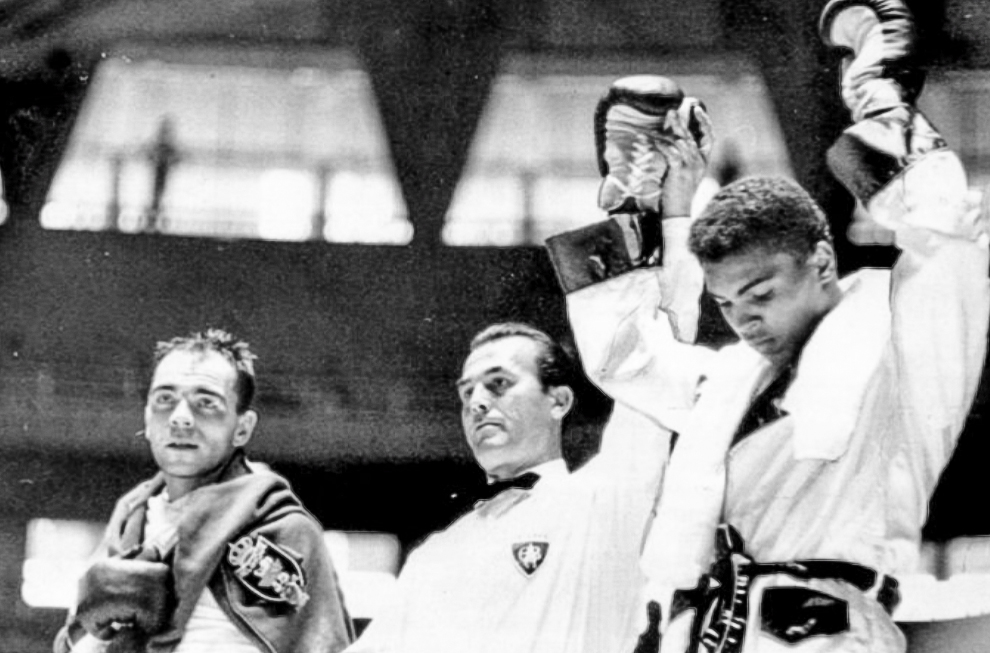
*Via Wikimedia Commons: [Yvon Becaus en Cassius Clay in Rome 1960](https://commons.wikimedia.org/wiki/File:Yvon_Becaus_en_Cassius_Clay_in_Rome_1960.jpg) by Unknown author Unknown author, [CC BY-SA 4.0](https://creativecommons.org/licenses/by-sa/4.0).*
A story Ali told in later years held that he threw his gold medal into the Ohio River after being refused service at a Louisville restaurant because of his race.[9][16] The Muhammad Ali Center calls it an "often-told story", and BoxRec notes that biographers doubt it.[6][16] He was given a replacement gold medal during the 1996 Olympic Games in Atlanta (see below).[6][16]
## Professional career and first championship
Clay turned professional after returning from Rome.[10] His first professional fight was a six-round bout against Tunney Hunsaker at Freedom Hall in Louisville on 29 October 1960, which he won by unanimous decision in front of 6,180 spectators; ESPN reports that he was paid $2,000.[7] He went on to win 19 professional bouts in a row.[2]
On 25 February 1964, at the age of 22, he won the world heavyweight championship from Sonny Liston in Miami.[8][6] The rematch was originally scheduled for Boston on 16 November 1964 but was postponed after he had hernia surgery.[6] It took place in Lewiston, Maine, on 25 May 1965 and ended with Liston knocked down in the first round by a punch whose force was disputed, which became known as the "phantom punch".[8][2] According to BoxRec, he made nine successful defences during his first reign as champion.[6]
## The Nation of Islam and his names
According to the Muhammad Ali Center, Clay first met a member of the Nation of Islam (a Black American religious and political movement then led by Elijah Muhammad) at a Golden Gloves tournament in Chicago in 1959, and in 1962 he attended a Nation of Islam meeting at which Malcolm X spoke, the start of a friendship between them.[9] After winning the title in 1964 he announced that he was a Muslim and took the name Cassius X.[9][10] On 6 March 1964 Elijah Muhammad gave him the name Muhammad Ali.[8][9] PBS reports that Ali said he was dropping his "slave name".[2] His friendship with Malcolm X ended in 1964, after Malcolm X left the Nation of Islam.[9]
## Refusal of induction and conviction
In 1965 the United States Army lowered the standards of its aptitude test, and, according to the Muhammad Ali Center, this changed Ali's draft classification; the Scribner Encyclopedia of American Lives dates his reclassification from 1-Y (not currently qualified) to 1-A (available for service) to early 1966.[8][9] In February 1966, with the Vietnam War under way, he said publicly that he had no interest in fighting in Vietnam; the Scribner entry dates to 17 February 1966 his remark that he had "no quarrel" with the Viet Cong.[8][9] Following his statements, the Illinois State Athletic Commission barred a fight he had planned against Ernie Terrell in Chicago in March 1966.[9]
He applied for classification as a conscientious objector (a person excused from military service because of religious opposition to war) in Louisville on 9 March 1966.[9] His local draft board turned the claim down, and on appeal the file was referred to the Department of Justice for an advisory recommendation.[12][13] A hearing officer, Judge Lawrence Grauman, heard testimony, found Ali sincere and recommended that the claim be upheld, but the Department advised the Appeal Board to deny it, and the board did so without giving reasons.[12] The Justice Department's letter gave three grounds: that his objection was to certain wars only rather than to war in any form; that his objection, drawn from Nation of Islam teachings, rested mainly on political and racial grounds rather than religious ones; and that he had not shown sincerity, having raised the claim only when military service became imminent.[12] According to PBS, the Justice Department regarded his objection as political rather than religious.[2] He moved to Houston in late 1966 and was refused again in March 1967.[9]
On 28 April 1967, in Houston, he refused induction into the armed forces.[8][9] Boxing authorities immediately stripped him of his title and his licences to box.[8][9] The National Archives summarises that boxing officials suspended him from 1967 to 1970, during which time he became an activist and spoke to civil rights and anti-war groups.[10] The Muhammad Ali Center describes how he lectured at colleges and other institutions between 1967 and 1970 on race relations, Islam and the Vietnam War.[9]
On 4 June 1967 the athletes Jim Brown, Bill Russell and Lew Alcindor (later Kareem Abdul-Jabbar) met Ali in Cleveland and publicly supported his decision.[9] He was tried in the United States District Court for the Southern District of Texas in Houston and convicted; the Muhammad Ali Center gives the date as 20 June 1967.[9][11] He was sentenced to five years in prison and fined $10,000, but he was released on bail while he appealed and did not go to prison.[8][9][11] The United States Court of Appeals for the Fifth Circuit upheld the conviction in an opinion dated 6 May 1968.[11]
## Clay v. United States
The Supreme Court of the United States heard his appeal, *Clay v. United States* (reported at 403 U.S. 698), on 19 April 1971 and decided it on 28 June 1971.[13][24] In an unsigned (per curiam) opinion, eight justices voted to reverse his conviction; Justice Thurgood Marshall took no part.[12][13] By the time the case reached the Court, the government had conceded that two of the Justice Department's three grounds were wrong: it accepted that his beliefs were religious, and it no longer questioned his sincerity.[12] Because the Appeal Board had given no reasons for its decision, the Court held, it was impossible to tell whether the board had relied on one of the invalid grounds, and under the Court's earlier precedent the conviction therefore had to be set aside.[12][13]
Justice William O. Douglas wrote a separate concurrence arguing that Ali's beliefs were protected by the First Amendment; he quoted Ali's testimony that his views came from the Qur'an and that "this is not me talking to get the draft board -- or to dodge nothing."[12] Justice John M. Harlan II also concurred separately.[12][13]
## Return to boxing and the Frazier, Foreman and Spinks fights
His exile from the ring ended in 1970.[2][10] The Scribner entry records that a New York court ordered his boxing licence restored on 28 September 1970, and on 26 October 1970 he beat Jerry Quarry in Atlanta in his first fight after his return.[8][6]
On 8 March 1971, at Madison Square Garden in New York, he fought Joe Frazier in a contest billed as the "Fight of the Century", and lost on a decision after 15 rounds, the first defeat of his professional career.[2][8][6] He met Frazier three times in all, winning twice and losing once.[6]
On 30 October 1974, in Kinshasa, then in Zaire, he regained the heavyweight championship by knocking out George Foreman late in the eighth round, in the fight known as the "Rumble in the Jungle".[2][8][9] PBS reports that he used a tactic he later called "rope-a-dope".[2] According to BoxRec, the win made him the World Boxing Association and World Boxing Council champion.[6]
His third fight with Frazier, the "Thrilla in Manila", took place on 1 October 1975 at the Araneta Coliseum near Manila in the Philippines (still 30 September in the United States, where it was shown live in prime time).[14] Ali won when Frazier's trainer, Eddie Futch, stopped the fight after the 14th round; the three officials had Ali ahead on their scorecards at that point.[14][2]
On 15 February 1978 he lost the title to Leon Spinks, and on 15 September 1978 he won it back in a rematch, becoming the first boxer to win the world heavyweight championship three times.[6][1][17] Britannica credits him with 19 successful title defences over his career.[1] BoxRec's title history records that he gave up this third championship on retiring, with the reign ending on 6 September 1979.[6]
## Comebacks, retirement and record
He came out of retirement and lost to Larry Holmes in 1980, and he lost his last fight, against Trevor Berbick, in 1981.[6][8] PBS reports that he retired at 39 after that defeat.[2] His professional record was 56 wins and 5 losses.[2][8][10] BoxRec divides it into 29 wins and no defeats (23 by knockout) before his 1967 exile and 27 wins and 5 defeats (14 by knockout) after it.[6]
He was among the 53 boxers and other figures named to the inaugural class of the International Boxing Hall of Fame, in Canastota, New York, announced in 1990.[20][6] BoxRec also lists his election to the United States Olympic Hall of Fame in 1983 and to *The Ring* magazine's Boxing Hall of Fame in 1987.[6][8]
## Religion after 1975
Elijah Muhammad died on 25 February 1975.[9] According to the Muhammad Ali Center, his son, Warith Deen Mohammed, then took over the Nation of Islam and moved it towards Sunni Islam (the largest branch of Islam), and Ali converted to Sunni Islam.[9] Other sources date his move later: the Scribner entry says he converted to orthodox Sunni Islam in the 1980s, and PBS says he later embraced Sunni Islam and Sufism (a mystical tradition within Islam).[8][2] He made the pilgrimage to Mecca (the Hajj) in January 1972 and again in 1988.[9]
In his later years he spoke on religious and political subjects.[9] The Muhammad Ali Center records that nine days after the attacks of 11 September 2001 he visited New York City and said the attacks had been carried out in the name of hate, not faith, and that in 2015, after attacks in Paris and California, he publicly condemned Islamic extremists, one of his last public statements.[9] PBS reports that in 1990 he helped win the release of 14 American hostages held by the Iraqi government of Saddam Hussein.[2] He was named a United Nations Messenger of Peace.[4][8]
## Parkinson's disease
Ali's diagnosis with Parkinson's disease (a progressive disorder of the nervous system that affects movement) became public in 1984, about three years after his last fight.[2][15] Barrow Neurological Institute in Phoenix states that he resisted being publicly associated with the disease for years until his neurologist there, Abraham Lieberman, changed his mind, and that in 1997 Ali, Lieberman and the Phoenix philanthropist Jimmy Walker founded the Muhammad Ali Parkinson Center at Barrow.[15] The Scribner entry notes speculation that blows to the head in the ring caused his illness.[8]
## 1996 Atlanta Olympics
At the opening ceremony of the 1996 Centennial Olympic Games in Atlanta, 36 years after his Rome gold medal, Ali lit the Olympic cauldron.[16][3][4] The Muhammad Ali Center states that the idea came from the NBC Sports chairman Dick Ebersol and was kept secret beforehand.[16] The tremor in his hand from Parkinson's disease was visible as he held the torch, and he kept it steady while a mechanical problem delayed the lighting of the cauldron.[16] Later in the Games, the president of the International Olympic Committee, Juan Antonio Samaranch, presented him with a replacement gold medal during the men's basketball final between the United States and Yugoslavia.[16] Jonathan Eig, author of the 2017 biography *Ali: A Life*, told Olympics.com that Ali had been depressed and largely out of public view in the early 1990s and that the cauldron moment led Americans to embrace him again.[3]
## Presidential Medal of Freedom
President George W. Bush awarded Ali the Presidential Medal of Freedom on 9 November 2005.[2][17] The White House citation describes him as one of the greatest athletes of all time, recalls his 1960 gold medal and his part in the 1996 torch ceremony, notes that he was the first three-time heavyweight champion, and honours his commitment to equal justice and peace and his "principled service to mankind".[17] The National Archives holds White House photographs of the President and Ali at the ceremony.[10]
## The Muhammad Ali Center
Ali and his wife, Lonnie, founded the Muhammad Ali Center in his home town of Louisville in 2005.[18][19] The centre, on the Louisville waterfront, cost about $80 million and was dedicated in November 2005 after more than a decade of planning and fundraising.[19] It is both a museum of his life, with a permanent exhibit on his boxing career, his conversion to Islam and the Supreme Court case over his draft refusal, and an educational centre built around six principles it associates with him: confidence, conviction, dedication, giving, respect and spirituality.[19][18] One permanent exhibit, "The Greatest" Timeline, follows his professional career from 1960 to 1981.[25] As of November 2026 its stated mission is to "mobilize Muhammad Ali's legacy to foster respect, inspire generations of changemakers, and advance social justice."[18]
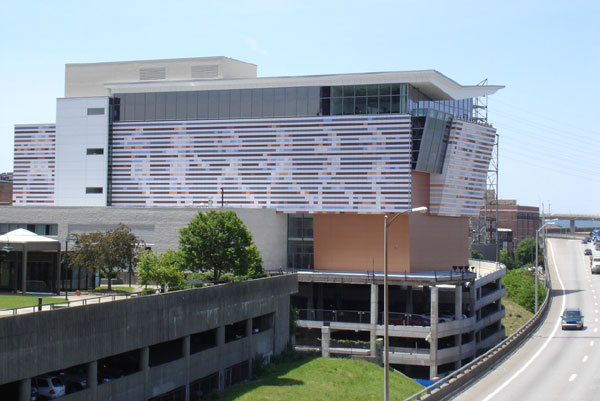
*Via Wikimedia Commons: [AliCenter](https://commons.wikimedia.org/wiki/File:AliCenter.jpg) by The original uploader was Stevietheman at English Wikipedia, [CC BY 2.0](https://creativecommons.org/licenses/by/2.0).*
## Death and funeral
Ali was taken to hospital in the Phoenix area of Arizona with a respiratory problem and died there on the night of Friday 3 June 2016, at the age of 74.[21][1][4] A family spokesman, Bob Gunnell, said the cause was septic shock due to unspecified natural causes.[21] Louisville Metro Government's announcement the next day said that he had died from complications of Parkinson's disease.[22]
On 10 June 2016 a funeral procession carried his body through Louisville, past his childhood home, his high school and his first boxing gym, to Cave Hill Cemetery, where he was buried in a private ceremony.[22][23] A public memorial service followed at the KFC Yum! Center arena; speakers included the former president Bill Clinton and the comedian Billy Crystal, along with clergy from several faiths.[23][21] PBS reported that Ali had planned the funeral himself years earlier and that the ceremony was predominantly Muslim, with an imam presiding.[21]
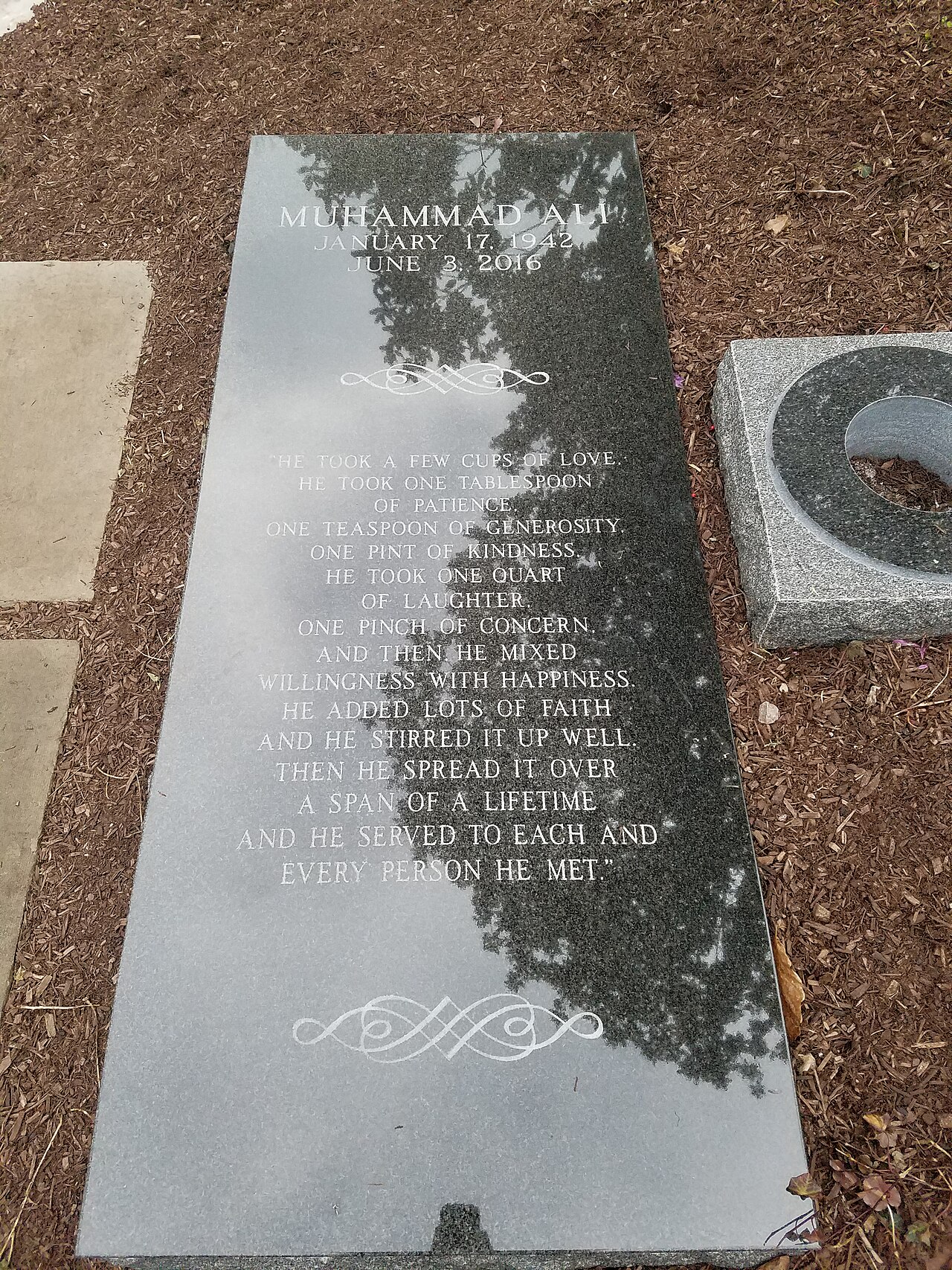
*Via Wikimedia Commons: [Muhammad Ali's grave marker](https://commons.wikimedia.org/wiki/File:Muhammad_Ali%27s_grave_marker.jpg) by RCJ21483, [CC BY-SA 4.0](https://creativecommons.org/licenses/by-sa/4.0).*
## Sources
1. The Editors of Encyclopaedia Britannica. "Muhammad Ali". Encyclopaedia Britannica. No date shown; accessed 25 November 2026. https://www.britannica.com/biography/Muhammad-Ali-boxer
2. Sam Lane. "Boxing legend Muhammad Ali dies at 74". PBS NewsHour, 4 June 2016. https://www.pbs.org/newshour/nation/edited-boxing-legend-muhammad-ali-dies-at-74
3. International Olympic Committee. "Snapped: the story behind that picture of Cassius Clay at Rome 1960". Olympics.com, 3 July 2018. https://olympics.com/ioc/news/snapped-the-story-behind-that-picture-of-cassius-clay-at-rome-1960
4. United States Olympic & Paralympic Committee. "Muhammad Ali". Team USA Hall of Fame. No date shown; accessed 25 November 2026. https://teamusa.com/hall-of-fame/hall-of-fame-members/muhammad-ali
5. Kentucky Commission on Human Rights. "Muhammad Ali". Kentucky Civil Rights Hall of Fame. No date shown; accessed 25 November 2026. https://kchr.ky.gov/Hall-of-Fame/Pages/Muhammad-Ali.aspx
6. BoxRec. "Muhammad Ali". BoxRec Wiki. No date shown; accessed 25 November 2026. https://boxrec.com/wiki/index.php/Muhammad_Ali
7. Nick Parkinson. Article on Cassius Clay's professional debut against Tunney Hunsaker. ESPN, 29 October 2015. https://africa.espn.com/boxing/story/_/id/13999218/muhammad-ali-vs-tunney-hunsaker-first-fight-greatest
8. Mike Marqusee. "Ali, Muhammad (Cassius Clay)". Scribner Encyclopedia of American Lives, Thematic Series: The 1960s, via Encyclopedia.com. No date shown; accessed 25 November 2026. https://encyclopedia.com/humanities/encyclopedias-almanacs-transcripts-and-maps/ali-muhammad-cassius-clay
9. Muhammad Ali Center. "Ali's Spirituality". alicenter.org, 26 August 2023 (last modified 12 September 2023). https://alicenter.org/about/muhammad-ali/
10. National Archives and Records Administration. "Muhammad Ali (January 17, 1942 - June 6, 2016)". African American Heritage, archives.gov. No date shown; accessed 25 November 2026. https://www.archives.gov/research/african-americans/individuals/muhammad-ali
11. National Archives and Records Administration. "Chronology of the Case Against Muhammad Ali for Selective Service Violation" (opinion of the U.S. Court of Appeals for the Fifth Circuit in Clay v. United States, 6 May 1968; National Archives at Fort Worth, RG 276). DocsTeach. Accessed 25 November 2026. https://www.docsteach.org/documents/document/chronology-ali-case
12. Supreme Court of the United States. *Clay v. United States*, 403 U.S. 698 (1971), per curiam opinion and concurrences. Justia. Accessed 25 November 2026. https://supreme.justia.com/cases/federal/us/403/698/
13. Oyez. "Clay v. United States". Oyez (Cornell's Legal Information Institute, Justia and Chicago-Kent College of Law). No date shown; accessed 25 November 2026. https://api.oyez.org/cases/1970/783
14. Joaquin M. Henson. "'Thrilla in Manila' marks 30th anniversary". The Philippine Star, 1 October 2005. https://philstar.com/sports/2005/10/01/299439/145thrilla-manila146-marks-30th-anniversary
15. Barrow Neurological Foundation. "Remembering 'The Champ': Muhammad Ali's Legacy at Barrow". No date shown; accessed 25 November 2026. https://www.supportbarrow.org/?p=2046
16. Muhammad Ali Center. "Ali Takes the Torch" (digital feature exhibit). alicenter.org, 15 July 2026. https://alicenter.org/ali-takes-the-torch/
17. The White House (President George W. Bush). "Citations for Recipients of the 2005 Presidential Medal of Freedom". 9 November 2005. https://georgewbush-whitehouse.archives.gov/news/releases/2005/11/20051109-10.html
18. Muhammad Ali Center. "About". alicenter.org, 17 February 2023 (last modified 12 September 2023). https://alicenter.org/about/
19. Rick Howlett. "Muhammad Ali Center Looks to the Future After 10 Years". Louisville Public Media, 20 November 2015. https://www.lpm.org/news/2015-11-20/muhammad-ali-center-looks-to-the-future-after-10-years
20. United Press International. "Boxing Hall of Fame names first inductees". UPI Archives, 7 April 1990. https://www.upi.com/Archives/1990/04/07/Boxing-Hall-of-Fame-names-first-inductees/6244639460800/
21. Kamala Kelkar. "Muhammad Ali died from septic shock, family spokesman says". PBS NewsHour, 4 June 2016. https://www.pbs.org/newshour/nation/muhammad-ali-died-from-septic-shock-family-spokesman-says
22. Louisville Metro Government. "Funeral plans from the Muhammad Ali family". louisvilleky.gov, 4 June 2016. https://louisvilleky.gov/news/funeral-plans-muhammad-ali-family
23. Madison Park and Melissa Gray (CNN). Report on Muhammad Ali's burial and memorial service in Louisville. KSL.com, 9 June 2016. https://www.ksl.com/article/40139342/muhammad-ali-buried-after-final-journey-through-hometown
24. Library of Congress. "Clay v. United States, 403 U.S. 698 (1971)". United States Reports, volume 403. Accessed 25 November 2026. https://www.loc.gov/item/usrep403698
25. Muhammad Ali Center. "'The Greatest' Timeline" (permanent exhibit). alicenter.org. No date shown; accessed 25 November 2026. https://alicenter.org/exhibits/the-greatest-timeline
