Version 2 (current)
Nov 25, 2026. Version history
Edward VIII (1894–1972) was the British king who reigned from 20 January to 11 December 1936, gave up the throne in order to marry Wallis Simpson, and was afterwards known as the Duke of Windsor.[1][5]
Early life and Prince of Wales
Edward was born on 23 June 1894 at White Lodge, Richmond, Surrey, the eldest of the six children of the Duke and Duchess of York, who later became King George V and Queen Mary.[5] He was christened at White Lodge in July 1894; a photograph of the ceremony in the Royal Collection shows Queen Victoria holding the infant.[7] He was taught at home until he was 13, then attended the Royal Naval Colleges at Osborne (1907–1909) and Dartmouth (1909–1911), and studied history and modern languages at Magdalen College, Oxford, from 1912 to 1914 without taking a degree.[5]
He became Prince of Wales in 1910, the year his father came to the throne.[5] On 13 July 1911 George V invested him as Prince of Wales at Caernarfon Castle, a ceremony recorded in a painting by the Welsh artist Christopher Williams that the King commissioned.[7]
First World War
Edward joined the Grenadier Guards in June 1914, once he had reached the minimum age for active service.[6] The Secretary of State for War, Lord Kitchener, refused to let him serve in the front line, but he saw trench warfare at first hand and visited the front as often as he could; he was awarded the Military Cross in 1916.[6] He served as a staff officer to Sir John French, commander of the British Expeditionary Force, and was with the Canadian Corps when the Armistice was signed in 1918.[5]
Prince of Wales between the wars
After the war Edward made long overseas tours, including visits to Canada in 1919, 1923, 1924 and 1927, and in 1919 he bought a ranch near Pekisko Creek in Alberta, which he kept until 1962.[5] At home he made regional visits, including to areas hit by economic depression, and these visits, his overseas tours and his war record made him popular.[1] According to the Royal Household, he was the first monarch to be a qualified pilot.[1]
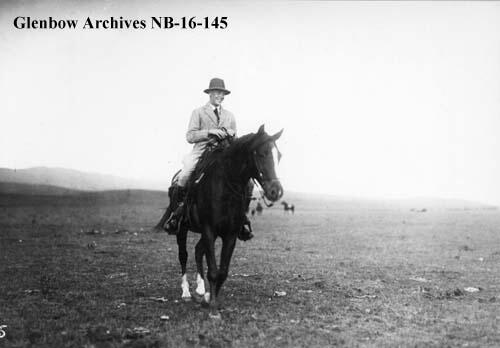
Via Wikimedia Commons: The Prince of Wales, 1919, nb-16-145 by W. J. Oliver, public domain.
Accession and reign
George V died just before midnight on 20 January 1936.[8] Edward was proclaimed king on 21 January,[5] and the proclamation was read publicly from the balcony of Friary Court, St James's Palace, on 22 January.[8] His coronation was fixed for 12 May 1937.[8] During his reign he created the King's Flight to provide air transport for the royal family's official duties,[1] and on 26 July 1936 he unveiled the Canadian National Vimy Memorial in France.[5] He was never crowned.[1]
Wallis Simpson and the constitutional crisis
Edward met Wallis Simpson, a married American woman, in 1930.[1] She had been introduced to him by his earlier companion, Thelma, Lady Furness; she had been divorced once before and had married Ernest Simpson in 1928.[11] Concern in the Cabinet, the opposition parties and the Dominions (the self-governing countries of the Empire, such as Canada and Australia) grew in 1936, when Mrs Simpson obtained a divorce and it became clear that the King meant to marry her.[1] As a twice-divorced woman she would not have been accepted as Queen, and Edward came to see that he had to choose between her and the Crown.[1]
The Prime Minister, Stanley Baldwin, later gave the House of Commons his own account of his meetings with the King.[4] According to Baldwin, he first raised the matter at Fort Belvedere, the King's house, on 20 October 1936; on 16 November the King told him, "I am going to marry Mrs. Simpson, and I am prepared to go."[4] On 25 November the King asked whether an Act of Parliament could let her be his wife without becoming Queen (an arrangement often called a morganatic marriage), and Baldwin said this would require consulting the Cabinet and the Dominion prime ministers; on 2 December Baldwin told him the plan was impracticable.[4] The Cabinet then formally asked the King to reconsider, and he replied that he could not change his decision.[4]
Abdication
On 10 December 1936, at Fort Belvedere, Edward signed an Instrument of Abdication, a short document declaring his "irrevocable determination to renounce the Throne" for himself and his descendants.[3] It was witnessed by his three younger brothers: Albert, Duke of York; Henry, Duke of Gloucester; and George, Duke of Kent.[3] The original is held by The National Archives of the United Kingdom under reference PC 11/1.[3]
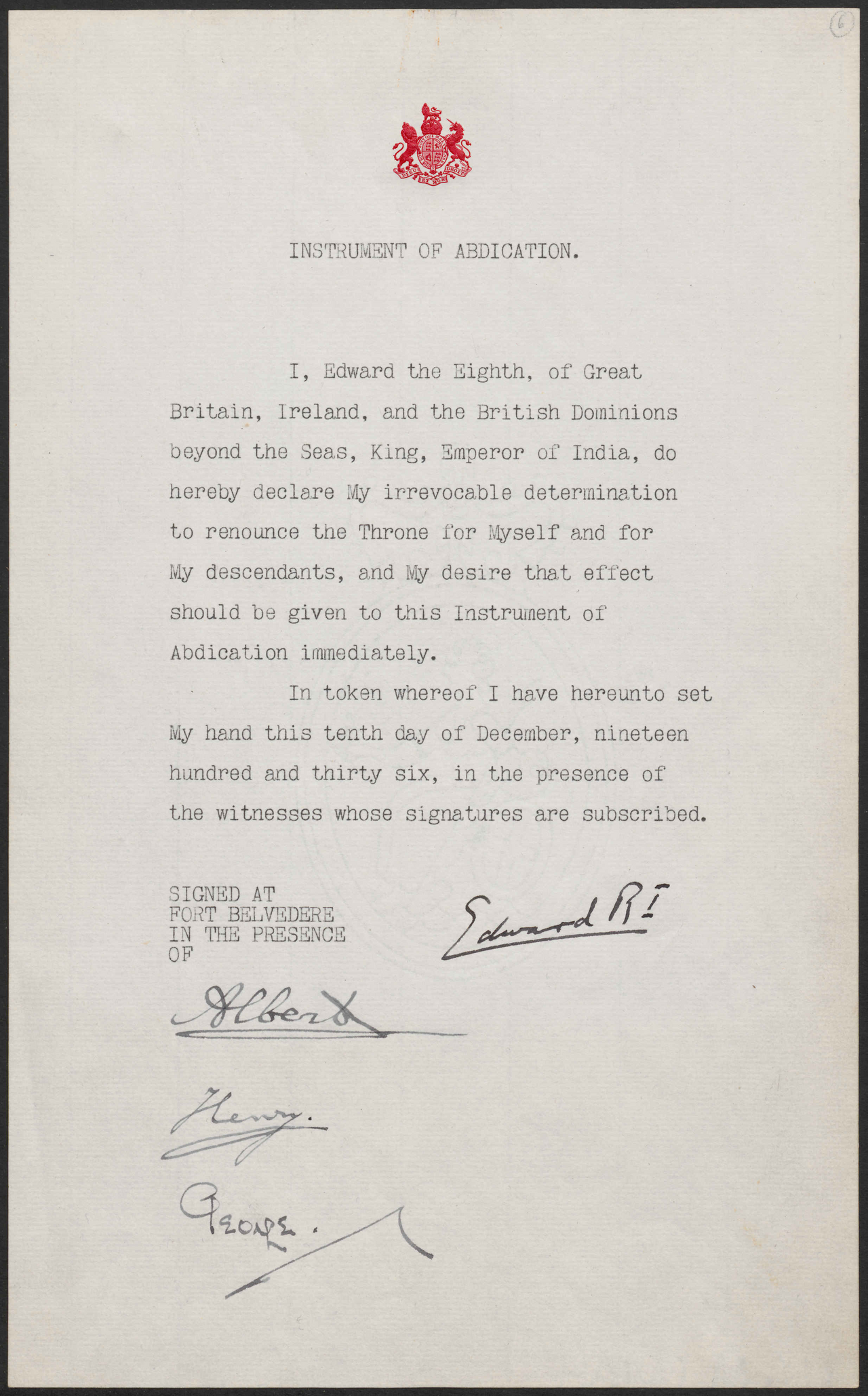
Via Wikimedia Commons: Edward abdication by Edward VIII, public domain.
The same day Baldwin brought the King's message to the House of Commons, in which Edward called the step his "final and irrevocable decision" and asked that the Duke of York succeed him.[4]
Parliament then passed His Majesty's Declaration of Abdication Act 1936.[2] Its preamble records that Canada had requested and consented to the Act under the Statute of Westminster 1931, and that Australia, New Zealand and South Africa had assented to it.[2] The Act provided that, on Royal Assent, the Instrument would take effect and Edward would cease to be king; it excluded him and any descendants from the succession, and it stated that the Royal Marriages Act 1772 would not apply to him or his descendants.[2] Edward gave Royal Assent on 11 December 1936, and the abdication took legal effect that day;[1] the Court Circular recorded the time of assent as 1.52 pm.[9] Canada also passed its own Succession to the Throne Act in 1937.[5]
On 11 December Edward explained his decision in a radio broadcast.[5] In it he said he had found it impossible to carry "the heavy burden of responsibility" and to do his duty as king "without the help and support of the woman I love," and that the decision had been "mine and mine alone."[11] His brother Albert succeeded him under the name George VI.[1] At an Accession Council on 12 December, George VI declared that his brother would henceforth be known as His Royal Highness the Duke of Windsor.[9]
Duke of Windsor
Letters patent (a formal royal grant) creating Edward Duke of Windsor were passed in 1937, and in May 1937 the style "Royal Highness" was confirmed for him alone, not for his wife or any descendants.[9] He married Wallis Simpson in France on 3 June 1937.[5]
In October 1937 the Duke and Duchess toured Germany.[5][12] An overview by Jennie MacDonald for EBSCO Research Starters says the visit was led by Robert Ley, head of the German Labour Front (the Nazi state's labour organisation); that King George VI and his advisers had urged the couple to cancel it; and that the Duke met Hermann Göring on 14 October and Adolf Hitler at Berchtesgaden on 22 October.[12] According to the same overview, both the Duke and Hitler's interpreter, Paul Schmidt, later described the talk with Hitler as noncommittal.[12]
When France fell in 1940 the Duke left Paris for Lisbon, and he was then appointed Governor of the Bahamas, a post he held until 1945.[1] A letter of 28 August 1940, held by The National Archives, records his taking up the office of Governor and Commander-in-Chief.[14] The historian Carolyn Harris writes that the appointment was partly meant to keep him away from Europe during the war, and that he was criticised for interfering in the investigation into the 1943 murder of his friend, the mining millionaire Harry Oakes.[5]
German Foreign Ministry papers about his passage through Spain and Portugal in 1940 were published in 1957 in volume X of the series Documents on German Foreign Policy.[13] How far the Duke sympathised with the Nazi regime remains disputed: MacDonald's overview notes that Martin Allen (2000) argued the Duke passed secrets to Germany through his friend Charles Bedaux, while it describes the biographies by Frances Donaldson (1974) and Philip Ziegler (2001) as more balanced.[12]
Later life, death and burial
The Duke returned to France in 1946 and lived there for the rest of his life.[5] He died at his home in Paris on 28 May 1972, a few days after Queen Elizabeth II had visited him during a state visit to France.[10] His coffin lay in state for two days at St George's Chapel, Windsor, and his funeral was held there on 5 June 1972; it was not a state funeral, and the Welsh Guards, of which he had been colonel, provided the bearer party.[10] He was buried privately in the royal burial ground beside the Frogmore Mausoleum at Windsor.[1][10] His stone records his reign as "King Edward VIII 20th January – 11th December 1936" together with his title as Duke of Windsor.[10]
Sources
- The Royal Household. "Edward VIII (Jan-Dec 1936)". royal.uk. No date shown; accessed 25 November 2026. royal.uk/edward-viii
- UK Parliament. "His Majesty's Declaration of Abdication Act 1936" (1936 c. 3), as enacted, 11 December 1936. legislation.gov.uk. Accessed 25 November 2026. legislation.gov.uk/ukpga/Edw8and1Geo6/1/3/enacted
- The National Archives (UK). "Abdication of Edward VIII 1936" (education resource on the Instrument of Abdication, PC 11/1). No date shown; accessed 25 November 2026. nationalarchives.gov.uk/education/resources/significant-events/abdi…
- Hansard. "Members of the House of Commons" (King's message and Prime Minister's statement), HC Deb 10 December 1936, vol. 318, cc. 2175–97. UK Parliament. Accessed 25 November 2026. api.parliament.uk/historic-hansard/commons/1936/dec/10/members-of-t…
- Carolyn Harris. "Edward VIII". The Canadian Encyclopedia, Historica Canada, 12 August 2020. thecanadianencyclopedia.ca/en/article/king-edward-viii
- Royal Collection Trust. "Edward VIII (1894-1972), when Prince of Wales", by Frank O. Salisbury, 1917 (RCIN 406708). No date shown; accessed 25 November 2026. col.rct.uk/collection/406708/edward-viii-1894-1972-when-prince-of-w…
- Royal Collection Trust. "The Investiture of the Prince of Wales at Caernarfon Castle, 13th July 1911", by Christopher Williams, 1912 (RCIN 400096); and "The christening of Prince Edward of York, White Lodge, Richmond Park, 1894", by W & D Downey (RCIN 2105959). No date shown; accessed 25 November 2026. rct.uk/collection/400096/the-investiture-of-the-prince-of-wales-at-… and rct.uk/collection/2105959/the-christening-of-prince-edward-of-york-…
- Russell Malloch. "Succession to the Crown: King Edward VIII". The Gazette, 1 March 2023. thegazette.co.uk/all-notices/content/104146
- Russell Malloch. "Succession to the Crown: King George VI". The Gazette, 4 April 2023. thegazette.co.uk/all-notices/content/104153
- Russell Malloch. "Demise of the Crown: #27: Death in France". The Gazette, 22 April 2025. thegazette.co.uk/all-notices/content/104366
- The National Archives (UK). "Sacrifices for love" (On the Record podcast episode transcript, with historian Anne Sebba). No date shown; accessed 25 November 2026. media.nationalarchives.gov.uk/index.php/sacrifices-for-love/
- Jennie MacDonald. "Duke and Duchess of Windsor Visit Nazi Germany". EBSCO Research Starters, 2022. ebsco.com/research-starters/history/duke-and-duchess-windsor-visit-…
- Hansard. "Duke of Windsor Papers", Written Answers, HC Deb 26 October 1995, vol. 264, c. 757W. UK Parliament. Accessed 25 November 2026. api.parliament.uk/historic-hansard/written-answers/1995/oct/26/duke…
- Atlantic Archive: UK-US Relations in an Age of Global War 1939-1945. "Duke of Windsor takes up the Office of the Governor and Commander-in-Chief of Bahamas", 28 August 1940 (The National Archives, FO 115/3421). Institute of Latin American Studies, School of Advanced Study, SAS-Space. Accessed 25 November 2026. sas-space.sas.ac.uk/8220
