Compare versions
Version 1 → Version 3 (current). Removed · Added. This shows the entry's text as it is written, including its formatting marks.
Version 1 · Version 3 (current) · Version history
Side by side · Together
James Earl "Jimmy" Carter Jr. (1 October 1924 – 29 December 2024) was an American politician and farmer from Plains, Georgia, who served as the 39th president of the United States from 1977 to 1981 and later received the 2002 Nobel Peace Prize.[1][2]
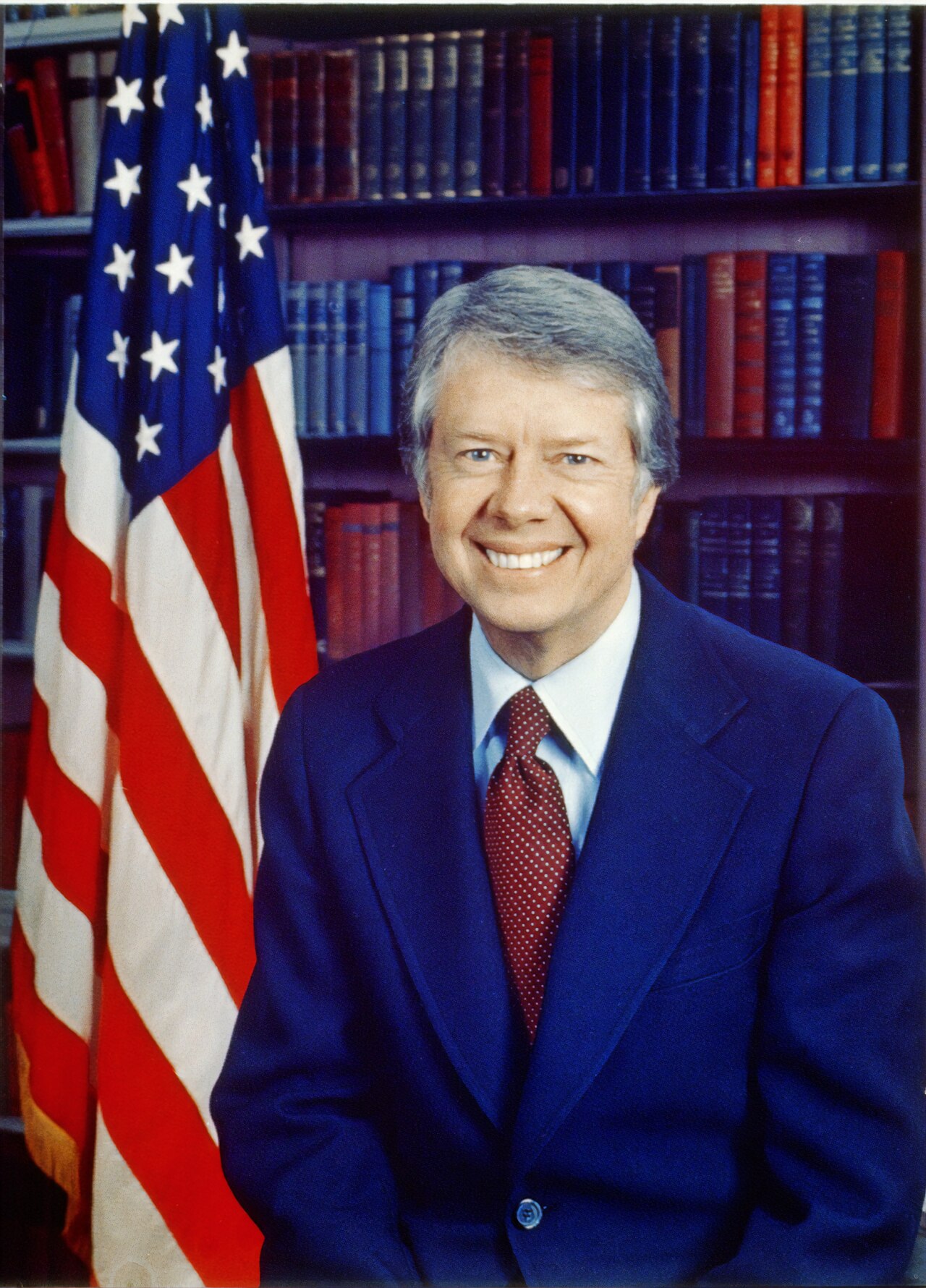
*Via Wikimedia Commons: [Official Portrait of Jimmy Carter (1977)](https://commons.wikimedia.org/wiki/File:Official_Portrait_of_Jimmy_Carter_(1977).jpg) by The White House, public domain.*
## Early life and naval career
Carter was born in Plains, Georgia, on 1 October 1924 and grew up in the nearby community of Archery.[1] His father, James Earl Carter Sr., was a farmer and businessman, and his mother, Lillian Gordy Carter, was a registered nurse.[1] The family farm covered about 360 acres, and his father began growing peanuts while Carter was a young child; at the age of five Carter sold boiled peanuts on the streets of Plains.[4]
After attending school in Plains, Georgia Southwestern College and the Georgia Institute of Technology, Carter graduated from the United States Naval Academy with a Bachelor of Science degree in 1946.[1] He married Rosalynn Smith, also from Plains, on 7 July 1946; the couple had three sons and a daughter.[1][3] Carter served as a submarine officer in the Atlantic and Pacific fleets and reached the rank of lieutenant.[1] Admiral Hyman Rickover chose him for the Navy's nuclear submarine program, and Carter did graduate work in reactor technology and nuclear physics at Union College in Schenectady, New York, while serving as senior officer of the crew preparing the Seawolf, the second nuclear-powered submarine, for service.[1]
## Farming and business in Plains
When his father died in 1953, Carter resigned his naval commission and returned to Plains to run the family's farmland and its farm supply business.[1][4] He and Rosalynn ran Carter's Warehouse, which sold certified seed peanuts, shelled, bought and stored peanuts, and also sold fertilizer, ginned cotton and offered other farm services.[1][4] Instead of only reselling certified seed (seed tested and approved for planting quality), Carter began growing peanut seed himself, which allowed the business to grow.[4] Before taking office as president he placed the business in a blind trust, an arrangement in which an independent trustee manages assets without the owner's involvement.[4] According to the National Park Service, after his presidency the Carters found that drought and management changes had left them more than $1 million in debt, and they sold the business.[4]
## Georgia politics
Carter served on local boards dealing with education, the hospital authority and the library.[1] He was elected to the Georgia Senate in 1962.[1] He lost his first race for governor in 1966, won the next election, and was sworn in as Georgia's 76th governor on 12 January 1971.[1] In 1974 he chaired the Democratic National Committee's campaign effort for that year's congressional and gubernatorial elections.[1]
## 1976 presidential election
Carter announced his candidacy for president on 12 December 1974.[1] He won the Democratic nomination on the first ballot at the 1976 national convention, with Senator Walter F. Mondale as his running mate.[3] After three debates with the incumbent Republican president, Gerald R. Ford, Carter won the election on 2 November 1976 by 297 electoral votes to 241.[1][3] The Nobel Prize organisation's account attributes his victory partly to his reputation as an honest man and a born-again Christian.[2]
## Presidency (1977–1981)
Carter took office on 20 January 1977 and served one term, ending on 20 January 1981.[1]
### Foreign policy
Carter made human rights a central theme of his foreign policy, an emphasis that the Soviet Union and some other governments received poorly.[1][3]
In September 1977 the United States and Panama signed two treaties on the Panama Canal: a Neutrality Treaty, which allowed the United States to use military force to defend the canal's neutrality, and the Panama Canal Treaty, which ended the Panama Canal Zone on 1 October 1979 and provided for the canal to be handed over to Panama on 31 December 1999.[6] The United States Senate approved the Neutrality Treaty on 16 March 1978 and the Panama Canal Treaty on 18 April 1978, each by 68 votes to 32.[6]
In 1978 Carter invited Egyptian President Anwar Sadat and Israeli Prime Minister Menachem Begin to a summit at Camp David, held from 5 to 17 September 1978.[5] The summit did not produce a treaty, but it produced two "framework" documents: one setting out principles for an Egyptian–Israeli peace agreement and one proposing self-government for Palestinians in the West Bank and Gaza; these became known as the Camp David Accords.[5] After further negotiation, including a visit by Carter to Israel in March 1979, Egypt and Israel signed a peace treaty on 26 March 1979.[5] The Nobel Prize organisation describes the Egypt–Israel peace agreement as the high point of his presidency.[2]
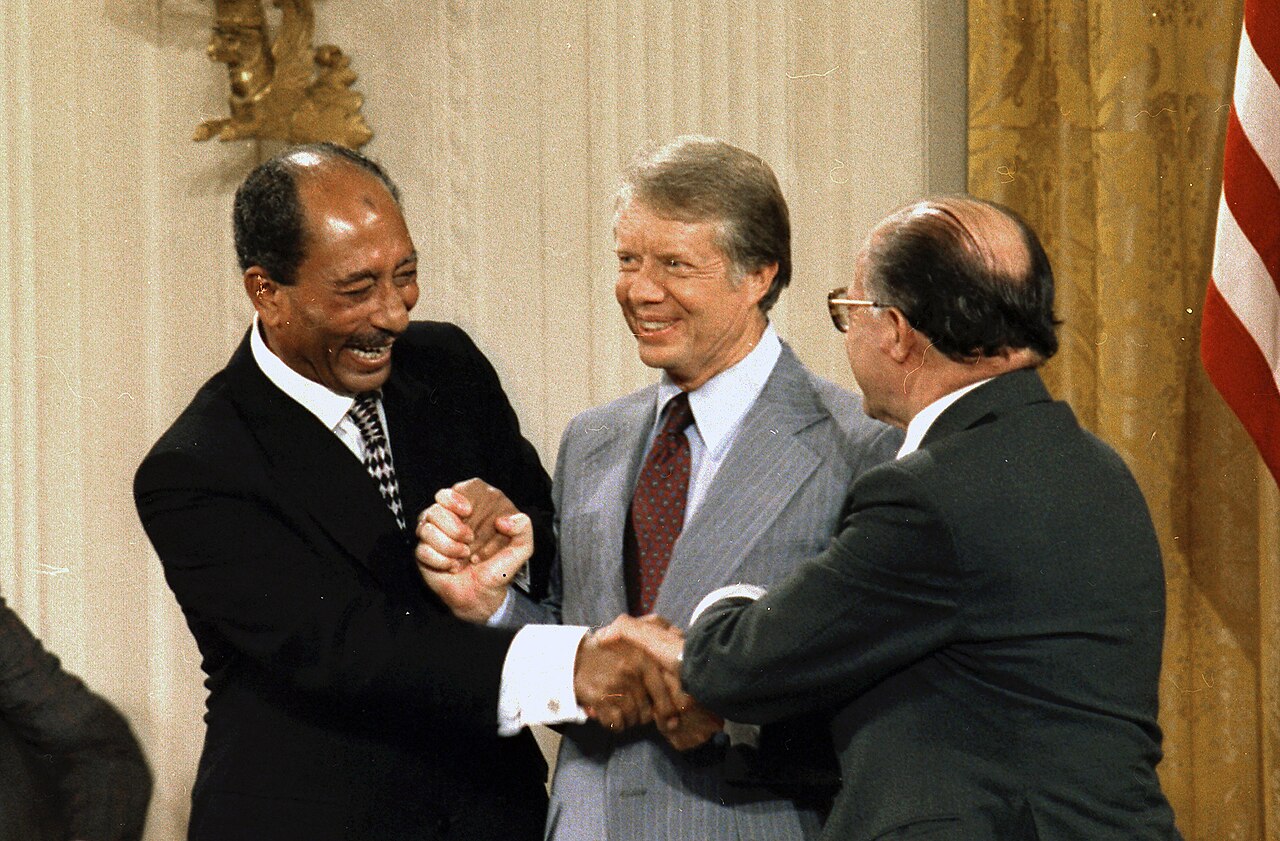
*Via Wikimedia Commons: [Anwar Sadat Jimmy Carter Menachem Begin sign Camp David Accords-1978](https://commons.wikimedia.org/wiki/File:Anwar_Sadat_Jimmy_Carter_Menachem_Begin_sign_Camp_David_Accords-1978.jpg) by Not know or unknown, public domain.*
His administration also completed negotiations with the Soviet Union on SALT II, a treaty limiting strategic nuclear weapons, and established full diplomatic relations with the People's Republic of China.[1][3] After the Soviet Union invaded Afghanistan in 1979, plans to seek Senate ratification of SALT II were suspended.[2][3]
### Domestic policy
Carter introduced a national energy policy, administered through a newly created Department of Energy, and removed price controls on domestic oil to encourage production.[1][3] His administration also created a Department of Education.[1][3] It pursued deregulation (the removal of government rules on prices and market entry) in sectors including energy, transportation, communications and finance, with trucking and airlines among the industries affected.[1][3] The Alaska National Interest Lands Conservation Act, signed during his term, protected large areas of Alaska; the Carter Center says it doubled the size of the national park system and tripled the area of protected wilderness.[1][3] According to the archived White House biography, high inflation and interest rates persisted during his term, and efforts to bring them down contributed to a short recession.[3]
### Iran hostage crisis and 1980 election
On 4 November 1979, a group of Iranian students seized the United States Embassy in Tehran and took its staff hostage, with the approval of the Iranian government led by Ayatollah Khomeini.[7] Thirteen hostages were released later that month, and another was released in July 1980, leaving 52 Americans in captivity.[7] A U.S. military rescue attempt on 24 April 1980 was abandoned after three of its eight helicopters failed, and eight American servicemen died when a helicopter collided with a transport aircraft during the withdrawal.[7] The crisis dominated news coverage for the last 14 months of Carter's presidency.[3] It ended with the Algiers Accords, signed on 19 January 1981, and the 52 hostages were freed on 20 January 1981, minutes after Ronald Reagan was sworn in as Carter's successor, after 444 days in captivity.[7] Carter lost the 1980 presidential election to Reagan; the archived White House biography cites the hostage crisis and continuing inflation as contributing to his defeat.[2][3]
## The Carter Center and later work
In 1982 Carter became a University Distinguished Professor at Emory University in Atlanta, and with Rosalynn Carter, in partnership with Emory, he founded the Carter Center, a nonpartisan, nonprofit organisation working on public policy in the United States and abroad.[1][8] The Carter Presidential Center's permanent buildings in Atlanta were dedicated in October 1986; they include the Jimmy Carter Library and Museum, which is run by the National Archives.[1]
The Carter Center leads the international campaign to eradicate Guinea worm disease.[1][8] People usually catch the disease by drinking water contaminated with the parasite, and about a year later a worm roughly a metre long emerges through a painful blister in the skin, usually on the legs or feet.[8] When the Center took charge of the campaign in 1986, an estimated 3.5 million human cases occurred each year in 21 countries in Africa and Asia.[8] In January 2026 the Center reported 10 provisional human cases worldwide for 2025, the lowest number on record, in South Sudan, Chad and Ethiopia; it also reported infections in animals, with Cameroon reporting the most.[8] The Center's chief executive, Paige Alexander, recalled that Carter had said he wanted to outlive the last Guinea worm.[8]
Carter took part in mediation efforts in places including Ethiopia and Eritrea (1989), North Korea (1994), Liberia, Haiti, Bosnia, Sudan and the Middle East, and by the Carter Center's count he led 114 election-observation missions in the Americas, Africa and Asia.[1] The Nobel Prize organisation notes that his peace and mediation work as a former president sometimes appeared to run counter to official United States policy.[2]
From 1984 Carter and Rosalynn Carter volunteered with the housing charity Habitat for Humanity, giving a week each year until 2020.[1][9] The annual build week that carries their name, the Jimmy & Rosalynn Carter Work Project, had built 4,496 homes in 14 countries with 112,031 volunteers as of 2026, according to Habitat for Humanity.[9] Carter also taught Sunday school at Maranatha Baptist Church in Plains and wrote 32 books, including the memoir Keeping Faith: Memoirs of a President (1982) and An Hour Before Daylight (2001).[1]
## Nobel Peace Prize
The Norwegian Nobel Committee awarded Carter the 2002 Nobel Peace Prize, as sole recipient, for "decades of untiring effort to find peaceful solutions to international conflicts, to advance democracy and human rights, and to promote economic and social development."[2] The award came in autumn 2002, while the administration of George W. Bush was preparing for war with Iraq, and the committee's chairman said Carter should already have received the prize in 1978, for his mediation between Egypt and Israel.[2]
## Final years, death and funeral
On 18 February 2023, Carter decided to spend his remaining time at home with his family and to receive hospice care.[1] Rosalynn Carter died on 19 November 2023.[13] He died at his home in Plains on 29 December 2024, at the age of 100; he was the longest-lived president in U.S. history.[1][2]
His body lay in repose at the Carter Presidential Center in Atlanta and was then taken to Washington, D.C., where it lay in state in the Rotunda of the U.S. Capitol.[10][11] A state funeral was held at Washington National Cathedral on 9 January 2025, attended by all five living presidents; President Joe Biden spoke, and eulogies written by Gerald Ford and Walter Mondale before their deaths were read by their sons.[12] A private service followed the same day at Maranatha Baptist Church in Plains.[10][12] Carter was buried on 9 January 2025 beside Rosalynn Carter, in a memorial garden she designed on the grounds of their former home, which is part of the Jimmy Carter National Historical Park.[12][13]
## Sources
1. The Carter Center. "Jimmy Carter" (biographical summary). The Carter Center, revised 2 January 2025. https://www.cartercenter.org/people/jimmy-carter/
2. Nobel Prize Outreach. "Jimmy Carter – Facts." NobelPrize.org. No date shown; accessed 25 November 2026. https://www.nobelprize.org/prizes/peace/2002/carter/facts
3. The White House (archived Clinton administration website, hosted by the National Archives). "Jimmy Carter." No date shown; accessed 25 November 2026. https://clintonwhitehouse4.archives.gov/WH/glimpse/presidents/html/jc39.html
4. National Park Service, Jimmy Carter National Historical Park. "The Mighty Peanut." National Park Service, last updated 17 October 2023. https://www.nps.gov/jica/planyourvisit/the-mighty-peanut.htm
5. Office of the Historian, U.S. Department of State. "Camp David Accords and the Arab-Israeli Peace Process." Milestones in the History of U.S. Foreign Relations, 1977–1980 (series retired, no longer maintained). No date shown; accessed 25 November 2026. https://history.state.gov/milestones/1977-1980/camp-david
6. Office of the Historian, U.S. Department of State. Panama Canal treaties page, Milestones in the History of U.S. Foreign Relations, 1977–1980 (series retired, no longer maintained). No date shown; accessed 25 November 2026. https://history.state.gov/milestones/1977-1980/panama-canal
7. U.S. National Archives and Records Administration. "Iran Hostage Crisis." National Archives, last reviewed 9 January 2017. https://www.archives.gov/research/foreign-policy/iran-hostage-crisis
8. The Carter Center. "Guinea Worm Disease Reaches All-Time Low: Only 10 Human Cases Reported in 2025." The Carter Center, 30 January 2026. https://www.cartercenter.org/?p=22014
9. Habitat for Humanity International. "Jimmy & Rosalynn Carter Work Project." Habitat for Humanity. No date shown; accessed 25 November 2026. https://www.habitat.org/carter-work-project/jimmy-rosalynn-carter-work-project-habitat
10. NBC News. Article on the arrangements for Jimmy Carter's state funeral (published before the funeral; headline not recorded). NBC News. No date shown; accessed 25 November 2026. https://www.nbcnews.com/politics/politics-news/state-funeral-jimmy-carter-held-jan-9-rcna185747
11. Associated Press. "Jimmy Carter continues to lie in state at Capitol Rotunda ahead of his state funeral." WTOP News, January 2025 (no exact date shown). https://wtop.com/news/2025/01/jimmy-carter-continues-to-lie-in-state-at-capitol-rotunda-ahead-of-his-state-funeral
12. The Week. "Jimmy Carter honored in state funeral, laid to rest." The Week, January 2025 (no exact date shown). https://theweek.com/politics/jimmy-carter-state-funeral
13. National Park Service, Jimmy Carter National Historical Park. "Burial Site of Jimmy and Rosalynn Carter." National Park Service, last updated 12 June 2025. https://www.nps.gov/places/burial-site-of-jimmy-and-rosalynn-carter.htm
