← North Atlantic Treaty Organization
Version 3
Nov 25, 2026. Compare with the current version · Version history
The North Atlantic Treaty Organization (NATO) is a political and military alliance of 32 countries in Europe and North America, founded by the North Atlantic Treaty signed in Washington, D.C., on 4 April 1949, whose members pledge to treat an armed attack on one of them as an attack on all.[1][2]
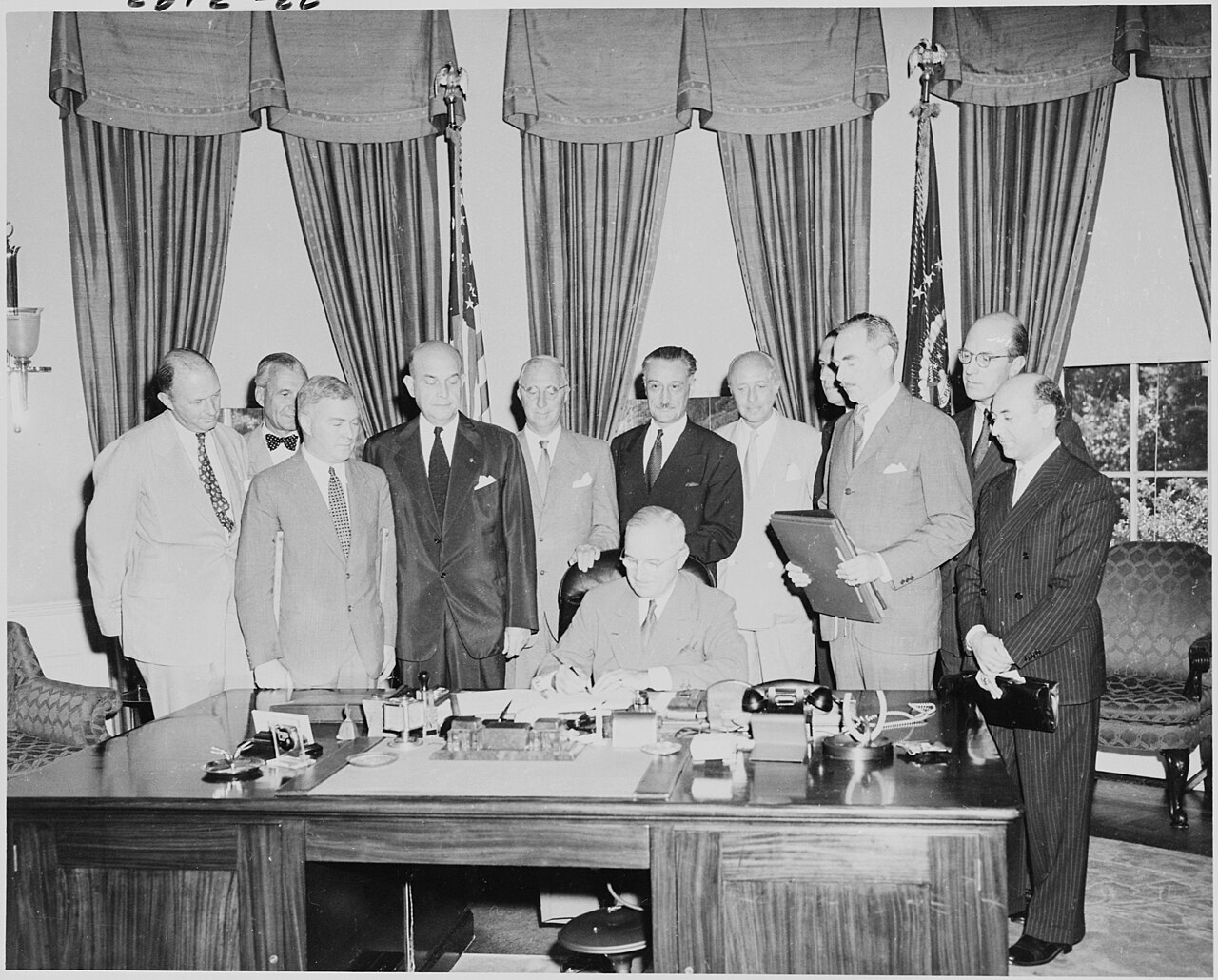
Via Wikimedia Commons: Photograph of President Truman signing the document implementing the N by Abbie Rowe, public domain.
Origins
In March 1948 Great Britain, France, Belgium, the Netherlands and Luxembourg signed the Brussels Treaty, a collective defence treaty under which an attack on one would obligate the others to help defend it.[3] In May 1948 U.S. Senator Arthur H. Vandenberg proposed a resolution urging the President to seek a security arrangement with Western Europe outside the UN Security Council, where the Soviet Union held a veto; the resolution passed and negotiations on a North Atlantic treaty began.[3] The U.S. State Department's history office adds that the 1948 Soviet blockade of West Berlin, and the airlift that answered it, made U.S. officials wary that Western Europe might come to terms with the Soviets, which spurred the alliance idea.[3]
The treaty was signed on 4 April 1949 by twelve founding members: Belgium, Canada, Denmark, France, Iceland, Italy, Luxembourg, the Netherlands, Norway, Portugal, the United Kingdom and the United States.[1][2] It entered into force on 24 August 1949.[1] The outbreak of the Korean War soon afterwards led members to integrate and coordinate their forces under a centralized headquarters, and the United States increased its troop commitments to Europe.[3]
The North Atlantic Treaty
The treaty is short: a preamble and fourteen articles.[1] In the preamble the parties reaffirm their faith in the purposes and principles of the Charter of the United Nations and resolve to unite their efforts for collective defence.[1] The main provisions are:
- Article 1: the parties undertake to settle international disputes by peaceful means and to refrain from the threat or use of force in ways inconsistent with UN purposes.[1]
- Article 3: individually and together, through self-help and mutual aid, they maintain and develop their capacity to resist armed attack.[1]
- Article 4: they consult whenever any of them considers its territorial integrity, political independence or security threatened.[1]
- Article 5: an armed attack against one or more of them in Europe or North America is considered an attack against them all, and each will take the action it deems necessary, including armed force, to restore and maintain security in the North Atlantic area.[1]
- Article 10: by unanimous agreement the parties may invite another European state able to further the treaty's principles and contribute to North Atlantic security to accede.[1]
- Article 13: after twenty years any party may withdraw one year after giving notice to the U.S. government.[1]
NATO describes collective defence as its most fundamental principle. Under Article 5 each Ally decides for itself what assistance to provide, which "may or may not involve the use of armed force."[4]
Article 5 has been invoked once. The attacks of 11 September 2001 struck the United States; the North Atlantic Council met on 12 September and agreed that, if the attack was directed from abroad, it would be covered by Article 5, and on 2 October 2001 it determined that the attacks were regarded as covered by the article.[4] On 4 October 2001 the Allies agreed eight measures to support the United States, including intelligence sharing and access to ports and airfields.[4]
How decisions are made
Consensus has been accepted as the sole basis for decision-making in NATO since 1949, and NATO states that there is no voting: members consult until a decision acceptable to all is reached.[5] The principle applies at every level, from the North Atlantic Council, described as the Alliance's principal political decision-making body, down through its subordinate committees.[5]
Enlargement
According to NATO, 20 countries have joined in ten rounds of enlargement since the founding, bringing the total to 32.[2] Accession dates given by NATO:[2]
- 18 February 1952: Greece and Türkiye
- 6 May 1955: Germany
- 30 May 1982: Spain
- 12 March 1999: Czechia, Hungary and Poland
- 29 March 2004: Bulgaria, Estonia, Latvia, Lithuania, Romania, Slovakia and Slovenia
- 1 April 2009: Albania and Croatia
- 5 June 2017: Montenegro
- 27 March 2020: North Macedonia
- 4 April 2023: Finland (instrument deposited)
- 7 March 2024: Sweden (instrument deposited)
In 1966 France withdrew from NATO's integrated military structure under President de Gaulle.[2]
The Warsaw Pact
The Soviet Union and seven allied states (Albania, Poland, Czechoslovakia, Hungary, Bulgaria, Romania and East Germany) established the Warsaw Treaty Organization on 14 May 1955, shortly after West Germany joined NATO. The U.S. State Department's history office describes it as a Soviet counterbalance to NATO, formed because the Soviets feared a strengthened NATO and a rearmed West Germany.[6] By the late 1980s it was "virtually ineffectual," and it was officially disbanded in March and July 1991.[6] After it ended, NATO says, enlargement to Central and Eastern Europe became possible.[2]
Crisis response in the Balkans
NATO's first military engagement came on 28 February 1994, when its aircraft shot down four warplanes that had violated the no-fly zone over Bosnia and Herzegovina.[7] The Alliance had begun monitoring operations in the Adriatic in July 1992 and started Operation Deny Flight in April 1993.[7] Operation Deliberate Force, in August and September 1995, lasted 12 days and helped push the parties toward a peace agreement.[7] The General Framework Agreement for Peace was signed in Paris on 14 December 1995 after negotiations in Dayton, Ohio.[7]
NATO describes the Implementation Force (IFOR), deployed in December 1995 with a one-year mandate under UN Security Council Resolution 1031, as its first major crisis response operation; it had about 60,000 troops.[7] A Stabilisation Force (SFOR), authorised by Resolution 1088, replaced it from December 1996. It began with 31,000 troops, fell to about 7,000 by 2004, and was officially ended on 2 December 2004, when an EU-led operation took over with NATO planning and command support.[7]
In Kosovo, NATO launched a 78-day air campaign against the Milošević government in March 1999, saying it aimed "to halt and reverse the humanitarian catastrophe that was then unfolding."[8] The Kosovo Force (KFOR) deployed on 12 June 1999 under UN Security Council Resolution 1244 of 10 June 1999 and operates under Chapter VII of the UN Charter.[8] It began with about 50,000 troops and had fallen to about 17,500 by the end of 2003.[8] As of the page NATO updated on 10 November 2026, KFOR had about 4,700 troops from 31 Allied and partner countries, and NATO had announced on 12 June 2026 a "gradual, calibrated and conditions-based" adjustment of its posture over the following year.[8]
Afghanistan
The International Security Assistance Force (ISAF) was a UN-mandated force under Chapter VII of the UN Charter, first deployed in 2001 to secure Kabul.[9] NATO assumed its leadership on 11 August 2003, replacing six-month national rotations, and in October 2003 UN Security Council Resolution 1510 extended its mandate to the whole of Afghanistan.[9] Its presence covered the whole country by the second half of 2006, and at its peak it was more than 130,000 strong, with troops from 51 NATO and partner nations.[9] Responsibility for security began shifting to Afghan forces in July 2011, the last tranche of transition areas was announced on 18 June 2013, and ISAF was completed at the end of 2014.[9] A smaller non-combat mission to train, advise and assist Afghan security forces and institutions began on 1 January 2015.[9]
Defence spending since 2025
At the Hague Summit, on 25 June 2025, NATO's heads of state and government committed to invest 5 percent of GDP annually on core defence requirements and on defence- and security-related spending by 2035, citing the long-term threat from Russia and the persistent threat of terrorism.[10] Of that, at least 3.5 percent of GDP a year is to go to core defence requirements, measured by the agreed NATO definition of defence expenditure, and up to 1.5 percent to wider needs such as protecting critical infrastructure, civil preparedness, innovation and the defence industrial base.[10] Allies are to submit annual plans showing a credible, incremental path to the goal, and the declaration provides for a review of the trajectory and balance of spending in 2029.[10] It also states that direct contributions to Ukraine's defence and defence industry count toward Allies' defence spending.[10]
Sources
- North Atlantic Treaty Organization, "The North Atlantic Treaty", Washington D.C., 4 April 1949 (official text). nato.int/cps/en/natohq/official_texts_17120.htm
- North Atlantic Treaty Organization, "NATO Member Countries" / enlargement history page (read November 2026). nato.int/cps/en/natohq/topics_52044.htm
- Office of the Historian, U.S. Department of State, "The Formation of NATO, 1949", Milestones: 1945-1952 (series retired; undated). history.state.gov/milestones/1945-1952/nato
- North Atlantic Treaty Organization, "Collective defence and Article 5" (read November 2026). nato.int/cps/en/natohq/topics_110496.htm
- North Atlantic Treaty Organization, "Consensus decision-making at NATO" (read November 2026). nato.int/en/what-we-do/introduction-to-nato/consensus-decision-maki…
- Office of the Historian, U.S. Department of State, "The Warsaw Treaty Organization, 1955", Milestones: 1953-1960 (series retired; undated). history.state.gov/milestones/1953-1960/warsaw-treaty
- North Atlantic Treaty Organization, "Peace support operations in Bosnia and Herzegovina (1995-2004)" (read November 2026). nato.int/cps/en/natohq/topics_52122.htm
- North Atlantic Treaty Organization, "NATO's role in Kosovo" (page updated 10 November 2026). nato.int/en/what-we-do/operations-and-missions/natos-role-in-kosovo
- North Atlantic Treaty Organization, "ISAF's mission in Afghanistan (2001-2014)" (read November 2026). nato.int/cps/en/natohq/topics_69366.htm
- North Atlantic Treaty Organization, "The Hague Summit Declaration", 25 June 2025 (read November 2026). nato.int/en/about-us/official-texts-and-resources/official-texts/20…
