Version 2 (current)
Nov 25, 2026. Version history
The Federal Deposit Insurance Corporation (FDIC) is an independent agency of the United States government, created by Congress in 1933, that insures deposits at U.S. banks and savings associations and supervises many of them.[5][4]
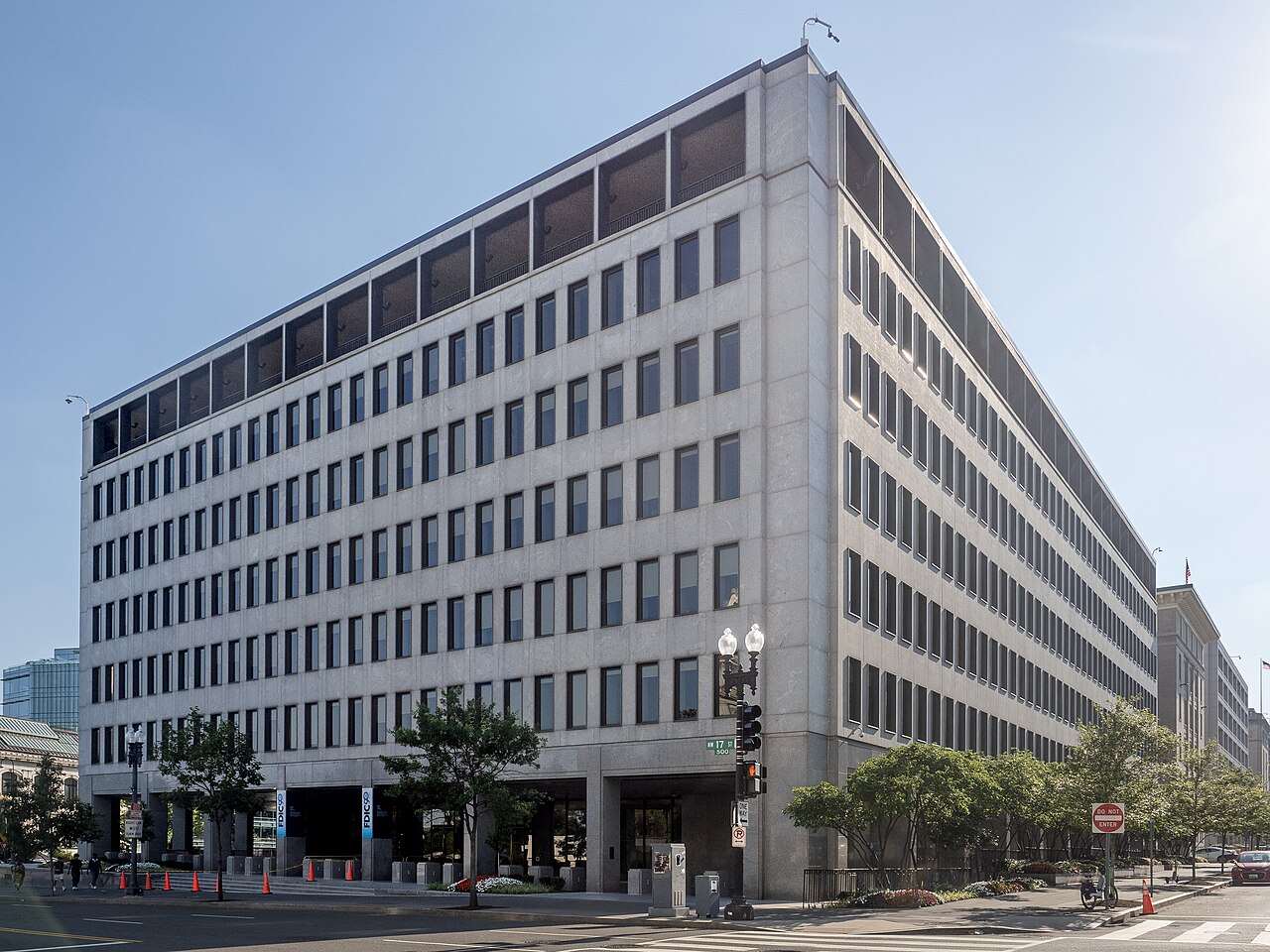
Via Wikimedia Commons: Federal Deposit Insurance Corporation Headquarters (53844538271) by ajaysuresh, CC BY 2.0.
What it insures
As of the FDIC's page last updated April 1, 2024, the agency insures deposits up to at least $250,000 per depositor, per ownership category, at each FDIC-insured bank.[1] Deposits in the same ownership category at one bank are added together, while the same person's accounts at a different insured bank are covered separately.[1] The categories the FDIC lists include single accounts, joint accounts, certain retirement accounts, trust accounts, employee benefit plan accounts, business accounts and government accounts.[1]
Covered products are checking, NOW, savings and money market deposit accounts, certificates of deposit, and official items such as cashier's checks and money orders.[1] Not covered are stocks, bonds, mutual funds, annuities, life insurance, the contents of safe deposit boxes, U.S. Treasury securities, municipal securities and crypto assets, nor non-deposit investment products sold through an insured bank.[1] The FDIC states that since its founding in 1933 "no depositor has lost a penny of FDIC-insured funds."[1]
Origins
The FDIC was created by the Banking Act of 1933, commonly called Glass-Steagall, which President Franklin D. Roosevelt signed on June 16, 1933.[3][4] Deposit insurance was its most controversial provision: Representative Henry Steagall insisted on it, mainly to protect small rural banks, large banks opposed it for fear of subsidizing smaller ones, and Roosevelt threatened a veto before public support after the bank holiday helped win him over.[3] A temporary insurance fund began in January 1934 covering deposits up to $2,500; in July 1934 the fund became permanent and the limit rose to $5,000.[3] Federal Reserve member banks had to become FDIC stockholders by July 1, 1934.[3]
The agency's statutory basis was first section 12B of the Federal Reserve Act; in 1950 that text was set apart as its own chapter of the U.S. Code.[4] Savings associations were added to the institutions it insures in 1989 by Pub. L. 101-73.[4] For the run-on-the-bank problem the corporation was built to address, see Bank run; for the broader idea, see Deposit insurance.
Changes to the coverage limit
The limit began at $2,500 in the temporary fund of January 1934 and rose to $5,000 when the fund became permanent that July.[3] On March 31, 1980, the Depository Institutions Deregulation and Monetary Control Act, signed by President Jimmy Carter, raised it from $40,000 to $100,000.[7] On October 3, 2008, during the financial crisis, the Emergency Economic Stabilization Act temporarily raised coverage to $250,000, and Public Law 111-22 of May 20, 2009 extended that increase to the end of 2013.[9] The Dodd-Frank Act of July 21, 2010 made $250,000 the permanent standard maximum, retroactive to January 1, 2008.[10] The same law temporarily gave unlimited coverage to noninterest-bearing transaction accounts from December 31, 2010 to December 31, 2012.[10]
Crises and reforms, 1980 to 2010
The FDIC's own timeline records 11 FDIC-insured banks and 11 thrifts (savings institutions insured by a separate agency, the FSLIC) failing in 1980, and 279 banks and 185 thrifts in 1988.[7] On August 9, 1989, President George H.W. Bush signed the Financial Institutions Reform, Recovery and Enforcement Act (FIRREA), which mainly addressed the savings and loan crisis; it replaced the FSLIC's insurance fund with a new Savings Association Insurance Fund managed by the FDIC, which became responsible for deposit insurance for both banks and savings institutions.[7]
The Federal Deposit Insurance Corporation Improvement Act, signed on December 19, 1991, introduced "prompt corrective action", which requires regulators to respond more severely as an institution's capital ratios fall, required annual on-site examinations (with relief for small, healthy banks), and required risk-based deposit insurance premiums by 1994.[8] The FDIC's timeline lists failures of 169 banks and 213 thrifts in 1990, falling to 13 banks and 2 thrifts in 1994, with the thrift counts covering institutions the Resolution Trust Corporation was responsible for.[8] On January 6, 1991, Bank of New England Corp. failed with $21.8 billion in total assets, which the timeline describes as the largest failure since MCorp in 1989.[8] In the 2008 crisis, the timeline says 157 insured institutions failed in 2010, the most of any year of the crisis, and that the number of problem institutions rose to 884 by the end of that year.[10]
Structure and funding
As of a page last updated January 28, 2026, the FDIC lists three main responsibilities: insuring deposits, supervising and examining banks and savings associations for safety, soundness and consumer-protection compliance (it directly supervises over 2,700 institutions), and responding when an institution fails, most commonly by selling the failed institution's deposits and loans to another bank.[2] Its Board of Directors has up to five members, appointed by the President and confirmed by the Senate, with no more than three from one political party; the Comptroller of the Currency and the Director of the Consumer Financial Protection Bureau sit on it.[2]
The FDIC receives no Congressional appropriations and is funded by assessments paid by the institutions it insures.[2] Its Deposit Insurance Fund draws on those assessments and on interest earned on Treasury notes the FDIC buys, and is backed by the full faith and credit of the U.S. government.[1] For how failures are handled, see Bank resolution.
Bank failures
The FDIC publishes a list of banks that have failed since October 1, 2000. As of its update of September 25, 2026, the most recent entry is Nano Banc of Irvine, California, which closed on September 25, 2026 and was acquired by Sunwest Bank.[6]
Sources
- Federal Deposit Insurance Corporation, "Understanding Deposit Insurance," last updated April 1, 2024. fdic.gov/resources/deposit-insurance/understanding-deposit-insurance/
- Federal Deposit Insurance Corporation, "What We Do," last updated January 28, 2026. fdic.gov/about/what-we-do
- Julia Maues, "Banking Act of 1933, Commonly Called Glass-Steagall," Federal Reserve History, November 22, 2013. federalreservehistory.org/essays/glass-steagall-act
- "12 U.S. Code § 1811 – Federal Deposit Insurance Corporation," Legal Information Institute, Cornell Law School. law.cornell.edu/uscode/text/12/1811
- Federal Deposit Insurance Corporation, "History of the FDIC," last updated March 8, 2024. fdic.gov/about/history
- Federal Deposit Insurance Corporation, "Failed Bank List," last updated September 25, 2026. fdic.gov/bank-failures/failed-bank-list
- Federal Deposit Insurance Corporation, "Historical Timeline: 1980-1989," last updated August 6, 2025. fdic.gov/history/1980-1989
- Federal Deposit Insurance Corporation, "Historical Timeline: 1990-1999," last updated August 6, 2025. fdic.gov/history/1990-1999
- Federal Deposit Insurance Corporation, "Historical Timeline: 2000-2009," last updated May 15, 2025. fdic.gov/history/2000-2009
- Federal Deposit Insurance Corporation, "Historical Timeline: 2010-2019," last updated May 15, 2025. fdic.gov/history/2010-2019
