Version 2
Nov 25, 2026. Compare with the current version · Version history
Christian Dior (1905–1957) was a French couturier who opened his own fashion house in Paris in 1946 and, with his first collection in February 1947, set the silhouette that the press named the "New Look".
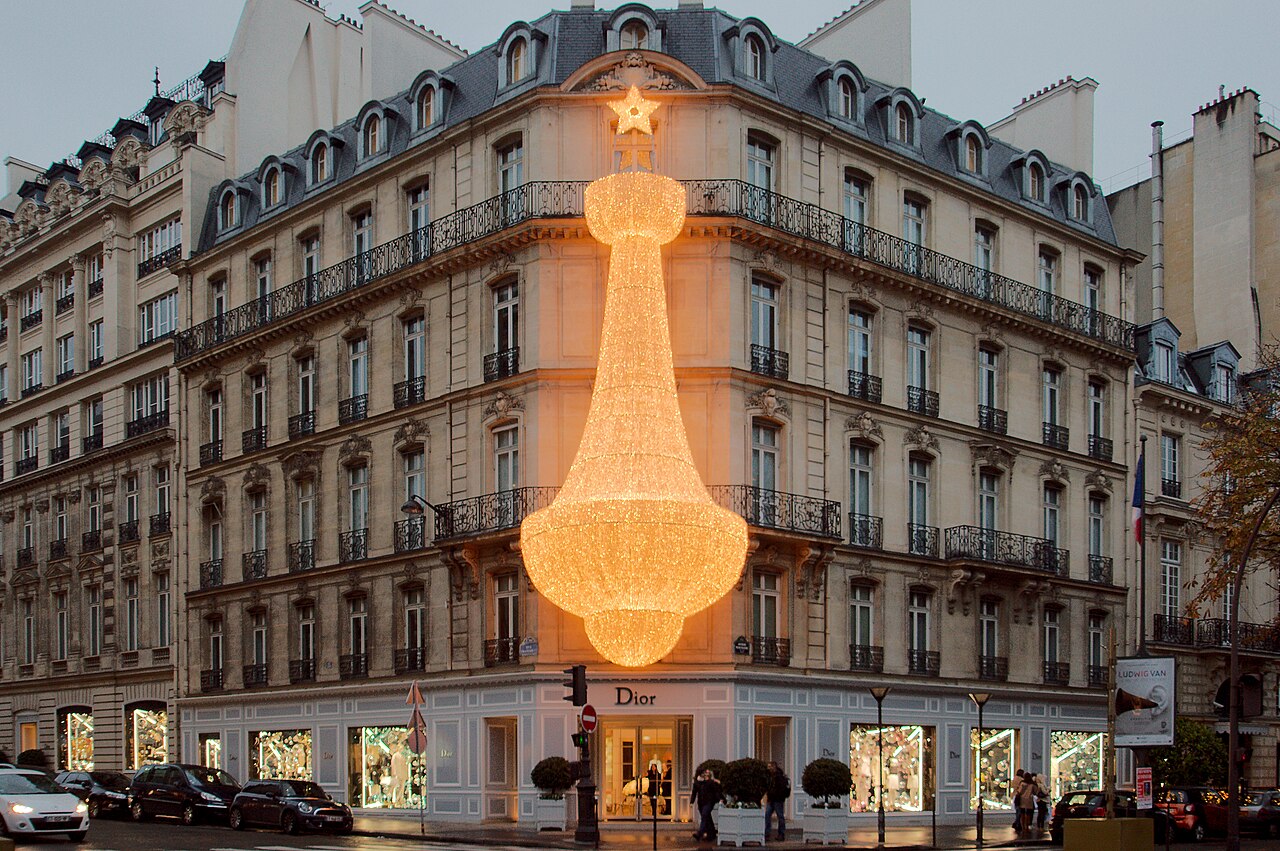
Via Wikimedia Commons: Christian Dior, 30 Avenue Montaigne, Paris 2016 by Frédéric BISSON from Rouen, France, CC BY 2.0.
Early life and training
Christian Dior was born on 21 January 1905 in Granville, in Normandy, and died on 24 October 1957 in Montecatini, Italy, at the age of 52.[1] His father wanted him to enter diplomacy, so he studied politics at the Paris school Sciences Po, though he wanted to work in the arts.[1] One biographical dictionary describes his father as a wealthy Norman manufacturer of chemicals and fertiliser.[3]
In 1928 he opened an art gallery with a partner, paid for by his family, and it closed in 1931 after the family business collapsed.[1] The National Gallery of Victoria's timeline gives the partner as Jacques Bonjean, places the gallery on the Rue La Boétie, and records that in 1931 his brother Raymond and his mother Madeleine died and the family business was ruined after the 1929 stock market crash.[2]
He then worked as a fashion illustrator, first of hats and later of dresses.[3] The same timeline dates the start of that work to 1935. It records that in 1938 he spent a year as a design assistant to Robert Piguet before war service, and that in 1941 he became a designer for Lucien Lelong, where Pierre Balmain also worked.[2] The Design Museum says he was called up in the Second World War, demobilised after France's surrender and spent time on a farm in Provence.[1]
The house and the New Look
With the financial backing of the textile industrialist Marcel Boussac, Dior opened his own couture house at 30 Avenue Montaigne in Paris in 1946.[1][2] The National Gallery of Victoria dates the opening to December 1946.[2] His first collection was shown on 12 February 1947 in two lines, La Ligne Corolle and En 8, and 95 looks.[2] The clothes had soft shoulders, narrow waists, rounded hips and full skirts.[1] The editor of Harper's Bazaar, Carmel Snow, praised the collection, saying the dresses had "such a new look", and the name stuck.[1] The Design Museum lists the "Bar suit" among the most popular designs of the line.[1]
Dior was awarded the French Legion of Honour in 1950.[2] Later collections included the H-line in 1954 and the A-line in 1955.[3] In August 1955 he lectured at the Sorbonne on "The Aesthetics of Fashion" to 4,000 students, and he appeared on the cover of Time on 4 March 1957.[2]
A fashion house as a business
Dior moved beyond couture into other products, which set him apart from the traditional small Paris houses.[1] Parfums Christian Dior was founded in 1947 with Serge Heftler Louiche, and its first perfume, Miss Dior, was named after his sister Catherine.[2] A ready-to-wear boutique, Christian Dior–New York, opened in 1948, and the house also had a furs branch in Paris.[1][2]
The house also changed how fashion was licensed. When a US hosiery company offered a flat fee for the right to make Dior stockings, Dior proposed a percentage of sales instead, which brought royalty-based licensing into the fashion industry; a licensing system for stockings in the United States began in 1949.[1] One biographical dictionary says the business grew to eight firms and sixteen associate firms in twenty-four countries, reportedly grossing about $20 million a year, and that the label extended to jewellery, scarves, men's ties, furs, stockings, gloves and ready-to-wear clothing.[3]
In 1953 the shoe designer Roger Vivier began a ten-year working relationship with Dior, and was the only person to have his name stamped in the insole alongside Dior's.[2]
Death and succession
Dior died on 24 October 1957 in Montecatini, Italy, aged 52, ten days after leaving Paris for a rest cure at the spa town once the fittings for his autumn 1957 collection were finished.[1] The National Gallery of Victoria timeline gives a heart attack as the cause.[2] The Design Museum notes that the cause "has attracted many speculations" and that accounts differ.[1] That autumn collection included thirty-five outfits by Yves Saint Laurent, who had joined the house in 1955 as Dior's first assistant.[1]
Marcel Boussac sent his private plane to bring the body back to Paris, and some 2,500 people attended the funeral, among them the house's staff and clients led by the Duchess of Windsor.[1] The French newspaper Le Monde described him as a man "identified with good taste, the art of living and refined culture that epitomises Paris to the outside world".[1] By the National Gallery of Victoria's account, the house then produced half of all French haute couture exports.[2]
A fortnight after the death, the house's managing director Jacques Rouët announced how it would be run: a studio head, a head of the couture workshops, and Mitza Bricard continuing to oversee the collections, with the sketches the responsibility of Saint Laurent.[1] Saint Laurent was named successor at the age of 21, and his first collection, on 30 January 1958, was a range of triangular silhouettes later called the Trapeze line, which was a popular success.[2] The Design Museum says he designed it in nine weeks and made the clothes softer, lighter and easier to wear than Dior's, though built with the same care.[1]
His designs grew bolder, culminating in the 1960 "Beat Look", inspired by the existentialists and jazz clubs of Saint-Germain-des-Prés. The Design Museum reports that Boussac was furious, and that when Saint Laurent was called up for army service in spring 1960 the house's management raised no objection; after his discharge he opened his own couture house.[1] The two sources date the change of designer differently: the National Gallery of Victoria says Marc Bohan replaced Saint Laurent in 1960, the Design Museum says 1961.[1][2]
The house after Dior
Bohan led the house for twenty-nine years and presented fifty-seven haute couture collections, with a conservative style, until 1989.[1][2] In the meantime the ownership changed. The National Gallery of Victoria records that the Agache group had owned the Dior firm since 1978, following the compulsory liquidation of the Boussac group, that Bernard Arnault gained control of that group in 1984, and that in 1985 he became chairman and managing director of Maison Dior.[2]
Gianfranco Ferré became artistic director in 1989 and spent fifteen seasons at the house.[2] John Galliano was appointed chief designer in 1996 by the house's new owner, the luxury group LVMH, and left in 2011; the National Gallery of Victoria, which counts his term in seasons, dates its start to the house's fiftieth anniversary in 1997 and notes that he was the first British designer in nearly 150 years to head a major French fashion house.[1][2] The Design Museum records that Raf Simons was announced as Creative Director in April 2012 and stepped away in October 2015, and that Maria Grazia Chiuri was announced in July 2016 as the first woman to design womenswear for Dior.[1] Neither source covers appointments after that, and this entry does not either.
Sources
- Design Museum, "Christian Dior", designmuseum.org (undated; opened 25 November 2026). designmuseum.org/designers/christian-dior
- National Gallery of Victoria, "The House of Dior: Seventy Years of Haute Couture", timeline, ngv.vic.gov.au (2017 exhibition; opened 25 November 2026). ngv.vic.gov.au/ngv_timeline/the-house-of-dior-seventy-years-of-haut…
- "Christian Dior", Encyclopedia of World Biography (Gale), reproduced on Encyclopedia.com (page © 2019). encyclopedia.com/history/encyclopedias-almanacs-transcripts-and-map…
