Version 2 (current)
Nov 25, 2026. Version history
Alexander Hamilton was a Caribbean-born American lawyer, soldier and political leader who helped write The Federalist and served as the first United States Secretary of the Treasury, from 1789 to 1795.[1][2]
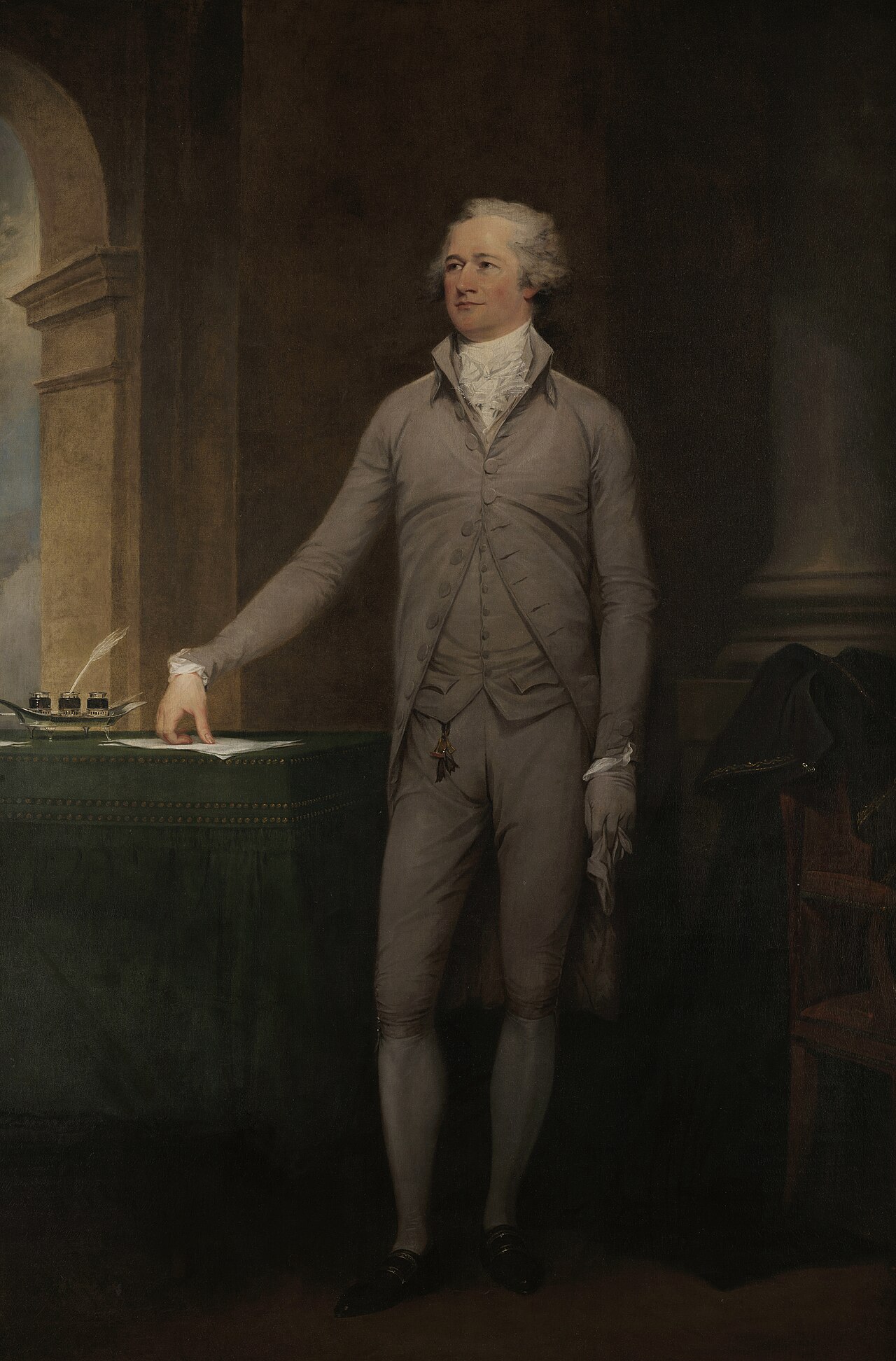
Via Wikimedia Commons: Google Arts Project - Alexander Hamilton (1792 portrait) by John Trumb by John Trumbull, public domain.
Birth and early life
Hamilton was born on 11 January on Nevis, a British island in the Caribbean.[2][3] Sources differ on the year. The National Park Service gives 1755,[3] the US Department of the Treasury gives 1757,[1] and Encyclopaedia Britannica gives the date as "1755/57" to show that the year is uncertain.[2]
According to Britannica, his father, James Hamilton, was a trader and a son of a Scottish laird (landowner) of Cambuskeith in Ayrshire.[2] His mother, Rachel, was the daughter of a French Huguenot (Protestant) physician and was married to John Michael Lavine, a merchant who had settled on St. Croix in the Danish West Indies.[2]
James Hamilton left the family in 1765.[2] At about age 11, Alexander became a clerk in the counting-house (trading office) of two New York merchants who had recently set up business on St. Croix.[2] His mother died in 1768, leaving him an orphan at about 13, and he became the ward of her relatives.[2][3] In 1772 he rose from bookkeeper to manager of the business.[2]
Hamilton moved to North America in 1772.[3][4] After a preparatory school in Elizabethtown, New Jersey, he entered King's College in New York (later Columbia University).[2] Britannica dates his entry to autumn 1773, while the National Park Service says he officially entered in 1774.[2][3] He left without finishing his studies to fight in the Revolution.[3] In 1774 and 1775 he wrote pamphlets defending the trade boycott that the Continental Congress had called against Britain.[2]
Revolutionary War
In March 1776 he was commissioned a captain in New York's provincial artillery.[2][5]
In February 1777, George Washington invited him to join his staff as an aide-de-camp (a personal assistant officer) with the rank of lieutenant colonel.[2][5] His duties were largely administrative.[2][5] Because he spoke French, he also served as a go-between with French generals and admirals.[2]
In early 1781 Hamilton quarrelled with Washington and resigned as his aide.[2][5] In July 1781 Washington gave him command of a battalion.[2] On the night of 14 October 1781, at the Siege of Yorktown in Virginia, Hamilton led an assault on a British redoubt (a small fort).[5]
In December 1780 Hamilton had married Elizabeth Schuyler, daughter of General Philip Schuyler.[2][3] The couple had eight children.[3]
Lawyer and constitution-maker
After studying law in Albany, Hamilton was admitted to practise in July 1782.[2] The New York legislature sent him to the Continental Congress, where he served from November 1782 to July 1783.[2] From 1783 he practised law in New York City, where he defended Loyalists (colonists who had sided with Britain) sued under the state's Trespass Act.[2]
Hamilton was a New York delegate to the Annapolis Convention of September 1786, and he drafted its address calling for a wider convention in Philadelphia.[2] At the Constitutional Convention, which opened in May 1787, he served on the committees on rules and on style.[2] In a speech on 18 June he proposed a national government with very wide power over the states, a plan the delegates did not adopt.[2] Because New York's two other delegates had left, the state was not officially represented at the end, and Hamilton signed the Constitution as an individual.[2]
In support of the new Constitution, Hamilton, James Madison and John Jay wrote a series of newspaper essays under the shared pen name "Publius".[2] The 85 essays, later collected as The Federalist, appeared between October 1787 and May 1788.[2] Britannica says Hamilton wrote at least two-thirds of them; the National Park Service puts his share at 51.[2][3] At New York's ratifying convention in June 1788, he was the Constitution's chief advocate.[2]
Secretary of the Treasury
Washington, who became president in April 1789, appointed Hamilton the first Secretary of the Treasury on 11 September 1789.[5] The Treasury describes him as the architect of the department's structure; he wanted it to be strong and centrally controlled, to collect and pay out public money, and to promote national economic growth.[1]
Public credit. Hamilton described the national debt left by the Revolutionary War as "the price of liberty".[1] His 1790 Report on Public Credit urged the federal government to take over (assume) the war debts of the states.[3]
Revenue. In 1790 and 1791 he put in place a revenue system based on customs duties (taxes on imports) and excise taxes (taxes on goods made at home).[1] He urged Congress to build ten cutters (small armed ships) to enforce the tariff laws and stop smuggling, and Washington signed the law creating this revenue marine on 4 August 1790.[6] The service is the forerunner of the US Coast Guard.[6]
The national bank. In 1791 Hamilton's plan produced the First Bank of the United States, which acted as the government's financial agent, held public funds and issued paper money.[1] Washington received written opinions from Secretary of State Thomas Jefferson and Attorney General Edmund Randolph, both arguing that it was unconstitutional, and on 16 February 1791 he asked Hamilton for his view.[7] Hamilton's reply, dated 23 February 1791, argued that the Constitution's "necessary and proper" clause gave Congress powers beyond those it lists by name.[7] This idea became known as the doctrine of implied powers, and Chief Justice John Marshall later relied on it, most famously in McCulloch v. Maryland (1819).[7] Washington signed the bill.[7]
The Mint. Hamilton wanted the national Mint to be part of the Treasury, but Jefferson prevailed, and the Mint was set up in 1792 under the State Department.[1]
Manufactures. Washington had urged Congress to encourage American manufacturing, and the House asked the Treasury for a report.[8] Hamilton's Report on Manufactures is dated 5 December 1791.[8] The report argued that relying on foreign trade was risky, that public debt could serve as "artificial capital" for industry, and that the government could support manufacturers with bounties and premiums (payments and prizes).[8]
Political conflict. Hamilton's view of a powerful Treasury brought him into conflict with Jefferson and with Albert Gallatin.[1] He belonged to the Federalist Party.[2]
Hamilton resigned in 1795, citing money troubles (his salary was $3,500 a year), and returned to law practice in New York.[1] Near the end of Washington's presidency, he helped draft Washington's Farewell Address.[5]
The Reynolds affair
In December 1792, three members of Congress, Frederick Muhlenberg, James Monroe and Abraham Venable, questioned Hamilton about charges made by James Reynolds and Jacob Clingman, two men who had been accused of fraud.[9] Hamilton told them he had had an affair with Reynolds's wife, Maria, and that Reynolds had blackmailed him; he showed them papers, and they appeared satisfied.[9]
In June and July 1797 the writer James Thomson Callender published pamphlets charging that Hamilton, while at the Treasury, had joined Reynolds in improper speculation.[9] In August 1797 Hamilton replied with a pamphlet, "Observations on Certain Documents", now known as the Reynolds Pamphlet.[5][9] In it he admitted the affair, said Reynolds had extorted money from him through 1792, and denied any misuse of public funds.[9] Most historians have broadly accepted his account, but the historian Julian P. Boyd argued that parts of it may have been invented.[9] Republicans, among them James Madison, were largely scornful of the pamphlet, holding that it confirmed a private scandal without answering the charge of official misconduct.[9] The affair also led to a quarrel with Monroe in which a duel was narrowly avoided.[9]
Later years
During the Quasi-War, a period of conflict with France from 1798 to 1800, Hamilton was made inspector general of the US Army, with Washington's backing and President John Adams's reluctant agreement.[5] In 1800 he bought 32 acres in Harlem, in upper Manhattan, and built a country house there, completed in 1802 and named the Grange after his family's ancestral home in Scotland.[3]
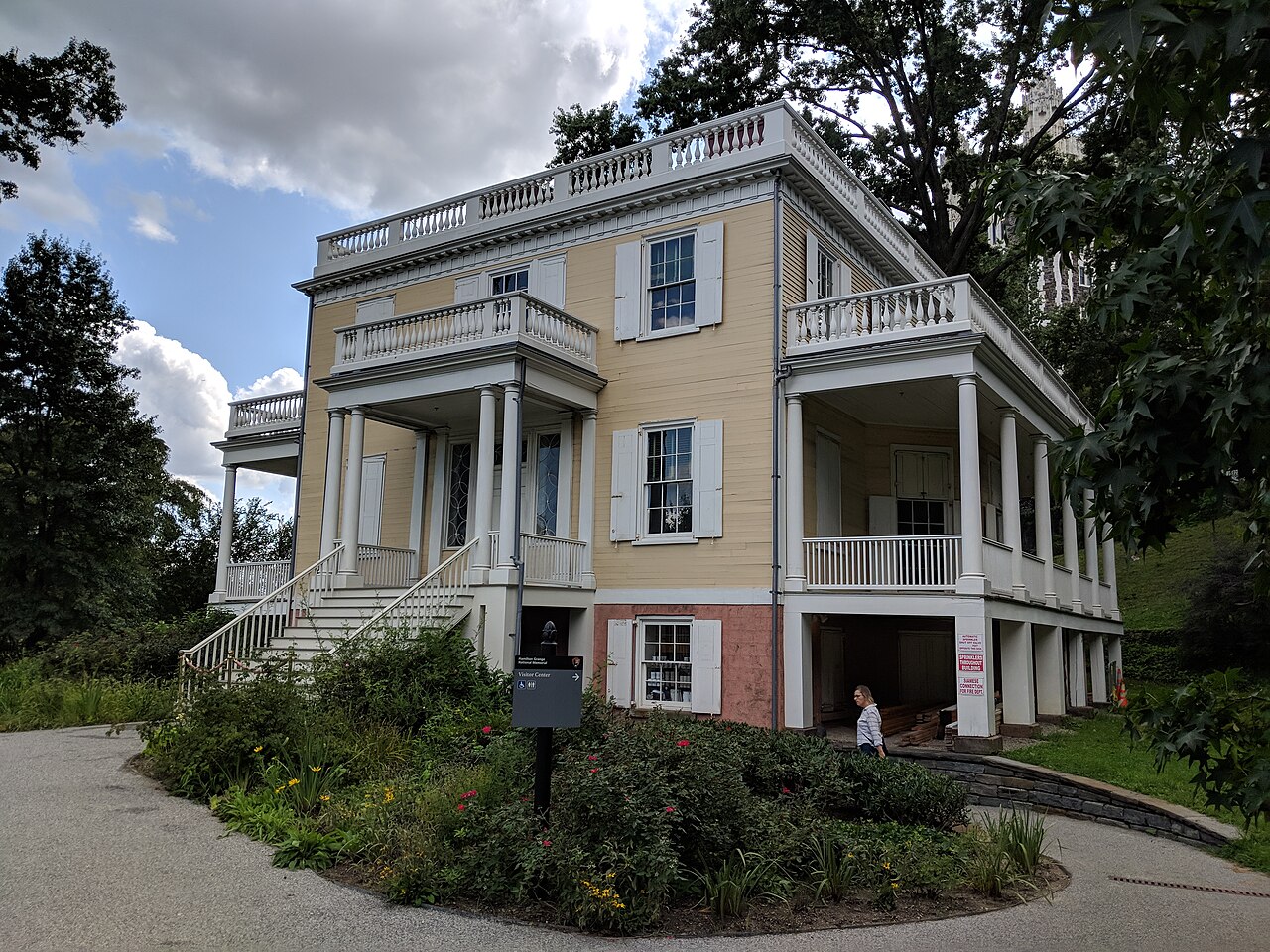
Via Wikimedia Commons: Hamilton Grange National Memorial, Mansion by Kalfatovic, CC BY-SA 4.0.
His eldest son, Philip, was killed in a duel in 1801.[3]
Duel with Aaron Burr and death
In 1804 Hamilton worked against Aaron Burr's campaign for governor of New York, and Burr then accused him of an insult, which led to a challenge.[3] Before the meeting Hamilton wrote a statement to be read if he died.[10] In it he said his religious and moral principles were opposed to duelling, worried about his wife, his children and his creditors, and wrote that he meant to "reserve and throw away my first fire".[10] He said he bore Burr no ill will "distinct from political opposition", but felt "a peculiar necessity not to decline the call".[10]
The duel took place a little after 7 a.m. on 11 July 1804 at Weehawken, New Jersey, with the two men standing ten paces apart.[3] Hamilton was mortally wounded and died the next day, 12 July 1804, in New York.[2][3]
Legacy
The Coast Guard traces its origins to the revenue cutters he proposed.[6] His widow, Elizabeth, outlived him by 50 years and co-founded the New York Orphan Asylum Society in 1806.[3] The Grange is preserved by the National Park Service.[3]
The portrait of Hamilton now on the $10 note was introduced in the 1928 series.[4] It is based on a painting by John Trumbull displayed in New York City Hall, which was itself based on a 1791 marble bust by Giuseppe Ceracchi.[4]
Sources
- U.S. Department of the Treasury. "Alexander Hamilton (1789-1795)." No date shown; accessed 25 November 2026. home.treasury.gov/about/history/prior-secretaries/alexander-hamilto…
- Encyclopaedia Britannica. "Alexander Hamilton." Encyclopaedia Britannica. No date shown; accessed 25 November 2026. britannica.com/biography/Alexander-Hamilton-United-States-statesman
- National Park Service, Hamilton Grange National Memorial. "Visitor Center Exhibit Audio Description." No date shown; accessed 25 November 2026. nps.gov/hagr/visitor-center-exhibit-audio-description.htm
- U.S. Currency Education Program. "Alexander Hamilton $10." uscurrency.gov. Last updated 3 April 2025; accessed 25 November 2026. uscurrency.gov/educational-materials/alexander-hamilton-10
- National Park Service. "Alexander Hamilton and George Washington." No date shown; accessed 25 November 2026. nps.gov/articles/000/alexander-hamilton-and-george-washington.htm
- William Thiesen. "The Long Blue Line: Hamilton's Grand Experiment: 230 Years of the U.S. Coast Guard." U.S. Coast Guard History Program. No date shown; accessed 25 November 2026. history.uscg.mil/Research/THE-LONG-BLUE-LINE/Article/2923236/the-lo…
- Editorial note to "To George Washington from Alexander Hamilton, 23 February 1791." Founders Online, National Archives (Papers of George Washington). No date shown; accessed 25 November 2026. founders.archives.gov/documents/Washington/05-07-02-0245-0000
- "Introductory Note: Report on the Subject of Manufactures, [5 December 1791]." Founders Online, National Archives (Papers of Alexander Hamilton). No date shown; accessed 25 November 2026. founders.archives.gov/documents/Hamilton/01-10-02-0001-0001
- Editorial note on the Reynolds affair, introducing "From Oliver Wolcott, Junior, 3 July 1797." Founders Online, National Archives (Papers of Alexander Hamilton). No date shown; accessed 25 November 2026. founders.archives.gov/documents/Hamilton/01-21-02-0076-0001
- Alexander Hamilton. "Statement on Impending Duel with Aaron Burr, [28 June–10 July 1804]." Founders Online, National Archives (Papers of Alexander Hamilton). No date shown; accessed 25 November 2026. founders.archives.gov/documents/Hamilton/01-26-02-0001-0241
