Compare versions
Version 1 → Version 2 (current). Removed · Added. This shows the entry's text as it is written, including its formatting marks.
Version 1 · Version 2 (current) · Version history
Side by side · Together
Version 1Version 2 (current)
32 unchanged paragraphs
Richard Milhous Nixon (9 January 1913 – 22 April 1994) was an American politician who served as a congressman, senator and vice president before becoming the 37th president of the United States in 1969 and resigning in 1974 during the Watergate scandal.[1][2]
Richard Milhous Nixon (9 January 1913 – 22 April 1994) was an American politician who served as a congressman, senator and vice president before becoming the 37th president of the United States in 1969 and resigning in 1974 during the Watergate scandal.[1][2]
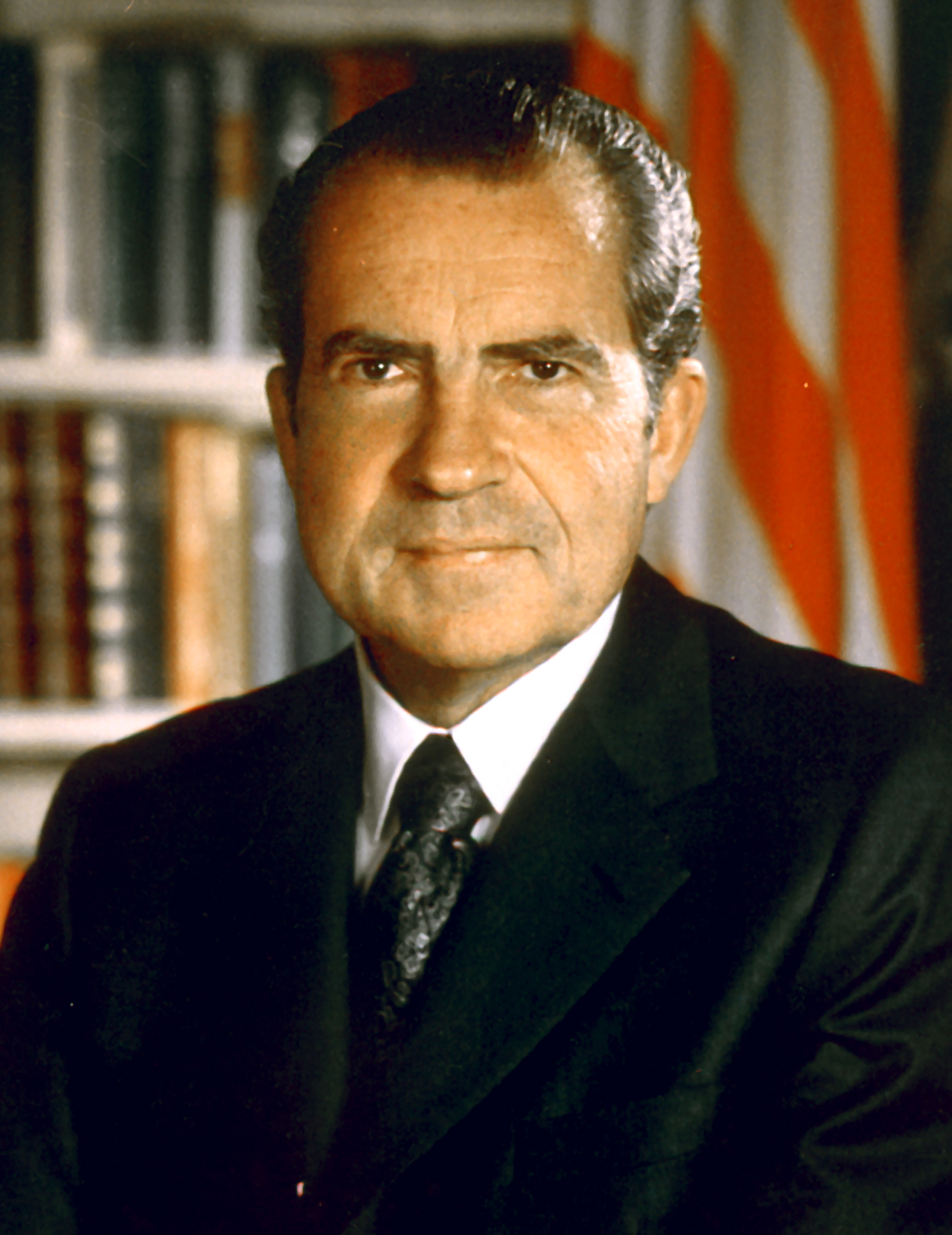

*Via Wikimedia Commons: [Nixon Official Presidential Portrait 07-08-1971 (cropped)](https://commons.wikimedia.org/wiki/File:Nixon_Official_Presidential_Portrait_07-08-1971_(cropped).jpg) by Unknown author Unknown author Derivative work: TharonXX, public domain.*
*Via Wikimedia Commons: [Nixon Official Presidential Portrait 07-08-1971 (cropped)](https://commons.wikimedia.org/wiki/File:Nixon_Official_Presidential_Portrait_07-08-1971_(cropped).jpg) by Unknown author Unknown author Derivative work: TharonXX, public domain.*
## Early life and education
## Early life and education
Nixon was born on 9 January 1913 on his parents' citrus farm in Yorba Linda, California, and the family moved to Whittier in 1922 after the ranch failed.[1] His parents were Francis (Frank) and Hannah Nixon.[2] He studied at Whittier College and then at Duke University's law school, from which he graduated in 1937, and returned to practise law in Whittier.[1][3] He married Thelma Catherine "Pat" Ryan in 1940; the couple had two daughters, Tricia and Julie.[2][3]
Nixon was born on 9 January 1913 on his parents' citrus farm in Yorba Linda, California, and the family moved to Whittier in 1922 after the ranch failed.[1] His parents were Francis (Frank) and Hannah Nixon.[2] He studied at Whittier College and then at Duke University's law school, from which he graduated in 1937, and returned to practise law in Whittier.[1][3] He married Thelma Catherine "Pat" Ryan in 1940; the couple had two daughters, Tricia and Julie.[2][3]
## Navy service
## Navy service
During the Second World War Nixon worked for the Office of Price Administration in Washington before joining the Navy.[3] He accepted an appointment as a lieutenant (junior grade) in the US Naval Reserve on 15 June 1942.[1] He served in the South Pacific as officer in charge of the South Pacific Combat Air Transport Command.[1] He was released from active duty as a lieutenant commander in March 1946.[1]
During the Second World War Nixon worked for the Office of Price Administration in Washington before joining the Navy.[3] He accepted an appointment as a lieutenant (junior grade) in the US Naval Reserve on 15 June 1942.[1] He served in the South Pacific as officer in charge of the South Pacific Combat Air Transport Command.[1] He was released from active duty as a lieutenant commander in March 1946.[1]
## House and Senate
## House and Senate
In November 1946 Nixon defeated the Democratic congressman Jerry Voorhis in California's 12th congressional district by more than 15,000 votes.[1]
In November 1946 Nixon defeated the Democratic congressman Jerry Voorhis in California's 12th congressional district by more than 15,000 votes.[1]
In 1948, as a member of the House Un-American Activities Committee (HUAC), Nixon led the investigation of Alger Hiss, a former State Department official accused of spying for the Soviet Union.[2] The case made Nixon nationally known.[3] Miller Center researcher Ken Hughes writes that Hiss was shown to have passed information to the Soviets and that later-declassified intercepted Soviet messages, known as the Venona decrypts, strengthened that conclusion.[3]
In 1948, as a member of the House Un-American Activities Committee (HUAC), Nixon led the investigation of Alger Hiss, a former State Department official accused of spying for the Soviet Union.[2] The case made Nixon nationally known.[3] Miller Center researcher Ken Hughes writes that Hiss was shown to have passed information to the Soviets and that later-declassified intercepted Soviet messages, known as the Venona decrypts, strengthened that conclusion.[3]
In 1950 Nixon was elected to the US Senate, defeating the Democratic congresswoman Helen Gahagan Douglas.[1]
In 1950 Nixon was elected to the US Senate, defeating the Democratic congresswoman Helen Gahagan Douglas.[1]
## Vice presidency
## Vice presidency
In 1952 Dwight D. Eisenhower chose Nixon as his running mate.[2] When the New York Post reported on a secret fund for Nixon, he defended himself in a televised address on 23 September 1952, remembered as the "Checkers speech" after a cocker spaniel given to his daughter, which he said the family would keep.[1][3] The Eisenhower–Nixon ticket won in 1952 and again in 1956.[2]
In 1952 Dwight D. Eisenhower chose Nixon as his running mate.[2] When the New York Post reported on a secret fund for Nixon, he defended himself in a televised address on 23 September 1952, remembered as the "Checkers speech" after a cocker spaniel given to his daughter, which he said the family would keep.[1][3] The Eisenhower–Nixon ticket won in 1952 and again in 1956.[2]
As vice president from 1953 to 1961, Nixon made goodwill tours abroad.[2] On 13 May 1958 protesters spat on Nixon and his wife at the airport in Caracas, Venezuela, and on 24 July 1959 he took part in an unplanned exchange with the Soviet leader Nikita Khrushchev that became known as the "Kitchen Debate".[1]
As vice president from 1953 to 1961, Nixon made goodwill tours abroad.[2] On 13 May 1958 protesters spat on Nixon and his wife at the airport in Caracas, Venezuela, and on 24 July 1959 he took part in an unplanned exchange with the Soviet leader Nikita Khrushchev that became known as the "Kitchen Debate".[1]
## Defeats of 1960 and 1962
## Defeats of 1960 and 1962
Nixon was the Republican presidential nominee in 1960 and lost to John F. Kennedy by fewer than 120,000 votes, or about 0.2 percent of the popular vote.[1] The Miller Center describes it as the narrowest presidential margin of the twentieth century.[4] In 1962 he lost the race for governor of California to the incumbent, Edmund G. "Pat" Brown, by nearly 300,000 votes, after which he held what he called his "last press conference".[1][3]
Nixon was the Republican presidential nominee in 1960 and lost to John F. Kennedy by fewer than 120,000 votes, or about 0.2 percent of the popular vote.[1] The Miller Center describes it as the narrowest presidential margin of the twentieth century.[4] In 1962 he lost the race for governor of California to the incumbent, Edmund G. "Pat" Brown, by nearly 300,000 votes, after which he held what he called his "last press conference".[1][3]
## Elections of 1968 and 1972
## Elections of 1968 and 1972
In 1968 Nixon won the Republican nomination and defeated the Democratic nominee, Vice President Hubert Humphrey, by nearly 500,000 popular votes.[1] Hughes notes that the 1968 result was almost as close as that of 1960.[4]
In 1968 Nixon won the Republican nomination and defeated the Democratic nominee, Vice President Hubert Humphrey, by nearly 500,000 popular votes.[1] Hughes notes that the 1968 result was almost as close as that of 1960.[4]
In 1972 Nixon was re-elected over Senator George McGovern with 520 electoral votes to McGovern's 17 and nearly 61 percent of the popular vote.[1]
In 1972 Nixon was re-elected over Senator George McGovern with 520 electoral votes to McGovern's 17 and nearly 61 percent of the popular vote.[1]
## Domestic policy
## Domestic policy
Nixon proposed an Environmental Protection Agency (EPA) in 1970 and signed amendments to the Clean Air Act that called for lower automobile emissions.[5] In the same year he signed the law creating the Occupational Safety and Health Administration (OSHA).[5] The National Archives credits his administration with the peaceful desegregation of public schools in the South.[2]
Nixon proposed an Environmental Protection Agency (EPA) in 1970 and signed amendments to the Clean Air Act that called for lower automobile emissions.[5] In the same year he signed the law creating the Occupational Safety and Health Administration (OSHA).[5] The National Archives credits his administration with the peaceful desegregation of public schools in the South.[2]
In August 1969 Nixon proposed the Family Assistance Plan, a welfare reform that would have guaranteed an income to all Americans, but Congress did not approve it.[1] In August 1971, facing high inflation, Nixon imposed wage and price controls and ended the convertibility of the dollar into gold, a package announced as the New Economic Policy.[1][5] On 28 September 1971 he signed legislation ending the military draft.[1]
In August 1969 Nixon proposed the Family Assistance Plan, a welfare reform that would have guaranteed an income to all Americans, but Congress did not approve it.[1] In August 1971, facing high inflation, Nixon imposed wage and price controls and ended the convertibility of the dollar into gold, a package announced as the New Economic Policy.[1][5] On 28 September 1971 he signed legislation ending the military draft.[1]
## Foreign policy
## Foreign policy
### Vietnam and Cambodia
### Vietnam and Cambodia
Nixon's public strategy in Vietnam combined negotiation with "Vietnamization", the training and arming of South Vietnamese forces so that US troops could withdraw.[6] US troop strength in Vietnam fell from 543,000 in April 1969 to zero on 29 March 1973.[1]
Nixon's public strategy in Vietnam combined negotiation with "Vietnamization", the training and arming of South Vietnamese forces so that US troops could withdraw.[6] US troop strength in Vietnam fell from 543,000 in April 1969 to zero on 29 March 1973.[1]
The war also widened into Cambodia. Nixon ordered secret bombing there in March 1969.[1][6] In 1970, after a coup in Cambodia replaced Prince Sihanouk with a pro-American military government, he sent US ground forces on a temporary incursion into the country.[6] The decision set off large antiwar protests, including those at Kent State University in Ohio, where National Guardsmen shot dead four protesters in May 1970.[6] The administration was harshly criticised for its use of military force in Cambodia.[1]
The war also widened into Cambodia. Nixon ordered secret bombing there in March 1969.[1][6] In 1970, after a coup in Cambodia replaced Prince Sihanouk with a pro-American military government, he sent US ground forces on a temporary incursion into the country.[6] The decision set off large antiwar protests, including those at Kent State University in Ohio, where National Guardsmen shot dead four protesters in May 1970.[6] The administration was harshly criticised for its use of military force in Cambodia.[1]
After a North Vietnamese offensive in spring 1972, Nixon mined Haiphong Harbor and ordered B-52 bombing of the North, and after the 1972 election he ordered the "Christmas bombings".[6] The Paris Peace Accords, signed on 23 January 1973, ended the participation of US ground forces in the war.[6]
After a North Vietnamese offensive in spring 1972, Nixon mined Haiphong Harbor and ordered B-52 bombing of the North, and after the 1972 election he ordered the "Christmas bombings".[6] The Paris Peace Accords, signed on 23 January 1973, ended the participation of US ground forces in the war.[6]
### Opening to China
### Opening to China
Nixon established a secret channel to the leaders of the People's Republic of China through Pakistan's president, Yahya Khan.[7] In April 1971 China invited a US table tennis team to visit, an episode known as "ping-pong diplomacy", and Henry Kissinger, Nixon's national security adviser, made two trips to Beijing that year, the first in secret.[7] From 21 to 28 February 1972 Nixon visited China, the first sitting US president to do so, meeting Mao Zedong and Premier Zhou Enlai.[7] The visit ended with the Shanghai Communiqué, in which the United States acknowledged that Chinese on both sides of the Taiwan Strait held that there is one China; its principles later underpinned formal diplomatic relations in 1979.[7] The State Department's Office of the Historian judges that the rapprochement "fundamentally altered the context of the Cold War".[7]
Nixon established a secret channel to the leaders of the People's Republic of China through Pakistan's president, Yahya Khan.[7] In April 1971 China invited a US table tennis team to visit, an episode known as "ping-pong diplomacy", and Henry Kissinger, Nixon's national security adviser, made two trips to Beijing that year, the first in secret.[7] From 21 to 28 February 1972 Nixon visited China, the first sitting US president to do so, meeting Mao Zedong and Premier Zhou Enlai.[7] The visit ended with the Shanghai Communiqué, in which the United States acknowledged that Chinese on both sides of the Taiwan Strait held that there is one China; its principles later underpinned formal diplomatic relations in 1979.[7] The State Department's Office of the Historian judges that the rapprochement "fundamentally altered the context of the Cold War".[7]
### Détente and SALT I
### Détente and SALT I
At a summit in May 1972 Nixon became the first president to visit Moscow, and he and the Soviet leader Leonid Brezhnev signed a Strategic Arms Limitation Treaty (SALT I) and an Anti-Ballistic Missile (ABM) Treaty to limit the growth of nuclear arms.[6][1] This easing of tension with the Soviet Union became known as détente.[2]
At a summit in May 1972 Nixon became the first president to visit Moscow, and he and the Soviet leader Leonid Brezhnev signed a Strategic Arms Limitation Treaty (SALT I) and an Anti-Ballistic Missile (ABM) Treaty to limit the growth of nuclear arms.[6][1] This easing of tension with the Soviet Union became known as détente.[2]
## Watergate
## Watergate
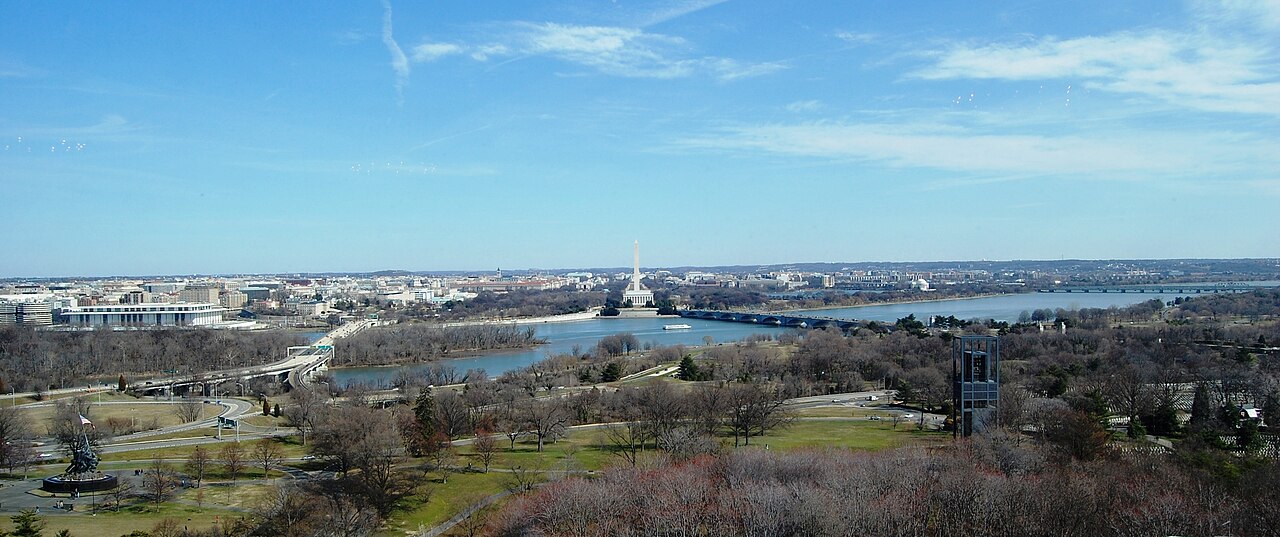
*Via Wikimedia Commons: [Washington DC Panorama](https://commons.wikimedia.org/wiki/File:Washington_DC_Panorama.jpg) by Jarek Tuszyński (aka Jarekt), [CC BY-SA 4.0](https://creativecommons.org/licenses/by-sa/4.0).*
13 unchanged paragraphs
On 17 June 1972 five men were arrested while trying to repair eavesdropping equipment in the Democratic National Committee offices at the Watergate building in Washington.[8] In 1973 a Senate select committee held public hearings, and on 16 July 1973 Alexander Butterfield told the committee about a White House taping system.[8] On 20 October 1973, in what became known as the "Saturday Night Massacre", Nixon ordered the firing of Special Prosecutor Archibald Cox; Attorney General Elliot Richardson refused and resigned, and Acting Attorney General Robert Bork carried out the dismissal.[8] Separately, Vice President Spiro Agnew resigned on 10 October 1973, and Nixon nominated House Minority Leader Gerald Ford to replace him.[1][2]
On 17 June 1972 five men were arrested while trying to repair eavesdropping equipment in the Democratic National Committee offices at the Watergate building in Washington.[8] In 1973 a Senate select committee held public hearings, and on 16 July 1973 Alexander Butterfield told the committee about a White House taping system.[8] On 20 October 1973, in what became known as the "Saturday Night Massacre", Nixon ordered the firing of Special Prosecutor Archibald Cox; Attorney General Elliot Richardson refused and resigned, and Acting Attorney General Robert Bork carried out the dismissal.[8] Separately, Vice President Spiro Agnew resigned on 10 October 1973, and Nixon nominated House Minority Leader Gerald Ford to replace him.[1][2]
On 16 April 1974 the new special prosecutor, Leon Jaworski, subpoenaed 64 White House tapes.[8][5] In United States v. Nixon, decided on 24 July 1974, the Supreme Court, in an opinion by Chief Justice Warren Burger with Justice Rehnquist taking no part, unanimously upheld the subpoena.[9][8] The Court held that neither the separation of powers nor a general need for confidentiality supports an absolute presidential privilege against judicial process, and that a privilege claim based only on a generalised interest in confidentiality must give way to a demonstrated, specific need for evidence in a pending criminal trial.[9]
On 16 April 1974 the new special prosecutor, Leon Jaworski, subpoenaed 64 White House tapes.[8][5] In United States v. Nixon, decided on 24 July 1974, the Supreme Court, in an opinion by Chief Justice Warren Burger with Justice Rehnquist taking no part, unanimously upheld the subpoena.[9][8] The Court held that neither the separation of powers nor a general need for confidentiality supports an absolute presidential privilege against judicial process, and that a privilege claim based only on a generalised interest in confidentiality must give way to a demonstrated, specific need for evidence in a pending criminal trial.[9]
The House Judiciary Committee then adopted three articles of impeachment: obstruction of the Watergate investigation (27 July), misuse of presidential powers and violation of the oath of office (29 July), and failure to comply with House subpoenas (30 July).[8] Among the recordings the White House released under court order in 1974 was a conversation recorded shortly after the break-in in which Nixon and his chief of staff, H. R. Haldeman, discussed having the CIA tell the FBI to stay out of the investigation.[5] The Nixon Library states that the tapes showed the president had participated in the cover-up.[1]
The House Judiciary Committee then adopted three articles of impeachment: obstruction of the Watergate investigation (27 July), misuse of presidential powers and violation of the oath of office (29 July), and failure to comply with House subpoenas (30 July).[8] Among the recordings the White House released under court order in 1974 was a conversation recorded shortly after the break-in in which Nixon and his chief of staff, H. R. Haldeman, discussed having the CIA tell the FBI to stay out of the investigation.[5] The Nixon Library states that the tapes showed the president had participated in the cover-up.[1]
Facing certain impeachment and removal, Nixon announced his resignation in a televised address on 8 August 1974, effective at noon on 9 August, and Gerald Ford became president.[1][2] As of November 2026, he remains the first and only US president to resign.[4]
Facing certain impeachment and removal, Nixon announced his resignation in a televised address on 8 August 1974, effective at noon on 9 August, and Gerald Ford became president.[1][2] As of November 2026, he remains the first and only US president to resign.[4]
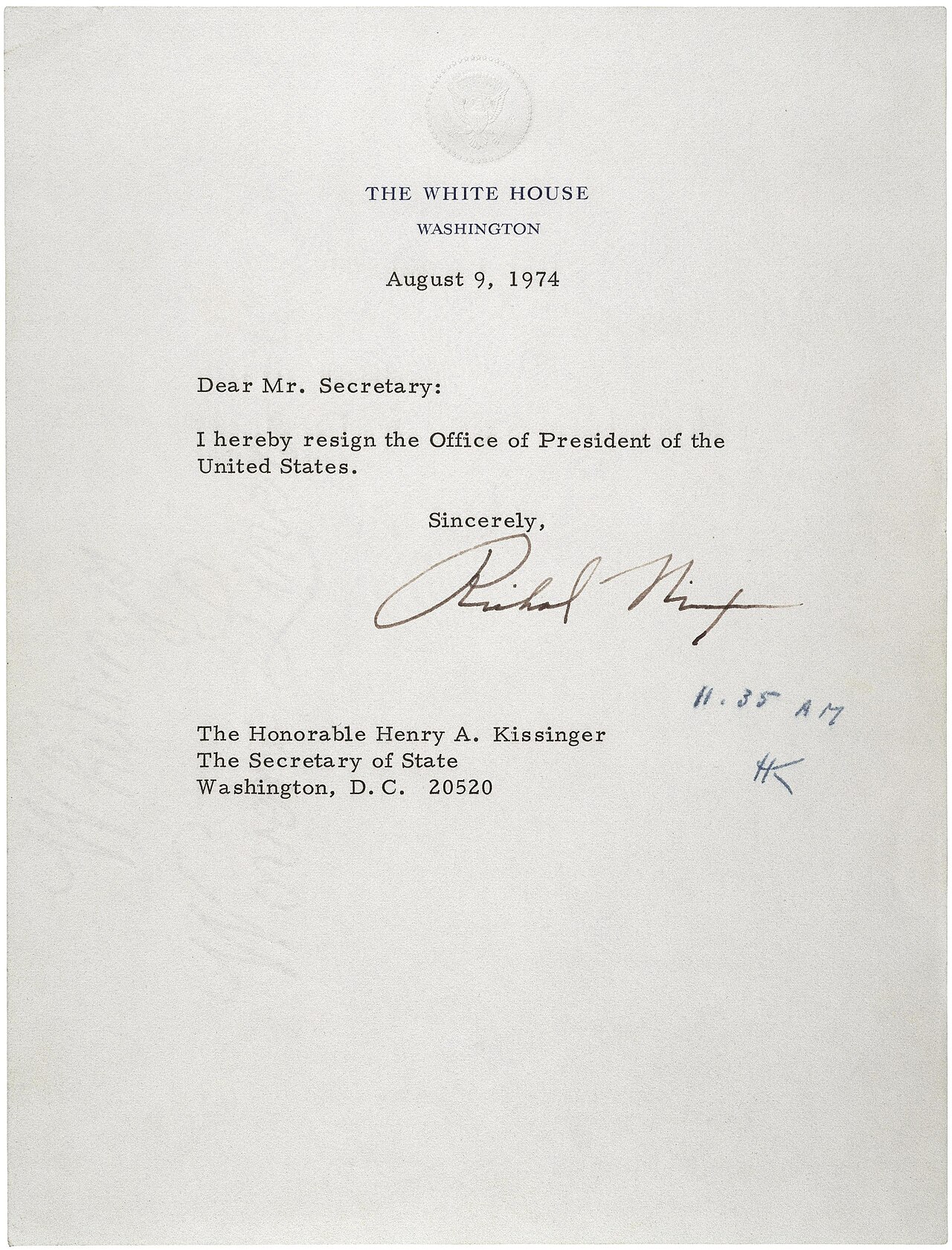

*Via Wikimedia Commons: [Letter of Resignation of Richard M. Nixon, 1974](https://commons.wikimedia.org/wiki/File:Letter_of_Resignation_of_Richard_M._Nixon,_1974.jpg) by Former U.S. President Richard M. Nixon, officially a work of, public domain.*
*Via Wikimedia Commons: [Letter of Resignation of Richard M. Nixon, 1974](https://commons.wikimedia.org/wiki/File:Letter_of_Resignation_of_Richard_M._Nixon,_1974.jpg) by Former U.S. President Richard M. Nixon, officially a work of, public domain.*
## Pardon
## Pardon
On 8 September 1974 President Ford pardoned Nixon for federal offences he had committed or may have committed between 20 January 1969 and 9 August 1974.[10] Nixon said he regretted not acting "more decisively and forthrightly" over Watergate.[1] According to the Miller Center, the pardon angered many Americans, and historians cite it as a significant factor in Ford's defeat in 1976.[10]
On 8 September 1974 President Ford pardoned Nixon for federal offences he had committed or may have committed between 20 January 1969 and 9 August 1974.[10] Nixon said he regretted not acting "more decisively and forthrightly" over Watergate.[1] According to the Miller Center, the pardon angered many Americans, and historians cite it as a significant factor in Ford's defeat in 1976.[10]
## Later life and death
## Later life and death
Nixon returned to his home in San Clemente, California.[10] His memoirs, *RN* (1978), became a best seller, and a series of television interviews with David Frost aired in May 1977.[10] He completed ten books after leaving office, many on foreign policy, travelled widely in Europe, Asia, Africa and the Middle East, and was privately consulted by later presidents.[2][10]
Nixon returned to his home in San Clemente, California.[10] His memoirs, *RN* (1978), became a best seller, and a series of television interviews with David Frost aired in May 1977.[10] He completed ten books after leaving office, many on foreign policy, travelled widely in Europe, Asia, Africa and the Middle East, and was privately consulted by later presidents.[2][10]
The privately funded Richard Nixon Library and Birthplace in Yorba Linda was dedicated in 1990; in 2007 it became the Richard Nixon Presidential Library and Museum, part of the federal system of presidential libraries.[10] Nixon died of complications from a stroke on 22 April 1994 in New York City and was buried in Yorba Linda on 27 April 1994.[2][10]
The privately funded Richard Nixon Library and Birthplace in Yorba Linda was dedicated in 1990; in 2007 it became the Richard Nixon Presidential Library and Museum, part of the federal system of presidential libraries.[10] Nixon died of complications from a stroke on 22 April 1994 in New York City and was buried in Yorba Linda on 27 April 1994.[2][10]
## Sources
## Sources
1. "President Nixon". Richard Nixon Presidential Library and Museum, National Archives and Records Administration. No date shown; accessed 25 November 2026. https://www.nixonlibrary.gov/index.php/president-nixon
2. "Biography" (Richard Nixon centennial). National Archives and Records Administration. Page last reviewed 19 September 2017; accessed 25 November 2026. https://www.archives.gov/presidential-libraries/events/centennials/nixon/biography.html
3. Ken Hughes. "Richard Nixon: Life Before the Presidency". Miller Center, University of Virginia. No date shown; accessed 25 November 2026. https://millercenter.org/president/nixon/life-before-the-presidency
4. Ken Hughes. "Richard Nixon: Life in Brief". Miller Center, University of Virginia. No date shown; accessed 25 November 2026. https://millercenter.org/president/nixon/life-in-brief
5. Ken Hughes. "Richard Nixon: Domestic Affairs". Miller Center, University of Virginia. Published 4 October 2016, modified 28 August 2023. https://millercenter.org/president/nixon/domestic-affairs
6. Ken Hughes. "Richard Nixon: Foreign Affairs". Miller Center, University of Virginia. No date shown; accessed 25 November 2026. https://millercenter.org/president/nixon/foreign-affairs
7. "Rapprochement with China, 1972". Milestones in the History of U.S. Foreign Relations, Office of the Historian, U.S. Department of State. No date shown; accessed 25 November 2026. https://history.state.gov/milestones/1969-1976/rapprochement-china
8. "Watergate and the Constitution" (chronology). National Archives and Records Administration. 15 August 2016. https://www.archives.gov/education/lessons/watergate-constitution/chronology.html
9. Supreme Court of the United States. United States v. Nixon, 418 U.S. 683 (1974), decided 24 July 1974. Text via Justia. https://supreme.justia.com/cases/federal/us/418/683/
10. Ken Hughes. "Richard Nixon: Life After the Presidency". Miller Center, University of Virginia. No date shown; accessed 25 November 2026. https://millercenter.org/president/nixon/life-after-the-presidency
