The Riemann hypothesis is a conjecture, first put forward by Bernhard Riemann in 1859, that every non-trivial zero of the Riemann zeta function is a complex number whose real part equals 1/2.[1][3]
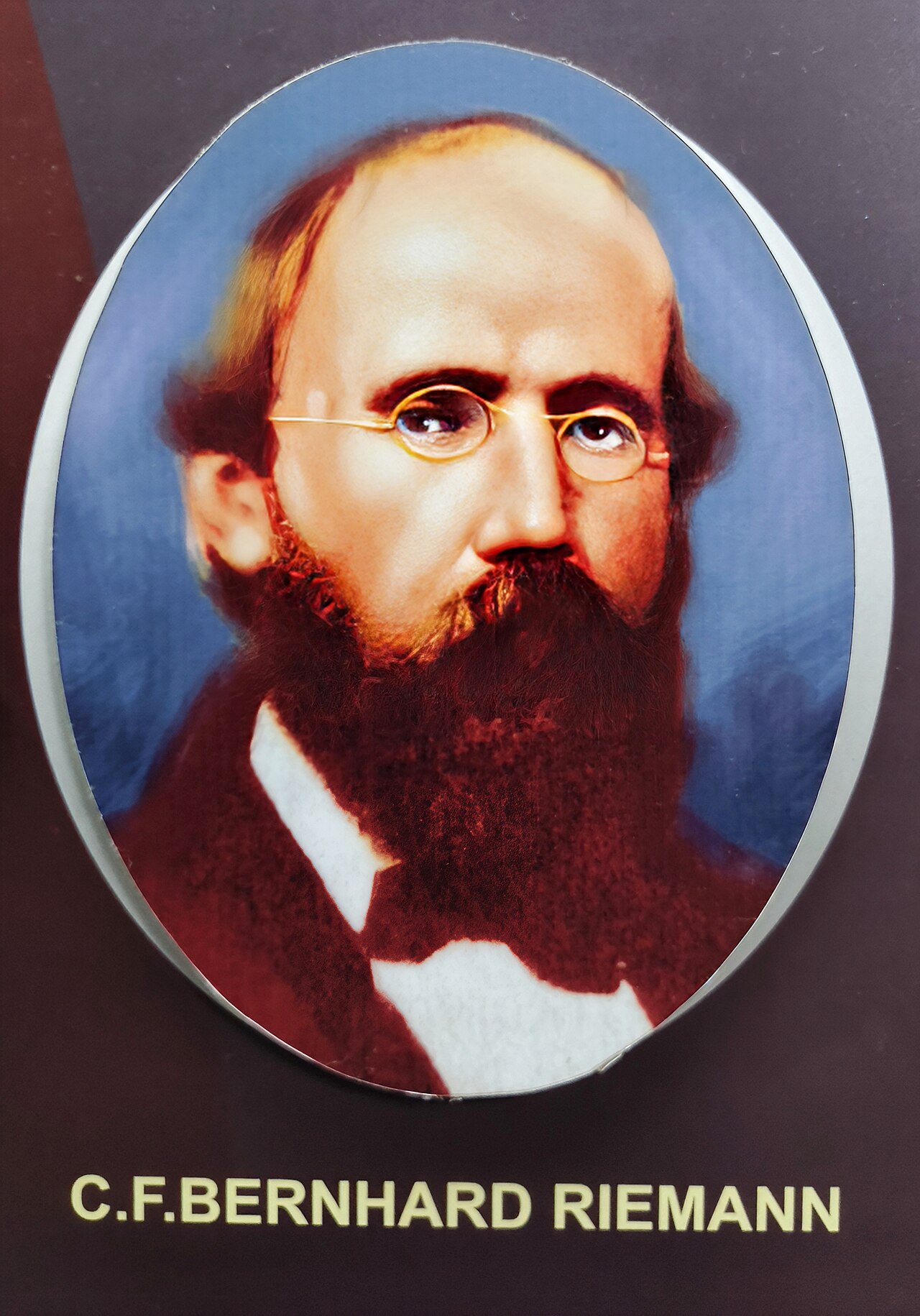
Portrait of the German mathematician Bernhard Riemann, who stated the hypothesis in 1859.
The hypothesis is about complex numbers. A complex number can be written as a + bi, where a and b are ordinary real numbers and i is a square root of −1; a is called the real part and b the imaginary part. Researchers on the problem write a zero of the zeta function in this form, as β + iγ, where β is the real part and γ the imaginary part.[8]
The Riemann zeta function, written ζ(s), starts from the infinite sum 1 + 1/2^s + 1/3^s + 1/4^s + …[2] This sum adds up to a finite value (it converges) when the real part of s is greater than 1.[3] Riemann's 1859 paper opens from an observation of Leonhard Euler: the same sum equals a product, taken over all the prime numbers p, of the factors 1/(1 − p^(−s)), which ties the function directly to the primes.[4][3] By a process called analytic continuation, the function can be extended to every complex number except s = 1, where it has a single pole (a point at which it becomes infinite).[3]
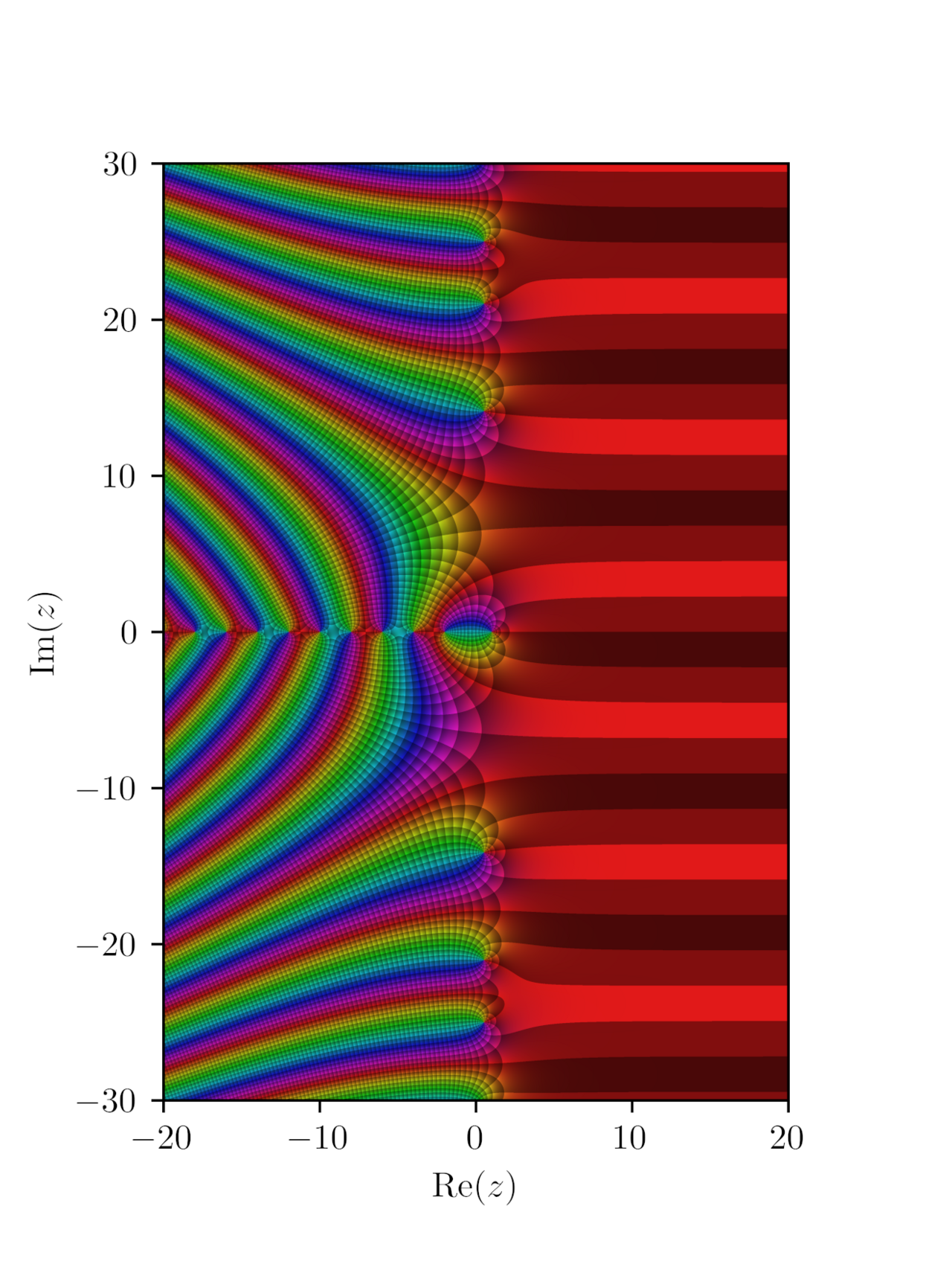
Colour map of the zeta function over part of the complex plane, in which hue shows the direction of each value and brightness its size.
A zero of the function is a value of s for which ζ(s) = 0. The function is zero at the negative even numbers −2, −4, −6 and so on; these are called the trivial zeros.[3] All of its other zeros, the non-trivial zeros, lie in the "critical strip", the band of complex numbers whose real part is between 0 and 1.[6] The vertical line in the middle of that strip, made of the numbers whose real part is exactly 1/2, is called the critical line. The Riemann hypothesis states that the non-trivial zeros of ζ(s) have real part equal to 1/2, that is, that all of them lie on the critical line.[3] The Clay Mathematics Institute's summary calls them the "non-obvious" zeros.[1]
Riemann himself worked with a closely related function, written ξ(t), and his form of the conjecture is that all of its roots are real numbers; the Clay Institute's official problem description states it in both forms.[3][4]
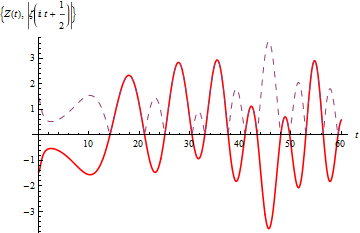
Graph of the size of the zeta function along the critical line; each point where the curve touches zero is a non-trivial zero.
A prime number is a whole number greater than 1 with no divisors other than 1 and itself. The prime-counting function, written π(x), gives how many primes there are up to a number x.[3] Carl Friedrich Gauss and Adrien-Marie Legendre studied the distribution of primes at the end of the eighteenth century, and in an 1849 letter Gauss said he had found in his early years that π(x) is well approximated by the logarithmic integral Li(x), the integral of 1/log t from 0 to x.[3]
Riemann's paper is titled "On the Number of Prime Numbers less than a Given Quantity", and in it he obtained an analytic formula for the number of primes up to a given limit.[4][3] In 1896 Jacques Hadamard and Charles de la Vallée Poussin independently proved that ζ(s) has no zeros whose real part equals 1, and from that fact deduced Gauss's conjecture, now called the prime number theorem.[6]
The Riemann hypothesis is tied to how good that approximation is. It is equivalent to the statement that π(x) = Li(x) + O(√x log x), meaning that the difference between the true count of primes and Li(x) never grows faster than a fixed multiple of the square root of x times the logarithm of x.[3] J. Brian Conrey gives an equivalent form: for every small positive number ε, the error is at most a fixed multiple of x raised to the power 1/2 + ε.[6] The Clay Institute's summary says that a proof would shed light on many of the mysteries surrounding the distribution of the primes.[2]
History
Riemann (1826–1866) published the paper in the monthly reports of the Berlin Academy in November 1859.[2][4] In it he wrote that it is very probable that all the roots are real, and that he had put aside the search for a proof after some fleeting, futile attempts.[4] He also estimated that the number of roots with real part between 0 and T is approximately (T/2π) log(T/2π) − T/2π.[4]
In his lecture "Mathematical Problems" for the International Congress of Mathematicians in Paris in 1900, David Hilbert set out 23 problems.[5] Under the heading "8. Problems of prime numbers", he noted recent progress by Hadamard, de la Vallée Poussin, von Mangoldt and others, and said that it still remained to prove "an exceedingly important statement of Riemann" about the zeros of the zeta function.[5] The same section also raised Goldbach's problem on writing numbers as the sum of two primes, and the question of whether there are infinitely many pairs of primes with a given difference.[5]
The Clay Mathematics Institute announced its Millennium Prize Problems at a meeting at the Collège de France in Paris on 24 May 2000, with $1 million allocated to the solution of each problem and $7 million in all.[1] The Riemann hypothesis is one of them.[1] Its official problem description, by E. Bombieri, states that in the opinion of many mathematicians the hypothesis and its extensions are probably the most important open problem in pure mathematics.[2][3]
Partial results
None of the results below proves the hypothesis, but each narrows down where the zeros can be.
Zeros on the critical line. In a paper published in 1914, G. H. Hardy showed that infinitely many zeros of ζ(s) lie on the critical line.[7] Conrey's survey, published by the American Mathematical Society, credits the first proof of infinitely many zeros on the line to Hardy and Littlewood together.[6] Selberg (1942) proved that a positive proportion of the zeros lie on the line.[3][6] Levinson (1974) showed that more than one third do, and Conrey (1989) raised this to more than two fifths.[3][7] In Bombieri's words, it is known that more than 40% of the non-trivial zeros are simple (not repeated) and satisfy the hypothesis.[3] A proportion is not all, so these results leave open the possibility that some zeros lie off the line.
Zero-free regions. A zero-free region is a part of the critical strip proven to contain no zeros. Building on the 1896 result that there are no zeros with real part 1, mathematicians have shown that the zeros also avoid a thin band just inside that edge, a band that becomes narrower as the imaginary part grows.[6][9] For example, in a paper posted in December 2022, Michael Mossinghoff, Timothy Trudgian and Andrew Yang proved that there are no zeros with real part at least 1 − 1/(5.558691 log|t|) when the imaginary part t has size at least 2, and gave a region of a different shape that is wider for very large t.[9]
Zero-density estimates. Instead of ruling zeros out entirely, a zero-density estimate limits how many zeros there can be away from the critical line. Writing N(σ, T) for the number of zeros with real part at least σ and imaginary part between −T and T, Larry Guth and James Maynard proved, in a paper first posted in May 2024, that N(σ, T) is at most T raised to the power 30(1 − σ)/13 + o(1), where o(1) stands for a quantity that shrinks towards zero as T grows.[10] They state that the exponent 30/13 improves on the previous exponent of 12/5, due to Huxley.[10] As a consequence they obtained an asymptotic count of primes in short intervals of length about x^(17/30), improving Huxley's exponent of 7/12.[10]
Computational checks
Large computer calculations have found no zero off the critical line. Bombieri's problem description reports that van de Lune, te Riele and Winter showed in 1986 that the first 1.5 billion zeros, in order of increasing imaginary part, are simple and on the line, and that Andrew Odlyzko checked the hypothesis for large numbers of zeros in selected ranges much higher up.[3] Conrey's survey reports later work by van de Lune covering the first 10 billion zeros.[6]
In a paper posted in April 2020, Dave Platt and Tim Trudgian verified, in a rigorous way using interval arithmetic (a method that keeps track of rounding errors), that every zero with imaginary part between 0 and 3 × 10^12 has real part 1/2.[8] They give the count of those zeros as 12,363,153,437,138.[8] They also note that two earlier computations reported in 2004, by Wedeniwski and by Gourdon, were never published in a peer-reviewed journal, and that it is not clear how those computations avoided a build-up of rounding and truncation errors.[8] The Clay Institute's page states that the hypothesis "has been checked for the first 10,000,000,000,000 solutions" without naming the computation behind that figure.[2] A finite check, however large, cannot prove the statement for the infinitely many zeros.
What is and is not proven
Proven: the trivial zeros are the negative even integers; all other zeros lie in the critical strip; none has real part exactly 1, and none lies in the known zero-free regions; infinitely many zeros, and more than two fifths of them, lie on the critical line; and every zero up to height 3 × 10^12 lies on it.[3][6][7][8][9]
Not proven: that all non-trivial zeros lie on the critical line. As of 25 November 2026 the Clay Mathematics Institute marks the Riemann hypothesis as "Active", and the Poincaré conjecture is the only Millennium Prize Problem it lists as solved.[1][2]
Bombieri also describes a wider, generalized form of the hypothesis for a broad class of related functions called L-functions; many results in number theory are known consequences of it, and computations have found no exception to it.[3]
Sources
Clay Mathematics Institute. "Millennium Problems." Clay Mathematics Institute. No date shown; accessed 25 November 2026. claymath.org/millennium-problems
E. Bombieri. "Problems of the Millennium: the Riemann Hypothesis" (official problem description, PDF). Clay Mathematics Institute. No date shown; accessed 25 November 2026. claymath.org/wp-content/uploads/2022/05/riemann.pdf
Bernhard Riemann, translated by David R. Wilkins. "On the Number of Prime Numbers less than a Given Quantity" (Monatsberichte der Berliner Akademie, November 1859; translation preliminary version, December 1998, PDF). Clay Mathematics Institute. Accessed 25 November 2026. claymath.org/wp-content/uploads/2023/04/Wilkins-translation.pdf
David Hilbert, translated by Mary Winston Newson. "Mathematical Problems" (lecture delivered before the International Congress of Mathematicians at Paris in 1900; translation 1902). Project Gutenberg, eBook #71655. Accessed 25 November 2026. gutenberg.org/ebooks/71655.html.images
J. Brian Conrey. "The Riemann Hypothesis" (PDF). American Mathematical Society. No date shown on the page; accessed 25 November 2026. ams.org/notices/200303/fea-conrey-web.pdf
Aleksandar Ivić. "Hardy's function Z(t) - results and problems." arXiv:1601.06512. 25 January 2016 (revised 8 February 2016). arxiv.org/abs/1601.06512
Dave Platt and Tim Trudgian. "The Riemann hypothesis is true up to 3·10^12." arXiv:2004.09765. 21 April 2020. arxiv.org/abs/2004.09765
Michael J. Mossinghoff, Timothy S. Trudgian and Andrew Yang. "Explicit zero-free regions for the Riemann zeta-function." arXiv:2212.06867. 13 December 2022. arxiv.org/abs/2212.06867
Larry Guth and James Maynard. "New large value estimates for Dirichlet polynomials." arXiv:2405.20552. 31 May 2024 (revised 7 April 2026). arxiv.org/abs/2405.20552