Version 1
Nov 25, 2026. Compare with the current version · Version history
The Tetragrammaton is the name of the God of Israel in the Hebrew Bible, written with the four Hebrew consonants yod, he, waw and he and usually transliterated as YHWH.[1][2]
The name and its letters
Biblical Hebrew was written with consonants only, so the name appears in the text as four letters without vowels.[3] The Encyclopaedia Britannica describes the sequence Yod, Heh, Waw, Heh as the name known as the tetragrammaton, and explains it as the name that the book of Exodus presents as revealed to Moses.[2] The Jewish Encyclopedia (1906) calls it the ancient Israelite name for God.[1]
Counts of how often the name occurs differ with the method used. The Jewish Encyclopedia gave a count of 5,410 occurrences of the name on its own, and 5,989 when combined forms (such as the name followed by "of hosts") are added; it noted that the name does not appear in the Song of Songs, Ecclesiastes or Esther.[1] The 2013 revision of the New World Translation, published by Jehovah's Witnesses, states that the four letters appear nearly 7,000 times in the Hebrew Scriptures.[3]
Meaning and origin
The meaning of the name is debated.[2] According to the Jewish Encyclopedia, the oldest Jewish interpreters derived it from the Hebrew verb hayah, "to be", and treated it as a verb form, linking it with the account in Exodus in which God speaks of himself using a related form, Ehyeh.[1] The same article reported that modern scholars had proposed many other meanings, and that whether the name was native to Israel or borrowed from a neighbouring people was debated.[1]
Britannica reports that many scholars consider the most likely meaning to be "He Brings into Existence Whatever Exists".[2] It also notes that the name of Moses' mother, Jochebed, is based on the divine name, which suggests that Moses' tribe, the Levites, already knew it.[2] The translation committee of the New World Translation understands the name to come from a verb meaning "to become" and to mean "He Causes to Become", while acknowledging that scholars differ.[3]
Early inscriptions
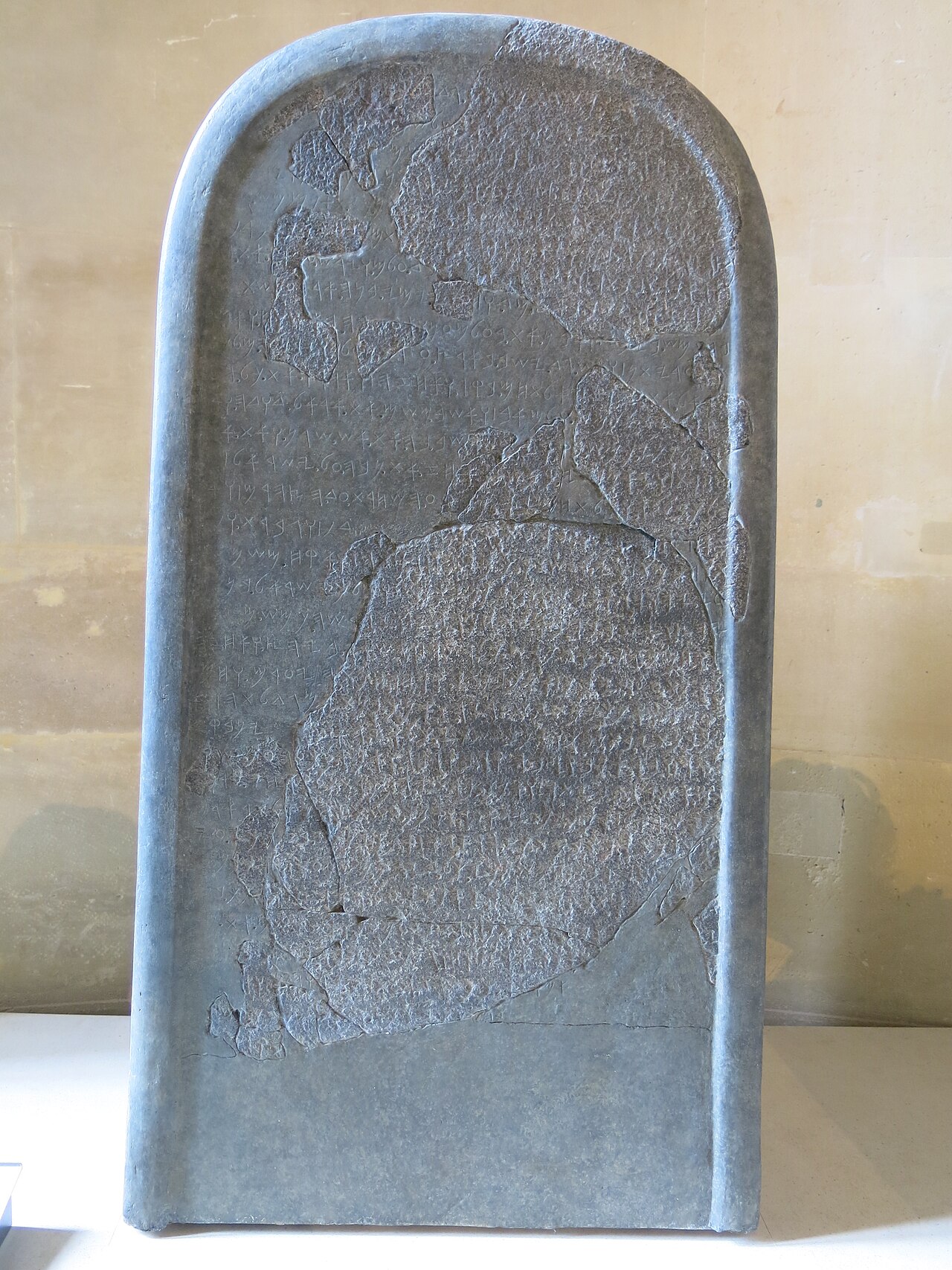
Via Wikimedia Commons: Mesha stele (Louvre, AO 5066) by Tangopaso, public domain.
The Mesha Stele, also called the Moabite Stone, is a basalt slab about 125 centimetres high, inscribed with 34 lines in a script of Phoenician type and in a dialect very close to Hebrew.[4] It came from Diban, and the Louvre in Paris, which bought it in 1873, dates it to the time of King Mesha of Moab, around 830 to 805 BCE, and says it was engraved shortly after 842 BCE when a sanctuary was built for the Moabite god Kemosh.[4] The inscription records Mesha's recapture of Moabite territory from Israel.[4] An article published in 1920 by the Royal Asiatic Society noted that line 18 of the stone was frequently quoted as the only early instance of the divine name being used outside Israel, and examined the form of the name there.[5]
Two small rolled sheets of silver from a tomb across the Hinnom Valley from the Old City of Jerusalem, known as the Ketef Hinnom amulets, date to about 600 BCE.[6] Their inscription preserves part of the priestly blessing known from the book of Numbers, which the University of Michigan's image database describes as making them the oldest evidence for a biblical text.[6] They were found rolled up and may have been worn around the neck.[6]
Dead Sea Scrolls and Greek manuscripts
Among the Dead Sea Scrolls, the Psalms Scroll from Qumran Cave 11, found in 1956 and copied around 30 to 50 CE, is written on parchment in the Jewish book hand of the Herodian period.[7] The Tetragrammaton in this scroll, however, is written in paleo-Hebrew, an older form of the Hebrew alphabet.[7] A 2021 article from the Australian Catholic University, on newly found fragments of a Greek scroll of the Minor Prophets from the Judean desert, listed the use of this archaic alphabet as one of the ways the Dead Sea Scrolls avoided pronouncing the divine name.[8]
The same article noted that in the Greek Minor Prophets scroll the name of God is written in Hebrew rather than in Greek.[8] The fragments came from a cave that served as a refuge during the Bar Kokhba revolt against Rome in 132 to 135 CE.[8] The Jewish Encyclopedia likewise stated that in the earliest manuscripts of the Septuagint, the ancient Greek translation of the Hebrew Bible, the Tetragrammaton was written in Hebrew letters.[1]
Pronunciation and its avoidance
Jewish practice came to avoid saying the name aloud. According to the Jewish Encyclopedia, by about 300 BCE the name was no longer pronounced in its original form, and the word Adonai, "Lord", was read in its place; it cited one scholar who placed this change in the later decades of the Babylonian exile.[1] The same article records that the high priest pronounced the name in the Temple during the services of the Day of Atonement.[1]
Britannica gives two reasons for the decline in use after the Babylonian exile.[2] As Judaism came to stress the universal rule of Israel's God, the common noun Elohim, "God", tended to replace the personal name, and the name itself was increasingly treated as too sacred to be spoken.[2] In synagogue reading, Adonai ("My Lord") was said instead.[2] Jewish usage also refers to the name with expressions such as Ha-Shem, "the Name", and Shem ha-Meforash.[1]
Because the vowels were not written, the original pronunciation is uncertain.[3] Greek-language sources record several forms: the Jewish Encyclopedia lists Iaoue, Iabe, Iao and others from magical papyri and, it judged, from the writings of the early Church Fathers, and it notes that Iabe was described as the Samaritan pronunciation.[1] Britannica states that early Christian writers, such as Clement of Alexandria in the second century, used a form like Yahweh, and that scholars revived the form Yahweh in the 19th and 20th centuries.[2] The New World Translation appendix calls Yahweh one suggested pronunciation and states that the original pronunciation is not known.[3]
The Masoretes, the Jewish scholars who supplied the Hebrew text with vowel signs, gave the four letters the vowel signs of Adonai or Elohim.[2][1]
How traditions and translations render the name
In Jewish reading, the name is spoken as Adonai, or referred to as Ha-Shem.[1][2] Christian translations have either replaced the name with a title or written it out in one of several forms.[3][9]
The English form Jehovah arose when Christian scholars writing in Latin combined the four consonants with the vowels added by the Masoretes, replacing the Y, which Latin lacked, with I or J.[2] The New World Translation appendix states that William Tyndale used the form "Iehouah" in his 1530 English Pentateuch.[3] For the English form Jehovah, see Jehovah.
Many English Bibles put a title in place of the name. Some print "LORD" in capital letters, and others use "Lord" or "God".[3] The preface to the American Standard Version of 1901 explains that its American revisers replaced the words "Lord" and "God", printed in small capitals, with "Jehovah".[9] The revisers wrote that what they called a "Jewish superstition," which regarded the name as "too sacred to be uttered," "ought no longer to dominate" in the English version, and described the name as now restored to its place in the text.[9]
The Jerusalem Bible, a 1966 English counterpart of the Dominican Order's French La Bible de Jérusalem, made from the original Hebrew and Greek, is known for rendering the name as "Yahweh" rather than "the Lord".[10]
Jehovah's Witnesses teach that the divine name belongs in the text of the Bible, and that the reasons translators give for leaving it out are not sufficient.[3] Their New World Translation renders the four letters as "Jehovah", which its appendix explains by the long history of that form in the English language.[3]
Sources
- Crawford Howell Toy and Ludwig Blau. "Tetragrammaton." The Jewish Encyclopedia. Funk and Wagnalls, 1906. jewishencyclopedia.com/articles/14346
- "Yahweh." Encyclopaedia Britannica. No date shown; accessed 25 November 2026. britannica.com/topic/Yahweh
- "The Tetragrammaton and the Divine Name in the Hebrew Scriptures" (Appendix A4). New World Translation of the Holy Scriptures (2013 Revision). Watch Tower Bible and Tract Society (jw.org). No date shown; accessed 25 November 2026. jw.org/en/library/bible/nwt/appendix-a/tetragrammaton-divine-name/
- "Stèle de Mesha" (AO 5066). Collections du Louvre, Musée du Louvre, Département des Antiquités orientales. No date shown; accessed 25 November 2026. collections.louvre.fr/en/ark:/53355/cl010120339
- "A Passage in the Mesha Inscription, and the Early Form of the Israelitish Divine Name." Royal Asiatic Society, 1920; published online by Cambridge University Press, 15 March 2011. core-prod.cambridgecore.org/core/journals/journal-of-the-royal-asia…
- "Jerusalem: Ketef Hinnom Amulet." The Land of Israel / Palestine: Image Database, University of Michigan. No date shown; accessed 25 November 2026. image-database.nes.lsa.umich.edu/items/show/96
- "Introduction" (Psalms Scroll, 11QPs). Scrolls From the Dead Sea: The Ancient Library of Qumran and Modern Scholarship. Library of Congress exhibition. No date shown; accessed 25 November 2026. loc.gov/exhibits/scrolls/scr1.html
- "Finding fragments of history in the Cave of Horror." Australian Catholic University news, April 2021. acu.edu.au/about-acu/news/2021/april/finding-fragments-of-history-i…
- "American Standard Version: 1901 Preface." BibleVersion.org (reproduction of the 1901 preface). No date shown; accessed 25 November 2026. bibleversion.org/bible/versions/modern-english/american-standard-ve…
- "Jerusalem Bible, The (1966)." An Episcopal Dictionary of the Church, Church Publishing Incorporated, on the website of the Episcopal Church. No date shown; accessed 25 November 2026. episcopalchurch.org/?p=170386
