← Kingdom of God (Jehovah's Witnesses)
Version 2 (current)
Nov 25, 2026. Version history
Jehovah's Witnesses teach that the Kingdom of God is a real government in heaven, with Jesus Christ as its king, which they say began ruling in 1914 and will replace all human governments.[1]
The teaching in brief
Jehovah's Witnesses teach that the Kingdom of God is a heavenly government and that Jehovah, their name for God, appointed his Son Jesus to be its king.[1] Their publications describe a group called "the holy ones" who are raised from death with a spiritual body to rule alongside Jesus in heaven, and say that this group will finally number 144,000.[1] Britannica's article on Witness beliefs and practices summarizes the teaching the same way: Christ heads the Kingdom, and 144,000 human co-rulers share in running it.[6]
According to the article on Jehovah's Witnesses in the Worldmark Encyclopedia of Religious Practices, Witness teaching divides believers into the 144,000, a heavenly "church class", and a "great crowd" whose hope is everlasting life on a restored paradise earth, provided they stay faithful through a final test after a literal thousand-year reign.[7] Britannica notes that only those who believe they belong to the 144,000 eat the bread and drink the wine at the annual Memorial, the Witnesses' yearly observance of Christ's death.[6] The organization's report for the 2025 service year (September 2024 to August 2025) counted 24,576 such partakers worldwide, out of a Memorial attendance of 20,635,015.[5]
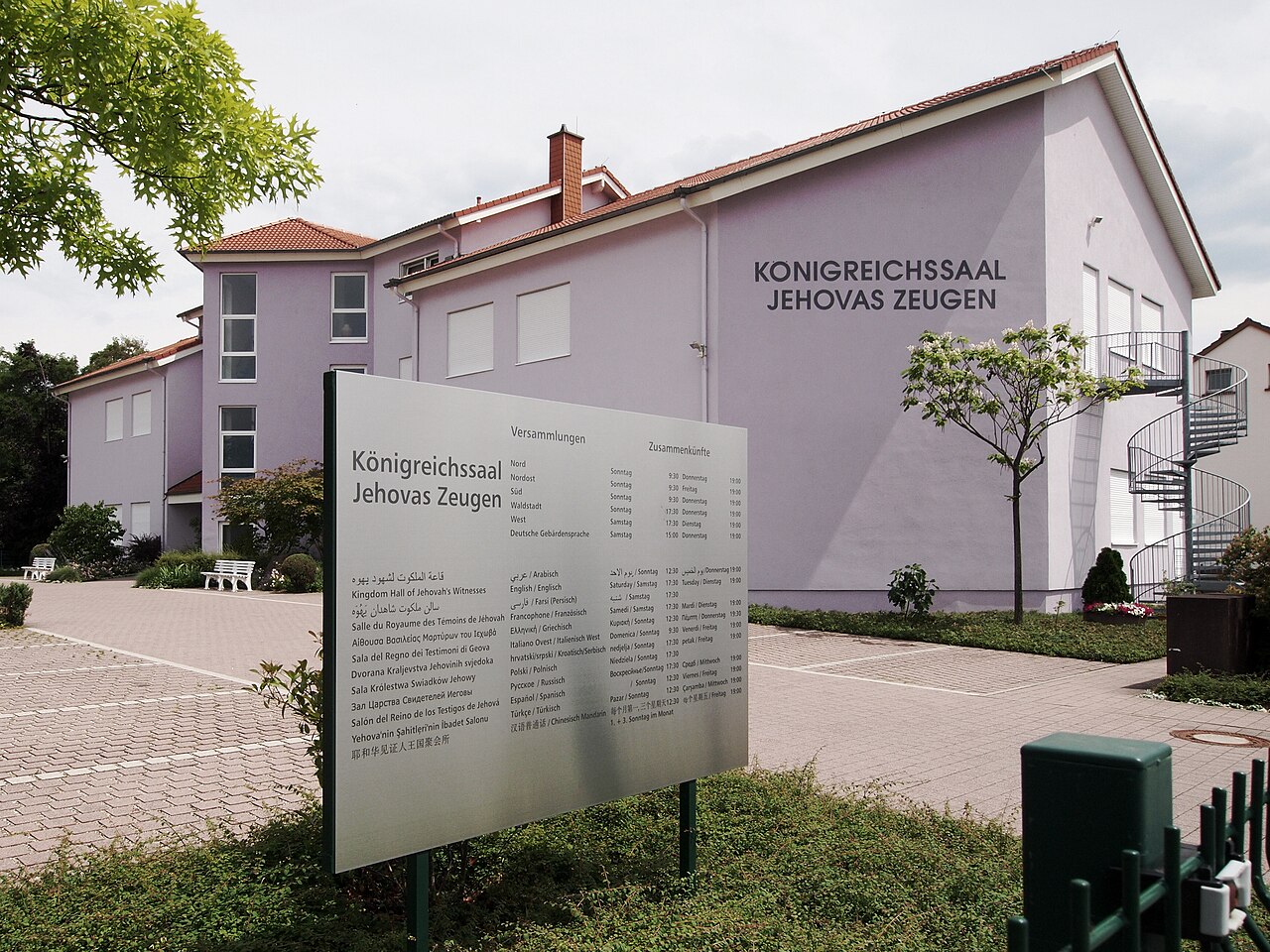
Via Wikimedia Commons: Kingdom Hall of Jehovah's Witnesses in Karlsruhe-Mühlburg in Baden-Wür by Ikar.us, CC BY 3.0 de.
1914
The year 1914 is central to the teaching, and has its own entry; this section gives only an outline.
The Worldmark article says that in 1876 Charles Taze Russell, the movement's founder, adopted an end-times chronology from the Adventist writer Nelson Barbour, which held that Christ had been invisibly present since 1874 and that Jesus' thousand-year kingdom would be set up on earth in 1914.[7] Christ's kingdom did not displace the world's nations in 1914, and Russell, according to the same article, still believed until his death in 1916 that the First World War would lead into Armageddon, which has its own entry.[7] The organization's own account, in a 2014 issue of The Watchtower, says the Bible Students had spent decades pointing to 1914 as a significant year.[2]
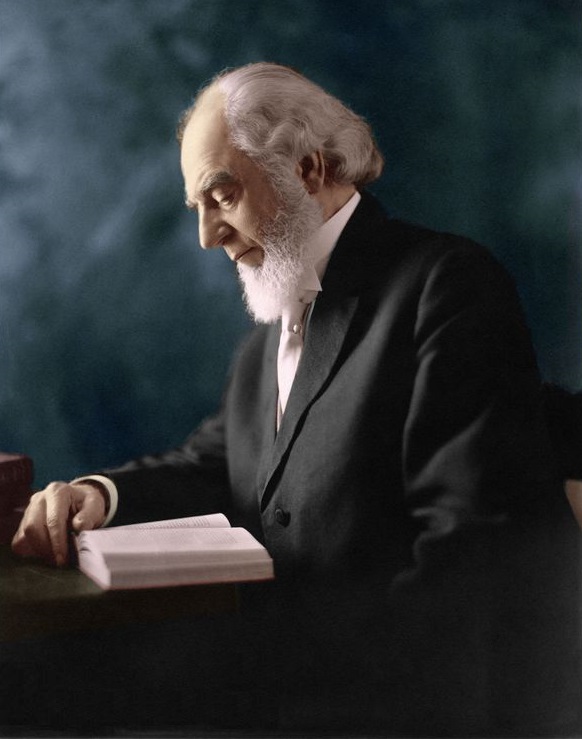
Via Wikimedia Commons: Russell Charles Taze 1911 by Watchtower, public domain.
Jehovah's Witnesses teach that God's Kingdom began ruling in 1914, when Jesus started to reign as king in heaven.[1][2] They teach that Jesus' first act as king was to throw Satan and his demons out of heaven down to the earth, and they treat wars, famines, epidemics and earthquakes since then as part of a "sign" that the Kingdom will soon take full control of the earth's affairs.[1] The same 2014 Watchtower article describes a period of spiritual cleansing of Jesus' followers on earth from 1914 to early 1919, and says that in 1919 Jesus appointed a "faithful and discreet slave" to supply them with spiritual teaching.[2]
Expectations continued to change after Russell's death. The Worldmark article says that under Joseph Franklin Rutherford, elected the Watch Tower Society's second president in 1917, the movement grew on the teaching that the millennium would begin in 1925, and that a majority of Bible Students broke with him after that did not happen and he began revising Russell's teachings and centralizing control.[7] It also records that in 1935 Rutherford taught that the "great multitude" would receive salvation on earth rather than in heaven.[7]
Scholars describe these changes in different ways. The Worldmark article presents 1914 as the year in which Russell's expectation that Christ's kingdom would replace the nations was not met.[7] A 2010 article in the International Journal for the Study of New Religions argues against treating the Witnesses simply as a case of failed prophecy.[8] It traces the Watch Tower Society's dates, including 1914, 1918, 1925 and 1975, and contends that, although there have been failures in prophetic speculation, the shifts came more from changed readings of biblical chronology than from failed predictions, with prophecy serving Witnesses more as a way of discerning a divine plan in history than as a means of predicting the future.[8]
The Kingdom's expected role
Jehovah's Witnesses teach that the Kingdom will protect its subjects when it destroys "the present wicked system of things on earth".[1] They teach that over the following 1,000 years the Kingdom will carry out God's original purpose for humankind, turning the earth into a global paradise, after which Jesus will hand the Kingdom back to his Father.[1] Britannica writes that, in Witness belief, those who acknowledge Jehovah in this life will enter the thousand-year kingdom, while those who reject him face total extinction rather than punishment in hell.[6] The Worldmark article describes house-to-house preaching as testimony that all Witnesses must give before an imminent "Great Tribulation", at the end of which, in Witness teaching, all except Jehovah's Witnesses will be annihilated.[7]
Preaching "the good news of the Kingdom"
Jehovah's Witnesses teach that the Kingdom is already at work on earth, uniting a great crowd of people from all nations through a worldwide preaching campaign.[1] The 2014 Watchtower article describes the Kingdom-preaching work as "the most important work being done on earth today", and says that by 1922 there were more than 17,000 proclaimers in 58 lands.[2]
Witnesses call their local places of worship Kingdom Halls rather than churches; Britannica notes that the movement met in rented halls in its early years and began buying its own buildings under Rutherford.[6] The same article describes members who preach as "publishers", who cover an assigned territory door to door, while "pioneers" spend a larger share of their time in religious service alongside ordinary jobs, and "special pioneers" are full-time workers paid by the Watch Tower Society.[6] Congregations keep detailed records of visits, return calls, Bible studies and literature placed.[6] The Worldmark article records 6,304,645 publishers in 2002, against nearly 15.6 million people at that year's Memorial.[7]
The organization's report for the 2025 service year counted a peak of 9,205,326 publishers, an average of 9,047,083 preaching each month (2.5 percent more than in 2024), 119,652 congregations, and activity in 241 lands.[5] The same report listed an average of 7,603,182 Bible studies a month, 304,643 people baptized, and an average of 1,743,567 pioneer publishers a month.[5]
Political neutrality
Jehovah's Witnesses teach that loyalty to God's Kingdom requires political neutrality. Their official explanation says that, as representatives of the Kingdom, they stay neutral in the political affairs of every country, including their own, and trust the Kingdom rather than human governments to solve the world's problems.[4] They do not vote for parties or candidates, run for public office, lobby, or take part in efforts to change governments, though they say they do not interfere with others who choose to vote.[4] They also say they respect governments, obey the law and pay taxes.[4] Britannica confirms that Witnesses do not vote in public elections, do not salute national flags, which they regard as an act of false worship, and refuse military service.[6] The Worldmark article adds that they do not stand for national anthems and avoid work in factories that make weapons.[7]
The organization's history God's Kingdom Rules! cites a Watchtower article of 1 November 1939, titled "Neutrality", which set a rule of strict neutrality between nations at war, and says Witnesses refuse noncombatant military duties as well as combat roles.[3]
These positions have repeatedly brought Witnesses into conflict with governments. Britannica lists imprisonment during the First World War, persecution under the Nazis, and continuing opposition in some countries, especially over military service.[6] The Worldmark article says that Rutherford and seven associates were briefly imprisoned in the federal penitentiary in Atlanta, Georgia, in 1918, allegedly for opposing conscription, and that Witnesses were repeatedly attacked by mobs in the United States between 1940 and 1943.[7] By the organization's own count, about 6,000 Witnesses were held in Nazi-era camps and more than 1,600 died; during the Second World War, Witnesses made up more than two-thirds of the inmates in United States federal prisons held for religious objection to the war; and in Armenia more than 450 young Witnesses were imprisoned over 20 years, the last released in November 2013.[3]
Several of these disputes reached the courts. In Minersville School District v. Gobitis (1940) the United States Supreme Court upheld, by eight votes to one, a school's expulsion of Witness children who would not salute the flag; on 14 June 1943, in West Virginia State Board of Education v. Barnette, the court reversed that position by six votes to three, ruling that compulsory flag salutes in public schools violated freedom of speech and religion.[10] God's Kingdom Rules! also reports that the European Court of Human Rights ruled in favor of a Greek Witness in 2000, and that in the case of an Armenian Witness and conscientious objector a chamber of the court ruled against him on 27 October 2009 before the Grand Chamber ruled in his favor on 7 July 2011.[3]
Comparison with other Christian views
In Christianity generally, Britannica defines the Kingdom of God as the spiritual realm over which God reigns as king, or the fulfillment of God's will on earth.[9] It explains that the underlying Greek word probably reflects an Aramaic term for a king's active rule rather than a territory or a people.[9] According to the same article, scholars disagree about whether Jesus taught that the Kingdom had already arrived, while early Christians came to see it as partly present in the life of the church, with its full realization awaiting the end of the world and the Last Judgment; in some periods, the church was identified closely with the Kingdom itself.[9]
Witness publications, by contrast, describe the Kingdom as a specific government in heaven, with a set number of co-rulers and a starting date of 1914, that is expected to take over the earth's affairs.[1][6]
Sources
- Jehovah's Witnesses. "What Is God's Kingdom?" Lesson 7 in Good News From God! (brochure). Watch Tower Bible and Tract Society of Pennsylvania, jw.org. No date shown; accessed 25 November 2026. jw.org/en/library/brochures/good-news-from-god/what-is-gods-kingdom/
- Jehovah's Witnesses. "100 Years of Kingdom Rule—How Does It Affect You?" The Watchtower (Study Edition), January 2014 (issue of 15 January). jw.org. Accessed 25 November 2026. jw.org/en/library/magazines/w20140115/100-years-kingdom-rule/
- Jehovah's Witnesses. "Loyally Supporting God's Government and No Other." Chapter 14 in God's Kingdom Rules! Watch Tower Bible and Tract Society of Pennsylvania, jw.org. No date shown; accessed 25 November 2026. jw.org/en/library/books/gods-kingdom/conquests/loyalty-to-gods-gove…
- Jehovah's Witnesses. "Why Do Jehovah's Witnesses Maintain Political Neutrality?" Frequently Asked Questions. jw.org. No date shown; accessed 25 November 2026. jw.org/en/jehovahs-witnesses/faq/political-neutrality/
- Jehovah's Witnesses. "2025 Grand Totals." 2025 Service Year Report of Jehovah's Witnesses Worldwide. Watchtower Online Library. No date shown (covers 1 September 2024 to 31 August 2025); accessed 25 November 2026. wol.jw.org/en/wol/d/r1/lp-e/1102025416
- Melton, J. Gordon. "Jehovah's Witness: Beliefs and practices." Encyclopaedia Britannica. Last updated 18 September 2026; accessed 25 November 2026. britannica.com/topic/Jehovahs-Witnesses/Beliefs-and-practices
- Penton, M. James. "Christianity: Jehovah's Witnesses." Worldmark Encyclopedia of Religious Practices, via Encyclopedia.com. No date shown; accessed 25 November 2026. encyclopedia.com/religion/encyclopedias-almanacs-transcripts-and-ma…
- Chryssides, George D. "How Prophecy Succeeds: The Jehovah's Witnesses and Prophetic Expectations." International Journal for the Study of New Religions 1, no. 1 (2010): 27–48. Equinox Publishing (abstract page). Accessed 25 November 2026. doi.org/10.1558/ijsnr.v1i1.27
- Encyclopaedia Britannica. "Kingdom of God." No date shown; accessed 25 November 2026. britannica.com/topic/Kingdom-of-God
- Encyclopaedia Britannica. "West Virginia State Board of Education v. Barnette." No date shown; accessed 25 November 2026. britannica.com/event/West-Virginia-State-Board-of-Education-v-Barnette
