Compare versions
Version 1 → Version 2. Removed · Added. This shows the entry's text as it is written, including its formatting marks.
Version 1 · Version 2 · Version history
Side by side · Together
Lizzie Borden (1860–1927) was an American woman from Fall River, Massachusetts, who was tried for the 4 August 1892 killings of her father and stepmother and was acquitted in June 1893.[1][2]
## Early life and family
Lizzie Borden was born in Fall River on 19 July 1860.[1][2] She grew up with an older sister, Emma, in a well-off Congregational household.[2] Their father, Andrew Jackson Borden, was a wealthy businessman, and after the sisters' mother died he married Abby Durfee Gray in 1865.[1][2] According to the State Library of Massachusetts, the sisters reportedly disliked their stepmother and believed she was chiefly interested in their father's money, especially after he gave property to members of her family.[2] Britannica likewise describes the sisters as at odds with their father and stepmother over money.[1]
## The killings of 4 August 1892
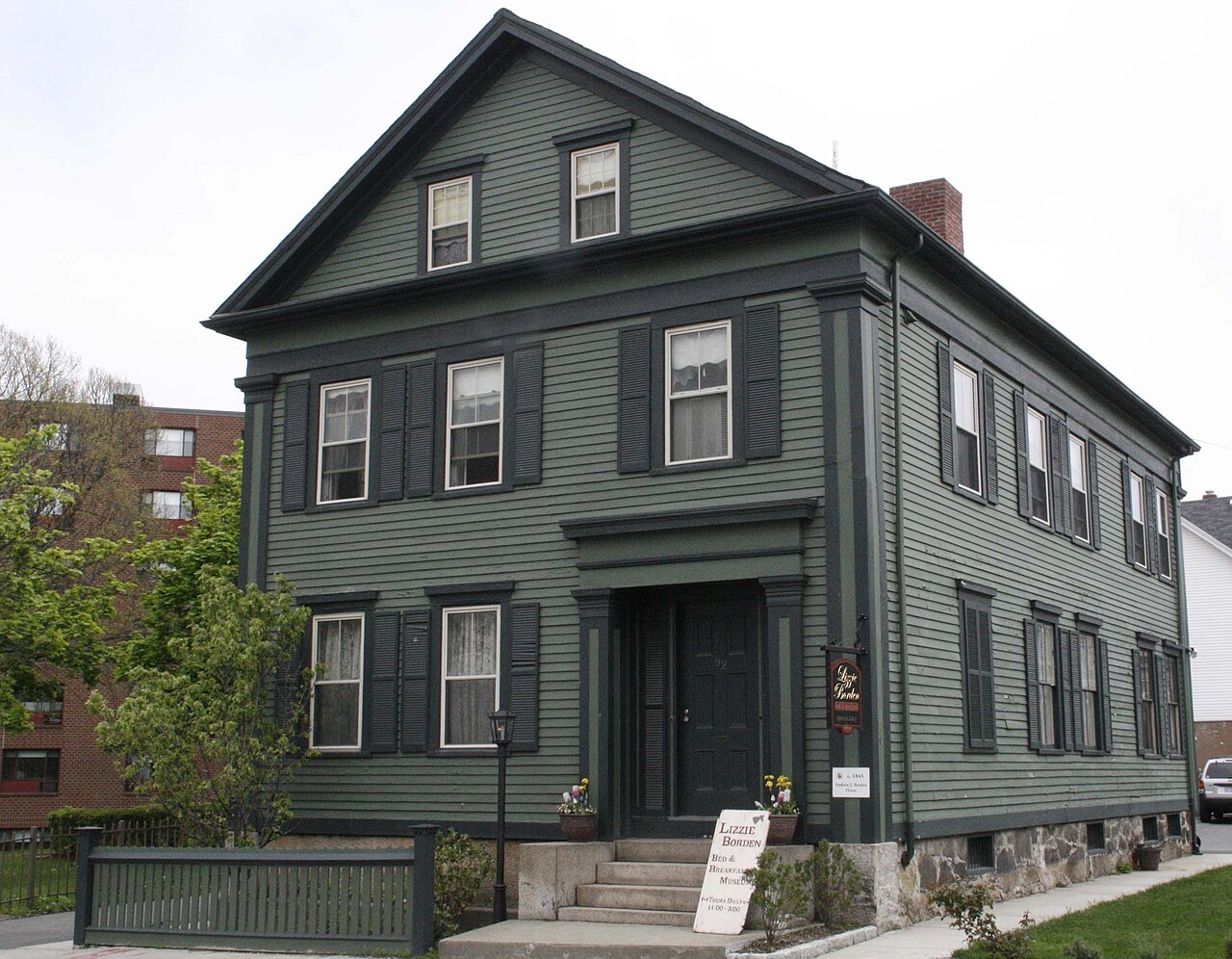
Andrew and Abby Borden were killed on the morning of 4 August 1892 in the family's house at 92 Second Street, Fall River.[3][2] Most accounts describe the weapon as a hatchet or axe.[1][2] Abby was found in an upstairs room by a neighbour, Adelaide Churchill, and Douglas O. Linder, a law professor who writes about historic trials, concludes from the state of the bodies that she had probably been killed at least ninety minutes before her husband.[3] Andrew Borden was found on the ground floor.[3]
The family's maid, Bridget Sullivan, was in the house that morning, and soon after 11 a.m. Lizzie called her downstairs, saying that her father was dead and that someone had come in and killed him.[3] Britannica gives about 11:15 a.m. as the time Lizzie, by her own testimony, found her father.[1] Lizzie said she had been in the barn behind the house when her father was killed.[3] Her explanations of what she was doing there changed between tellings, which investigators at the time treated as a reason for doubt.[4][5] Lizzie's maternal uncle, John Morse, had arrived for a visit the day before and gave police a detailed account of his movements.[5] Police also briefly held a farm worker, who had an alibi and was released, and witnesses reported unidentified men near the house, but no stranger was ever linked to the killings.[5]
## Inquest, arrest and indictment
An inquest (a closed judicial inquiry into a death) opened in Fall River on 9 August 1892 before Judge Josiah Blaisdell, and District Attorney Hosea Knowlton questioned Lizzie, Bridget Sullivan, John Morse and others.[3] Linder describes Lizzie's answers in a four-hour examination as confused and contradictory.[3] She was arrested on 11 August 1892.[4] The next day she pleaded not guilty and was taken to the jail at Taunton.[3]
At a preliminary hearing (a court session that decides whether there is enough evidence to send a case to trial) that began on 22 August, Judge Blaisdell sent the case to a grand jury.[3] A grand jury is a panel of citizens that decides whether to bring formal charges, called an indictment. According to Linder, the grand jury at first did not indict, but after it reconvened and heard Lizzie's friend Alice Russell describe seeing Lizzie burn a dress, it charged her with the killings.[3] Biography.com dates the indictment to December 1892 and says it contained three counts of murder.[4]
## Trial in New Bedford
The trial opened on 5 June 1893 in the courthouse at New Bedford, Massachusetts, before a panel of three judges and a jury of twelve men.[3] It lasted fifteen days.[2] District Attorney Knowlton led the prosecution.[3] The defence team included George D. Robinson, a former governor of Massachusetts, and Andrew J. Jennings.[2][3]
The prosecution relied on circumstantial evidence, meaning evidence that points to a conclusion only by inference rather than showing it directly.[1][3] Bridget Sullivan's testimony placed Lizzie in the house during the killings, although Sullivan also said she had never seen the stepmother and stepdaughter fight.[4] Alice Russell testified that a few days after the killings she saw Lizzie burn a blue dress, which Lizzie said was stained with paint.[3][4] The prosecution also showed the jury a hatchet head with a broken-off handle; the defence asked where the missing piece of the handle was, and, according to Linder, the state could not say.[3]
Two important pieces of evidence were kept from the jury. The judges ruled that Lizzie's inquest testimony could not be used, because she had in effect been a prisoner when she gave it, her answers were not voluntary, and she should have been warned of her right to remain silent.[3] They also excluded testimony from a drugstore clerk, Eli Bence, that Lizzie had tried to buy prussic acid, a poison, the day before the killings.[3][5] Biography.com reports that this claim was found to be unrelated to the case.[4]
In his instructions to the jury, Justice Dewey told jurors to weigh Lizzie's Christian character in her favour, and one newspaper of the time called his charge "a plea for the innocent".[3] On 20 June 1893 the jury returned a verdict of not guilty after deliberating for about an hour and a half.[4][2] No one else was ever charged with the killings.[2][4][5]
## Later life and death
After the trial Lizzie remained in Fall River, where many residents shunned her.[1][2] She and Emma inherited much of their father's estate and bought a house together that they called Maplecroft.[4] The house, at 306 French Street, is a Queen Anne-style Victorian about a mile from the Second Street house, and its name is carved into the front steps.[6] Lizzie began using the name Lizbeth.[4]
In 1905 Emma moved out, and the sisters did not speak again; Biography.com notes that Emma may have disliked Lizzie's friendship with the actress Nance O'Neil.[4] In 1913 Emma publicly stated that she believed her sister was innocent.[7] Lizzie herself reportedly never discussed the killings.[7]
Lizzie Borden died of pneumonia at her Fall River home on 1 June 1927, aged 66.[4] Her funeral was held at the house on 4 June, and she was buried next to her parents in Oak Grove Cemetery, Fall River.[6][4] Emma died days later in Newmarket, New Hampshire, and was buried in the same family plot.[4]
*Via Wikimedia Commons: [Lizzie Borden House (Bed Breakfast) (3535957840)](https://commons.wikimedia.org/wiki/File:Lizzie_Borden_House_(Bed_Breakfast)_(3535957840).jpg) by dbking from Washington, DC, [CC BY 2.0](https://creativecommons.org/licenses/by/2.0).*
## Views on who killed the Bordens
Because the jury acquitted Lizzie and no one else was charged, the question of who killed Andrew and Abby Borden has never been settled in court.[2][5] Writers have offered differing views, none of them proven.
- Douglas O. Linder, in "The Trial of Lizzie Borden: An Account" on his Famous Trials website, writes that the prosecution did not prove guilt beyond a reasonable doubt.[3] He suggests that the prosecution's case rested mainly on the argument that no one else could have committed the crime, and that a male defendant might have been convicted on the same evidence.[3]
- Arnold R. Brown, in his 1991 book "Lizzie Borden: The Legend, the Truth, the Final Chapter", argued that the killer was William Borden, whom he described as an illegitimate son of Andrew Borden.[5] A 2026 A&E overview of the case notes that no reliable contemporary evidence supports this theory.[5]
- The novelist Ed McBain, in his 1984 novel "Lizzie", speculated that Lizzie and Bridget Sullivan were lovers, an idea later taken up on screen.[9]
## Cultural afterlife
A famous schoolyard rhyme about the case begins "Lizzie Borden took an ax".[4][7] Linder notes that the rhyme greatly overstates the number of blows.[3] In 1965 Time magazine observed that, despite the acquittal, popular retellings in books, plays and a ballet had found her guilty.[8]
Stage works include "Fall River Legend" (1948), a ballet by Agnes de Mille, and the opera "Lizzie Borden" by the composer Jack Beeson with a libretto by Kenward Elmslie.[1] The opera was commissioned by the Ford Foundation and staged by New York City Opera in 1965, with the soprano Brenda Lewis in the title role; Time noted that it changed facts, for example making Lizzie the elder sister.[8] A play about Lizzie's friend Nance O'Neil was staged in 2010.[7]
On screen, the story was told in "The Legend of Lizzie Borden" (1975) and in "Lizzie Borden Took an Ax" (2014), with Christina Ricci as Lizzie.[4] The 2018 film "Lizzie", directed by Craig William Macneill and written by Bryce Kass, stars Chloë Sevigny as Lizzie and Kristen Stewart as Bridget Sullivan and builds on the idea that the two women were lovers.[9]
The fourth season of the Netflix drama anthology "Monster", created by Ryan Murphy and Ian Brennan, is titled "Monster: The Lizzie Borden Story" and is the first in the series to centre on a woman.[7] Netflix announced on 9 October 2025 that production was under way in Los Angeles, with Ella Beatty as Lizzie, Charlie Hunnam as Andrew Borden, Rebecca Hall as Abby Borden, Vicky Krieps as Bridget Sullivan, Billie Lourd as Emma Borden and Jessica Barden as Nance O'Neil.[7] BroadwayWorld reported on 11 August 2026 that Netflix had set the eight-episode limited series to premiere on 17 September 2026.[10] Like the earlier films, it is a dramatisation rather than a documentary account.[10]
The Second Street house offers ghost tours and promotes itself as "America's Most Haunted House".[7]
## Sources
1. "Lizzie Borden." Encyclopaedia Britannica. No date shown; accessed 25 November 2026. https://britannica.com/biography/Lizzie-Borden-American-murder-suspect
2. Alexandra Bernson. "True Crime Resources and the Borden Murder Trial." State Library of Massachusetts blog, 19 July 2021. https://mastatelibrary.blogspot.com/2021/07/true-crime-resources-and-borden-murder.html
3. Douglas O. Linder. "The Trial of Lizzie Borden: An Account." Famous Trials (Douglas O. Linder, University of Missouri–Kansas City School of Law). No date shown (copyright 1995–2026); accessed 25 November 2026. https://famous-trials.com/lizzieborden/1437-home
4. Biography.com Editors and Catherine Caruso. "Lizzie Borden: Murder Trial, Acquittal, and 'Monster'." Biography.com, 4 September 2026 (updated 15 September 2026). https://www.biography.com/crime/a73581416/lizzie-borden-trial
5. Barbara Maranzani. "Who Else Could Have Killed Andrew and Abby Borden?" A&E, 17 September 2026 (updated 24 September 2026). https://www.aetv.com/articles/who-else-could-have-killed-andrew-abby-borden-murders
6. Emily Sweeney. "Lizzie Borden's home in Fall River can be yours for $890,000. Take a look inside." The Boston Globe, 21 September 2020. https://www.bostonglobe.com/2020/09/21/metro/take-look-inside-lizzie-bordens-home-fall-river-it-can-be-yours-890000
7. Lauren Daley. "Lizzie Borden took an ax — and now will be Netflix's next 'Monster'." The Boston Globe, 16 October 2025. https://www.bostonglobe.com/2025/10/16/arts/lizzie-borden-netflix-monster/
8. "Opera: New Music, Old Legend." Time, 2 April 1965. https://time.com/archive/6874116/opera-new-music-old-legend
9. Sheila O'Malley. "Lizzie" (review). RogerEbert.com. No date shown; accessed 25 November 2026. https://www.rogerebert.com/reviews/lizzie-2018
10. Rachel Stone. "MONSTER: THE LIZZIE BORDEN STORY to Premiere on Netflix." BroadwayWorld, 11 August 2026. https://www.broadwayworld.com/article/MONSTER-THE-LIZZIE-BORDEN-STORY-to-Premiere-on-Netflix-20260811
