Version 1
Nov 25, 2026. Compare with the current version · Version history
East of Eden is a family saga by the American writer John Steinbeck, first published in September 1952, that follows the Trask and Hamilton families in California's Salinas Valley.[1][3]
Background and writing
John Steinbeck (1902–1968), a winner of the Nobel Prize in Literature, wrote East of Eden in the later part of his career, after The Grapes of Wrath and Of Mice and Men.[1] He regarded it as his most important work; in a letter quoted by his biographer Jackson Benson, he wrote that "This is 'the book.'"[3]
The novel draws on Steinbeck's own family. It opens with a description of the Salinas Valley shaped partly by his childhood memories, and it introduces his maternal grandparents, Samuel and Liza Hamilton, immigrants from Northern Ireland who settled on poor, dry land near King City around 1870.[2] The Hamiltons had nine children, one of whom, Olive, was Steinbeck's mother.[2] Their story runs alongside the invented story of the Trask family.[2]
From January to November 1951, while drafting the novel, Steinbeck wrote a series of letters to his editor at Viking Press, Pascal Covici.[4] These letters were published in 1969 as Journal of a Novel: The East of Eden Letters.[4] Reviewing the book in the San Francisco Chronicle on 16 December 1969, William Hogan compared it to Thomas Wolfe's working notes on Look Homeward, Angel, but found Steinbeck's letters more personal and revealing.[4] The review guide Kirkus, by contrast, judged the letters of limited interest to general readers.[5]
Plot
The story moves between the East Coast and California and covers several generations.[2] In Connecticut, Cyrus Trask, a Civil War veteran who exaggerates his service, has two sons by different wives, Adam and Charles.[2] Cyrus favours Adam, and the resentful Charles attacks him and nearly kills him.[2] After years in the cavalry and as a wanderer, Adam is reunited with Charles after their father's death, and the brothers inherit a large sum.[2]
A second line of the story follows Cathy Ames, a young woman from Massachusetts who manipulates the people around her and sets the house fire that kills her parents.[2] Beaten and abandoned by a man who had kept her as his mistress, she arrives at the Trask farm, and Adam marries her.[2] Around 1900 Adam takes Cathy to the Salinas Valley, buys land and hires Samuel Hamilton to dig wells, and also hires Lee, a Chinese American cook who talks with Samuel as an equal.[2] After Cathy gives birth to twin boys, she shoots Adam in the shoulder and leaves; under the name Kate she later takes over a brothel in the town of Salinas.[2]
Adam falls into despair, and Lee raises the twins.[2] Samuel pushes Adam to name them, and the names they choose, Caleb (Cal) and Aron, come from a discussion of the Cain and Abel story.[2] In the later parts of the novel the family moves to Salinas, Adam loses much of his money in a failed scheme to ship lettuce by refrigerated railway car, and Cal learns that Kate is his mother.[2] Cal tries to win his father's approval with money earned from wartime bean prices; when Adam refuses it, Cal takes Aron to meet Kate, and Aron, shaken, enlists in the army during the First World War.[2] Kate leaves her fortune to Aron and dies by suicide.[2] News of Aron's death in battle leaves Adam gravely ill after a stroke; at Lee's urging, Adam gives Cal his blessing with the single word "timshel."[2]
Themes and interpretation
Penguin Random House, the novel's current publisher, describes the book as a retelling of the Fall of Adam and Eve and of the rivalry of Cain and Abel, with themes of identity, the mysteries of love and the damage done by love's absence.[1] Inside the novel, the character Lee studies the Hebrew word "timshel" from the Cain and Abel story and translates it as "thou mayest," a reading that treats people as free to choose to overcome sin.[2]
Literary scholars have examined how the novel uses this material. In a 2015 article, Erik Van Achter argued that the word can be read either as "thou mayest" or "thou shalt," and that Steinbeck, through Lee, chose the reading that gives human beings free will.[6] Van Achter traces echoes of the Adam and Eve and Cain and Abel stories across the novel's two generations of brothers, noting the paired initials of Adam and Aron and of Charles and Cal, and reads redemption in the book as coming through free choice and forgiveness.[6] He describes Cathy as lacking the inborn inclination toward good that he calls the "yetzer tov."[6]
Critics have also debated the book's structure. The Steinbeck scholar Louis Owens argued that the Hamilton chapters add little to the central theme, and Richard Peterson identified the first half of the book as critics' main target, citing among other things the imbalance between the Trask and Hamilton sections.[3] Benson observed that the features critics most often attacked, including the character of Cathy and Lee's philosophical conversations, became the parts many readers found most memorable.[3]
Publication and reception
East of Eden was released in September 1952 and reached number one on the fiction bestseller list by November of that year.[3] According to Benson, most periodicals treated it as a serious work by a serious author, whether they praised or attacked it.[3] A 1952 review in The New York Times's "Books of the Times" column called it clumsy in structure and marred by melodrama, yet a serious and largely successful effort, while The New York Times Book Review called it "a strange and original work of art."[3] The Washington Post praised its storytelling, and Samuel F. Morse, writing in the Hartford Courant, argued that Steinbeck was more a moralist than a novelist.[3] Looking back in 1969, Hogan called it a novel that had "stirred a mixed critical reception."[4]
In 2003 Oprah Winfrey chose East of Eden for Oprah's Book Club, which returned the novel to second place on the bestseller list.[3][1]
The 1955 film
Warner Bros. released a film adaptation directed by Elia Kazan from a screenplay by Paul Osborn; it premiered at the Astor Theatre in New York on 9 March 1955.[7] The film used only about a quarter of the novel, centring on Cal Trask's search for his father's approval and his discovery that his mother runs a brothel.[7] James Dean played Cal in his first leading role, with Raymond Massey as his father, Julie Harris as Abra, Richard Davalos as his brother, Jo Van Fleet as his mother and Burl Ives as the sheriff.[7] Reviewing the film for The Hollywood Reporter in February 1955, Jack Moffitt praised the film's artistry and Kazan's direction and predicted strong appeal for Dean among young audiences.[7] The film received four nominations at the 28th Academy Awards and won one, the award for best supporting actress, for Jo Van Fleet.[7]
The 1981 television miniseries
ABC broadcast a miniseries adaptation in 1981, directed by Harvey Hart and written by Richard Shapiro.[8] Jane Seymour played Cathy Ames, with Timothy Bottoms as Adam Trask, Bruce Boxleitner as Charles, Sam Bottoms as Cal, Hart Bochner as Aron, Warren Oates as Cyrus, Lloyd Bridges as Samuel Hamilton and Soon-Tek Oh as Lee.[8] Running more than six hours, it covered the novel's full generational story, and the critic Paul Mavis, reviewing its 2009 DVD release, called it far more faithful to Steinbeck's novel than the 1955 film.[8]
The 2026 Netflix limited series
Netflix announced on 26 September 2024 that it had ordered a seven-episode limited series based on the novel, starring Florence Pugh as Cathy Ames, with Pugh also serving as an executive producer.[9] The announcement named Christopher Abbott as Adam, Mike Faist as Charles and Hoon Lee as Lee.[9] Zoe Kazan wrote the adaptation and served as co-showrunner (one of the lead producers in charge of the series) with Jeb Stuart; Garth Davis was named to direct episodes one to four and Laure de Clermont-Tonnerre episodes five to seven, with Fifth Season and Anonymous Content as co-studios.[9] Netflix's announcement described the 1955 film as the work of Zoe Kazan's grandfather, Elia Kazan.[9]
In an article dated 12 October 2026, Netflix's Tudum site stated that all seven episodes were streaming globally; as of 25 November 2026 the page still said so.[10] It described the series as spanning decades, bookended by the American Civil War and the First World War, and listed further cast members including Tracy Letts as Cyrus Trask, Martha Plimpton as Faye, Ciarán Hinds as Samuel Hamilton, Joseph Zada as Cal and Joe Anders as Aron.[10] According to Netflix, Kazan wrote and executive produced the series.[10]
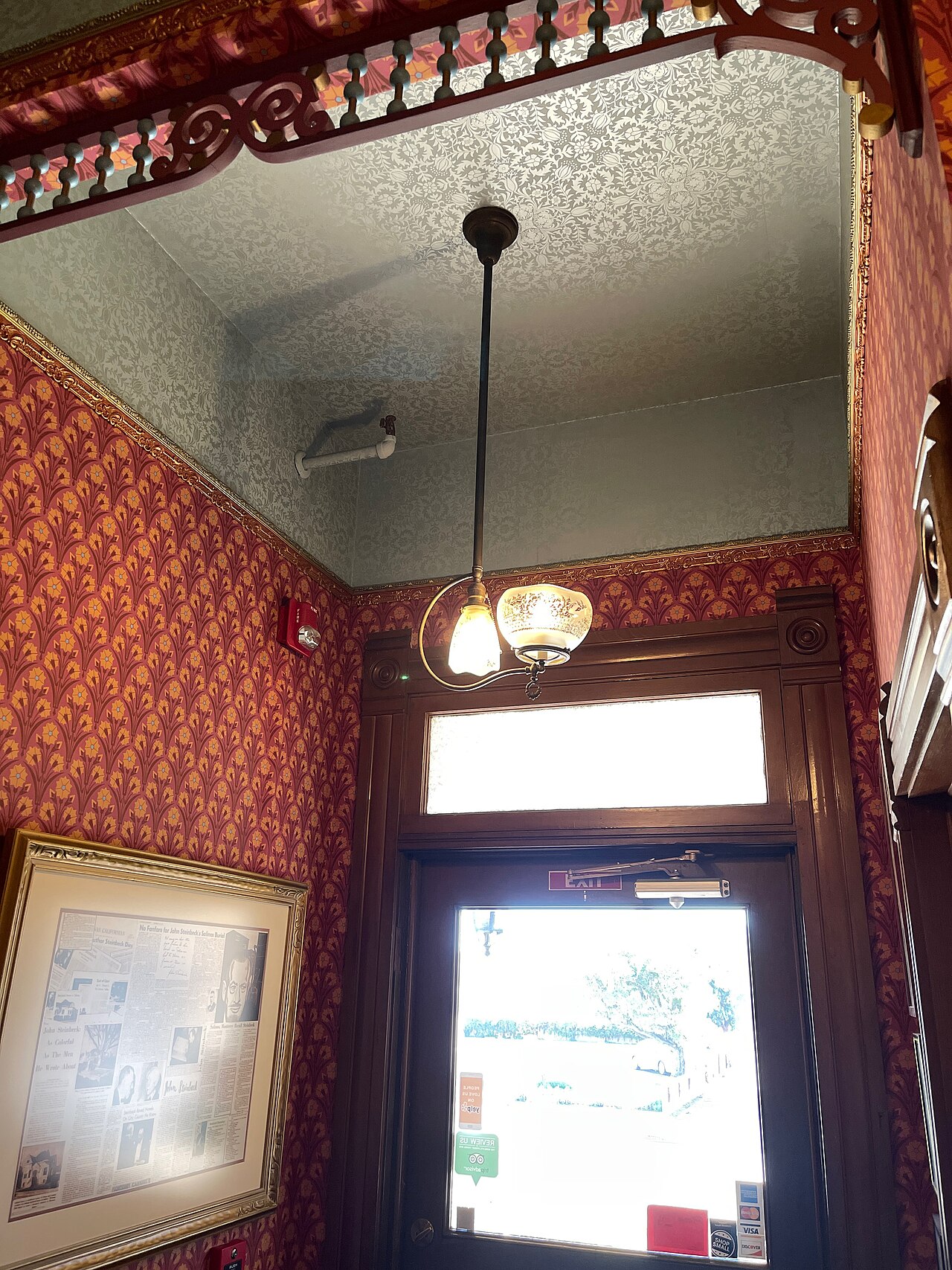
Via Wikimedia Commons: John Steinbeck House entryway by Gregory Ford Henderson, CC BY-SA 4.0.
Sources
- Penguin Random House. "East of Eden by John Steinbeck" (Penguin Orange Collection edition, published 18 October 2016). Penguin Random House. No date shown for the page; accessed 25 November 2026. penguinrandomhouse.com/books/541274
- Martha Heasley Cox Center for Steinbeck Studies, San José State University. "East of Eden: Synopsis" (Steinbeck in the Schools reading guide). Center for Steinbeck Studies, © 2023. steinbeckintheschools.com/east-of-eden-reading-guides/synopsis
- Martha Heasley Cox Center for Steinbeck Studies, San José State University. "East of Eden: Critical Reception" (Steinbeck in the Schools reading guide). Center for Steinbeck Studies, © 2023. steinbeckintheschools.com/east-of-eden-reading-guides/critical-rece…
- Joseph R. McElrath Jr., Jesse S. Crisler and Susan Shillinglaw (eds.). "Journal of a Novel: The East of Eden Letters (1969)," chapter 30 in John Steinbeck: The Contemporary Reviews. Cambridge University Press, 1996 (online 2010). cambridge.org/core/product/identifier/CBO9780511666629A038/type/BOO…
- Kirkus Reviews. "Journal of a Novel: The East of Eden Letters" (review). Kirkus Reviews. No review date shown (book published 20 December 1969); accessed 25 November 2026. kirkusreviews.com/book-reviews/john-steinbeck/journal-of-a-novel/print
- Erik Van Achter. "Thou Mayest or Thou Shalt: Discerning the Dramatic Role of Timshel in John Steinbeck's East of Eden." Forma Breve, no. 12 (2015), University of Aveiro. proa.ua.pt/index.php/formabreve/en/article/view/5218
- Jack Moffitt. "'East of Eden': THR's 1955 Review." The Hollywood Reporter (review first published 16 February 1955; republished 9 March 2023, via Yahoo News UK). uk.news.yahoo.com/east-eden-thr-1955-review-080000080.html
- Paul Mavis. "John Steinbeck's East of Eden" (DVD review). DVD Talk, 2 March 2009. dvdtalk.com/reviews/review/36482
- Netflix. "Netflix Orders Limited Series Adaptation of John Steinbeck's Classic, 'East of Eden'." Netflix, 26 September 2024. about.netflix.com/en/news/netflix-orders-limited-series-adaptation-…
- Kristin Iversen. "'East of Eden' by Zoe Kazan Stars Florence Pugh, Christopher Abbott, Mike Faist." Netflix Tudum, 12 October 2026. netflix.com/tudum/articles/east-of-eden-series
