Aileen Wuornos (1956–2002) was an American woman who was sentenced to death six times for killing men she met along central Florida highways in 1989 and 1990, and who was executed by lethal injection in Florida on 9 October 2002.[3][4][5]
Early life
Wuornos was born on 29 February 1956 in Rochester, Michigan, under the name Aileen Pittman.[8] Her parents separated before she was born, and from about the age of four she and her brother lived with their grandparents.[8] In her early teens she spent time in a home for unwed mothers, and she later left school.[8]
After leaving school she turned to prostitution, and by the late 1980s she was living as a drifter.[8] Britannica records that she was jailed in 1974 for drunk driving and for firing a gun from a moving vehicle, and that she was later arrested many times on charges including armed robbery, check forgery and car theft.[8] One of the aggravating factors later found at her first murder trial was a robbery conviction from 1982.[1]
Accounts of her childhood were disputed in court. At her 1992 sentencing hearing in the Marion and Citrus County cases, a woman who had adopted her as an adult testified, largely by repeating what others had said, that Wuornos had been abandoned and abused as a child; the prosecution called rebuttal witnesses who said her childhood had not been abusive.[2] The Florida Supreme Court later described most of that mitigation case as hearsay, meaning second-hand statements offered for their truth.[2] Billy Nolas, who represented her at her 1992 trial, told CBS News in 2002 that she had borderline personality disorder rooted in childhood neglect and sexual abuse.[5]
The killings
Between late 1989 and late 1990, while working as a hitchhiking prostitute, Wuornos killed middle-aged men she met along highways in central Florida.[5][6] The killings spanned about 13 months.[6] The offenses for which she was later sentenced were dated, in Florida's records, from about 1 December 1989 in Volusia County to 18 November 1990 in Dixie County.[3]
The six men named in the cases that ended in death sentences were Richard Mallory, Charles Humphreys, Troy Burress, David Spears, Charles Carskaddon and Walter Antonio.[3] The Florida Supreme Court's 1994 opinion in the Mallory case also listed a seventh killing, of a man whose body was never found; she was not sentenced for that death.[1][3] John Tanner, the state attorney who prosecuted her, said at her execution that the evidence showed she had killed seven men.[6] Britannica gives the total as at least seven and notes speculation about an eighth.[8]
Arrest and confessions
Wuornos was arrested in early 1991.[8] Florida investigators had contacted her former companion in Pennsylvania, who agreed to return to Florida and urged her to confess, partly out of fear of being charged as an accomplice.[1] Wuornos then gave taped confessions to an investigator from the Volusia County Sheriff's Office, even though a lawyer from the public defender's office strongly advised her not to.[1]
Her accounts changed over time.[2] In her earliest confession she said she had feared Mallory would rape her; in a later version she said he had raped her before she shot him.[1] In one confession she said she had killed to eliminate witnesses.[2] At her first trial she presented herself as the victim, and the Florida Supreme Court held that the jury could reject that testimony because it did not match her earlier statements.[1]
Trials and sentences
Her first trial, in Volusia County, concerned the death of Richard Mallory.[1] On 27 January 1992 a jury found her guilty of first-degree murder and of armed robbery with a firearm.[1][3] The court allowed the prosecution to present evidence of the other killings under Florida's "Williams rule", which governs when evidence of similar crimes may be shown to a jury; here it was admitted to rebut her claims of self-defense and lack of intent.[1] The jury recommended death by a vote of 12 to 0, and on 31 January 1992 the judge sentenced her to death for the murder and to ten years in prison for the robbery.[1][3]
The trial court found five aggravating factors, which are circumstances that the law allows to weigh in favour of a death sentence, among them that the murder was committed during a robbery and that it was cold, calculated and premeditated.[1] It found one mitigating factor, borderline personality disorder.[1]
On 31 March 1992 she pleaded no contest to the murders of Humphreys, Burress and Spears in Marion and Citrus Counties, together with the related robbery charges.[2][3] A no-contest plea accepts conviction without a formal admission of guilt. At the plea hearing she relied mainly on self-defense, and the Florida Supreme Court later called her statements there "at best inconsistent".[2] The sentencing jury recommended death by 10 to 2, and she received death sentences on 15 May 1992.[2][3]
In February 1993 she pleaded guilty in the Dixie County case of Walter Antonio and was sentenced to death after a jury recommended death by 7 to 5.[3] The same month she pleaded guilty in the Pasco County case of Charles Carskaddon, waived the penalty-phase hearing, and was sentenced to death.[3] In all, she held six death sentences from five Florida counties.[3][5]
Appeals
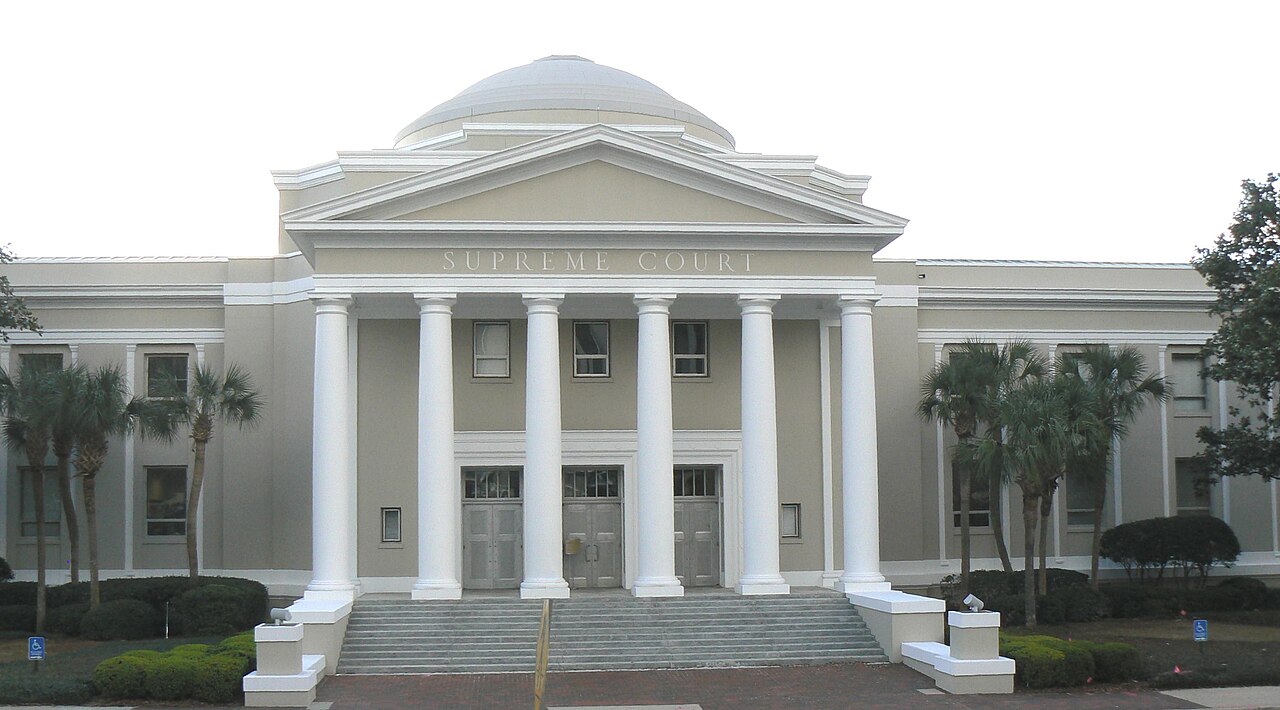
The Florida Supreme Court Building in Tallahassee, seat of the court that heard Wuornos's appeals.
The Florida Supreme Court affirmed the Mallory conviction and death sentence on 22 September 1994.[1][3] It held that her confessions had not been coerced, that the jury had been wrongly instructed on one aggravating factor but that the error was harmless, and that the trial court should have found additional mitigation, including alcoholism and a difficult childhood, but that this omission also did not change the result.[1] Justice Kogan wrote a separate concurring opinion that described two very different pictures of her, one of a life of victimization and violence and one of a cold-blooded killer, while concluding that the verdict and sentence stood.[1]
The court affirmed the three Marion and Citrus County sentences on 6 October 1994, rejecting challenges to her plea, her competency and the penalty phase.[2][3] It affirmed the Pasco County sentence in 1995 and the Dixie County sentence in 1996.[3] The United States Supreme Court declined to hear her case in each of the four appeals, in 1995 and 1996.[3]
Between 1997 and 2001 her lawyers filed post-conviction motions, which are later challenges to a conviction or sentence brought in the trial court after the direct appeal, and several were denied.[3] In 2001 a circuit court found her competent, and on 1 April 2002 the Florida Supreme Court approved that finding, discharged her state-appointed post-conviction counsel, and dismissed her remaining appeals; she had fired those lawyers and chosen to drop her appeals.[3][5] Florida's legislative case record still listed one post-conviction motion in the Dixie County case as pending.[3]
At a hearing in 2001 she gave up her appeals and told a judge that she had killed the men while working as a hitchhiking prostitute; for years before that she had said she shot them in self-defense against rape.[5] CNN reported in 2002 that she had recanted her earlier self-defense claim.[7]
Execution
Governor Jeb Bush signed her death warrant on 5 September 2002, setting the execution for 9 October 2002.[3] A Fort Lauderdale lawyer wrote to the Florida Supreme Court questioning her mental condition.[5] Bush issued a stay and ordered a mental examination; a panel of three state-appointed psychiatrists concluded that she understood her situation and was competent to be executed, and the stay was lifted.[5][7] The day before the execution, the Florida Supreme Court rejected two further efforts to stop it, including one by an Ohio group that sought to appeal on her behalf.[5]
Wuornos was executed by lethal injection at Florida State Prison in Starke and was pronounced dead at 9:47 a.m. on 9 October 2002, at the age of 46.[5][6][7] The Florida Department of Corrections lists her as number 53 among people executed in Florida since the death penalty was reinstated in 1976, after 11 years on death row.[4] She was the second woman executed in Florida in that period, after Judias (Judy) Buenoano in 1998, and the tenth woman executed in the United States since 1976.[4][5][6] A childhood friend from Michigan took her ashes back to that state for burial.[6]
Later portrayals
The documentary film-maker Nick Broomfield made a film about her in 1992.[10] He was later subpoenaed to her final appeal, where extracts of that film were shown in court, and with Joan Churchill he directed a second documentary, Aileen: Life and Death of a Serial Killer, which ends with his final interview with her before the execution.[10] That film was nominated for the European Documentary Award (Prix Arte) in 2004.[10]
The 2003 feature film Monster was based on her life.[8] On 29 February 2004, at the 76th Academy Awards, Charlize Theron won the Oscar for Actress in a Leading Role for playing her in that film.[9] By the time of her execution her case had also been the subject of an opera and several books.[5]
Academy of Motion Picture Arts and Sciences. "The 76th Academy Awards" (2004). No date shown; accessed 25 November 2026. oscars.org/oscars/ceremonies/2004