Robin Williams (21 July 1951 – 11 August 2014) was an American stand-up comedian and actor, known for rapid improvised comedy, the television series Mork & Mindy and films such as Good Morning, Vietnam, Aladdin, Mrs. Doubtfire and Good Will Hunting.[1][2]
Early life and training
Williams was born in Chicago and grew up in Bloomfield Hills, Michigan, and in Marin County, California, north of San Francisco.[2] His father was a car-industry executive in Detroit.[2] The Associated Press (AP) described him as a shy child who first got laughs by imitating his grandmother, and who became more outgoing after joining his high school's drama club.[1]
He went on to study acting in New York at the Juilliard School, entering its Drama Division in 1973 as part of the class it calls Group 6.[3] According to the AP, the actor and producer John Houseman, one of his teachers there, encouraged him to pursue comedy.[1] Juilliard's president, Joseph W. Polisi, said that Williams's talent for comic improvisation (making up material on the spot) was matched by a deep understanding of acting.[3] The school gave him an honorary degree at its 1991 commencement.[3]
Stand-up comedy and recordings
Williams first became known as a stand-up comedian.[1] The AP described his act as loud, fast and manic, built on rapid impressions of figures ranging from John Wayne to Keith Richards, and noted that he saw himself in the tradition of comedians such as Jonathan Winters, Lenny Bruce, Richard Pryor and George Carlin.[1] Early television and film work included an appearance on The Richard Pryor Show and a role in the 1977 film Can I Do It 'Til I Need Glasses?.[2]
His comedy albums brought him a long run of Grammy Awards, the awards of the US Recording Academy.[4] The Recording Academy lists five wins from nine nominations.[4] He won Best Comedy Recording at the 22nd Grammy Awards (1980) for Reality... What a Concept, a year in which he was also nominated for Best New Artist.[4] Further wins followed for A Night at the Met (30th awards, 1988), for the Good Morning, Vietnam recording (31st awards, 1989), and for Robin Williams – Live 2002, which won Best Spoken Comedy Album at the 45th awards in 2003.[4] At the 31st awards he also won Best Recording for Children for Pecos Bill, made with the musician Ry Cooder.[4] His other Grammy nominations were for Throbbing Python of Love (1984), a children's spoken-word recording of Jumanji (1997) and the comedy album Weapons of Self Destruction (2011).[4]
Mork & Mindy
Williams's breakthrough came with the ABC sitcom Mork & Mindy, which began in September 1978.[2] He played Mork, an alien who befriends a young woman in Colorado, played by Pam Dawber.[2] The series ran until 1982.[1] According to the Golden Globes' own profile of him, the role earned Williams his first Golden Globe Award, as best actor in a television comedy or musical series.[5]
The house in Boulder, Colorado, whose exterior was used as Mindy's house in the television series Mork & Mindy.
Williams moved into film with Robert Altman's live-action musical Popeye (1980) and George Roy Hill's 1982 adaptation of John Irving's novel The World According to Garp.[2] His performance in Moscow on the Hudson brought a Golden Globe nomination for best actor in a comedy or musical film.[5]
In Good Morning, Vietnam (1987) he played an unconventional US Armed Forces Radio host in 1960s Saigon.[2] The role brought his first Academy Award nomination and a Golden Globe win.[2][5] Two years later he received a second Academy Award nomination for Dead Poets Society, in which he played an unconventional English teacher at a 1950s boarding school.[2] That role also brought a Golden Globe nomination, this time in the drama category.[5] He also appeared in Awakenings, and his role in The Fisher King earned a nomination for Actor in a Leading Role at the 64th Academy Awards, held on 30 March 1992, where the award went to Anthony Hopkins for The Silence of the Lambs.[1][6] The other nominees that year were Warren Beatty, Robert De Niro and Nick Nolte.[6] He won a Golden Globe for The Fisher King.[1][5]
In the early 1990s he voiced the genie in the animated film Aladdin.[2] He starred in Hook and in Mrs. Doubtfire (1993), playing a man who disguises himself as a British housekeeper, a performance that won another Golden Globe.[1][2][5]
At the 70th Academy Awards, held on 23 March 1998 at the Shrine Auditorium in Los Angeles, Williams won the award for Actor in a Supporting Role for Good Will Hunting.[7] The other nominees in that category were Robert Forster, Anthony Hopkins, Greg Kinnear and Burt Reynolds.[7] In the film he played a therapist who works with a troubled young prodigy, played by Matt Damon.[2] The AP noted that the Oscar came for a rare dramatic role.[1]
His later films included What Dreams May Come, Patch Adams (1998), Bicentennial Man (1999), Insomnia (2002) and The Butler (2013).[1][2] In the Night at the Museum films he played a museum figure of President Theodore Roosevelt.[1] In 2005 the Hollywood Foreign Press Association gave him its Cecil B. deMille Award, which the Golden Globes describe as given for outstanding contributions to the world of entertainment.[5]
Television and stage
CBS News reported in 2014 that he had been nominated for eight Emmy Awards, the main US television awards, and had won two.[8] In 2013 he starred in the CBS comedy The Crazy Ones as an advertising executive; the series was cancelled after one season.[2]
On stage, he appeared in a 1988 New York production of Samuel Beckett's Waiting for Godot with Steve Martin.[1][3] During that run he made a surprise visit to Juilliard to talk with drama students.[3] He made his Broadway acting debut in 2011 in Bengal Tiger at the Baghdad Zoo.[2]
Charity and work with the armed forces
Williams was one of the hosts, with Billy Crystal and Whoopi Goldberg, of an annual series of HBO telethons for Comic Relief, a charity fundraising effort.[2] At Juilliard he funded the Robin Williams Scholarship, which pays the tuition of a drama student each year.[3]
He was also a frequent entertainer for US troops through the USO, the nonprofit organisation that brings entertainment to service members.[9] According to the USO, he went on six USO tours between 2002 and 2013, five of them overseas, and visited troops in 12 foreign countries, including three stops each in Iraq and Afghanistan.[9] The USO estimated that he performed for or met more than 89,000 service members.[9]
Personal life
Williams was married three times and had three children; he was survived by his wife, Susan Schneider, and his three children.[1][2] According to the Irish Times, he used cocaine in the 1970s and 1980s, and in 2006, after about 20 years of sobriety, he sought treatment for alcohol addiction.[2] In 2009 he had heart surgery to replace an aortic valve.[2]
Death
Williams died by suicide on 11 August 2014 at his home in Tiburon, in Marin County, California, at the age of 63.[1] The Marin County Sheriff's Office announced that its preliminary investigation found the death to be a suicide.[1] His wife said in a statement that she was "utterly heartbroken" and asked for privacy for the family.[1]
In November 2014 the Marin County coroner released the autopsy report together with a pathology report from the University of California, San Francisco.[10] According to ABC News, the examination of his brain found Lewy bodies, tiny protein deposits on nerve cells that are associated with the condition known as Lewy body dementia, which is often confirmed only after death.[10]
Legacy
Williams's death drew tributes from public figures.[2] President Barack Obama said that Williams had given his talent "freely and generously to those who needed it most".[2] The producers of the 2014 Emmy Awards announced plans for a dedication to him at the ceremony on 25 August 2014, two weeks after his death.[8] The USO's own tribute described his tours as personal experiences for the troops he met.[9]
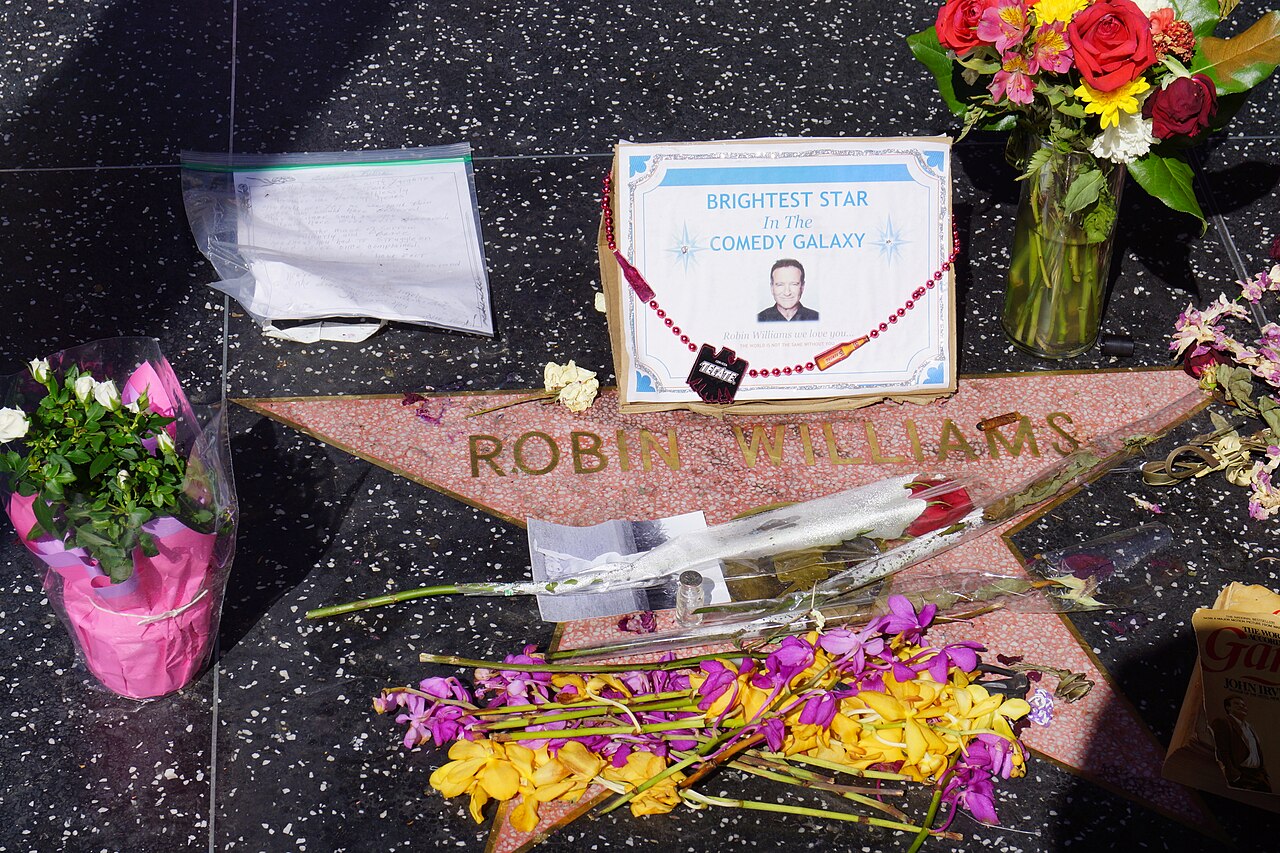
Robin Williams's star on the Hollywood Walk of Fame in Los Angeles.
If you are struggling, help is available: in the US you can call or text 988 (Suicide & Crisis Lifeline); elsewhere, contact local emergency services or a crisis line.
"Remembering Robin Williams". The Juilliard Journal, The Juilliard School. No date shown; accessed 25 November 2026. journal.juilliard.edu/node/39558
"Robin Williams: All Grammy Awards and Nominations". Recording Academy, grammy.com. No date shown; accessed 25 November 2026. grammy.com/artists/robin-williams/15004
Philip Berk (series author), "Ready for My deMille: Profiles in Excellence – Robin Williams, 2005". Golden Globes (goldenglobes.com). No date shown; accessed 25 November 2026. goldenglobes.com/?p=79540
"The 64th Academy Awards" (1992). Academy of Motion Picture Arts and Sciences, oscars.org. No date shown; accessed 25 November 2026. oscars.org/oscars/ceremonies/1992
"The 70th Academy Awards" (1998). Academy of Motion Picture Arts and Sciences, oscars.org. No date shown; accessed 25 November 2026. oscars.org/oscars/ceremonies/1998