← 1989 Tiananmen Square protests
Compare versions
Version 1 → Version 3 (current). Removed · Added. This shows the entry's text as it is written, including its formatting marks.
Version 1 · Version 3 (current) · Version history
Side by side · Together
The 1989 Tiananmen Square protests were demonstrations for political reform in Beijing and other Chinese cities in the spring of 1989, ended when soldiers opened fire on protesters and bystanders in Beijing on 3–4 June 1989.[2][9]
## Background
By the spring of 1989, many university students and others in China wanted political as well as economic reform, and economic change had brought price inflation and opportunities for corruption by officials.[2] Hu Yaobang had been general secretary of the Chinese Communist Party (CCP) from 1980 until he resigned in January 1987, after student protests in 1986.[2][1] Hu died on 15 April 1989, and a collection of declassified US documents published by the National Security Archive, a research institute at George Washington University, describes his death as the catalyst for the demonstrations that followed.[1] Students gathered in Tiananmen Square, the large public square in central Beijing, to mourn him, and on the day of his funeral, 22 April, tens of thousands of students assembled there.[1][2]
## Protests and hunger strike
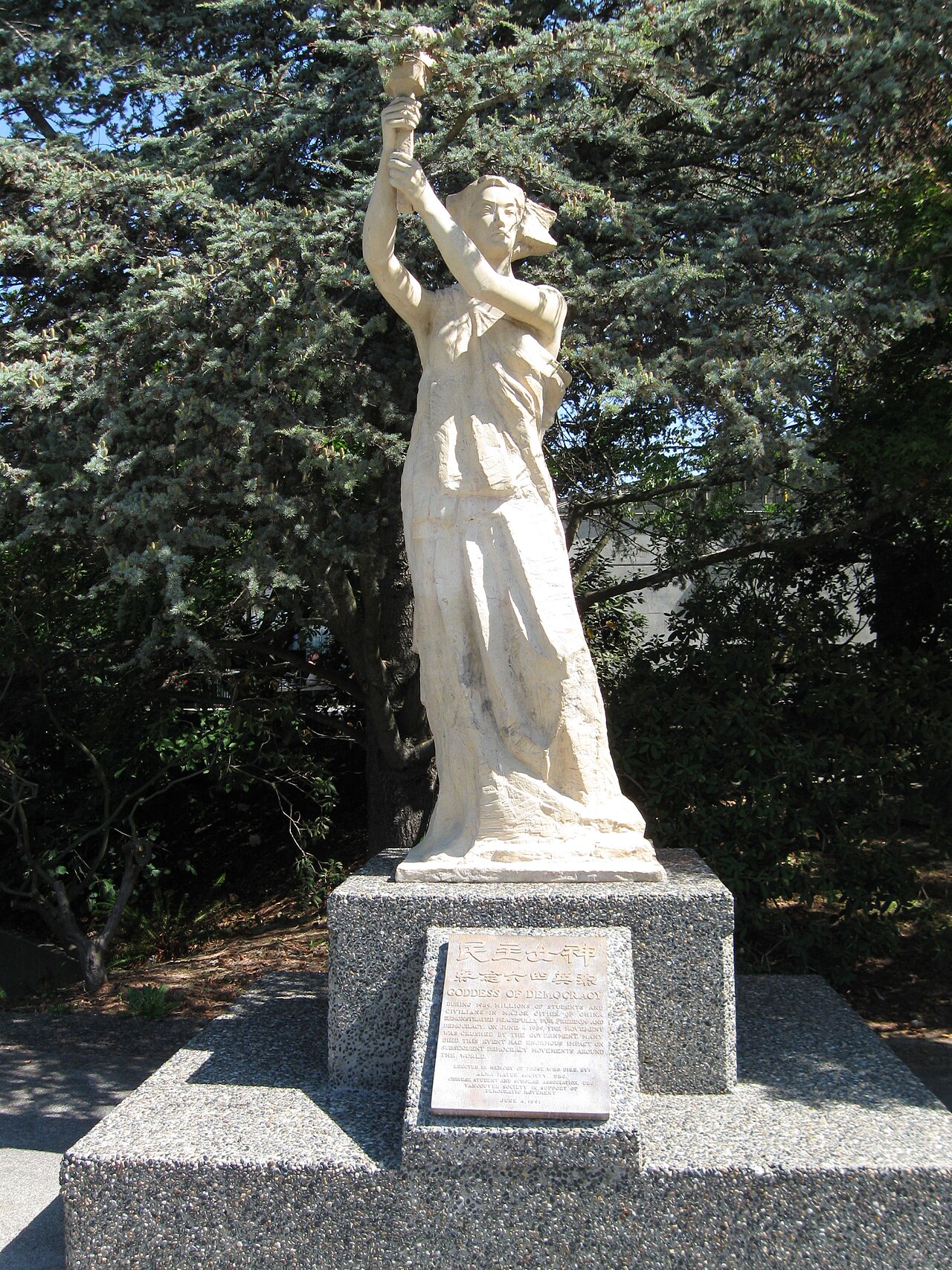
The gatherings grew over the following weeks, and at their height a demonstration in Tiananmen Square drew some one million participants.[2] Similar demonstrations took place in other cities, notably Shanghai, Nanjing, Xi'an, Changsha and Chengdu.[2] Protesters in the square gathered around a plaster statue known as the "Goddess of Democracy".[2]
*Via Wikimedia Commons: [UBC Goddess of Democracy statue 2009](https://commons.wikimedia.org/wiki/File:UBC_Goddess_of_Democracy_statue_2009.jpg) by Leoboudv, [CC BY-SA 3.0](https://creativecommons.org/licenses/by-sa/3.0).*
The protests continued through the visit of the Soviet leader Mikhail Gorbachev to China in mid-May.[2] In May some students went on hunger strike, and party general secretary Zhao Ziyang went to the square and pleaded with them to end the strike, telling them, "We have come too late."[5] Within the leadership, moderates argued for negotiating with the demonstrators and offering concessions, but they were overruled by hard-liners led by Premier Li Peng and supported by Deng Xiaoping, the senior elder statesman, who insisted on suppressing the protests by force.[2] A US State Department intelligence brief of about 10 June 1989 judged that, among the leaders, only Zhao "seemed to understand the depth of public grievances".[1]
## Martial law
On 20 May 1989 the Chinese leadership imposed martial law on the Beijing Municipality.[1] According to a 2009 account of Zhao's secret memoir, Deng had the final say in the decision to impose martial law and send troops into the capital.[5] When army units moved toward the centre of the city, Beijing residents filled the streets and blocked their way.[2]
## The night of 3–4 June
On the night of 3–4 June, tanks and heavily armed troops advanced toward Tiananmen Square and opened fire on people who tried to block them.[2] By the morning of 4 June the area had been cleared of protesters, although sporadic shooting continued through the day.[2] A US Embassy cable of 22 June 1989 concluded that many, if not most, of the deaths occurred on Chang'an Avenue and the surrounding streets rather than in the square itself, and that sporadic killing continued at least until Wednesday, 6 June.[1] The military also moved against protesters in several other cities, including Chengdu.[2] An image of a lone protester briefly facing down a column of tanks as it advanced on him near the square became widely known as "tank man".[2][9]
## Casualty figures
According to Reuters (2019), the Chinese government has never provided a final death toll.[6] The figures published by different sources differ widely; each is given below with its source and date.
- **Chinese government, 6 June 1989.** A Chinese government spokesman said there were "nearly 300" deaths, a total that he said included soldiers, "hoodlums" and bystanders.[4]
- **Chinese government, 30 June 1989.** The mayor of Beijing said that 200 people had died, including 36 university students.[3]
- **Chinese government count, as reported by Encyclopaedia Britannica (no date shown).** 241 killed, including soldiers, and some 7,000 wounded; Britannica notes that most other estimates are much higher.[2]
- **Red Cross Society of China, early June 1989.** A figure announced by the Red Cross Society of China is reported as 2,600 deaths by a June 1989 US Embassy cable and by Radio Free Asia (2012), and as 2,700 deaths by Hong Kong Free Press (2017); Radio Free Asia reports that the figure was later withdrawn.[1][4][3]
- **US government, 4 June 1989.** The Secretary of State's morning summary put deaths from the assault at 180 to 500, and a State Department task force report of the same day gave estimates of 500 to 2,600 deaths and up to 10,000 injured.[1]
- **US Embassy in Beijing, 22 June 1989.** The embassy judged that civilian deaths probably did not reach the figure of 3,000 used in some press reports, and called the Red Cross figure of 2,600 deaths "not an unreasonable estimate".[1]
- **British government, 5 June 1989.** A telegram from the British ambassador in Beijing relayed a claim, passed on by an unnamed intermediary and attributed to a member of China's State Council, that at least 10,000 civilians had been killed; the document was declassified at the UK National Archives in October 2017.[3]
- **US White House files, as reported in 2014.** A Hong Kong magazine, Next Magazine, reported in 2014 that declassified White House files estimated 10,454 deaths.[3]
- **Tiananmen Mothers.** This victims' advocacy group said in 2012 that it had confirmed 186 deaths, not all of them caused by the army, and by June 2026 had documented 202 killings in Beijing and other cities.[4][9]
As of 2019, rights groups and witnesses quoted by Reuters said that hundreds or even thousands may have been killed.[6]
## Arrests and aftermath
After the crackdown the government arrested thousands of suspected dissidents, and some were executed.[2] The US Secretary of State's morning summary for 21 June 1989 reported more than 1,500 arrests, including at least six of the 21 student leaders on the government's "most wanted" list.[1] On 5 June 1989 President George H. W. Bush announced US sanctions that included suspending government arms sales, commercial weapons exports and visits between US and Chinese military leaders.[1]
Zhao Ziyang was removed as party general secretary, replaced by Jiang Zemin and placed under house arrest.[2] He spent his last 16 years confined in this way and died in 2005.[5] He had secretly recorded his memoirs on about 30 tapes, which were published in May 2009 as *Prisoner of the State: The Secret Journal of Premier Zhao Ziyang*; in them he wrote that he had refused to become the general secretary who used the army against students.[5]
General Xu Qinxian, long said to have resisted orders to use force against the protesters, was tried by a secret military court; he was reportedly sentenced to five years in prison and died in 2021.[9]
## Decisions of the leadership and the US response
The National Security Archive collection reproduces the order of Premier Li Peng announcing that "the State Council has decided to enforce martial law", and a report that on 24 May Yang Shangkun told the Central Military Commission, "We can no longer retreat and must launch an offensive."[1] A US document in the collection says that Deng Xiaoping had "split with Zhao" Ziyang and given Yang and Li a free hand to enforce martial law and end the demonstrations; the collection also describes Deng's public appearance on 9 June as signifying his endorsement of martial law and of the military's action.[1] In December 1989 Li Peng told US envoys that the situation in China "would be even more turbulent today" without the measures of 4 June.[1]
On the US side, the same collection records that in June 1989 Brent Scowcroft and Lawrence Eagleburger secretly visited Beijing to keep open lines of communication and that by December 1989 the administration concluded that the process had stalled, with "no significant steps to point to" in justifying normalisation.[1]
## The Chinese government's account
In 1989 the Chinese government called the protests a "counter-revolutionary" uprising, blamed them on people seeking to overthrow the party, and played down the extent of the military's actions on 3–4 June.[4][6][2] In April 1999, during a visit to the United States, a senior Chinese leader told reporters that the 1989 events happened "because they wanted democracy but they didn't want the rule of law"; the National Security Archive describes this as the first acknowledgment by a senior Chinese leader of the demonstrators' democratic aims.[1] The same 1999 collection notes that Chinese government and party officials had reexamined and often revised the official version of the crackdown.[1]
On 2 June 2019, asked about the events at the Shangri-La Dialogue security conference in Singapore, China's defence minister described the protests as political turmoil that the central government had needed to quell, called this the correct policy, and pointed to the stability China had enjoyed since.[6] On 4 June 2019 a foreign ministry spokesperson, answering a US statement on the anniversary, said that "the Chinese government has already drawn a clear conclusion on the political disturbance in the late 1980s".[7] As of June 2026, Human Rights Watch said that the government had never accepted responsibility for the killings or held any official legally accountable.[9]
## Commemoration and its restriction
Public commemoration of the events is officially banned in mainland China, and the authorities censor references to them, including the "tank man" image.[2][9] On 28 December 2025, Beijing police obstructed a New Year gathering of the Tiananmen Mothers, and on 27 May 2026 the group issued a statement calling on the government to address, through lawful means, the wounds and unresolved injustices left by the killings.[9]
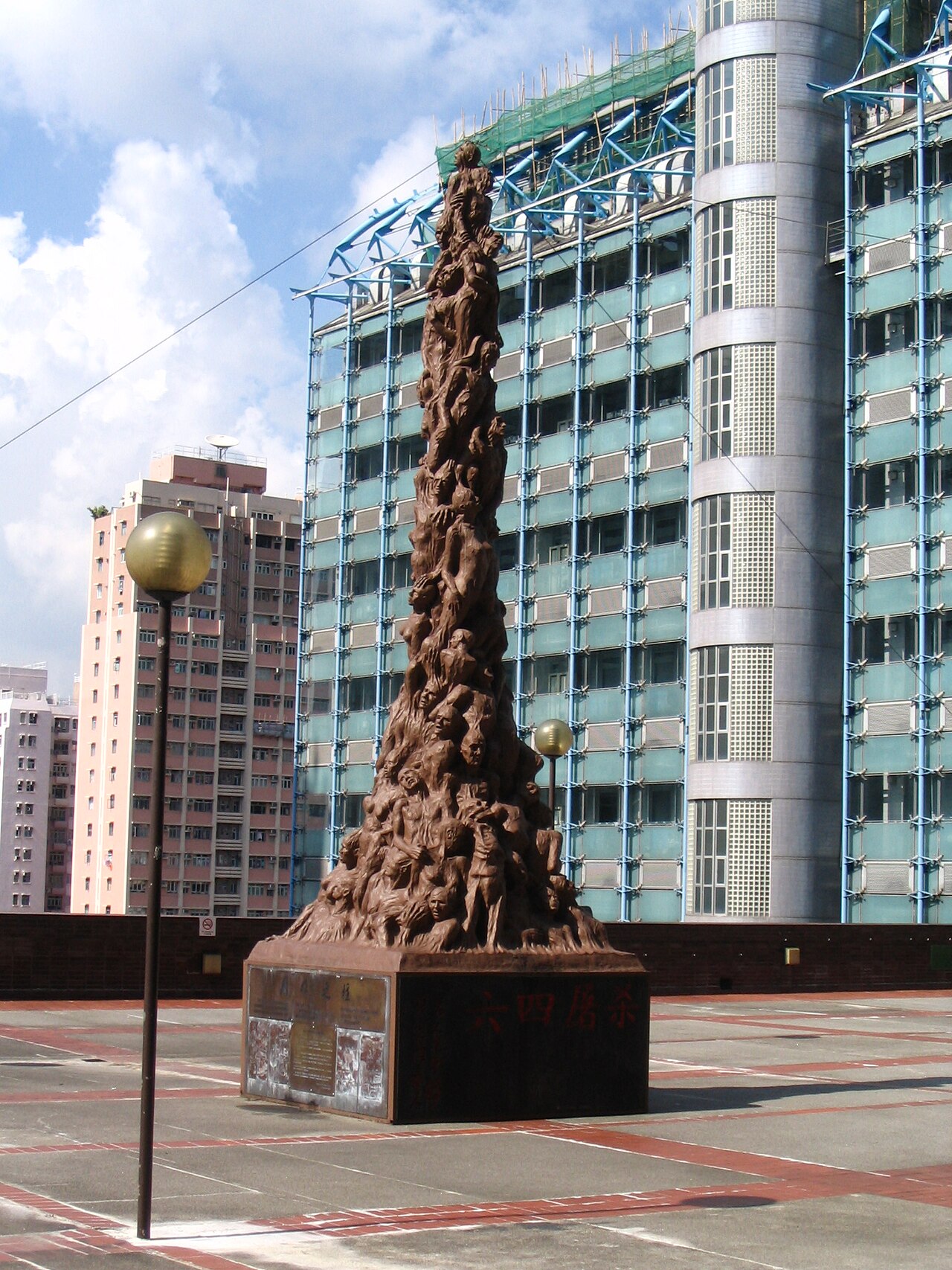
Residents of Hong Kong long held an annual vigil on the anniversary.[2] The authorities banned the vigil on Covid-19 grounds in 2020 and 2021, and in 2021 the Hong Kong Alliance in Support of Patriotic Democratic Movements of China, which had organised it, was forced to disband.[10][8] On 23 December 2021 the University of Hong Kong removed the "Pillar of Shame", a 26-foot sculpture by a Danish artist commemorating those killed in the crackdown, which had stood on its campus for more than two decades; the university said the work could pose legal risks.[8]
*Via Wikimedia Commons: [Pillar of Shame 1](https://commons.wikimedia.org/wiki/File:Pillar_of_Shame_1.jpg) by Minghong, [CC BY-SA 4.0](https://creativecommons.org/licenses/by-sa/4.0).*
Since 2022, Victoria Park, the traditional vigil site, has hosted a "patriotic food carnival" around the anniversary.[9] On 21 August 2026 Hong Kong's High Court convicted two former leaders of the Hong Kong Alliance of "inciting subversion" under the National Security Law; a third former leader had pleaded guilty to the same charge in January.[10] The court ruled that the Alliance's aim to "end one-party dictatorship" in China amounted to an attempt to overthrow the government, while the defence argued that the defendants had only been exercising their right to free expression; Human Rights Watch called for the convictions to be quashed.[10] On 11 September 2026 the court sentenced the three to prison terms of between 5 years and 2 months and 7 years and 3 months, and fined the Alliance HK$1.5 million.[10] Elsewhere, commemorations were planned in more than 30 cities in 7 countries in 2026.[9]
## Documents released later
On 1 June 1999 the National Security Archive published a collection of 35 previously classified US government documents on the crackdown and its background, including embassy situation reports and State Department intelligence briefs.[1] In October 2017 the UK National Archives declassified British diplomatic telegrams from June 1989, including the ambassador's report of the 10,000 figure.[3] In November 2025, six hours of footage of General Xu's secret military trial, filmed on 17 March 1990, were leaked; in it he said that he had hoped to resolve the issue mainly by political means.[9]
## Sources
1. Jeffrey T. Richelson and Michael L. Evans (eds.), "Tiananmen Square, 1989: The Declassified History", National Security Archive Electronic Briefing Book No. 16, National Security Archive, George Washington University, 1 June 1999. https://nsarchive2.gwu.edu/NSAEBB/NSAEBB16/index.html
2. The Editors of Encyclopaedia Britannica, "Tiananmen Square incident", Encyclopaedia Britannica, no date shown; accessed 25 November 2026. https://www.britannica.com/event/Tiananmen-Square-incident
3. Kris Cheng, "Declassified: Chinese official said at least 10,000 civilians died in 1989 Tiananmen massacre, documents show", Hong Kong Free Press, 21 December 2017 (updated 31 March 2020). https://hongkongfp.com/2017/12/21/declassified-chinese-official-said-least-10000-civilians-died-1989-tiananmen-massacre-documents-show/
4. Qiao Long (reporting) and Luisetta Mudie (English text), "Tiananmen Spokesman Evades Comment", Radio Free Asia, 30 May 2012. https://www.rfa.org/english/news/china/tiananmen-05302012120418.html
5. Adi Ignatius, "The Secret Memoir of a Fallen Chinese Leader", Time, 14 May 2009. https://time.com/archive/6688487/the-secret-memoir-of-a-fallen-chinese-leader/
6. Reuters, "Tiananmen Square: China minister says 1989 crackdown justified", The Irish Times, 2 June 2019. https://www.irishtimes.com/news/world/asia-pacific/tiananmen-square-china-minister-says-1989-crackdown-justified-1.3912435
7. Ministry of Foreign Affairs of the People's Republic of China, "Foreign Ministry Spokesperson Geng Shuang's Regular Press Conference on June 4, 2019", republished by China Daily, 4 June 2019. https://govt.chinadaily.com.cn/s/201906/04/WS5d030d56498e12256565da8b/foreign-ministry-spokesperson-geng-shuangs-regular-press-conference-on-june-4-2019.html
8. Associated Press, "Hong Kong tears down 'Pillar of Shame' sculpture honoring victims of 1989 Tiananmen Square massacre", Anchorage Daily News, 23 December 2021. https://www.adn.com/nation-world/2021/12/23/hong-kong-tears-down-pillar-of-shame-sculpture-honoring-victims-of-1989-tiananmen-square-massacre/
9. Human Rights Watch, "China: No Justice for Tiananmen Massacre 37 Years On", 1 June 2026. https://www.hrw.org/news/2026/06/01/china-no-justice-for-tiananmen-massacre-37-years-on
10. Human Rights Watch, "Hong Kong: Activists Convicted for Tiananmen Vigils", 21 August 2026 (updated 11 September 2026). https://www.hrw.org/news/2026/08/21/hong-kong-activists-convicted-for-tiananmen-vigils
