Version 1
Nov 26, 2026. Compare with the current version · Version history
Cristóbal Balenciaga (1895–1972) was a Spanish couturier, born in Getaria in the Basque Country, who built a fashion house in Spain and then in Paris and is regarded as one of the most influential designers of the 20th century.[1][4]
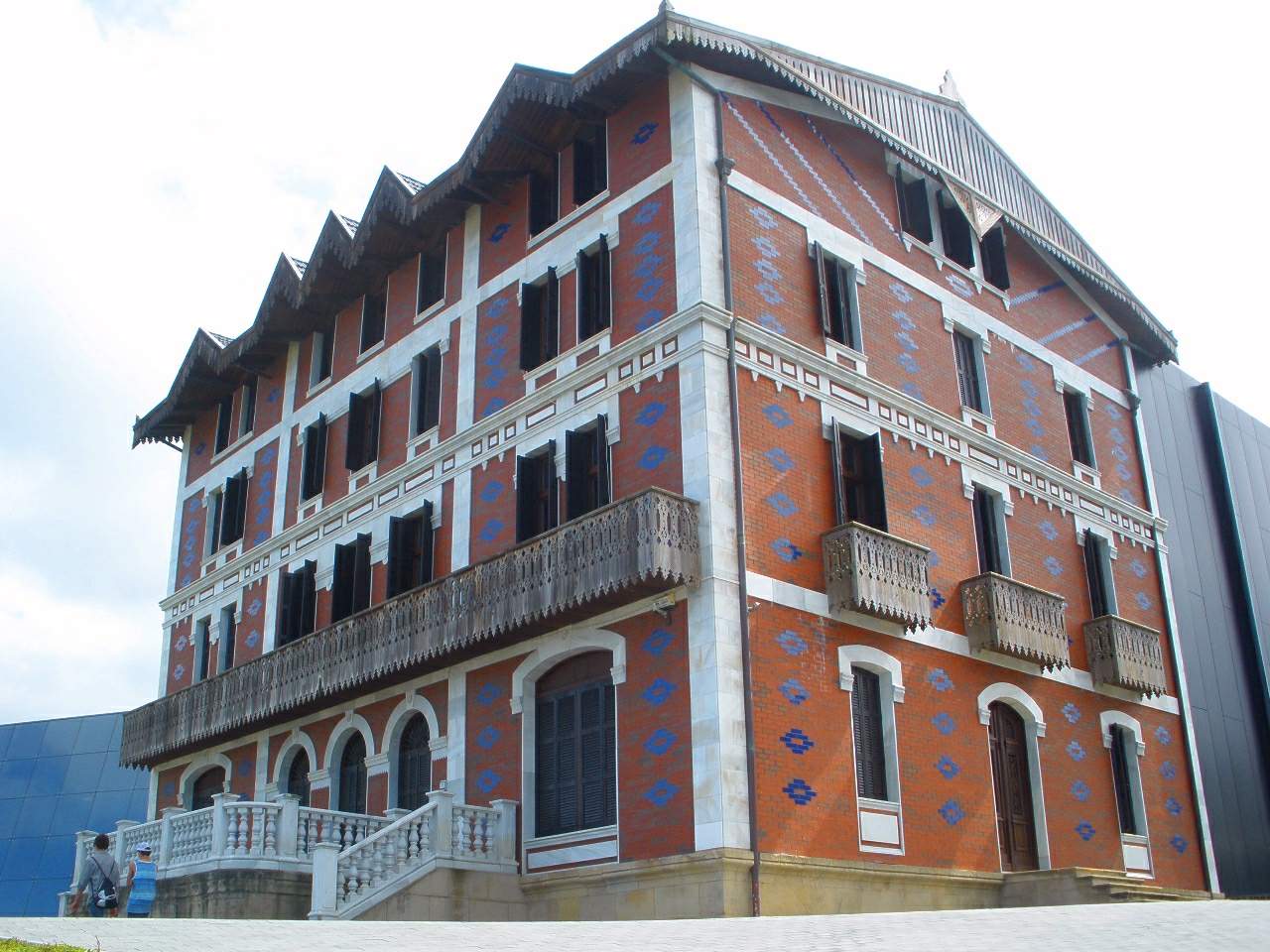
Via Wikimedia Commons: Getaria - Palacio de Aldamar-Cristobal Balenciaga Museoa 2 by Zarateman, CC BY-SA 4.0.
Early life and first workshops
Balenciaga was born on 21 January 1895 in Getaria, a fishing village in the Basque Country, into a working-class family. His father, a fisherman, died when he was 11. His mother was a seamstress for the family of the Marquises de Casa-Torres, and the marchioness encouraged the boy's talent and became one of his first clients.[2] At about 12 he began training with a tailor in San Sebastián, and he later knew every stage of making a garment, from drafting the pattern to the finish.[1]
At 22, around 1917, he opened his first business as a couturier in San Sebastián, at Calle Vergara 2.[2][4] The sources differ on the name EISA, which the V&A says he gave his first house in 1917, shortening his mother's maiden name.[1] The museum in Getaria records a different sequence: a partnership called Balenciaga y Cía from 1917 to 1924, a business under his own name at Avenida 2 with 71 workers, and a company founded in March 1927 as Martina Robes et Manteaux that was renamed EISA Costura in October of that year.[2] EISA then expanded to Madrid in 1933 and Barcelona in 1935.[2][4] The V&A places the Madrid and Barcelona houses in the late 1930s.[1]
Paris, 1937
The outbreak of the Spanish Civil War led Balenciaga to move to Paris, where he set up his salons at 10 Avenue George V and presented his first collection in 1937.[2][3] The V&A says the house quickly became the most expensive and exclusive couturier in the city.[1] His clients included Gloria Guinness, Mona von Bismarck and Ava Gardner.[1]
Spanish art stayed in his work. In the late 1930s he made wide-hipped "Infanta" dresses inspired by the painter Diego Velázquez, and Spain's tourism board lists Goya, Velázquez, El Greco and Zurbarán among the painters his work drew on, along with Spanish folklore.[1][4] He also relied on the lace-making industry of Calais throughout his Paris career.[5]
Design and technique
The museum in Getaria says Balenciaga concentrated on the back of the garment, blurred the waistline, created volume and simplified the cut. It dates his best-known lines as the "tonneau" (1947), the semi-fitted look (1951), balloon skirts (1953), a tunic (1955), the sack dress (1957) and the baby-doll dress (1958).[2] The V&A's dates are looser: balloon-hem dresses in the early 1950s, "semi-fit" lines in the mid-1950s, the sack dress, which removed the waist, in 1957, a baby-doll dress in the late 1950s and an "envelope" dress in 1967.[1] One magazine account contrasts his broad shoulders and box shapes with the nipped-in waists of Christian Dior's 1947 "New Look".[5]
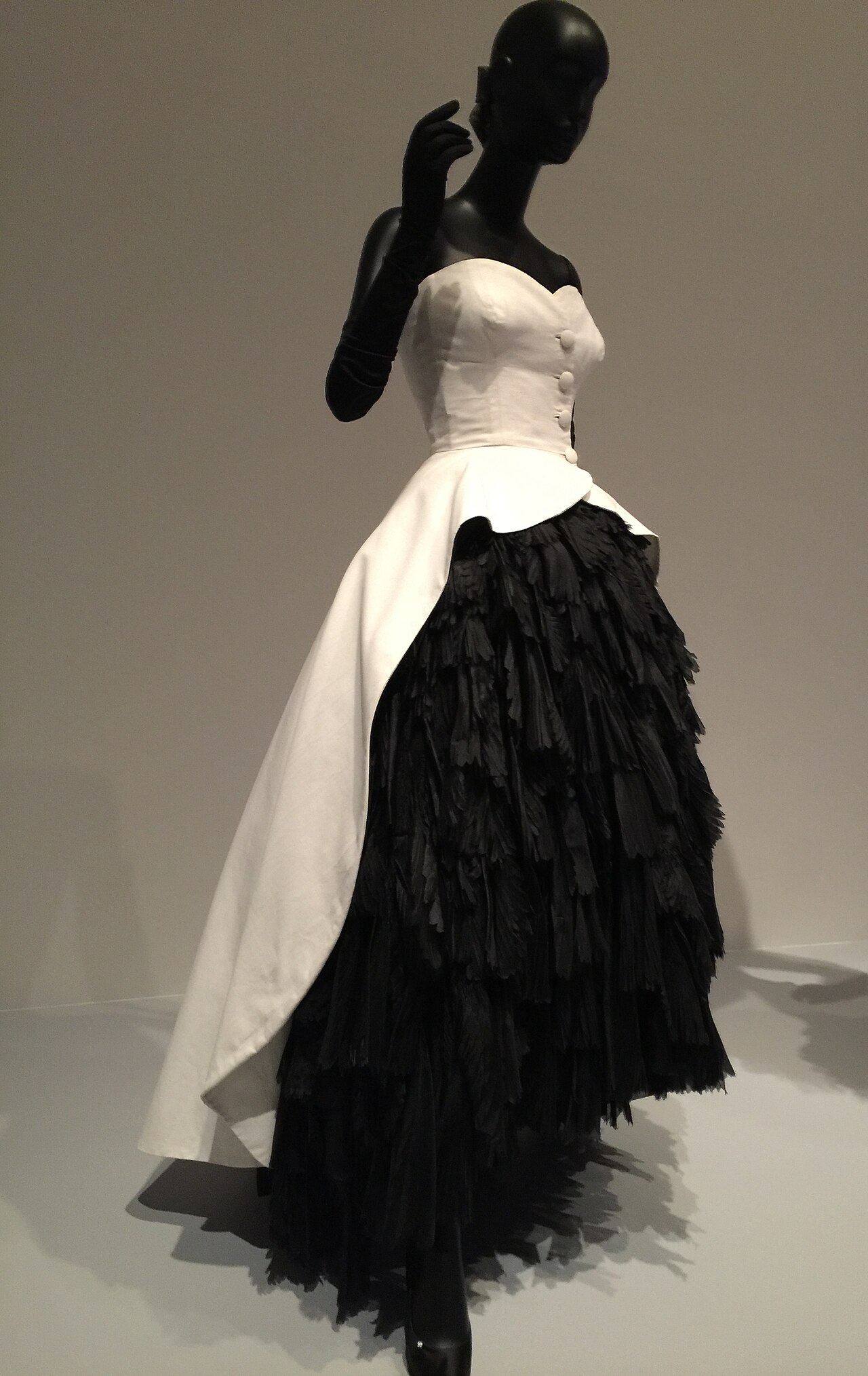
Via Wikimedia Commons: Spring 1951 Balenciaga evening dress by Laura Blanchard, CC BY-SA 2.0.
Retirement and death
In 1968, as haute couture gave way to ready-to-wear (prêt-à-porter), Balenciaga decided to retire.[2][3] That year he also designed navy uniforms for Air France in-flight staff.[5] He avoided publicity and gave his only full interview in 1971, to Prudence Glyn of The Times.[5] He died on 23 March 1972 in Jávea, in the province of Alicante.[3]
Reputation, students and museum
Dior called him "the master of us all", and Hubert de Givenchy called him "the architect of Haute Couture".[2][5] Emanuel Ungaro trained with him and André Courrèges was his protégé.[1] The Cristóbal Balenciaga Museum opened in Getaria in 2011.[3] The Balenciaga label was relaunched in 1986 under a series of creative directors, and Nicolas Ghesquière, creative director from 1997 to 2012, is credited with reviving it.[1] In 2017 the V&A in London held the exhibition Balenciaga: Shaping Fashion.[1]
Sources
- Victoria and Albert Museum, "Introducing Cristóbal Balenciaga": vam.ac.uk/articles/introducing-cristobal-balenciaga
- Cristóbal Balenciaga Museoa, "Cristóbal Balenciaga": cristobalbalenciagamuseoa.com/en/discover/cristobal-balenciaga/
- San Sebastián Turismoa, "Cristóbal Balenciaga: The fashion architect": sansebastianturismoa.eus/en/culture-en/8299-cristobal-balenciaga-th…
- Spain.info (Spanish tourism board), "Cristóbal Balenciaga": spain.info/en/balenciaga/
- Another Magazine, "All you need to know about Cristóbal Balenciaga": anothermag.com/fashion-beauty/7271/all-you-need-to-know-about-crist…
