Compare versions
Version 1 → Version 2 (current). Removed · Added. This shows the entry's text as it is written, including its formatting marks.
Version 1 · Version 2 (current) · Version history
Side by side · Together
Vivienne Westwood (1941–2022) was a British fashion designer who helped create the look of punk in the 1970s and went on to build an international fashion house.[2][4]
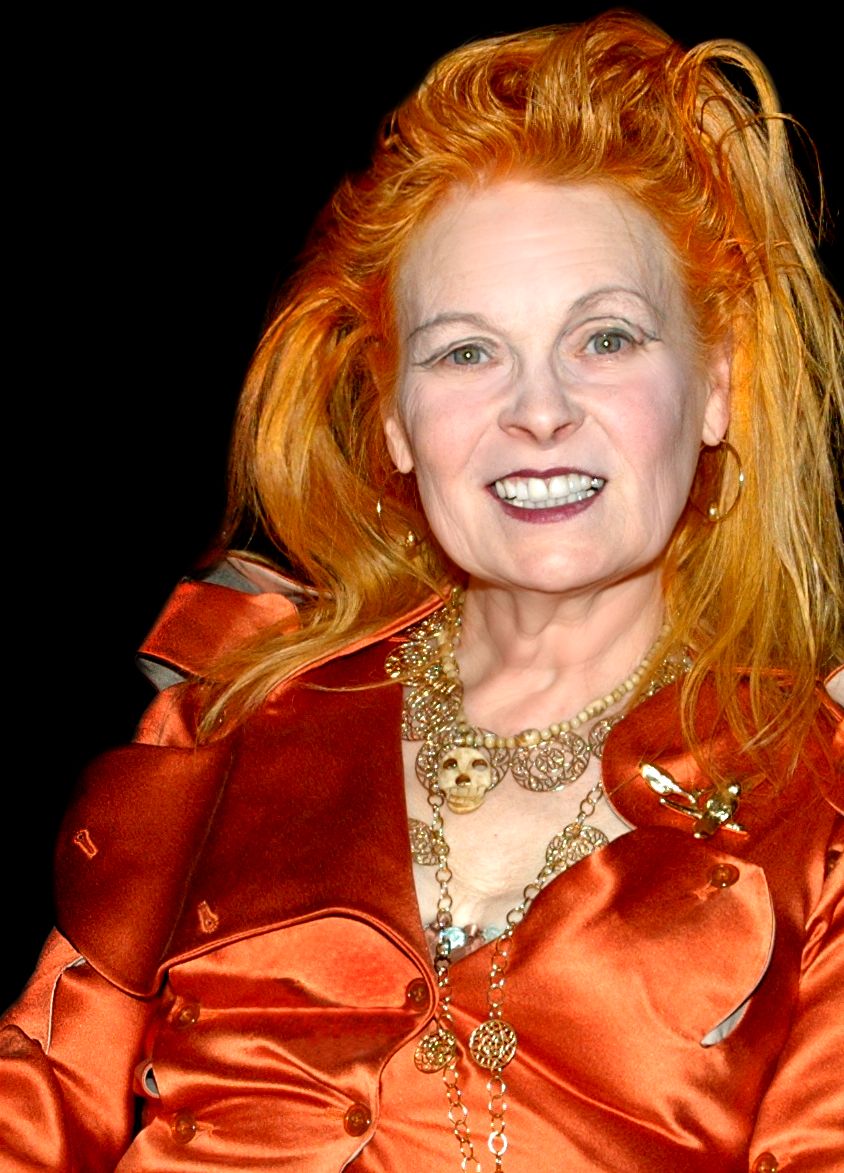
*Via Wikimedia Commons: [Vivienne Westwood by Mattia Passeri](https://commons.wikimedia.org/wiki/File:Vivienne_Westwood_by_Mattia_Passeri.jpg) by Mattia Passeri, [CC BY-SA 4.0](https://creativecommons.org/licenses/by-sa/4.0).*
## Early life and partnership with Malcolm McLaren
Born Vivienne Isabel Swire in Glossop, Derbyshire, in 1941, she was the daughter of a shoemaker and a cotton weaver.[3] At 16 she moved with her family to Harrow, Middlesex, where she studied silversmithing and jewellery-making at Harrow School of Art, left abruptly, and trained as a typist.[3] In the 1960s she trained as a primary school teacher, married Derek Westwood and had a son.[3] She met Malcolm McLaren in 1965, and the two formed a professional and romantic partnership.[3] The V&A describes her early move away from the hippie style of the late 1960s toward youth-culture references.[2]
## The King's Road shop and punk
In 1970 or 1971 Westwood and McLaren took over 430 King's Road in Chelsea, London, first trading as Let It Rock and selling 1950s Teddy-boy clothing.[3] By 1974 it was SEX, selling fetish-style clothing, including rubber dresses and spike-studded stilettos, to people with underground sexual tastes and to young proto-punks.[1] In 1976 the premises were refitted and renamed Seditionaries: Clothes for Heroes.[1][2] Its signature pieces included bondage trousers, distressed mohair jumpers and graphic T-shirts with provocative imagery.[1] McLaren managed the Sex Pistols, and many members of the band wore Seditionaries clothing.[1][4] In 1981 the shop was renamed World's End.[3]
Andrew Bolton, curator of the Costume Institute at the Metropolitan Museum of Art, told the Associated Press in 2022 that she pioneered the punk look by pairing radical fashion with the sound of the Sex Pistols.[4] The V&A describes her as primarily known for her part in creating punk.[2]
## Catwalk collections, 1981 to 1996
*Pirate* (Autumn/Winter 1981) was Westwood and McLaren's first catwalk collection.[1][2] It drew on 17th- and 18th-century highwaymen, dandies and buccaneers, and its look spread through the New Romantic music scene.[1] *Buffalo Girls/Nostalgia of Mud* (Autumn/Winter 1982) borrowed from National Geographic images of Andean women and was the first collection to show underwear as outerwear.[1][2] *Witches* (1983), with graphics by Keith Haring, was the last official collaboration with McLaren.[2]
From 1985 her work turned toward tailoring and the past. The V&A dates *Mini-Crini* to 1985 and quotes Westwood calling it a "cardinal change" toward tailoring.[2] The Design Museum lists *Harris Tweed* (1987), *Portrait* (1990–91), built on 18th-century paintings, and *Anglomania* (1993–94), which included the MacAndreas tartan named after her collaborator Andreas Kronthaler.[3] The V&A says her ideas often reached the mainstream quickly and that she was sometimes judged "uncommercial".[2]
## Shops abroad and later collections
The Design Museum's timeline lists a second London shop in Mayfair in 1988 and a shop at 43 Conduit Street in 1992.[3] It dates the launch of the menswear label to 1996 in Milan, and the first New York shop, together with the launch of Red Label in the United States, to 1999.[3] Further shops followed in Hong Kong in 2002 and in Milan and Liverpool in 2003.[3] The same source records that she won the Queen's Award for Export in 1998 and the UK Fashion Export Award for Design in 2003.[3]
On the catwalk, the V&A describes *Anglomania* (Autumn/Winter 1993) as featuring clan tartans, *Café Society* (Spring/Summer 1994) as featuring cushion bustles, and a Spring/Summer 1996 collection as built around sack-back gowns inspired by paintings by Jean-Antoine Watteau.[2] It says her couture work concentrated on exchanges of style between England and France.[2] In 2006 the Metropolitan Museum of Art in New York held an exhibition titled *Anglomania*, and in 2008 she returned to London Fashion Week to show Red Label.[3] After the 2016 handover the V&A says the couple continued to design the main lines together, and that the Gold Label was renamed "Andreas Kronthaler for Vivienne Westwood".[2]
## Honours, business and activism
The British Fashion Council named her Womenswear Designer of the Year in 1990 and 1991, and she received an OBE in 1992 and was made a Dame in 2006.[2][3] The V&A held a major retrospective of her work in 2004.[2] Her business grew to include Gold Label (semi-couture), Red Label (ready-to-wear), a menswear line and the Anglomania diffusion line.[3] In March 2016 she handed the Gold Label line to her husband, Andreas Kronthaler.[2]
From the 2000s she campaigned on climate change, civil liberties and nuclear disarmament.[2][3] In 2007 she launched a manifesto, *Active Resistance*, and in 2013 she dedicated a collection to the whistleblower Chelsea Manning.[3]
## Death
Westwood died on 29 December 2022 in London, aged 81.[3] Her fashion house announced the death on social media, said she died peacefully and gave no cause.[4]
## Sources
1. "Vivienne Westwood: punk, new romantic and beyond", Victoria and Albert Museum. https://www.vam.ac.uk/articles/vivienne-westwood-punk-new-romantic-and-beyond
2. "Vivienne Westwood designs" (last updated 17 April 2024), Victoria and Albert Museum. https://www.vam.ac.uk/content/articles/v/vivienne-westwood-designs
3. "Vivienne Westwood", Design Museum, London. https://designmuseum.org/designers/vivienne-westwood
4. "Vivienne Westwood, influential punk fashion maverick, dies at 81", Associated Press, published by PBS NewsHour, 29 December 2022. https://www.pbs.org/newshour/arts/vivienne-westwood-influential-punk-fashion-maverick-dies-at-81
