Version 1
Nov 26, 2026. Compare with the current version · Version history
The New Testament apocrypha are Christian writings, many of them from the second century, that tell of Jesus, his family or the apostles, often in the forms of New Testament books, but that were left out of the New Testament canon.[1][2]
Name and definition
The Greek word apokryphos means "hidden" or "concealed", and also "secret".[1] It was first applied to secret traditions and writings of Gnostic groups (early Christian movements that taught salvation through hidden knowledge), both by those groups and by their critics; by the fourth century it was used for books that were not read publicly in church.[2] Church writers came to use the label as a condemnation of texts they considered heretical.[1] Athanasius of Alexandria, writing in 367, called the apocryphal books an invention of heretics.[3]
A canon is the fixed list of books a church accepts as Scripture. The New Testament apocrypha are, almost without exception, pseudepigraphal: they are written under the name of an apostle or disciple, or are about one.[2] Tobias Nicklas (2023), however, stresses that many were widely copied and used in early Christian communities and were far from hidden, secret or heretical.[1]
Specialists often use the wider term "Christian apocrypha", as in the title of Nicklas's article.[1] Nicklas defines these as writings outside the canon of the Old and New Testaments that show a clear literary relation to biblical, especially New Testament, writings; the category also includes texts with no New Testament model, such as accounts of the Dormition (death and assumption) of Mary.[1] He distinguishes texts that were composed as secret books from texts that only later came to be treated as apocryphal.[1] The North American Society for the Study of Christian Apocryphal Literature (NASSCAL) uses the same term for its online reference work, e-Clavis: Christian Apocrypha.[4]
The Old Testament apocrypha, or deuterocanonical books (books found in the Greek and Latin Old Testament but not in the Hebrew Bible), such as the Book of Tobit and Sirach, are a separate group; Athanasius, for example, listed both among books to be read by new converts but outside the canon.[3]
Kinds of writings
Most New Testament apocrypha were written in the second century, after the New Testament books and in imitation of them, but before a closed canon existed, and they take the same four basic forms: gospels, acts, letters and apocalypses.[2] Nicklas counts several dozen gospels or gospel-like texts, a number of early Acts, several letters attributed to apostles and dozens of apocalypses.[1]
Gospels. The Gospel of Thomas is a collection of sayings of Jesus with no narrative.[5] Nicklas notes that scholars generally date it to the second century, while some argue for the first.[1] Infancy gospels tell of the birth and childhood of Mary and Jesus: the Protevangelium of James, whose ancient title was the Birth of Mary, probably dates from the late second century, and later examples include the Arabic Infancy Gospel and the Gospel of Pseudo-Matthew.[1] Another early infancy gospel is the Infancy Gospel of Thomas. The Gospel of Peter, a second-century text, was first allowed to be read by Serapion, bishop of Antioch, at the end of the second century; he withdrew the permission after judging its teaching about Christ to be false.[1][2] Nicklas also discusses later gospels such as the Gospel of Nicodemus.[1] Nicklas discusses the Gospel of Judas together with the Nag Hammadi writings, whose authors belonged to groups that the majority church labelled "Gnostic"; he notes that the label itself is problematic.[1]
Acts. Nicklas names Acts of Paul, Peter, John, Andrew and Thomas; he dates the story of Paul and Thecla to the late second century, the Acts of John to the late second or third century and the Acts of Thomas to the early third century.[1] Britannica notes that Tertullian reported that the presbyter who wrote the Acts of Paul was removed from office.[2] The genre continued later, as with the fifth-century Acts of Barnabas.[1]
Letters and apocalypses. Several letters were written in the names of apostles.[1] The Apocalypse of Peter may date from as early as the first half of the second century and survives in Greek and Ethiopic; the Apocalypse of Paul, first written in Greek, was also received in medieval Latin.[1]
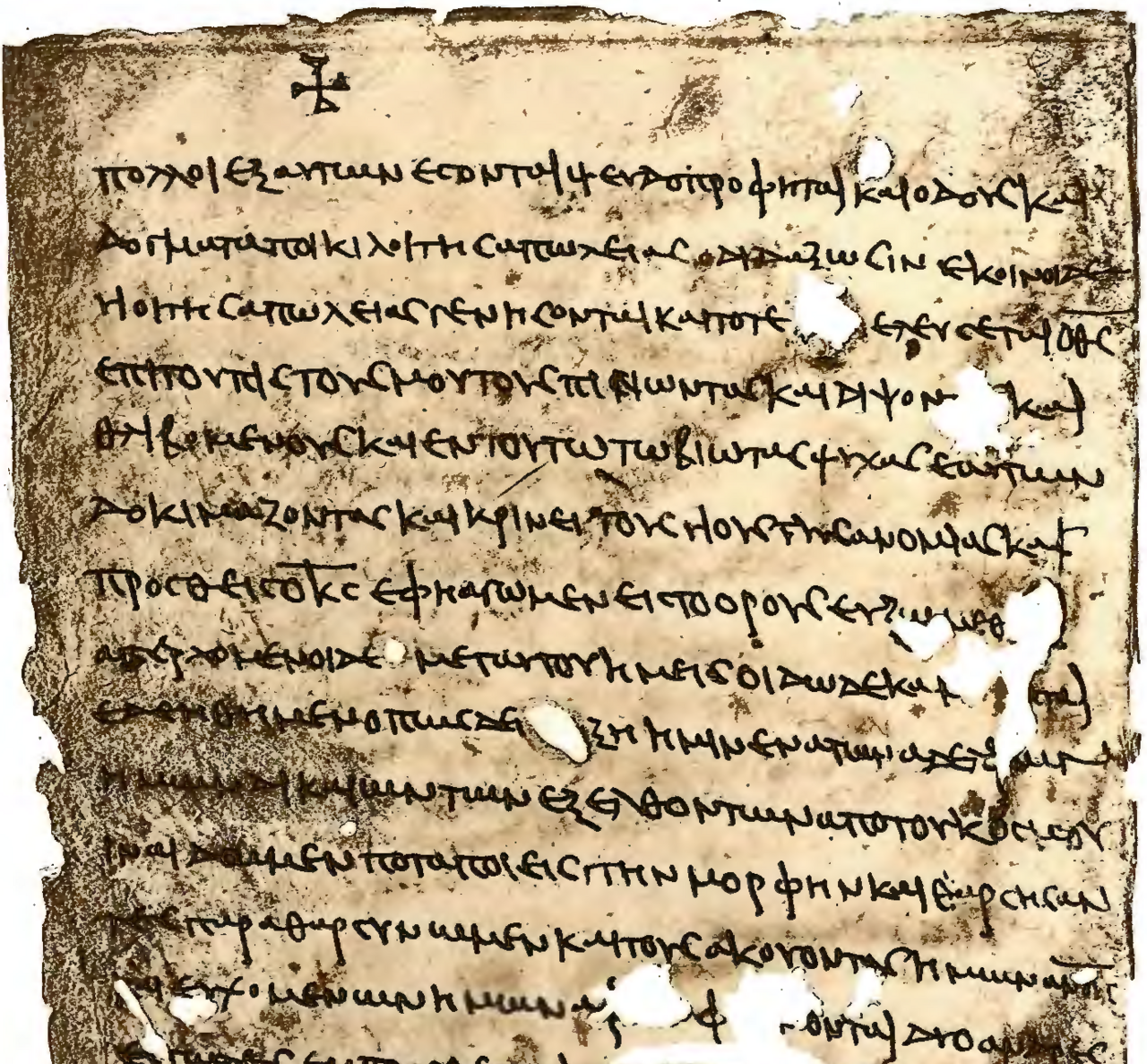
Via Wikimedia Commons: Apocalypse of Peter Akhmim Plate vii (cropped) by Adolphe Lods, public domain.
Apocryphal writing did not stop in antiquity: Lives of the Virgin Mary appeared only after the fourth century, and Nicklas argues that later texts and manuscripts belong to the field as much as early ones.[1]
Survival and discovery
Excluded from church reading and largely suppressed, most of these books survive only in fragments.[2] Texts survive in Greek, Latin, Coptic (the last stage of the Egyptian language, written in a Greek-based alphabet) and Syriac, and Nicklas notes that important versions in Armenian, Georgian, Irish, Old Church Slavonic and other languages have not yet been edited.[1] Three Greek papyrus fragments of the Gospel of Thomas from Oxyrhynchus in Egypt are known as P. Oxy. 1, 654 and 655.[1]
The largest single find came in December 1945, when Egyptian peasants found a jar near Jabal al-Tarif, across the Nile from Nag Hammadi, holding thirteen leather-bound codices (books made of bound pages rather than scrolls).[5] The codices contain forty-six different tractates, all composed in Greek and preserved in Coptic translation; a scrap of papyrus used to stiffen one cover (cartonnage), dated to 348, shows that the codices were made around 350.[5] Except for a fragment, all were deposited in the Coptic Museum in Old Cairo.[5] Codex II contains the Gospel of Thomas.[5]
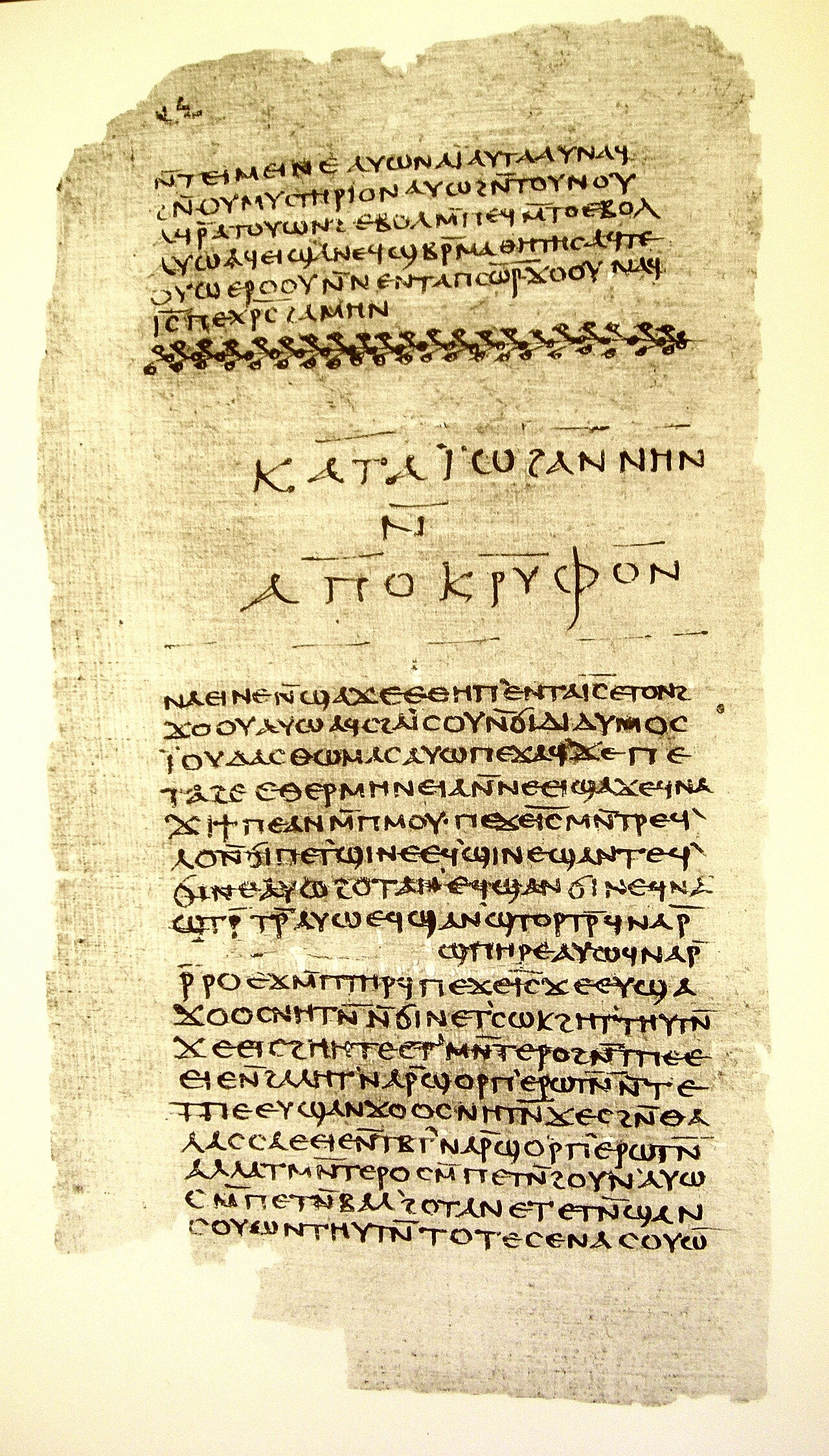
Via Wikimedia Commons: Nag Hammadi Codex II by Unknown author Unknown author, public domain.
Formation of the canon and rejection
The Muratorian fragment, a Latin list of New Testament books preserved in an eighth-century manuscript, is dated by Britannica to Rome around 170 to 180.[2] It says that the Apocalypse of Peter may be read, though some object, and rejects the Shepherd of Hermas as written only recently.[2] Its date is contested: according to Clare Rothschild (2016), about half of scholars accept a second-century Roman origin, while the rest follow Albert Sundberg (1968) in placing it in the fourth century in the East, a view Geoffrey Hahneman defended in a full monograph.[6] Rothschild herself argued that the fragment is a fiction meant to supply a venerable second-century precedent.[6]
In the early fourth century Eusebius of Caesarea sorted writings into groups in his Church History (book 3, chapter 25).[2][7] The accepted books began with the four Gospels; the disputed books included James; the rejected books included the Acts of Paul, the Shepherd, the Apocalypse of Peter, the Epistle of Barnabas and the Teachings of the Apostles.[7] Eusebius set apart the Gospels of Peter, Thomas and Matthias and the Acts of Andrew and John as works circulated by heretics in the apostles' names, and called them the fictions of heretics.[7]
Athanasius's Festal Letter 39, issued for Easter 367, lists the twenty-seven books of the New Testament.[3] It names the Teaching of the Apostles and the Shepherd among books outside the canon that the Fathers appointed to be read by new converts.[3] Britannica notes that the Latin Church, under Jerome's influence, accepted Athanasius's list, while the Greek churches long disputed the Book of Revelation and the Syriac church used a 22-book canon that matched the Greek one only later, perhaps in the seventh century.[2]
In North Africa, a canon of the Council of Carthage of 397, which the church historian Hefele traced to an earlier council at Hippo Regius in 393, lists the same twenty-seven New Testament books and directs that the church across the sea be consulted to confirm it.[8] The Gelasian Decree presents itself as the work of a Roman council under Pope Damasus, and most manuscripts attribute it to Pope Gelasius (died 496).[4] Its fifth chapter lists sixty-one apocryphal works to be rejected.[4]
The Catholic Church defined its canon at the Council of Trent on 8 April 1546, listing the twenty-seven New Testament books and declaring anathema anyone who does not accept them as sacred and canonical.[9] Among Protestants, Martin Luther kept Hebrews, James, Jude and Revelation but placed them at the end of his New Testament.[2]
Influence
Apocryphal stories were copied into liturgical books as hagiography (accounts of saints) and read on feast days.[1] The Protevangelium of James tells how Mary was taken to the Temple in Jerusalem at the age of three, in fulfilment of a promise made by her parents, Joachim and Anne.[10] This story is the basis of the Feast of the Presentation of the Virgin Mary on 21 November, which began in the Eastern church in the sixth century; in the West it spread in the fifteenth century, was suppressed by Pope Pius V and was restored by Pope Sixtus V in 1585.[10]
Many apocrypha shaped Christian art, including motifs of the childhood and passion of Jesus, for example from the Protevangelium, and the image of Veronica.[1] The Pilate cycle passed into the Golden Legend of Jacobus de Voragine, and Nicklas counts Dante's Divine Comedy among the literary works that drew on apocryphal traditions.[1] Britannica notes that historians value the apocrypha as evidence of popular belief and of Gnostic thought.[2]
Modern study and collections
English collections include Wilhelm Schneemelcher's New Testament Apocrypha (1991), which includes a translation of the Gelasian Decree's fifth chapter, and J. K. Elliott's The Apocryphal New Testament (Oxford University Press, 1993).[4][1] Christoph Markschies and Jens Schröter edited a German collection, Antike christliche Apokryphen in deutscher Übersetzung (2012), and Tony Burke and Brent Landau edited New Testament Apocrypha: More Noncanonical Scriptures (2016).[1] NASSCAL's e-Clavis gives descriptions, manuscript lists and bibliographies for individual texts.[4]
See also
- Infancy Gospel of Thomas
- Gospel of Judas
- Gospel of Mary
- Book of Tobit and Sirach (Old Testament apocrypha)
Sources
- Tobias Nicklas, "Christian Apocrypha", St Andrews Encyclopaedia of Theology, University of St Andrews, 1 June 2023. saet.ac.uk/Christianity/ChristianApocrypha
- Encyclopaedia Britannica, "Biblical literature", sections "New Testament Apocrypha", "Late 2nd-century canons" and "Determination of the canon in the 4th century". No date shown; accessed 26 November 2026. britannica.com/topic/biblical-literature/New-Testament-Apocrypha ; britannica.com/topic/biblical-literature/Late-2nd-century-canons ; britannica.com/topic/biblical-literature/Determination-of-the-canon…
- Athanasius of Alexandria, Festal Letter 39 (367), translated by R. Payne-Smith, Nicene and Post-Nicene Fathers, Second Series, vol. 4 (1892), New Advent. newadvent.org/fathers/2806039.htm
- Brandon W. Hawk, "Gelasian Decree", e-Clavis: Christian Apocrypha, North American Society for the Study of Christian Apocryphal Literature, created February 2023. nasscal.com/e-clavis-christian-apocrypha/gelasian-decree/
- David Brakke, "Nag Hammadi", Encyclopedia of Religion (2005), via Encyclopedia.com. encyclopedia.com/environment/encyclopedias-almanacs-transcripts-and…
- Department of Classical Studies, University of Pennsylvania, "Colloquium: Clare Rothschild, Lewis University, 'The Muratorian Fragment as Fraud'", 17 March 2016. classics.upenn.edu/node/1507
- Eusebius of Caesarea, Church History, book 3, chapter 25, "The Divine Scriptures that are accepted and those that are not", English translation, Bibliothek der Kirchenväter, University of Fribourg. No date shown; accessed 26 November 2026. bkv.unifr.ch/works/cpg-3495/versions/the-church-history-of-eusebius…
- "The Council of Carthage (A.D. 397)", Latin text and English translation from B. F. Westcott, A General Survey of the History of the Canon of the New Testament (5th ed., 1881), Bible Research. No date shown; accessed 26 November 2026. bible-researcher.com/carthage.html
- Council of Trent, Fourth Session (8 April 1546), "Decree concerning the Canonical Scriptures", translated by J. Waterworth (1848), Hanover Historical Texts Project. history.hanover.edu/texts/trent/ct04.html
- Encyclopaedia Britannica, "Presentation of the Virgin Mary". No date shown; accessed 26 November 2026. britannica.com/print/article/629930
