Version 2 (current)
Nov 26, 2026. Version history
India, officially the Republic of India, is a country in South Asia, a federal republic made up (as of November 2026) of 28 states and 8 union territories, and by United Nations estimates for 2025 the world's most populous country.[1][2][3]
Geography
India lies in South Asia, facing the Bay of Bengal on the southeast and the Arabian Sea on the southwest.[1] Britannica ranks it as the seventh-largest country in the world by area and gives its area as 3,166,391 square kilometres (1,222,550 square miles).[1] It is bounded to the northwest by Pakistan, to the north by Nepal, China and Bhutan, and to the east by Myanmar; Bangladesh, also to the east, is surrounded by India to the north, east and west.[1] The island country of Sri Lanka lies about 65 km (40 miles) off India's southeast coast, across the Palk Strait and the Gulf of Mannar.[1]
The country has three major physical regions.[1] The Himalayas, the highest mountain system in the world, form its northern limit.[1] South of them lies the Indo-Gangetic Plain, built from the alluvial deposits (soil and silt laid down by rivers) of three great river systems, one of which is the Ganges (Ganga).[1] The south is noted for the Deccan plateau.[1]
India's climate is dominated by a wet season called the southwest monsoon, which usually lasts from about mid-June to early October.[1] Roughly three-quarters of the country's yearly rainfall falls in those months.[1]
As of November 2026, the Government of India's national portal lists 28 states and 8 union territories.[2] Union territories have less self-government than states.[1] The eight listed are the Andaman and Nicobar Islands; Chandigarh; Dadra and Nagar Haveli and Daman and Diu; the National Capital Territory of Delhi; Jammu and Kashmir; Ladakh; Lakshadweep; and Puducherry.[2] The capital is New Delhi.[1]
History
People have lived in India for thousands of years, and agriculture there dates to the 7th millennium BCE.[1] An urban civilisation in the Indus valley was established by about 2600 BCE and dominated the northwest of the subcontinent until about 2000 BCE.[1] Buddhism and Jainism arose in the 6th century BCE; Britannica describes them as a reaction to the caste-based society created by the Vedic religion and its successor, Hinduism.[1]
The first Muslim contact with the subcontinent came in the 8th century CE.[1] Invasions that began after about 1000 CE led to the founding of the Delhi Sultanate in 1206 and of the Mughal dynasty in 1526.[1] Vasco da Gama's voyage to India in 1498 began several centuries of commercial rivalry among the Portuguese, Dutch, English and French.[1] British conquests in the 18th and 19th centuries led to rule by the British East India Company, and direct administration by the British Empire began in 1858.[1]
British rule ended in 1947, a change that Mahatma Gandhi helped bring about.[1] In 1947 the subcontinent was partitioned into two countries: India, with a Hindu majority, and Pakistan, with a Muslim majority.[1] Jawaharlal Nehru became India's first prime minister, and he, his daughter Indira Gandhi and his grandson Rajiv Gandhi held that office for all but a few years over more than three decades.[1] A later conflict with Pakistan led to the creation of Bangladesh in 1971.[1]
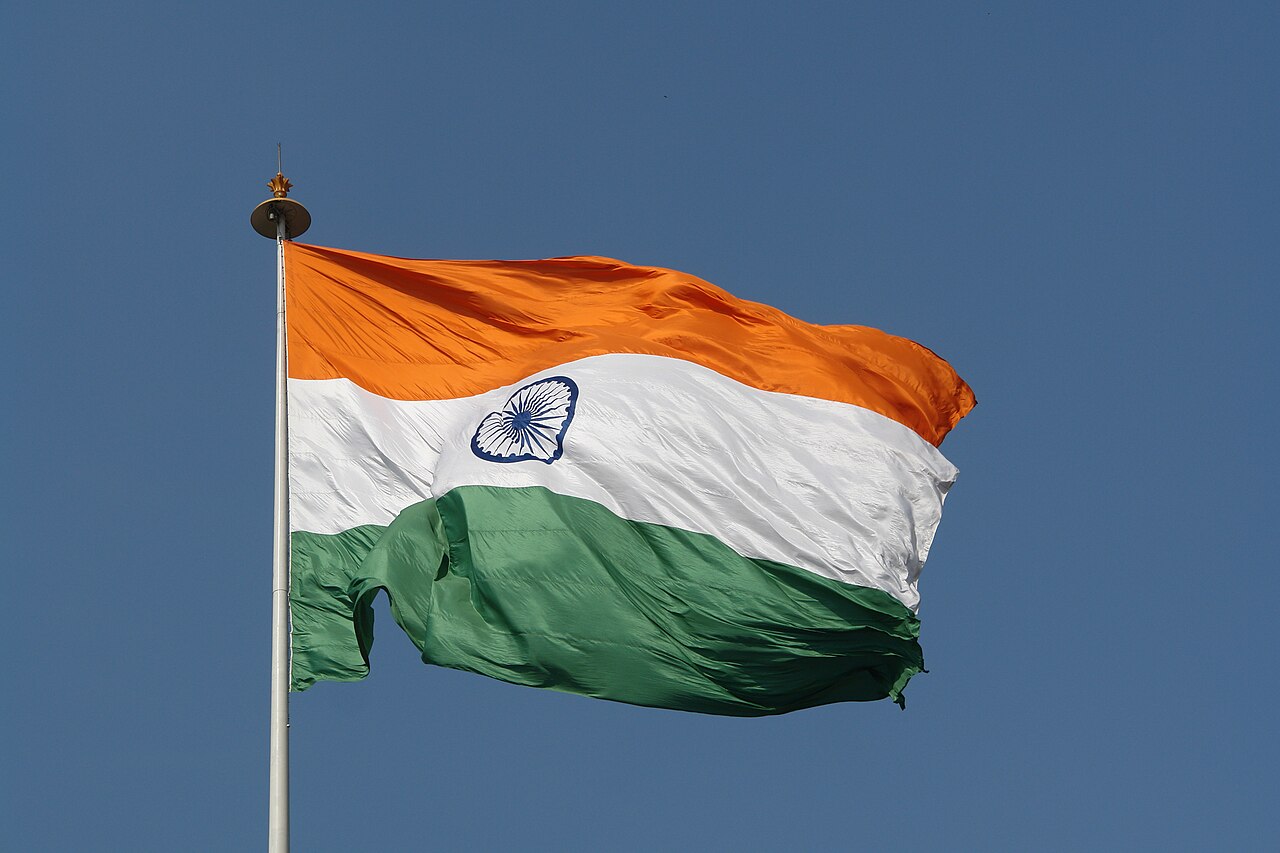
Via Wikimedia Commons: Flag of India, New Delhi by Yann Forget, CC BY-SA 4.0.
Government and politics
India is a multiparty federal republic with a parliament of two houses.[1] The president is head of state and the prime minister is head of government.[1] The lower house of Parliament is the Lok Sabha, which has 543 seats, and the upper house is the Rajya Sabha.[4]
The 2024 general election to the Lok Sabha was held in seven phases between 19 April and 1 June 2024, and the votes were counted from 4 June.[4] More than 968 million voters had registered, and a record 642 million people voted.[4] A party or coalition needs 272 of the 543 seats for a majority.[4] The Bharatiya Janata Party (BJP) won 240 seats and did not gain a majority on its own, while the BJP-led National Democratic Alliance (NDA) won 293 seats.[4] The opposition INDIA bloc won 234 seats, and the Indian National Congress gained 47 seats compared with its 2019 result.[4] The result put the NDA on course to form the federal government.[4]
Economy
In its India overview, last updated on 10 November 2025, the World Bank described India as the world's fifth-largest economy and said its share of the global economy had risen from 1.6 percent in 2000 to 3.4 percent in 2023.[5] The same overview reported growth of 6.5 percent in the 2024–25 financial year, supported by agriculture, which grew 4.6 percent, and by services, which the bank said stayed strong while industry slowed.[5] The World Bank also reported that extreme poverty fell from 16.2 percent of the population in 2011–12 to 2.3 percent in 2022–23.[5]
India's main agricultural products include rice, wheat, cotton, sugarcane, coconut, spices, jute, tobacco, tea, coffee and rubber.[1] Britannica describes its manufacturing sector as highly diversified, covering both heavy and high-technology industries.[1] The currency is the Indian rupee.[1]
Society and culture
According to the UN Population Fund's State of World Population report for 2025, India's population was estimated at 1,463.9 million in 2025, making it the world's most populous country.[3] The same report put India's total fertility rate (the average number of children born per woman) at 1.9, below the replacement level of 2.1.[3] According to that report, about 24 percent of the population in 2025 was aged 0–14, about 68 percent was of working age (15–64) and about 7 percent was 65 or older.[3] It projected life expectancy at birth in 2025 at 71 years for men and 74 years for women.[3]
Hindi and English are the official languages of the national government.[1] Other languages spoken include Indo-European languages such as Bengali, Kashmiri, Marathi and Urdu, the Dravidian languages, and hundreds of languages from several other language families.[1] Religions practised in India include Hinduism, Islam, Christianity, Sikhism, Buddhism and Jainism.[1] Britannica describes India's peoples as widely varying mixtures drawn from groups that settled in the subcontinent before recorded history or that arrived later as invaders.[1]
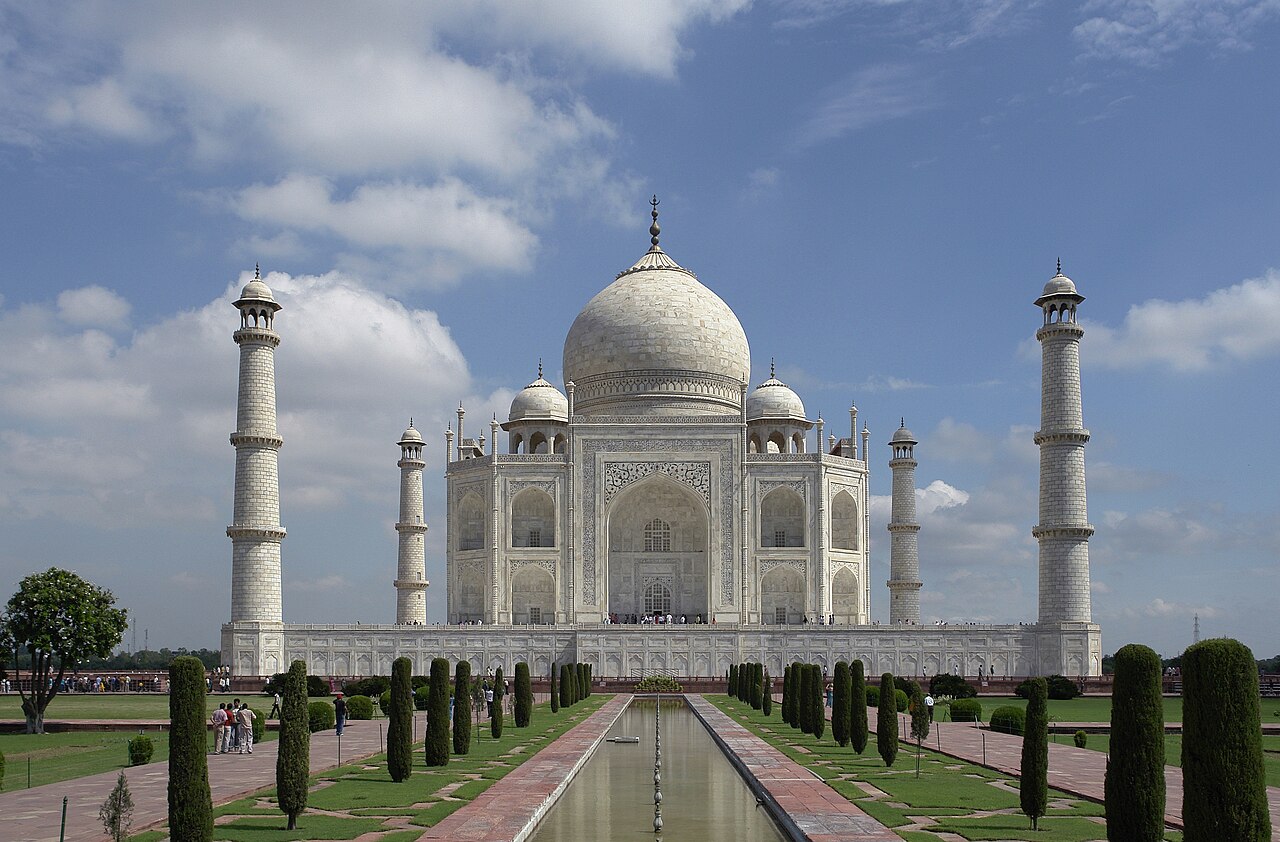
Via Wikimedia Commons: Taj Mahal, Agra, India edit2 by Yann ; edited by King of Hearts, CC BY-SA 4.0.
Disputed territory
Parts of India's frontiers are disputed: the Kashmir region with Pakistan, and sections of the boundary with China.[1][6] The positions below are given in each government's own terms.
Jammu and Kashmir
India's government regards the part of Kashmir administered by Pakistan as Indian territory.[6] In a statement to Parliament on 17 September 2020, India's defence minister called that area "Pakistan Occupied Kashmir" and said Pakistan had "illegally ceded" 5,180 square kilometres of "Indian territory" there to China under a 1963 boundary agreement between China and Pakistan.[6]
After the 1947 partition, the status of Jammu and Kashmir was left undecided, and India and Pakistan soon went to war over it.[7] A 1948 United Nations resolution called for a referendum on the territory's future, but it was never held.[7] As of December 2023, India and Pakistan each controlled part of the territory, divided by a heavily militarised frontier, according to the Associated Press.[7] An armed revolt began in 1989, seeking either union with Pakistan or independence, and tens of thousands of civilians, rebels and government forces were killed in the conflict, according to the same report.[7]
Pakistan's position, as its Ministry of Foreign Affairs restated at a press briefing on 6 August 2026, is that Jammu and Kashmir is an "internationally recognized disputed territory".[8] The ministry said the territory's final status should be decided in line with the relevant UN Security Council resolutions and through a "free and impartial plebiscite" (a popular vote) under United Nations auspices.[8]
In 2019, India ended Jammu and Kashmir's status as a semi-autonomous region with its own constitution.[7] The region lost its flag, criminal code and constitution, as well as inherited protections on land and jobs, and it was divided into two federally administered territories, Jammu and Kashmir and Ladakh.[7] The Indian government said the change was needed to "wipe out militancy and anti-India sentiments" and to "completely integrate the territory into the Union of India."[7] Pakistan's foreign ministry calls these India's "illegal and unilateral actions of 5 August 2019", describes them as a violation of UN Security Council resolutions, and has called on India to reverse them.[8]
In December 2023, a five-judge bench of the Supreme Court of India upheld the 2019 change, ruling that the special status had been a "temporary provision".[7] The court said the government should restore Jammu and Kashmir's statehood as soon as possible and ordered elections to the region's legislature by 30 September 2024.[7] Pakistan's caretaker foreign minister rejected the ruling, saying it had "no legal value".[7]
The 2025 attack and fighting with Pakistan
On 22 April 2025 gunmen killed 26 people near Pahalgam, in Indian-administered Kashmir.[11][12] India's government said the attackers were Pakistani and Pakistan-trained members of the militant group Lashkar-e-Taiba; Pakistan denied any role.[11][12] As of 13 May 2025, the US Congressional Research Service reported that India had not presented evidence of a Pakistani link to the attack.[11] In the days after it, India said it was holding the 1960 Indus Waters Treaty, a river-sharing agreement between the two countries, "in abeyance".[11]
Late on 6 May and into 7 May 2025, India launched drone and missile strikes, called Operation Sindoor, on what it said were nine terrorist targets.[11][12] India's defence ministry described the strikes as "focused, measured and non-escalatory"; Pakistan condemned them as an act of war.[11] Fighting between the two countries followed. Pakistan reported on 8 May that 31 people had been killed in the strikes, and India reported that at least 15 of its civilians had been killed by Pakistani shelling.[11][12]
On 10 May 2025 US President Donald Trump announced a ceasefire, and both governments confirmed a halt.[11] Their accounts of how it came about differed. The US Secretary of State called it a US-brokered deal and Pakistan's prime minister thanked the United States for facilitating it, while Indian officials maintained that it was negotiated directly between India and Pakistan.[11][12] The two sides also disagreed over which of them had asked for it.[12]
Boundary with China
India and China have not resolved their boundary question.[6] In its September 2020 statement, India's government said that China does not accept the customary and traditional alignment of the boundary, and that there is no commonly delineated Line of Actual Control (LAC), the line separating the areas each side actually holds.[6]
In the western sector, India's government says China is in "illegal occupation" of about 38,000 square kilometres in the union territory of Ladakh.[6] China's Ministry of Foreign Affairs said on 13 October 2026 that China has never recognised the "Union Territory of Ladakh", which it described as unilaterally and illegally established by India, and that the western sector of the China–India boundary belongs to China.[9] That statement answered a question about India's Ministry of Home Affairs identifying standardised names for 28 places in Ladakh and marking them on the official map.[9]
In the eastern sector, India's government says China claims about 90,000 square kilometres of Indian territory in Arunachal Pradesh, which India lists as one of its states.[2][6] China calls the area Zangnan.[10] On 14 April 2026, a Chinese foreign ministry spokesperson said that "Zangnan region is China's territory" and that China does not recognise "Arunachal Pradesh", after China's Ministry of Civil Affairs published a sixth batch of Chinese names for places there on 10 April 2026 and India's foreign ministry objected.[10]
Troops of the two countries clashed at Galwan in eastern Ladakh on 15 June 2020.[6] India's defence minister told Parliament that 20 Indian soldiers were killed.[6] In the same statement, India's government said both countries had formally agreed to seek a "fair, reasonable and mutually acceptable solution" to the boundary question through dialogue and peaceful negotiations.[6]
Sources
- Encyclopaedia Britannica, "India" (article summary page and main article page). Encyclopaedia Britannica. No date shown; accessed 26 November 2026. britannica.com/summary/India and britannica.com/place/India
- Government of India, National Portal of India, "Know India: Districts" (list of States and Union Territories). National Informatics Centre. No date shown; accessed 26 November 2026. knowindia.india.gov.in/districts/
- Press Trust of India, "India's population touches 1.46 billion, fertility drops below replacement rate: UN report". ThePrint, 10 June 2025. theprint.in/india/indias-population-touches-1-46-billion-fertility-…
- Encyclopaedia Britannica, "Indian Lok Sabha elections of 2024". Encyclopaedia Britannica. No date shown; accessed 26 November 2026. britannica.com/event/Indian-Lok-Sabha-elections-of-2024
- World Bank, "India" (Overview and Economy sections, last updated 10 November 2025). World Bank. Accessed 26 November 2026. worldbank.org/india
- Press Information Bureau, Ministry of Defence, "Text of Raksha Mantri Shri Rajnath Singh Statement in Rajya Sabha on September 17". Government of India, 17 September 2020. pib.gov.in/Pressreleaseshare.aspx?PRID=1655521®=48&lang=2
- The Associated Press, "India's Supreme Court upholds decision to end Kashmir's special status". CBC News, 11 December 2023 (updated 12 December 2023). cbc.ca/lite/story/1.7055041
- Ministry of Foreign Affairs of Pakistan, "Transcript of the Press Briefing by the Spokesperson on Thursday 6th August 2026". Government of Pakistan, 6 August 2026. mofa.gov.pk/press-releases/transcript-of-the-press-briefing-by-the-…
- Ministry of Foreign Affairs of the People's Republic of China, "Foreign Ministry Spokesperson Mao Ning's Regular Press Conference on October 13, 2026". 13 October 2026. mfa.gov.cn/eng/xw/fyrbt/202610/t20261013_12039583.html
- Ministry of Foreign Affairs of the People's Republic of China, "Foreign Ministry Spokesperson Guo Jiakun's Regular Press Conference on April 14, 2026". 14 April 2026. mfa.gov.cn/eng/xw/fyrbt/lxjzh/202604/t20260414_11891740.html
- Congressional Research Service. "India-Pakistan Conflict in Spring 2025" (IF13000). 13 May 2025, as reproduced by EveryCRSReport. everycrsreport.com/reports/IF13000.html
- Arms Control Association. "Ceasefire Halts India, Pakistan Missile Exchange". Arms Control Today, June 2025. armscontrol.org/index%2Ephp/node/14664
