Version 3 (current)
Nov 27, 2026. Version history
Niccolò Machiavelli (1469–1527) was a Florentine official and writer, best known for The Prince, a short treatise on gaining and keeping political power, and for the Discourses on Livy, which favours republican government.[1][2]
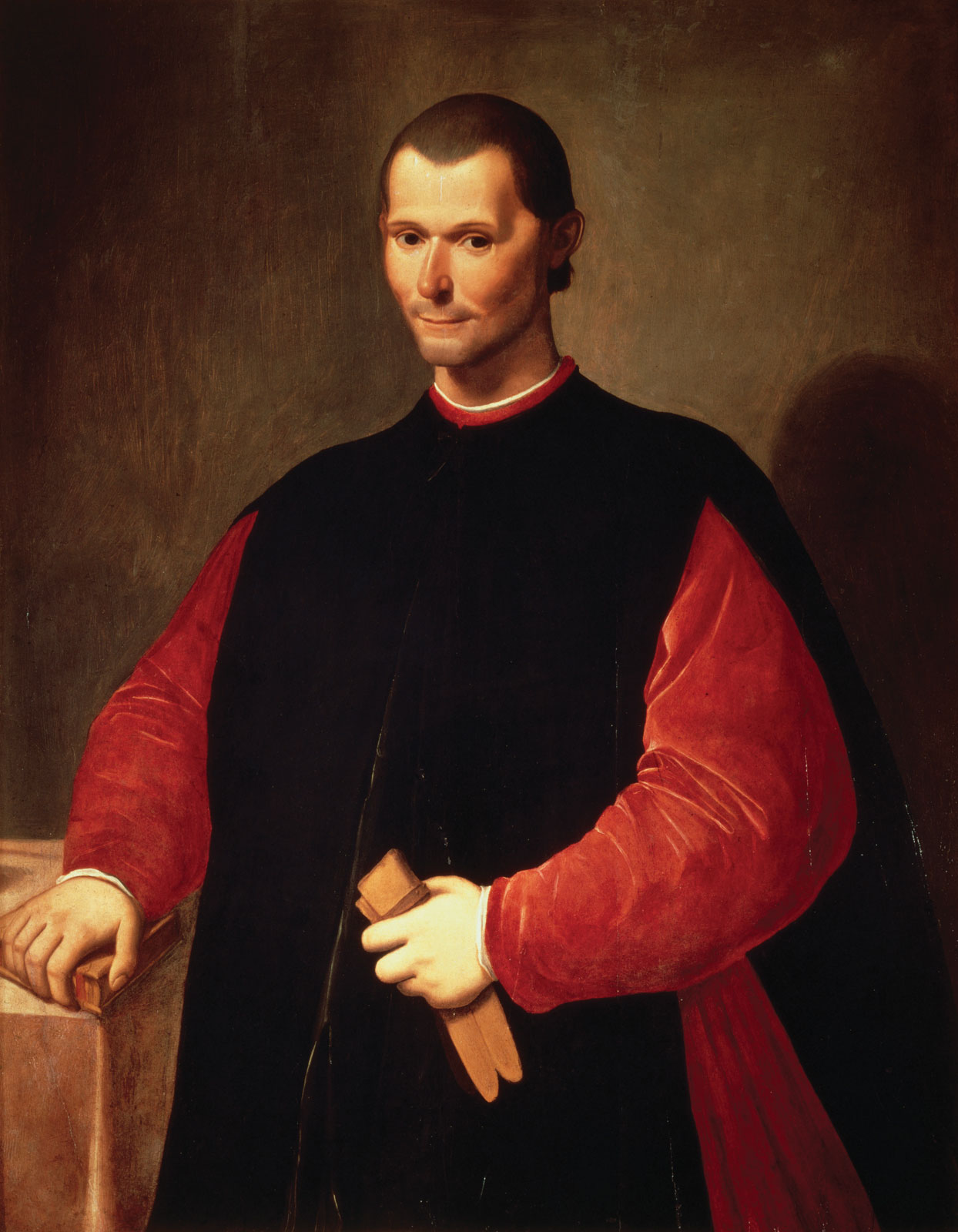
Via Wikimedia Commons: Portrait of Niccolò Machiavelli by Santi di Tito by Santi di Tito, public domain.
Life
Machiavelli was born in Florence on 3 May 1469.[1] He was the son of Bernardo, a lawyer, and Bartolomea de' Nelli, and in autumn 1501 he married Marietta Corsini, with whom he had seven children.[2]
In 1498, after the execution of Savonarola, he became secretary of the second chancery of the Florentine Republic, and was later secretary of the Ten.[1][2] For about fourteen years he carried out diplomatic missions, among them visits to the French royal court and to the court of Emperor Maximilian.[1] Treccani's account adds missions to Caterina Sforza at Forlì, to Cesare Borgia and to the papal conclave of 1503.[2] He served under Piero Soderini, who was elected gonfaloniere (the republic's chief magistrate) for life in 1502.[1] He also helped organise a Florentine militia, and in 1507 was appointed chancellor of the Nine Officers of the militia.[1][2]
In 1512 the Medici family, supported by Spanish and papal troops, defeated the militia he had organised and ended the republican government, and Machiavelli was dismissed.[1] In February 1513 he was imprisoned and tortured over a suspected plot against the Medici; he was released under an amnesty, and he then withdrew to the family farm outside Florence.[1][2]
In 1520 Cardinal Giulio de' Medici commissioned from him the Florentine Histories, which he finished in 1525 and presented in Rome to the cardinal, by then Pope Clement VII.[1] In 1526 he became chancellor of the procurators of the city walls.[2] The republic was restored in May 1527, but he was not recalled to office.[2] He died in Florence on 21 June 1527 and was buried in Santa Croce the next day.[2]
The Prince
According to the Stanford Encyclopedia of Philosophy, The Prince was written at the end of 1513, possibly extending into early 1514.[1] Treccani dates its writing between autumn 1513 and April 1514.[2] It was first dedicated to Giuliano de' Medici and then, after Giuliano's death, to Lorenzo de' Medici the Younger.[1] It was not printed until 1532, after Machiavelli's death.[1][2] Treccani gives the Latin title of the work as De principatibus ("On principalities") and says it was printed in 1532 under the later title Il Principe.[2]
In the English translation by W. K. Marriott, the work has twenty-six chapters. The first eleven treat the kinds of principalities and how they are acquired, including hereditary, mixed, new, civil and ecclesiastical ones. Chapters 12 to 14 take up soldiers and the art of war, and chapters 15 to 23 the conduct of a prince, including liberality, cruelty and clemency, keeping faith, and avoiding flatterers. Chapter 17 asks whether it is better for a prince to be loved or feared. Chapter 24 asks why the princes of Italy have lost their states, chapter 25 concerns what fortune can effect in human affairs, and chapter 26 is an exhortation to liberate Italy "from the Barbarians".[3]
The Stanford Encyclopedia reads the book as an analysis of power. It describes virtù as the personal skill and adaptability needed to hold power, distinct from conventional moral virtue, and fortuna as a harmful, often violent force opposing human order, pictured in chapter 25 as a river that can be held back by dikes.[1]
The Discourses and other works
The Discourses on the Ten Books of Titus Livy present themselves as a commentary on Livy's history of Rome but set out a defence of republican government.[1] The Stanford Encyclopedia dates the start of composition to perhaps 1514 or 1515, its completion to 1518 or 1519, and publication to 1531, after Machiavelli's death.[1] Treccani gives a different, earlier span of about 1513 to 1517, calls the work his masterpiece, and names Cosimo Rucellai and Zanobi Buondelmonti as its dedicatees.[2] Treccani notes that chapters 5 and 6 of the first book compare Venice with ancient Rome, and that chapter 12 argues that the Church prevented Italian unification.[2]
In the Discourses, Machiavelli distinguishes living securely (vivere sicuro) from living freely (vivere libero) and holds that only a republic can give the second.[1] He argues that the quarrels between the people and the Senate in Rome were a source of Roman liberty, and that the people can be more prudent and stable than a prince.[1] The Stanford Encyclopedia also reports that the Discourses treat conventional Christianity as draining the vigour needed for civic life, and that many scholars read Machiavelli as preferring the civil religions of ancient Rome, while others read him as a religious thinker.[1] Because The Prince and the Discourses can seem to contradict each other, readers have long debated how they fit together; the same source notes that Machiavelli never repudiated The Prince and referred to it in the Discourses as a companion.[1]
Treccani lists further works. The Art of War (Arte della guerra) was written in 1519 and 1520 and printed in Florence in August 1521; it is a dialogue in which Fabrizio Colonna argues for a return to Roman military principles and a citizen army instead of mercenaries.[2] The comedy Mandragola was staged in Florence around March 1520.[2] The Florentine Histories (Istorie fiorentine), in eight books from the city's founding to 1492, were presented in June 1525 to Giulio de' Medici, by then Pope Clement VII, and treat above all the city's civil strife.[2]
Reception and legacy
Treccani says that Machiavelli's major works were printed in Rome and Florence in 1531 and 1532, and that he was placed on the Church's Index of prohibited books in 1559, which ended his influence on political culture in Italy.[2] It links his later influence to Bodin, Harrington, and Fichte and Hegel, and says that Foscolo and De Sanctis revived him as a figure of the Italian national spirit in the Risorgimento.[2]
The Stanford Encyclopedia reports that he was denounced in the sixteenth century as an "apostle of the Devil", and that the word "Machiavellism" was apparently coined by Pierre Bayle in the seventeenth century.[1] Interpretations differ widely. Rousseau held that The Prince in fact exposes the immorality of one-man rule to the people.[1] Benedetto Croce (1925) read Machiavelli as a realist, while Leo Strauss (1958) called him a "teacher of evil".[1] J. G. A. Pocock (1975) traced his civic republicanism into the Atlantic world and the ideas of the American framers, and Quentin Skinner (1978) argued that Machiavelli treats vicious acts as a last resort and prefers virtue where possible.[1] Later writers including Philip Pettit, Skinner and Maurizio Viroli have drawn on him for a republican idea of freedom as non-domination.[1]
Sources
- Cary Nederman, "Niccolò Machiavelli", Stanford Encyclopedia of Philosophy, first published 13 September 2005, substantive revision 6 December 2023. plato.stanford.edu/entries/machiavelli/
- "Machiavelli, Niccolò", Dizionario di Storia (2010), Istituto della Enciclopedia Italiana (Treccani). treccani.it/enciclopedia/niccolo-machiavelli_(Dizionario-di-Storia)/
- Niccolò Machiavelli, The Prince, translated by W. K. Marriott (table of contents), Wikisource. en.wikisource.org/wiki/The_Prince_(Marriott)
