Compare versions
Version 1 → Version 2 (current). Removed · Added. This shows the entry's text as it is written, including its formatting marks.
Version 1 · Version 2 (current) · Version history
Side by side · Together
Version 1Version 2 (current)
9 unchanged paragraphs
Cyber Monday is the name given to the Monday after [Thanksgiving](https://micwyn.com/t/3386/thanksgiving) in the United States, a day that online retailers have promoted since 2005 as one of the busiest for internet shopping.[1][2]
Cyber Monday is the name given to the Monday after [Thanksgiving](https://micwyn.com/t/3386/thanksgiving) in the United States, a day that online retailers have promoted since 2005 as one of the busiest for internet shopping.[1][2]
## Origin of the name
## Origin of the name
The term was introduced by Shop.org, the online retail division of the National Retail Federation (NRF), the main trade body for US retailers.[1][9] A Shop.org press release dated 21 November 2005 in Washington, DC, carried the headline "'Cyber Monday' Quickly Becoming One of the Biggest Online Shopping Days of the Year".[1] The release drew a contrast with Black Friday, the day after Thanksgiving, which traditional store-based retailers watched for foot traffic and sales, and said online retailers had found their sales on the following Monday had been creeping higher for several years.[1] It cited the Shop.org/BizRate "eHoliday Mood Study", a survey of consumers and retailers, in which 77 percent of online retailers said their sales had risen substantially on the Monday after Thanksgiving the previous year.[1][2] Scott Silverman, then executive director of Shop.org, was quoted as saying that on Cyber Monday consumers turned to "surfing for holiday gifts and shopping online".[1][2] CNNMoney reported on the new name on 28 November 2005, noting that many online retailers planned extra incentives for that Monday.[2]
The term was introduced by Shop.org, the online retail division of the National Retail Federation (NRF), the main trade body for US retailers.[1][9] A Shop.org press release dated 21 November 2005 in Washington, DC, carried the headline "'Cyber Monday' Quickly Becoming One of the Biggest Online Shopping Days of the Year".[1] The release drew a contrast with Black Friday, the day after Thanksgiving, which traditional store-based retailers watched for foot traffic and sales, and said online retailers had found their sales on the following Monday had been creeping higher for several years.[1] It cited the Shop.org/BizRate "eHoliday Mood Study", a survey of consumers and retailers, in which 77 percent of online retailers said their sales had risen substantially on the Monday after Thanksgiving the previous year.[1][2] Scott Silverman, then executive director of Shop.org, was quoted as saying that on Cyber Monday consumers turned to "surfing for holiday gifts and shopping online".[1][2] CNNMoney reported on the new name on 28 November 2005, noting that many online retailers planned extra incentives for that Monday.[2]
Accounts differ on who should be credited with the name itself. A 2016 profile published by Georgetown University's McDonough School of Business says that Ellen Davis, who was then working in public relations for Shop.org, was part of a small team brainstorm that gave the day its name; the same profile describes her later role as an NRF senior vice president.[3] In an interview published by the research firm eMarketer, Silverman described the name as coming from Shop.org after its consumer research showed a surge in shopping on that Monday.[4] The news site Axios attributed the term to "a marketing executive" in 2005, and Encyclopaedia Britannica attributes it to the National Retail Federation.[5][9]
Accounts differ on who should be credited with the name itself. A 2016 profile published by Georgetown University's McDonough School of Business says that Ellen Davis, who was then working in public relations for Shop.org, was part of a small team brainstorm that gave the day its name; the same profile describes her later role as an NRF senior vice president.[3] In an interview published by the research firm eMarketer, Silverman described the name as coming from Shop.org after its consumer research showed a surge in shopping on that Monday.[4] The news site Axios attributed the term to "a marketing executive" in 2005, and Encyclopaedia Britannica attributes it to the National Retail Federation.[5][9]
## The office-connection explanation
## The office-connection explanation
The 2005 release suggested that the rise in web traffic might be explained by consumers having faster or more secure internet connections at work, or by shoppers who had not finished their holiday buying over the Thanksgiving weekend.[1] It also said that 37 percent of consumers, or about 51.7 million people, planned to use internet access at work to shop online during the holiday season.[1] In his eMarketer interview, Silverman said that many people in 2005 shopped from their offices, where they had more privacy and faster connections than most homes had at the time.[4]
The 2005 release suggested that the rise in web traffic might be explained by consumers having faster or more secure internet connections at work, or by shoppers who had not finished their holiday buying over the Thanksgiving weekend.[1] It also said that 37 percent of consumers, or about 51.7 million people, planned to use internet access at work to shop online during the holiday season.[1] In his eMarketer interview, Silverman said that many people in 2005 shopped from their offices, where they had more privacy and faster connections than most homes had at the time.[4]
Later accounts treat this explanation as belonging to its time. In 2010 the measurement firm comScore reported that 48.9 percent of the money spent on US websites on Cyber Monday came from work computers, 3.8 percentage points less than a year earlier.[6] Axios wrote in an article dated 2 December 2019 that the office lines once credited with the day's sales "no longer matter", because most people had home broadband and internet-connected smartphones.[5] By 2025 most Cyber Monday spending came through phones and other mobile devices (see below).[7]
Later accounts treat this explanation as belonging to its time. In 2010 the measurement firm comScore reported that 48.9 percent of the money spent on US websites on Cyber Monday came from work computers, 3.8 percentage points less than a year earlier.[6] Axios wrote in an article dated 2 December 2019 that the office lines once credited with the day's sales "no longer matter", because most people had home broadband and internet-connected smartphones.[5] By 2025 most Cyber Monday spending came through phones and other mobile devices (see below).[7]
## Growth
## Growth
Silverman told eMarketer that the 2005 release never claimed that Cyber Monday was the biggest shopping day of the year, although news reports presented it that way, and that it did become the top online day around 2010, calling this "a self-fulfilling prophecy".[4] comScore reported on 1 December 2010 that US online spending on Cyber Monday 2010 reached $1.028 billion, up 16 percent on the previous year, the first time daily online spending had passed $1 billion and the heaviest online spending day it had recorded.[6] The same release put Cyber Monday 2009 at $887 million.[6]
Silverman told eMarketer that the 2005 release never claimed that Cyber Monday was the biggest shopping day of the year, although news reports presented it that way, and that it did become the top online day around 2010, calling this "a self-fulfilling prophecy".[4] comScore reported on 1 December 2010 that US online spending on Cyber Monday 2010 reached $1.028 billion, up 16 percent on the previous year, the first time daily online spending had passed $1 billion and the heaviest online spending day it had recorded.[6] The same release put Cyber Monday 2009 at $887 million.[6]
15 unchanged paragraphs
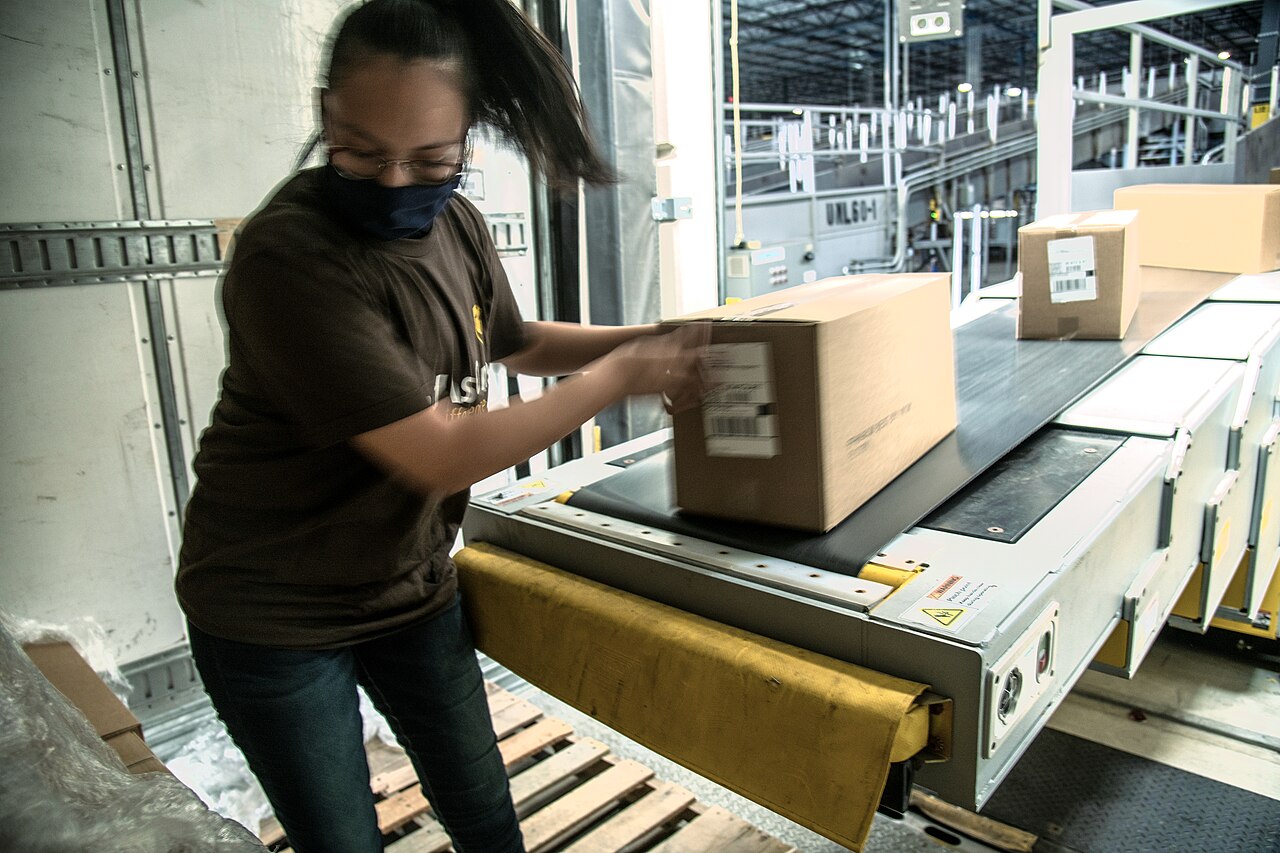
*Via Wikimedia Commons: [UPS worker unloads boxes from semi trailer truck onto conveyor belt](https://commons.wikimedia.org/wiki/File:UPS_worker_unloads_boxes_from_semi_trailer_truck_onto_conveyor_belt.jpg) by U.S. Department of Agriculture, public domain.*
*Via Wikimedia Commons: [UPS worker unloads boxes from semi trailer truck onto conveyor belt](https://commons.wikimedia.org/wiki/File:UPS_worker_unloads_boxes_from_semi_trailer_truck_onto_conveyor_belt.jpg) by U.S. Department of Agriculture, public domain.*
Adobe, which publishes figures based on its Adobe Analytics data covering more than 1 trillion visits to US retail websites, reported on 2 December 2025 that US consumers spent $14.25 billion online on Cyber Monday 2025 (1 December 2025), up 7.1 percent on 2024 and slightly above the $14.2 billion Adobe had forecast.[7] Adobe said that Cyber Monday "remains the biggest online shopping day of all time".[7] It also reported that 57.5 percent of Cyber Monday 2025 online sales were made on a mobile device.[7]
Adobe, which publishes figures based on its Adobe Analytics data covering more than 1 trillion visits to US retail websites, reported on 2 December 2025 that US consumers spent $14.25 billion online on Cyber Monday 2025 (1 December 2025), up 7.1 percent on 2024 and slightly above the $14.2 billion Adobe had forecast.[7] Adobe said that Cyber Monday "remains the biggest online shopping day of all time".[7] It also reported that 57.5 percent of Cyber Monday 2025 online sales were made on a mobile device.[7]
The NRF measures the number of shoppers rather than spending. On 2 December 2025 it and the research firm Prosper Insights & Analytics reported that a record 202.9 million people shopped in stores or online during the five days from Thanksgiving Day through Cyber Monday 2025, and that Cyber Monday itself drew 75.9 million online shoppers, compared with 64.4 million in 2024.[8] Their figures came from a survey of 3,099 adults carried out from 26 to 30 November 2025, with a stated margin of error of plus or minus 1.8 percentage points.[8]
The NRF measures the number of shoppers rather than spending. On 2 December 2025 it and the research firm Prosper Insights & Analytics reported that a record 202.9 million people shopped in stores or online during the five days from Thanksgiving Day through Cyber Monday 2025, and that Cyber Monday itself drew 75.9 million online shoppers, compared with 64.4 million in 2024.[8] Their figures came from a survey of 3,099 adults carried out from 26 to 30 November 2025, with a stated margin of error of plus or minus 1.8 percentage points.[8]
## Cyber Week and the longer season
## Cyber Week and the longer season
Retailers and analysts have increasingly treated Cyber Monday as the end of a longer period rather than a single day. Adobe uses "Cyber Week" for the five days from Thanksgiving to Cyber Monday, and reported on 2 December 2025 that US online spending over those five days reached $44.2 billion in 2025.[7] The NRF uses the same five-day period for its shopper counts.[8] Adobe also reported that 2025 was the second holiday season in a row in which online spending on Black Friday grew faster than on Cyber Monday, although Cyber Monday remained the larger day.[7]
Retailers and analysts have increasingly treated Cyber Monday as the end of a longer period rather than a single day. Adobe uses "Cyber Week" for the five days from Thanksgiving to Cyber Monday, and reported on 2 December 2025 that US online spending over those five days reached $44.2 billion in 2025.[7] The NRF uses the same five-day period for its shopper counts.[8] Adobe also reported that 2025 was the second holiday season in a row in which online spending on Black Friday grew faster than on Cyber Monday, although Cyber Monday remained the larger day.[7]
## Spread beyond the United States
## Spread beyond the United States
Britannica states that Cyber Monday has become popular in countries such as Canada, the United Kingdom and Japan, even though they do not celebrate the American Thanksgiving holiday.[9] In Europe, the name is used for sales that national consumer authorities monitor together with Black Friday sales (see Disputes).[10][11] Reporting from Spain in November 2023, the news agency Reuters described Cyber Monday as the first working day after Thanksgiving and an important date for retailers because consumers return to work and begin ordering [Christmas](https://micwyn.com/t/2237/christmas) gifts.[14]
Britannica states that Cyber Monday has become popular in countries such as Canada, the United Kingdom and Japan, even though they do not celebrate the American Thanksgiving holiday.[9] In Europe, the name is used for sales that national consumer authorities monitor together with Black Friday sales (see Disputes).[10][11] Reporting from Spain in November 2023, the news agency Reuters described Cyber Monday as the first working day after Thanksgiving and an important date for retailers because consumers return to work and begin ordering [Christmas](https://micwyn.com/t/2237/christmas) gifts.[14]
## Disputes and criticism
## Disputes and criticism
**Accuracy of discounts.** Regulators have questioned whether the price cuts advertised during these sales are genuine. Between November and December 2025, the European Commission and consumer protection authorities from 23 European Union member states, Iceland and Norway screened 314 online traders during the Black Friday and Cyber Monday sales, in a coordinated check known as a "sweep".[10][11] In findings published on 26 March 2026, the Commission said that 30 percent of the traders checked had stated discounts incorrectly; under EU law, a claimed reduction must be measured against the lowest price charged in the previous 30 days.[11] It also reported that 36 percent of traders tried to add optional items to shoppers' baskets, 40 percent of whom did so without clearly asking for consent, and that some used pressure tactics such as countdown timers or false claims of low stock.[11] The Commission said national authorities could take action against the businesses concerned.[11]
**Accuracy of discounts.** Regulators have questioned whether the price cuts advertised during these sales are genuine. Between November and December 2025, the European Commission and consumer protection authorities from 23 European Union member states, Iceland and Norway screened 314 online traders during the Black Friday and Cyber Monday sales, in a coordinated check known as a "sweep".[10][11] In findings published on 26 March 2026, the Commission said that 30 percent of the traders checked had stated discounts incorrectly; under EU law, a claimed reduction must be measured against the lowest price charged in the previous 30 days.[11] It also reported that 36 percent of traders tried to add optional items to shoppers' baskets, 40 percent of whom did so without clearly asking for consent, and that some used pressure tactics such as countdown timers or false claims of low stock.[11] The Commission said national authorities could take action against the businesses concerned.[11]
**Scams.** Law enforcement agencies have warned that criminals target shoppers during these sales. On 21 November 2011 the US Internet Crime Complaint Center (IC3) issued holiday shopping guidance noting that the Monday after Thanksgiving had been labelled Cyber Monday since 2005.[12] It warned that scammers try to exploit Black Friday and Cyber Monday bargain hunters with "one day only" offers that appear to come from well-known brands, as well as phishing emails (messages designed to trick people into giving away personal or payment details), counterfeit goods and fraudulent gift cards.[12]
**Scams.** Law enforcement agencies have warned that criminals target shoppers during these sales. On 21 November 2011 the US Internet Crime Complaint Center (IC3) issued holiday shopping guidance noting that the Monday after Thanksgiving had been labelled Cyber Monday since 2005.[12] It warned that scammers try to exploit Black Friday and Cyber Monday bargain hunters with "one day only" offers that appear to come from well-known brands, as well as phishing emails (messages designed to trick people into giving away personal or payment details), counterfeit goods and fraudulent gift cards.[12]
**Worker protests.** Because the day falls during the busiest period for online orders, labour groups have used it for protests at warehouses. On Cyber Monday 2022 (28 November 2022), workers at an Amazon cross-dock facility in Joliet, Illinois, walked out for the second time in two months to protest pay and working conditions, according to CBS News Chicago.[13] In a statement, Amazon referred to "a small demonstration initiated by outside groups" and said it was proud of the pay, benefits and safety it provided.[13] In November 2023 the Spanish union CCOO called on about 20,000 Amazon warehouse and delivery workers in Spain to hold one-hour strikes on each shift on Cyber Monday, 27 November 2023, and on the following day, over pay and working conditions, Reuters reported; a local Amazon spokesperson said its staff in Spain already worked in a safe environment with competitive wages and benefits.[14]
**Worker protests.** Because the day falls during the busiest period for online orders, labour groups have used it for protests at warehouses. On Cyber Monday 2022 (28 November 2022), workers at an Amazon cross-dock facility in Joliet, Illinois, walked out for the second time in two months to protest pay and working conditions, according to CBS News Chicago.[13] In a statement, Amazon referred to "a small demonstration initiated by outside groups" and said it was proud of the pay, benefits and safety it provided.[13] In November 2023 the Spanish union CCOO called on about 20,000 Amazon warehouse and delivery workers in Spain to hold one-hour strikes on each shift on Cyber Monday, 27 November 2023, and on the following day, over pay and working conditions, Reuters reported; a local Amazon spokesperson said its staff in Spain already worked in a safe environment with competitive wages and benefits.[14]
## 2026
## 2026
Cyber Monday 2026 falls on 30 November 2026.[15] In a forecast released on 28 September 2026, Adobe predicted that US online spending on that day would reach $15.1 billion, up 6.2 percent on 2025, which Adobe described as a new milestone of more than $15 billion spent online in a single day.[15] Adobe also forecast that US online spending over Cyber Week 2026 would reach $47.5 billion, up 7.4 percent.[15] These are forecasts made before the event, not results.[15]
Cyber Monday 2026 falls on 30 November 2026.[15] In a forecast released on 28 September 2026, Adobe predicted that US online spending on that day would reach $15.1 billion, up 6.2 percent on 2025, which Adobe described as a new milestone of more than $15 billion spent online in a single day.[15] Adobe also forecast that US online spending over Cyber Week 2026 would reach $47.5 billion, up 7.4 percent.[15] These are forecasts made before the event, not results.[15]
## Sources
## Sources
1. Baker, John. "Cyber Monday" (post reproducing the Shop.org press release "'Cyber Monday' Quickly Becoming One of the Biggest Online Shopping Days of the Year", dated 21 November 2005). ADS-L mailing list of the American Dialect Society, 28 November 2005. https://listserv.linguistlist.org/pipermail/ads-l/2005-November/055457.html
2. "After Black Friday comes Cyber Monday". CNNMoney, 28 November 2005. https://money.cnn.com/2005/11/21/news/economy/cyber_monday/
3. Kaplan, Melanie D.G. "Shopping Spree". Georgetown University McDonough School of Business (first published in Georgetown Business, Fall 2016), page dated 20 November 2017. https://msb.georgetown.edu/news-story/shopping-spree/
4. "The History of Cyber Monday: Q&A with Scott Silverman, Co-Founder of the Biggest Day in Ecommerce". eMarketer. No date shown; accessed 26 November 2026. https://www.emarketer.com/content/the-history-of-cyber-monday-q-a-with-scott-silverman-co-founder-of-the-biggest-day-in-ecommerce
5. "How we got Cyber Monday". Axios, 2 December 2019 (date from the page address; no byline shown). https://www.axios.com/2019/12/02/cyber-monday-online-shopping-high-speed-internet
6. "Billion Dollar Bonanza: Cyber Monday Surpasses $1 Billion in U.S. Spending as Heaviest Online Shopping Day in History". comScore, 1 December 2010. https://www.comscore.com/Insights/Press-Releases/2010/12/Billion-Dollar-Bonanza-Cyber-Monday-Surpasses-1-Billion-in-U.S.-Spending/
7. "Adobe: Cyber Monday Hits Record $14.25 Billion in Online Spending with Over $1 Billion Driven by Buy Now Pay Later". Adobe Newsroom, 2 December 2025. https://news.adobe.com/news/2025/12/adobe-cyber-monday-hits-record
8. "Thanksgiving Holiday Weekend Draws a Record 203 Million Shoppers". National Retail Federation, 2 December 2025. https://nrf.com/media-center/press-releases/thanksgiving-holiday-weekend-draws-a-record-203-million-shoppers
9. Gisonna, Nicholas. "Cyber Monday". Encyclopaedia Britannica. No date shown; accessed 26 November 2026. https://www.britannica.com/topic/Cyber-Monday
10. "Sweeps". European Commission. No date shown; accessed 26 November 2026. https://commission.europa.eu/topics/consumers/consumer-rights-and-complaints/enforcement-consumer-protection/sweeps_en
11. "EU check reveals misleading sales practices online". European Commission, 26 March 2026. https://commission.europa.eu/news-and-media/news/eu-check-reveals-misleading-sales-practices-online-2026-03-26_en
12. "Holiday Shopping Tips" (public service announcement). Internet Crime Complaint Center (IC3), 21 November 2011. https://www.ic3.gov/PSA/2011/PSA111121.pdf
13. "Amazon workers in Joliet walk out to protest low pay, poor conditions on 'Cyber Monday'". CBS News Chicago, 28 November 2022. https://cbsnews.com/chicago/news/amazon-joliet-walkout
14. Reuters. "20,000 Amazon workers in Spain set to walk out on Cyber Monday". Fortune, 21 November 2023. https://www.fortune.com/europe/2023/11/21/amazon-strike-in-spain-thousands-to-walk-out
15. "CORRECTING and REPLACING Adobe: U.S. Holiday Shopping Season to Hit Record $275.1 Billion Online, Rising 6.7% YoY". Adobe via Business Wire, 28 September 2026. https://www.businesswire.com/news/home/20260928285775/en/CORRECTING-and-REPLACING-Adobe-U.S.-Holiday-Shopping-Season-to-Hit-Record-$275.1-Billion-Online-Rising-6.7-YoY
