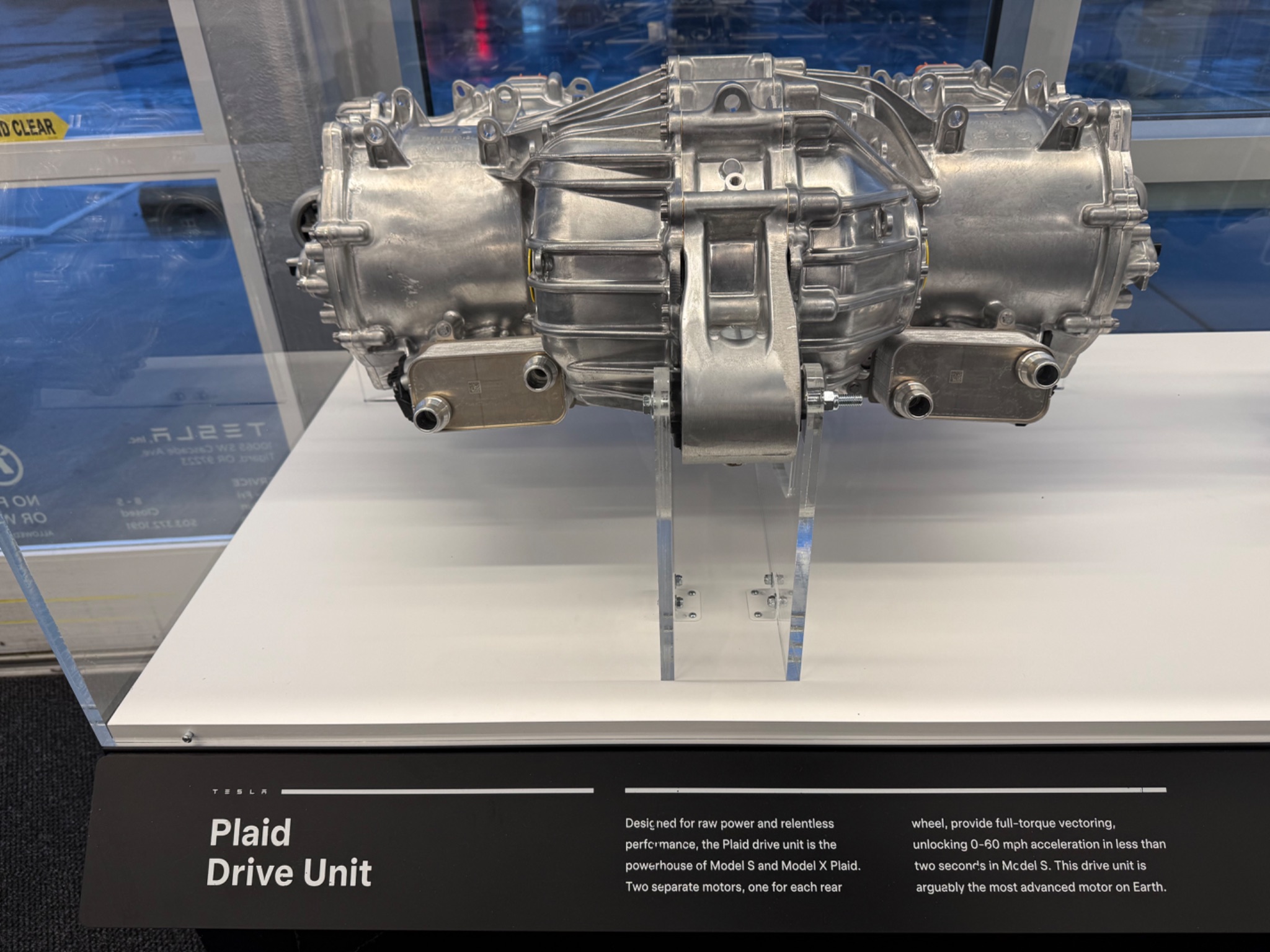
oil cooler
Where are the oil coolers located?

The oil coolers are the two flat, rectangular metal blocks you can see at the lower left and lower right of the unit, one on each side of the central housing. Each one sits low on its motor housing, with two fittings (the round ports with hose connectors) on its face. Oil is pumped through the cooler to carry heat away from the motor and gearset, then returns to the unit.
I'm describing what's visible in the photo, not the internal layout, so I can't tell you exactly which internal components each cooler is plumbed to. For that, Tesla's service documentation or a Tesla technician would be the authoritative source, and this is general engineering knowledge rather than a study.
Is the reason why EV's don't need oil changes like ICE cars because there is no burning of fuel that muddies up the oil?
Or is it because it is a different synthetic oil?
Good question, and the short answer is that it's mostly the fuel, but not in the way you might expect.
In a gasoline or diesel engine, combustion products and unburned fuel get past the piston rings and into the oil, and the oil also picks up soot and acids. That contaminates it and breaks it down, which is why oil changes are scheduled by time or distance. An electric drive unit has no combustion, so that contamination pathway doesn't exist. Its gears and bearings still wear, but the oil is doing a much easier job.
The second part is the oil itself. A drive-unit fluid is a specialized lubricant and coolant, not the engine oil you'd buy for a gas car. Its formulation is tuned for gear wear, electrical insulation and heat transfer, so it's a different product, not just a synthetic version of the same thing. Each maker specifies its own fluid and change interval.
So the honest answer is both, with combustion contamination being the bigger reason. Some EVs still list a fluid change at high mileage, and the owner's manual for a specific model is the place to confirm that, since the interval varies by manufacturer.
