Advent is the season of preparation before Christmas in most Western Christian churches: the four Sundays and the weekdays leading up to 25 December, which open the church year in those churches.[1][2]
Name and meaning
The name comes from the Latin adventus, "coming".[1] Encyclopaedia Britannica describes the season as a preparation both for the celebration of the birth of Jesus at Christmas and for the Second Coming of Christ, the return that Christians expect at the end of time.[1] The United States Conference of Catholic Bishops (USCCB) gives the same twofold purpose and calls Advent "a period of devout and expectant delight".[2] The Christmas entry gives the Roman Catholic rule for when the season starts; this entry covers the season itself.
Dates in 2026
The USCCB's liturgical calendar for the dioceses of the United States lists the First Sunday of Advent on 29 November 2026, and the Second, Third and Fourth Sundays on 6, 13 and 20 December 2026.[3] It lists Thursday 24 December 2026 as an Advent weekday and Friday 25 December 2026 as the Nativity of the Lord (Christmas).[3] The season ends before Evening Prayer I of Christmas, the first evening service of the feast.[2] The online Revised Common Lectionary of the Vanderbilt Divinity Library, a table of Bible readings used by many Protestant and Anglican churches, gives the same four Sundays for 2026.[4] On both calendars, 29 November 2026 begins Year B of the three-year cycle of Sunday readings.[3][4]
In the Eastern Orthodox Church, the time before Christmas is the Nativity Fast. The Orthodox Church in America says it begins on 15 November and continues through the Eve of the Nativity; in 2026 that is 15 November to 24 December.[5] The Greek Orthodox Archdiocese of America notes that the Old (Julian) calendar is 13 days behind the New calendar, and that the Churches of Jerusalem, Russia and Serbia and the monasteries of Mount Athos keep the Old calendar.[6] For those churches, 15 November falls on 28 November of the civil calendar.[6]
History: what the records show
The origins of Advent are uncertain. The Catholic Encyclopedia of 1907 states that it cannot be determined with certainty when the celebration was first introduced, and Britannica also calls the date of the first observance uncertain.[7][1]
The earliest records come from Spain and Gaul (roughly modern France). According to the Catholic Encyclopedia, the fourth canon (church rule) of a synod held at Saragossa in Spain in 380 ordered that from 17 December until the feast of the Epiphany no one should stay away from church.[7] Britannica reports that Perpetuus, bishop of Tours from 461 to 490, set up a fast before Christmas beginning on 11 November, the feast of St Martin, and that the Council of Tours in 567 mentioned an Advent season.[1] The Catholic Encyclopedia reports that the ninth canon of the Council of Mâcon in 581 ordered that from 11 November to Christmas the Mass be offered in the Lenten manner on Mondays, Wednesdays and Fridays.[7] The liturgical historian Archdale King, as quoted by the New Liturgical Movement website in 2009, held that Advent appeared first in Spain and Gaul and that there is no trace of it at Rome until after the time of Pope Leo the Great, who died in 461.[8]
The length of the season varied. The same website notes that Advent has been counted as three, four, five or six Sundays depending on time and place, and quotes King's view that Spain normally kept six Sundays "as in Gaul and Milan".[8] The Catholic Encyclopedia says that the Gelasian Sacramentary, an early Roman service book, has five Sundays, and that Spain kept five Sundays in 650.[7]
Sources disagree on when Rome settled on four Sundays. The Catholic Encyclopedia credits the reduction to Pope Gregory VII, who reigned from 1073 to 1085.[7] King, by contrast, held that the number had been reduced to four from the time of Pope Gregory the Great, who died in 604.[8] The Catholic Encyclopedia also notes that the collection of Gregory the Great's homilies begins with a sermon for the second Sunday of Advent.[7]
In the Greek-speaking East, the Catholic Encyclopedia found no documents for an observance before the eighth century, when the time before Christmas was kept as a fast from 15 November rather than as a liturgical season.[7]
How churches differ
Roman Catholic Church
The Roman Rite, the form of worship used by most Catholics, keeps four Sundays of Advent.[2] The USCCB explains that purple is used in Advent, as in Lent, because both seasons prepare for a major feast, and that the season's penitential character is shown through that colour and through restrained decoration of the altar.[2] The Catholic Encyclopedia described the rules in force in 1907, such as leaving out the hymn Gloria at Mass and restricting flowers and organ music except on the third Sunday.[7]
Ambrosian Rite (Milan)
The Archdiocese of Milan follows its own Ambrosian Rite. The Italian Catholic daily Avvenire reported in 2020 that the Roman Rite has four Sundays of Advent while the Ambrosian Rite has six, and that in 2020 the Ambrosian season began on 15 November and the Roman one on 29 November.[9] King held that Milan had kept six weeks of Advent from at least the seventh century, beginning on the Sunday after the feast of St Martin.[8]
Anglican and Protestant churches
A Church of England diocesan page (Sheffield) describes Advent as a season of expectation and preparation for the coming of Christ, with purple, or blue, as its colour.[10] Many Protestant churches follow the Revised Common Lectionary, whose 2026 Advent Sundays match the Roman Catholic dates.[4] The United Methodist Church's Discipleship Ministries reports that The United Methodist Book of Worship names purple or blue as suitable colours for Advent, and that the 1978 Lutheran Book of Worship lists blue as the preferred colour, with purple as an option.[11] The same article links blue with the hope of the season, as distinct from the repentance of Lent, and names the Church of Sweden and the Mozarabic (old Spanish) Rite as earlier users of blue.[11] Britannica likewise reports that the traditional colour is violet and that many Protestant denominations have adopted blue or purple.[1]
Eastern Orthodox churches
Britannica describes the Nativity Fast kept by many Eastern churches as a similar time of penance and preparation lasting the 40 days before Christmas.[1] The Orthodox Church in America presents it as a time for believers to think more seriously about their relationship with Jesus Christ.[5]
The third Sunday
The third Sunday of Advent is called Gaudete Sunday, from the Latin word for "rejoice".[2] The USCCB describes it as the midpoint of the season, when the rose candle of the Advent wreath is lit and the priest may wear rose vestments.[2] Its 2026 calendar gives the colour for 13 December 2026 as "violet or rose".[3]
Customs
Advent wreath
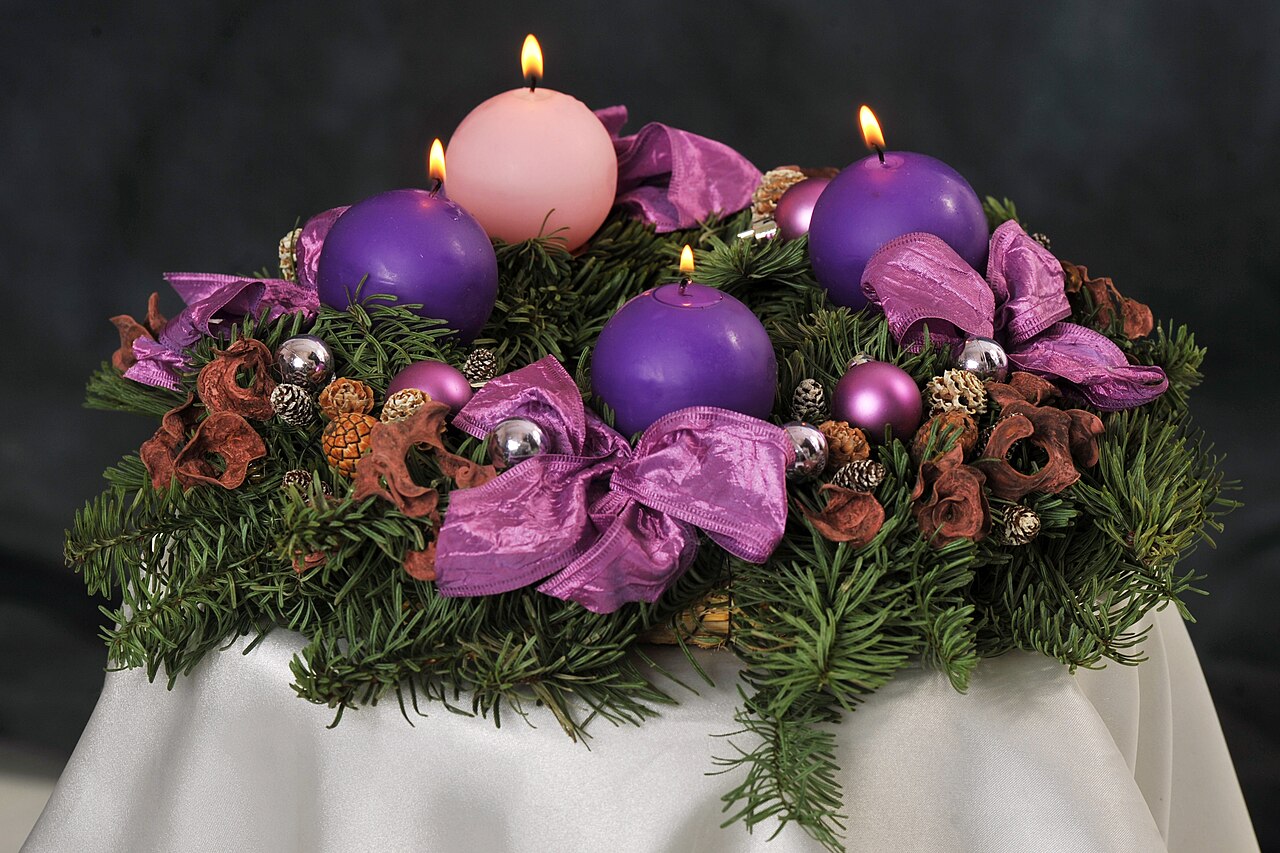
The USCCB describes the Advent wreath as a circle of evergreen branches holding four candles, one for each week, ideally three purple and one rose, though white candles may also be used.[2] The Sheffield page describes four outer candles, traditionally purple and sometimes with one pink, and a central candle of a different colour that stands for Christ.[10]
German Protestant sources trace the wreath to the theologian Johann Hinrich Wichern at the Rauhes Haus in Hamburg-Horn. The Protestant weekly Sonntagsblatt reported in 2026 that the first wreath hung in the prayer hall of the Rauhes Haus on the first Sunday of Advent in 1839, as a candle holder the size of a cartwheel.[12] It reports that the hall was first decorated with fir branches in Advent 1851, that the candle holder itself was first decorated with fir in 1860, and that when the wreath moved into family homes in the early 20th century it became smaller and the weekday candles were dropped.[12]
The popular picture of Wichern's wreath, with four large white candles for the Sundays and small red candles for the weekdays, is questioned. Sonntagsblatt repeats it, describing four large white Sunday candles and 18 to 24 small red weekday candles.[12] But the Protestant news agency epd, in a 2020 report published by evangelisch.de, said the Rauhes Haus had found no evidence that Wichern used different sizes for Sundays and weekdays, and that the only known picture, a black-and-white drawing, appears to show candles of equal size.[13] The same report says the number of candles depended on the weekday on which 24 December fell, that it was later reduced to four, and that the custom was taken up on the Catholic side from 1925.[13]
An Advent wreath of fir branches with three violet candles and one rose candle, all four lit, photographed in 2015.
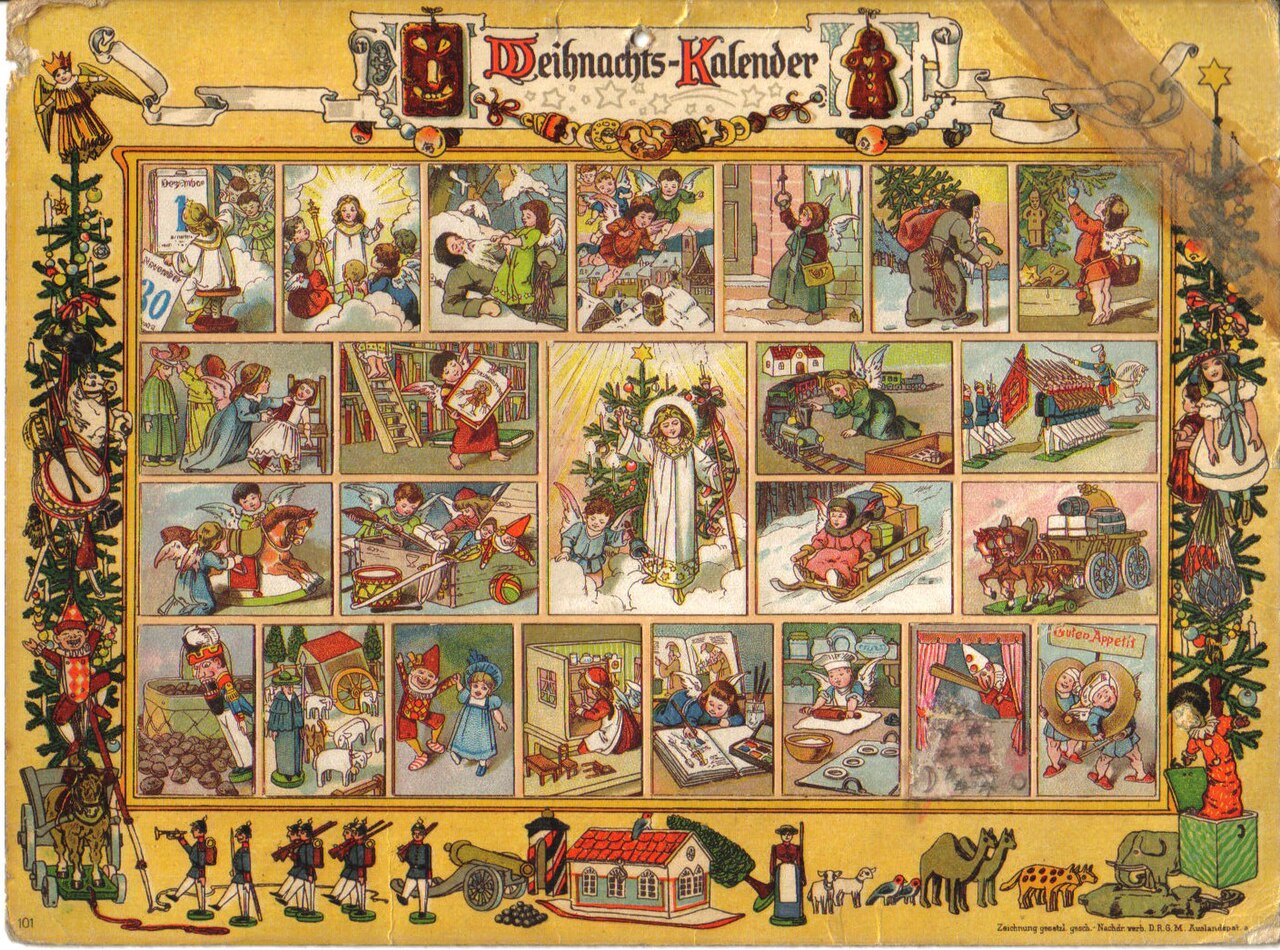
The Advent calendar counts the days to Christmas. The Deutsches Hopfenmuseum in Wolnzach, in the press text for a 2008-2009 exhibition of a collector's calendars, dated home-made calendars to around 1850 and the first printed calendars to 1902 in Hamburg and 1904 in Stuttgart.[14] A flyer for the exhibition "Warten auf das Christkind" in Neuwied, made with the Museum Europäischer Kulturen of the Berlin State Museums, says the printed calendar "Im Lande des Christkinds" ("In the Land of the Christ Child") was conceived in 1903 by Gerhard Lang (1881-1974), a pastor's son, and drawn by the illustrator Richard Ernst Kepler.[15] The flyer calls Lang the real "father" of the Advent calendar because he brought out more than 30 different calendars between 1908 and 1938, and it also names the Munich publisher Reichhold & Lang.[15] It adds that calendars with little doors were especially popular, and that the printing of picture calendars stopped entirely in the early 1940s, during the Second World War.[15]
The printed Advent calendar "Im Lande des Christkinds", drawn by Richard Ernst Kepler and published by Gerhard Lang in Munich, shown with all its picture window
In the last week before Christmas, Catholic evening prayer uses the "O Antiphons", short sung verses that draw on the messianic hopes of the Old Testament and repeat the plea "Come!".[16] The USCCB says they accompany the Magnificat, the Song of Mary, at Evening Prayer from 17 to 23 December, and that the Roman Church has sung them since at least the eighth century.[16]
Sources
The Editors of Encyclopaedia Britannica (most recently revised by Meg Matthias). "Advent". Encyclopaedia Britannica. No date shown; accessed 26 November 2026. britannica.com/topic/Advent
United States Conference of Catholic Bishops. "Liturgical Calendar for the Dioceses of the United States of America 2026". USCCB. No date shown; accessed 26 November 2026. usccb.org/resources/2026cal.pdf
Francis Mershman. "Advent". The Catholic Encyclopedia, vol. 1. New York: Robert Appleton Company, 1907; online at New Advent. Accessed 26 November 2026. newadvent.org/cathen/01165a.htm
Shawn Tribe. "Advent Variations". New Liturgical Movement, 17 November 2009 (quoting Archdale A. King, Liturgy of the Roman Church, Liturgies of the Primatial Sees and Liturgies of the Past). Accessed 26 November 2026. newliturgicalmovement.org/2009/11/advent-variations.html
Städtische Galerie Mennonitenkirche, Neuwied, with the Museum Europäischer Kulturen – Staatliche Museen zu Berlin. "Warten auf das Christkind" (exhibition flyer). No date shown (it cites a 2009 catalogue); archived copy, accessed 26 November 2026. wayback.edoweb-rlp.de/weltweit/20241029mp_/http:/www.neuwied.de/fil…
United States Conference of Catholic Bishops. "The 'O Antiphons' of Advent". USCCB. No date shown; accessed 26 November 2026. usccb.org/prayers/o-antiphons-advent