Compare versions
Version 1 → Version 2 (current). Removed · Added. This shows the entry's text as it is written, including its formatting marks.
Version 1 · Version 2 (current) · Version history
Side by side · Together
Version 1Version 2 (current)
10 unchanged paragraphs
Santa Claus is a legendary figure who brings gifts to children at Christmas, and whose popular image in the United States and many other countries is based on traditions about Saint Nicholas, a 4th-century Christian saint.[1]
Santa Claus is a legendary figure who brings gifts to children at Christmas, and whose popular image in the United States and many other countries is based on traditions about Saint Nicholas, a 4th-century Christian saint.[1]
## Names and related gift-bringers
## Names and related gift-bringers
Santa Claus is closely tied to [Christmas](https://micwyn.com/t/2237/christmas), and Encyclopaedia Britannica lists Father Christmas, Saint Nicholas and Sinterklaas among his other names.[1] Saint Nicholas was a bishop of Myra in the Roman province of Lycia, near modern Demre in Turkey, and is regarded as the patron saint of children, sailors, travellers and bakers; his feast and its customs are covered in the separate Saint Nicholas Day entry.[1][2] A Library of Congress article of 2024 lists other names used for gift-bringers in different countries, among them Père Noël, Grandfather Frost, Joulupukki, Jultomten and Kris Kringle, and says the Dutch name Sinterklaas eventually became "Santa Claus" in English.[2] The same article traces Kris Kringle to the "Christkindl" brought by German settlers in Pennsylvania.[2]
Santa Claus is closely tied to [Christmas](https://micwyn.com/t/2237/christmas), and Encyclopaedia Britannica lists Father Christmas, Saint Nicholas and Sinterklaas among his other names.[1] Saint Nicholas was a bishop of Myra in the Roman province of Lycia, near modern Demre in Turkey, and is regarded as the patron saint of children, sailors, travellers and bakers; his feast and its customs are covered in the separate Saint Nicholas Day entry.[1][2] A Library of Congress article of 2024 lists other names used for gift-bringers in different countries, among them Père Noël, Grandfather Frost, Joulupukki, Jultomten and Kris Kringle, and says the Dutch name Sinterklaas eventually became "Santa Claus" in English.[2] The same article traces Kris Kringle to the "Christkindl" brought by German settlers in Pennsylvania.[2]
Father Christmas began as a separate English figure. Stephen Winick, writing on the Library of Congress's Folklife Today blog in 2018, says that Ben Jonson's "Christmas his Masque" of 1616 presented Old Christmas as a character in old-fashioned clothes, and that in the 18th-century mummers' plays (traditional folk plays performed at Christmas) Father Christmas was mainly concerned with feasting, food and drink.[3] Only in the Victorian era did he become a companion to children and a bringer of their gifts.[3] Winick dates the arrival in Britain of the American Santa Claus stories, with the sleigh and flying reindeer, to around the 1860s, says the two characters began to merge in the 1870s, and says the merger was complete by the early 20th century.[3]
Father Christmas began as a separate English figure. Stephen Winick, writing on the Library of Congress's Folklife Today blog in 2018, says that Ben Jonson's "Christmas his Masque" of 1616 presented Old Christmas as a character in old-fashioned clothes, and that in the 18th-century mummers' plays (traditional folk plays performed at Christmas) Father Christmas was mainly concerned with feasting, food and drink.[3] Only in the Victorian era did he become a companion to children and a bringer of their gifts.[3] Winick dates the arrival in Britain of the American Santa Claus stories, with the sleigh and flying reindeer, to around the 1860s, says the two characters began to merge in the 1870s, and says the merger was complete by the early 20th century.[3]
In German-speaking lands a different gift-bringer, the Christkind ("Christ child"), took over much of Saint Nicholas's role.[4] A University of Hamburg article of 17 December 2025 explains that as Saint Nicholas, being a saint, faded into the background, a new gift-bringer was sought, and the main exchange of gifts gradually moved from 6 December to Christmas Eve or Christmas Day.[4] The same article notes that some writers credit Martin Luther with inventing the Christkind, but calls that view disputed and unproven; it adds that the figure was later adopted in Catholic areas, including Bavaria and the Rhineland, from the early 19th century.[4]
In German-speaking lands a different gift-bringer, the Christkind ("Christ child"), took over much of Saint Nicholas's role.[4] A University of Hamburg article of 17 December 2025 explains that as Saint Nicholas, being a saint, faded into the background, a new gift-bringer was sought, and the main exchange of gifts gradually moved from 6 December to Christmas Eve or Christmas Day.[4] The same article notes that some writers credit Martin Luther with inventing the Christkind, but calls that view disputed and unproven; it adds that the figure was later adopted in Catholic areas, including Bavaria and the Rhineland, from the early 19th century.[4]
## Saint Nicholas in early New York
## Saint Nicholas in early New York
The first United States illustration of Saint Nicholas was a broadside (a single printed sheet) that John Pintard, one of the founders of the New-York Historical Society, commissioned from the engraver Alexander Anderson for the society's Saint Nicholas dinner on 6 December 1810, according to the St. Nicholas Center, an educational website about the saint.[5] It shows the saint with a purse and a birch rod, a beehive and a Dutch pug dog, beside a fireplace with two stockings, one filled with treats for a good child and one holding only a rod for a naughty one.[5] The New York Commercial Advertiser described the dinner on 11 December 1810, and the society has held the dinner every year since.[5] The Dutch verses on the sheet were reconstructed from the memories of elderly women.[5]
The first United States illustration of Saint Nicholas was a broadside (a single printed sheet) that John Pintard, one of the founders of the New-York Historical Society, commissioned from the engraver Alexander Anderson for the society's Saint Nicholas dinner on 6 December 1810, according to the St. Nicholas Center, an educational website about the saint.[5] It shows the saint with a purse and a birch rod, a beehive and a Dutch pug dog, beside a fireplace with two stockings, one filled with treats for a good child and one holding only a rod for a naughty one.[5] The New York Commercial Advertiser described the dinner on 11 December 1810, and the society has held the dinner every year since.[5] The Dutch verses on the sheet were reconstructed from the memories of elderly women.[5]
Washington Irving's satirical "A History of New York", published on 6 December 1809, gave the saint a wider readership; in one dream scene Saint Nicholas comes riding over the treetops in the wagon in which he brings his yearly presents to children, and lights his pipe by the fire.[6] Irving joined the New-York Historical Society at the 1810 dinner.[5]
Washington Irving's satirical "A History of New York", published on 6 December 1809, gave the saint a wider readership; in one dream scene Saint Nicholas comes riding over the treetops in the wagon in which he brings his yearly presents to children, and lights his pipe by the fire.[6] Irving joined the New-York Historical Society at the 1810 dinner.[5]
## Sleigh, reindeer and "A Visit from St. Nicholas"
## Sleigh, reindeer and "A Visit from St. Nicholas"
In 1821 the New York publisher William B. Gilley issued a small booklet, "The Children's Friend. Number III. A New-Year's Present, to the Little Ones from Five to Twelve", which the American Antiquarian Society describes as containing one of the earliest images of Santa Claus.[7] Its pictures were made "in a method entirely new", which the society connects with the then recent process of lithography (printing from a drawing on stone).[7] The booklet's anonymous poem, "Old Santeclaus", opens with Santeclaus driving his reindeer over chimney-tops on a frosty night, and says he comes each Christmas Eve.[8]
In 1821 the New York publisher William B. Gilley issued a small booklet, "The Children's Friend. Number III. A New-Year's Present, to the Little Ones from Five to Twelve", which the American Antiquarian Society describes as containing one of the earliest images of Santa Claus.[7] Its pictures were made "in a method entirely new", which the society connects with the then recent process of lithography (printing from a drawing on stone).[7] The booklet's anonymous poem, "Old Santeclaus", opens with Santeclaus driving his reindeer over chimney-tops on a frosty night, and says he comes each Christmas Eve.[8]
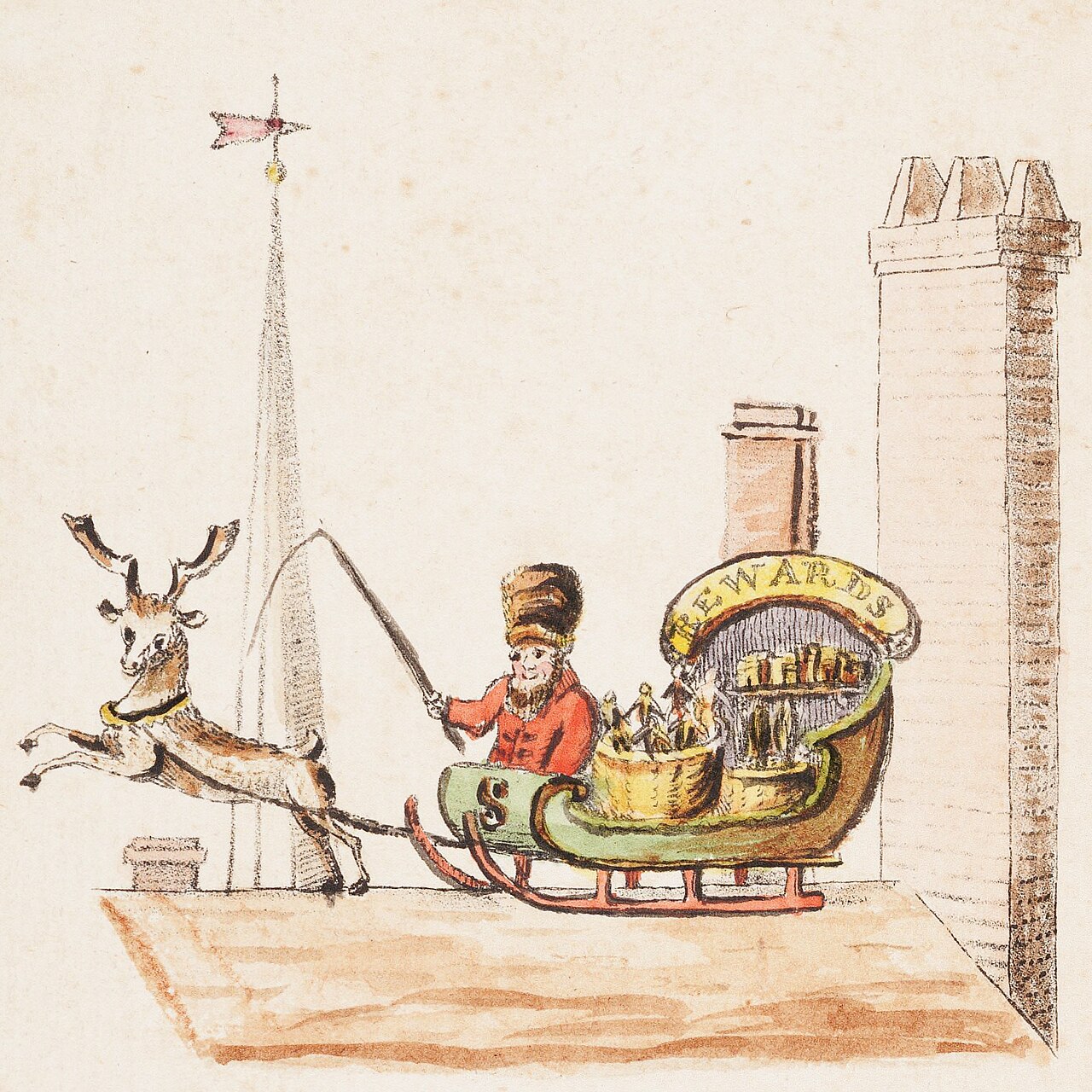
*Via Wikimedia Commons: [The Children's friend. Number III. A New-Year's present, to the little](https://commons.wikimedia.org/wiki/File:The_Children%27s_friend._Number_III._A_New-Year%27s_present,_to_the_little_ones_from_five_to_twelve._Part_III_(1821),_page_1.jpg) by Unknown author Unknown author, public domain.*
8 unchanged paragraphs
"A Visit from St. Nicholas", also known as "'Twas the Night Before Christmas", was first printed, without an author's name, in the Troy Sentinel in Troy, New York, on 23 December 1823.[9][10] Columbia Magazine reported in 2021 that a woman named Harriet Butler had copied the poem a year earlier and that her friend Sarah Sackett sent it to the newspaper.[11] The anthologist Charles Fenno Hoffman printed it under Clement Clarke Moore's name in "The New-York Book of Poetry" in 1837, and Moore included it in a book of his own poems in 1844, calling it a "trifle" written long before.[9][11] The poem's St. Nicholas is a small, soot-covered elf who looks "like a peddler", not the tall figure of later pictures.[10]
"A Visit from St. Nicholas", also known as "'Twas the Night Before Christmas", was first printed, without an author's name, in the Troy Sentinel in Troy, New York, on 23 December 1823.[9][10] Columbia Magazine reported in 2021 that a woman named Harriet Butler had copied the poem a year earlier and that her friend Sarah Sackett sent it to the newspaper.[11] The anthologist Charles Fenno Hoffman printed it under Clement Clarke Moore's name in "The New-York Book of Poetry" in 1837, and Moore included it in a book of his own poems in 1844, calling it a "trifle" written long before.[9][11] The poem's St. Nicholas is a small, soot-covered elf who looks "like a peddler", not the tall figure of later pictures.[10]
### The authorship dispute
### The authorship dispute
Who wrote the poem is disputed. Henry Livingston Jr., who died in 1828, never claimed it, but by about 1900 members of his family were insisting, from family memory, that he was the author, and in 1919 the Dutchess County Historical Society cited internal evidence in their support.[9] In "Author Unknown" (2000), the Vassar College professor Don Foster used stylometry (the statistical study of writing style) to argue for Livingston, pointing to the poem's anapestic metre (two short syllables followed by a long one), its use of "all" as an adverb and the Dutch forms of the reindeer names.[9][11] Moore's side was defended point by point by the manuscript dealer Seth Kaller, who once owned a copy of the poem in Moore's handwriting, and in a detailed rebuttal by Scott Norsworthy.[9][11] Columbia Magazine noted in 2021 that there is no physical evidence linking Livingston to the poem, and the historian Stephen Nissenbaum treats Moore as the author.[11][12] A Library of Congress article of 2020 says that some modern scholars support the Livingston claim.[10]
Who wrote the poem is disputed. Henry Livingston Jr., who died in 1828, never claimed it, but by about 1900 members of his family were insisting, from family memory, that he was the author, and in 1919 the Dutchess County Historical Society cited internal evidence in their support.[9] In "Author Unknown" (2000), the Vassar College professor Don Foster used stylometry (the statistical study of writing style) to argue for Livingston, pointing to the poem's anapestic metre (two short syllables followed by a long one), its use of "all" as an adverb and the Dutch forms of the reindeer names.[9][11] Moore's side was defended point by point by the manuscript dealer Seth Kaller, who once owned a copy of the poem in Moore's handwriting, and in a detailed rebuttal by Scott Norsworthy.[9][11] Columbia Magazine noted in 2021 that there is no physical evidence linking Livingston to the poem, and the historian Stephen Nissenbaum treats Moore as the author.[11][12] A Library of Congress article of 2020 says that some modern scholars support the Livingston claim.[10]
## Thomas Nast and Harper's Weekly
## Thomas Nast and Harper's Weekly
The cartoonist Thomas Nast drew his first Santa Claus for the cover of Harper's Weekly on 3 January 1863, during the American Civil War, showing him as a supporter of the Union, sitting in a sleigh full of presents for soldiers.[13] Between 1863 and 1886 Nast drew 33 Christmas pictures for the magazine, all but one of them showing Santa.[13] An 1866 picture shows Santa in his workshop making toys and checking an "account book" of children's behaviour.[13]
The cartoonist Thomas Nast drew his first Santa Claus for the cover of Harper's Weekly on 3 January 1863, during the American Civil War, showing him as a supporter of the Union, sitting in a sleigh full of presents for soldiers.[13] Between 1863 and 1886 Nast drew 33 Christmas pictures for the magazine, all but one of them showing Santa.[13] An 1866 picture shows Santa in his workshop making toys and checking an "account book" of children's behaviour.[13]
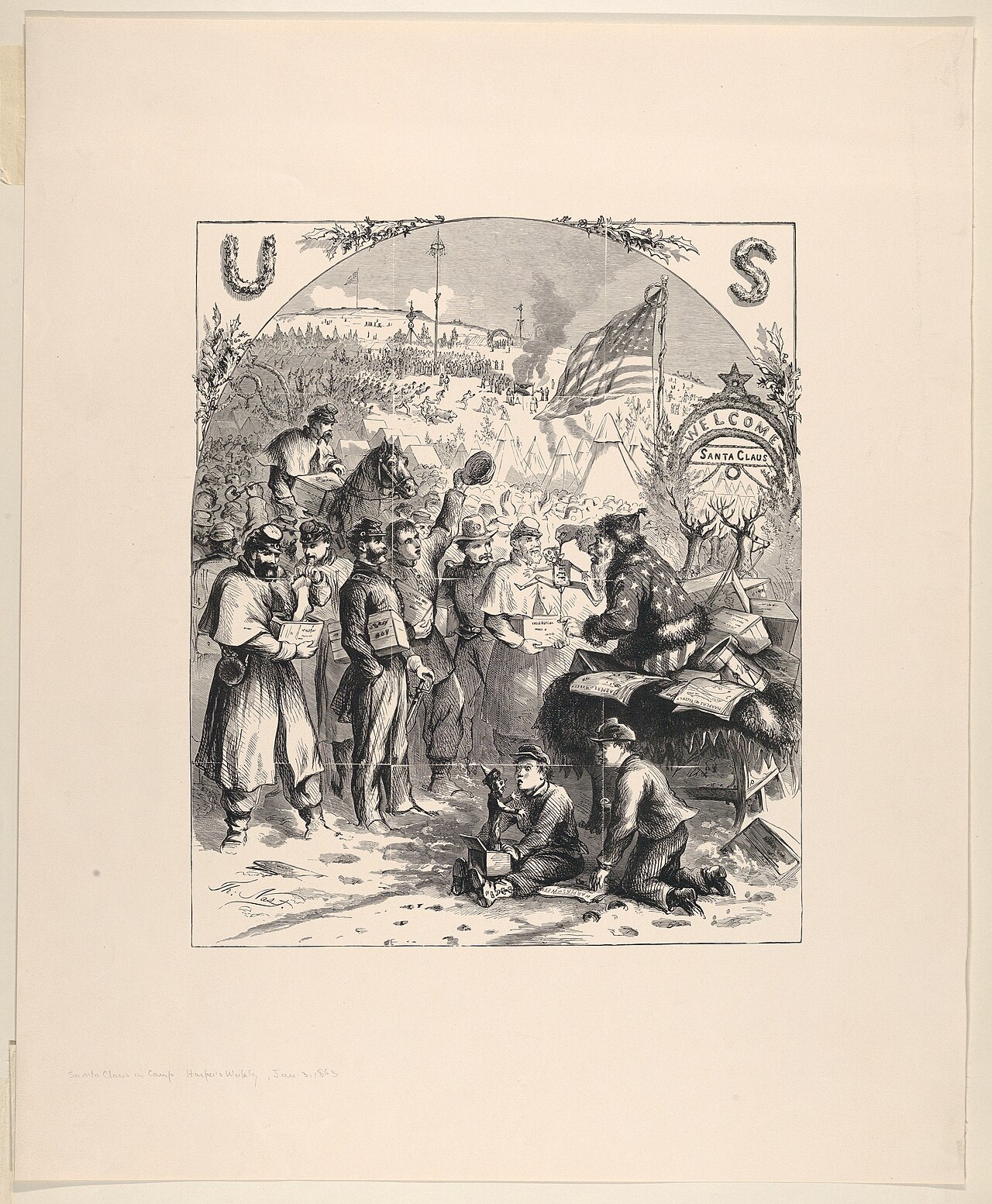

*Via Wikimedia Commons: [Santa Claus in Camp (published in Harper's Weekly, January 3, 1863) ME](https://commons.wikimedia.org/wiki/File:Santa_Claus_in_Camp_(published_in_Harper%27s_Weekly,_January_3,_1863)_MET_DP831803.jpg) by Thomas Nast, [CC0](http://creativecommons.org/publicdomain/zero/1.0/deed.en).*
*Via Wikimedia Commons: [Santa Claus in Camp (published in Harper's Weekly, January 3, 1863) ME](https://commons.wikimedia.org/wiki/File:Santa_Claus_in_Camp_(published_in_Harper%27s_Weekly,_January_3,_1863)_MET_DP831803.jpg) by Thomas Nast, [CC0](http://creativecommons.org/publicdomain/zero/1.0/deed.en).*
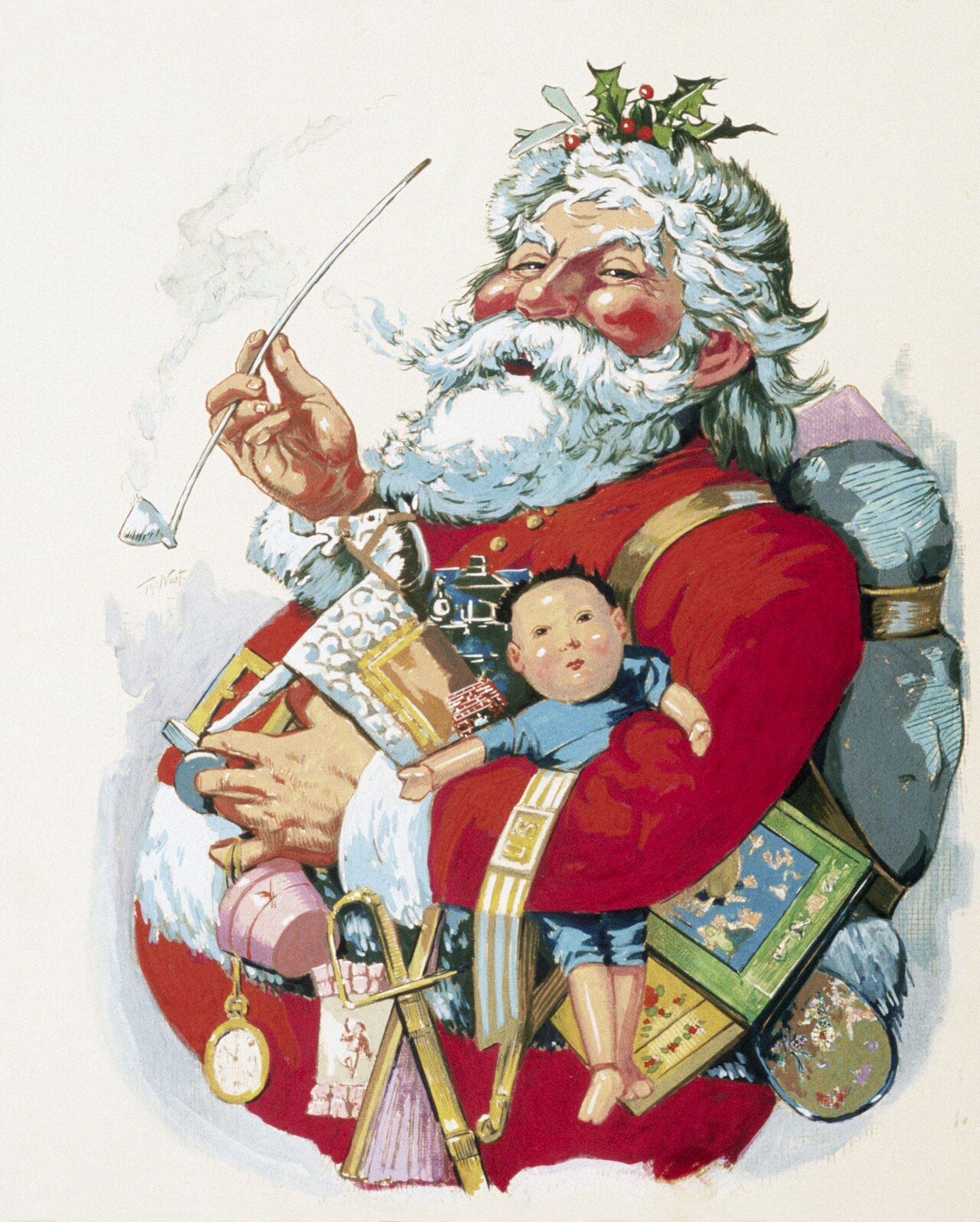
Nast's best-known drawing, "Merry Old Santa Claus", appeared in Harper's Weekly on 1 January 1881 and, in the words of a 2020 Library of Congress article, quickly attained a status akin to an official portrait.[13][10] That article credits Nast's drawings with first giving Santa his red coat, his pipe, his workshop and his home at the North Pole.[10] Sources disagree about the red coat: the Coca-Cola Company's history pages say Nast changed the colour of Santa's coat from tan to red over 30 years, while the American Battlefield Trust says Nast's Harper's Weekly pictures were printed in black and white and that he is not connected with the bright red shade.[14][13]
Nast's best-known drawing, "Merry Old Santa Claus", appeared in Harper's Weekly on 1 January 1881 and, in the words of a 2020 Library of Congress article, quickly attained a status akin to an official portrait.[13][10] That article credits Nast's drawings with first giving Santa his red coat, his pipe, his workshop and his home at the North Pole.[10] Sources disagree about the red coat: the Coca-Cola Company's history pages say Nast changed the colour of Santa's coat from tan to red over 30 years, while the American Battlefield Trust says Nast's Harper's Weekly pictures were printed in black and white and that he is not connected with the bright red shade.[14][13]
14 unchanged paragraphs
*Via Wikimedia Commons: [Merry Old Santa Claus by Thomas Nast](https://commons.wikimedia.org/wiki/File:Merry_Old_Santa_Claus_by_Thomas_Nast.jpg) by Thomas Nast, public domain.*
*Via Wikimedia Commons: [Merry Old Santa Claus by Thomas Nast](https://commons.wikimedia.org/wiki/File:Merry_Old_Santa_Claus_by_Thomas_Nast.jpg) by Thomas Nast, public domain.*
## Mrs. Claus, "Yes, Virginia" and Rudolph
## Mrs. Claus, "Yes, Virginia" and Rudolph
Santa's wife appears mostly in writing published after the Civil War, according to Maura Ives, a professor of English at Texas A&M University; the earliest example she names is Charles S. Dickinson's "Mrs. Santa Claus's Adventure", printed in Wood's Household Magazine on 1 December 1871.[15] Katharine Lee Bates's poem "Goody Santa Claus on a Sleigh Ride", in which Santa's wife has a voice of her own, first appeared in the children's magazine Wide Awake.[15] Ives argues that such stories and poems reflected 19th-century arguments about women's rights.[15]
Santa's wife appears mostly in writing published after the Civil War, according to Maura Ives, a professor of English at Texas A&M University; the earliest example she names is Charles S. Dickinson's "Mrs. Santa Claus's Adventure", printed in Wood's Household Magazine on 1 December 1871.[15] Katharine Lee Bates's poem "Goody Santa Claus on a Sleigh Ride", in which Santa's wife has a voice of her own, first appeared in the children's magazine Wide Awake.[15] Ives argues that such stories and poems reflected 19th-century arguments about women's rights.[15]
On 21 September 1897 the New York Sun printed an unsigned editorial headed "Is There A Santa Claus?", replying to a letter sent soon after her eighth birthday by Virginia O'Hanlon.[16] The media historian W. Joseph Campbell wrote in 2010 that the editor Edward P. Mitchell asked Francis P. Church to write it, that the paper did not reveal Church as the author until shortly after his death in 1906, and that the piece attracted no immediate attention, contrary to the common belief that it was an instant sensation.[16] From 1924 until the Sun's last Christmas before it closed in 1950, it ran as the paper's lead editorial on 23 or 24 December.[16]
On 21 September 1897 the New York Sun printed an unsigned editorial headed "Is There A Santa Claus?", replying to a letter sent soon after her eighth birthday by Virginia O'Hanlon.[16] The media historian W. Joseph Campbell wrote in 2010 that the editor Edward P. Mitchell asked Francis P. Church to write it, that the paper did not reveal Church as the author until shortly after his death in 1906, and that the piece attracted no immediate attention, contrary to the common belief that it was an instant sensation.[16] From 1924 until the Sun's last Christmas before it closed in 1950, it ran as the paper's lead editorial on 23 or 24 December.[16]
In 1939 a manager at the Montgomery Ward store chain in Chicago decided the company should produce its own children's book for its holiday promotion, and an employee, Robert L. May, was asked to write "Rudolph, the Red-Nosed Reindeer"; the company printed and gave out more than 2 million copies that year, NPR reported in 2013.[17] May considered the names Reginald, Rollo and Romeo before choosing Rudolph, and a song later written by his brother-in-law was recorded by the singer Gene Autry.[17]
In 1939 a manager at the Montgomery Ward store chain in Chicago decided the company should produce its own children's book for its holiday promotion, and an employee, Robert L. May, was asked to write "Rudolph, the Red-Nosed Reindeer"; the company printed and gave out more than 2 million copies that year, NPR reported in 2013.[17] May considered the names Reginald, Rollo and Romeo before choosing Rudolph, and a song later written by his brother-in-law was recorded by the singer Gene Autry.[17]
## Tracking Santa and letters to Santa
## Tracking Santa and letters to Santa
According to NORAD Public Affairs, the military's custom of "tracking" Santa began in 1955, when a Sears, Roebuck and Co. store's newspaper advertisement carried a misprinted telephone number, so that children calling Santa reached Colonel Harry Shoup of the Continental Air Defense Command (CONAD) in Colorado; CONAD kept up the practice until 1958, when the newly formed North American Aerospace Defense Command (NORAD) took it over.[18] A Smithsonian National Air and Space Museum article of 2020 gives a different account, dating the first call to 30 November 1955 and describing it as a misdial rather than a misprint.[19]
According to NORAD Public Affairs, the military's custom of "tracking" Santa began in 1955, when a Sears, Roebuck and Co. store's newspaper advertisement carried a misprinted telephone number, so that children calling Santa reached Colonel Harry Shoup of the Continental Air Defense Command (CONAD) in Colorado; CONAD kept up the practice until 1958, when the newly formed North American Aerospace Defense Command (NORAD) took it over.[18] A Smithsonian National Air and Space Museum article of 2020 gives a different account, dating the first call to 30 November 1955 and describing it as a misdial rather than a misprint.[19]
In 1912 the United States Postmaster General, Frank Hitchcock, authorized local postmasters to let postal workers and members of the public answer children's letters to Santa, and in the 1940s the Post Office Department invited charities to take part, according to the United States Postal Service.[20] A USPS fact page dated 15 May 2026 describes the programme, called USPS Operation Santa, as being in its 114th year in the 2025 season, and reports that in 2020 more than 1 million people visited its website and more than 21,000 packages were sent.[20]
In 1912 the United States Postmaster General, Frank Hitchcock, authorized local postmasters to let postal workers and members of the public answer children's letters to Santa, and in the 1940s the Post Office Department invited charities to take part, according to the United States Postal Service.[20] A USPS fact page dated 15 May 2026 describes the programme, called USPS Operation Santa, as being in its 114th year in the 2025 season, and reports that in 2020 more than 1 million people visited its website and more than 21,000 packages were sent.[20]
## Popular claims and myths
## Popular claims and myths
**Claim: Coca-Cola invented Santa Claus or his red suit.** The company itself rejects this. Its history page says Santa appeared in a red coat before the illustrator Haddon Sundblom painted him, that Sundblom's Santa first appeared in Coca-Cola advertisements in The Saturday Evening Post in 1931, and that the company's advertising showed Santa from 1931 to 1964.[14] Britannica says Sundblom's advertisements, from 1931, further defined an image that Nast had already established.[1]
**Claim: Coca-Cola invented Santa Claus or his red suit.** The company itself rejects this. Its history page says Santa appeared in a red coat before the illustrator Haddon Sundblom painted him, that Sundblom's Santa first appeared in Coca-Cola advertisements in The Saturday Evening Post in 1931, and that the company's advertising showed Santa from 1931 to 1964.[14] Britannica says Sundblom's advertisements, from 1931, further defined an image that Nast had already established.[1]
**Claim: Santa Claus descends from the Norse god Odin (Wotan).** The 2024 Library of Congress article presents the white-bearded Wotan, linked with Yule and the Wild Hunt (a legendary ghostly procession across the winter sky), as an earlier version of the gift-bringer, and the writer Phyllis Siefker argued in a 1997 book that Odin's Yuletide gift-giving and his flying eight-legged horse Sleipnir lie behind Santa and his reindeer.[2][21] The historian and archaeologist Ken Dark of King's College London told Live Science that few historians take the idea seriously.[21] Britannica traces Santa's image to Saint Nicholas and does not mention Odin.[1] No scholarly source opened for this entry supports a line of descent from Odin.
**Claim: Santa Claus descends from the Norse god Odin (Wotan).** The 2024 Library of Congress article presents the white-bearded Wotan, linked with Yule and the Wild Hunt (a legendary ghostly procession across the winter sky), as an earlier version of the gift-bringer, and the writer Phyllis Siefker argued in a 1997 book that Odin's Yuletide gift-giving and his flying eight-legged horse Sleipnir lie behind Santa and his reindeer.[2][21] The historian and archaeologist Ken Dark of King's College London told Live Science that few historians take the idea seriously.[21] Britannica traces Santa's image to Saint Nicholas and does not mention Odin.[1] No scholarly source opened for this entry supports a line of descent from Odin.
**Claim: Santa Claus came straight from the Dutch settlers of New Amsterdam.** Britannica says the Dutch brought the Sinterklaas legend, and the custom of giving gifts and sweets on 6 December, to New Amsterdam.[1] Stephen Nissenbaum, historian and author of "The Battle for Christmas" (1996), said in a 2022 interview that the Protestant Dutch of New Amsterdam tried to get rid of saints' celebrations, that New York's "Knickerbockers" (old-family New Yorkers such as Moore and Irving) were fond of inventing Dutch traditions, and that there was only "a faint glimmer of historical fact" in the Dutch link.[12]
**Claim: Santa Claus came straight from the Dutch settlers of New Amsterdam.** Britannica says the Dutch brought the Sinterklaas legend, and the custom of giving gifts and sweets on 6 December, to New Amsterdam.[1] Stephen Nissenbaum, historian and author of "The Battle for Christmas" (1996), said in a 2022 interview that the Protestant Dutch of New Amsterdam tried to get rid of saints' celebrations, that New York's "Knickerbockers" (old-family New Yorkers such as Moore and Irving) were fond of inventing Dutch traditions, and that there was only "a faint glimmer of historical fact" in the Dutch link.[12]
## Sources
## Sources
1. The Editors of Encyclopaedia Britannica (most recently revised and updated by Meg Matthias). "Santa Claus". Encyclopaedia Britannica. No date shown; accessed 26 November 2026. https://www.britannica.com/topic/Santa-Claus
2. Abraham Parrish. "The Changing Geography of the Gift Giver". Worlds Revealed blog, Library of Congress, 13 December 2024. https://blogs.loc.gov/maps/2024/12/the-changing-geography-of-the-gift-giver/
3. Stephen Winick. "Christmas Cousins: Father Christmas and Santa Claus". Folklife Today blog, Library of Congress, 22 December 2018. https://blogs.loc.gov/folklife/2018/12/christmas-cousins-father-christmas-and-santa-claus/
4. Newsroom, University of Hamburg (with Jan Gehm). "Christmas traditions: Who is the Christkind?". University of Hamburg, 17 December 2025 (updated 19 December 2025). https://www.uni-hamburg.de/en/newsroom/im-fokus/2025/1217-christkind.html
5. St. Nicholas Center. "St. Nicholas in New York—1810". St. Nicholas Center. No date shown; accessed 26 November 2026. https://www.stnicholascenter.org/who-is-st-nicholas/origin-of-santa/st-nicholas-in-new-york-1810
6. Historic Hudson Valley. "How Washington Irving Introduced Americans to Santa Claus". Historic Hudson Valley, 6 December 2019. https://hudsonvalley.org/?p=11837
7. American Antiquarian Society. "The Children's Friend. Number III. A New-Year's Present, to the Little Ones from Five to Twelve" (exhibition case 3, item 9). American Antiquarian Society. No date shown; accessed 26 November 2026. https://collections.americanantiquarian.org/inpursuit/case3/case3_9.htm
8. Anonymous (1821). "Old Santeclaus", ed. Ian Lancashire. Representative Poetry Online, University of Toronto Libraries, RPO 2000. No page date shown; accessed 26 November 2026. https://rpo.library.utoronto.ca/poems/old-santeclaus
9. New York State Library. "A Visit from St. Nicholas" (online exhibit). New York State Library, December 2015. https://nysl.nysed.gov/collections/stnick/
10. Neely Tucker. "A Visit from Santa…Who You Might Not Recognize". Timeless blog, Library of Congress, 23 December 2020. https://blogs.loc.gov/loc/2020/12/a-visit-from-santa-who-you-might-not-recognize/
11. Paul Hond. "The Story Behind the Most Famous Christmas Poem of All". Columbia Magazine, Columbia University, 19 November 2021. https://magazine.columbia.edu/article/story-behind-most-famous-christmas-poem-all
12. Ben Tumin. "Professor Stephen Nissenbaum on Santa Claus' Elitist Origins". History News Network (Skipped History), 18 December 2022. https://historynewsnetwork.org/blog/154659
13. American Battlefield Trust. "The Man Behind 'Merry Old Santa Claus'". American Battlefield Trust, 17 December 2021 (updated 7 September 2023). https://www.battlefields.org/learn/articles/head-tilting-history/man-behind-merry-old-santa-claus
14. The Coca-Cola Company. "Haddon Sundblom and the Coca-Cola Santas". The Coca-Cola Company. No date shown on the page; accessed 26 November 2026. https://www.coca-colacompany.com/about-us/history/haddon-sundblom-and-the-coca-cola-santas
15. Maura Ives. "How Mrs. Claus embodied 19th-century debates about women's rights". Texas A&M University College of Arts and Sciences (first published in The Conversation), 16 December 2021. https://liberalarts.tamu.edu/blog/how-mrs-claus-embodied-19th-century-debates-about-womens-rights/
16. W. Joseph Campbell. "Saturday at Newseum: Telling the back story to 'Yes, Virginia'". Media Myth Alert, 10 December 2010. https://mediamythalert.com/2010/12/10/saturday-at-newseum-telling-the-back-story-to-yes-virginia/
17. Jessica Pupovac. "Writing 'Rudolph': The Original Red-Nosed Manuscript". NPR, republished by New Hampshire Public Radio, 25 December 2013. https://www.nhpr.org/national/2013-12-25/writing-rudolph-the-original-red-nosed-manuscript
18. Gail Braymen (North American Aerospace Defense Command Public Affairs). "NORAD observes 50th anniversary of tracking Santa". U.S. Air Force. No date shown; accessed 26 November 2026. https://www.af.mil/News/Article-Display/Article/132400/norad-observes-50th-anniversary-of-tracking-santa
19. Smithsonian National Air and Space Museum. "Why NORAD Tracks Santa Claus". Smithsonian Magazine, Air & Space blog, 21 December 2020 (date from the page address). https://www.smithsonianmag.com/blogs/air-space-museum/2020/12/21/why-norad-tracks-santa-claus/
20. United States Postal Service. "USPS Operation Santa" (USPS Fact #284). USPS, 15 May 2026. https://facts.usps.com/operation-santa-in-105th-year
21. Tom Metcalfe. "3 Christmas traditions that may have pagan roots, and 4 that (probably) don't". Live Science. No date shown; accessed 26 November 2026. https://www.livescience.com/archaeology/3-christmas-traditions-that-may-have-pagan-roots-and-4-that-probably-dont
