Compare versions
Version 1 → Version 2 (current). Removed · Added. This shows the entry's text as it is written, including its formatting marks.
Version 1 · Version 2 (current) · Version history
Side by side · Together
The winter solstice is the moment in the year when the midday Sun stands lowest in one hemisphere's sky, bringing that hemisphere its shortest day and longest night; in the Northern Hemisphere it falls between 20 and 23 December.[2]
## Date and time in 2026
The US Naval Observatory's table of Earth's seasons, as reproduced by the US National Weather Service, gives the December solstice of 2026 as 21 December 2026 at 20:50 Coordinated Universal Time (UTC), which it also gives as 3:50 p.m. Eastern Standard Time.[1] Converted from that UTC time, the moment falls at 12:50 p.m. Pacific Standard Time on 21 December 2026, at 8:50 p.m. in London (Greenwich Mean Time), and on 22 December 2026 in much of Asia and Australia: 4:50 a.m. in China Standard Time and 7:50 a.m. in Sydney's summer time. In Australia and the rest of the Southern Hemisphere this December moment is the summer solstice, not the winter one.[2] The same table gives the June solstice of 2026, the Southern Hemisphere's winter solstice, as 20 June 2026 at 08:24 UTC.[1]
The Met Office, the United Kingdom's national weather service, stresses that the solstice is a single instant rather than a whole day.[4] The calendar date of the December solstice moves between 20, 21, 22 and 23 December from year to year, according to timeanddate.com, because a calendar year does not exactly match the time Earth takes to orbit the Sun and leap days pull the dates back into line.[2] The same table gives the December solstice as 21 December in each year from 2024 to 2026, at different times of day (09:21 UTC in 2024, 15:03 UTC in 2025, 20:50 UTC in 2026), and, in 2027, at 02:42 UTC on 22 December.[1]
## Astronomy
Earth's axis of spin is tilted at about 23.4 degrees to the plane of its orbit, so over a year the Sun appears to move north and south in the sky along its yearly path, the [ecliptic](https://micwyn.com/t/3197/ecliptic).[2] At the December solstice the Sun is directly overhead at noon on the Tropic of Capricorn in the Southern Hemisphere; this is the farthest south it reaches in the year, and afterwards it begins moving north again.[2][4] North of the equator this brings the shortest day of the year, and south of the equator the longest.[2] Which solstice counts as the "winter solstice" therefore depends on the hemisphere: in the north it is the December solstice, and in the south it is the June solstice.[1][2]
The word "solstice" comes from the Latin *sol*, "Sun", and *sistere*, "to stand still", because around this time the Sun's noon height seems to pause before it starts to change direction.[2][4]
The shortest day is often thought to have both the year's latest sunrise and its earliest sunset, but in most places neither happens on the solstice.[2][3] The reason is the "equation of time", the difference between time told by the Sun (as on a sundial, called apparent solar time) and time told by clocks (mean solar time).[3] Around the December solstice in the United Kingdom, for example, solar noon comes about 10 minutes before 12:00 by the clock, according to the Met Office.[4] Because of this mismatch, the earliest sunset comes a few days before the solstice and the latest sunrise some days after it.[3][4] Timeanddate.com gives an example for New York: in the 2024–25 season the earliest sunset came on 7 December 2024 at 4:28 p.m. EST, the solstice on 21 December 2024 at 4:20 a.m. EST, and the latest sunrise on 3 and 4 January 2025 at 7:20 a.m. EST.[3] In the United Kingdom, according to the Met Office, the day of the winter solstice is roughly nine hours shorter than the day of the summer solstice.[4]
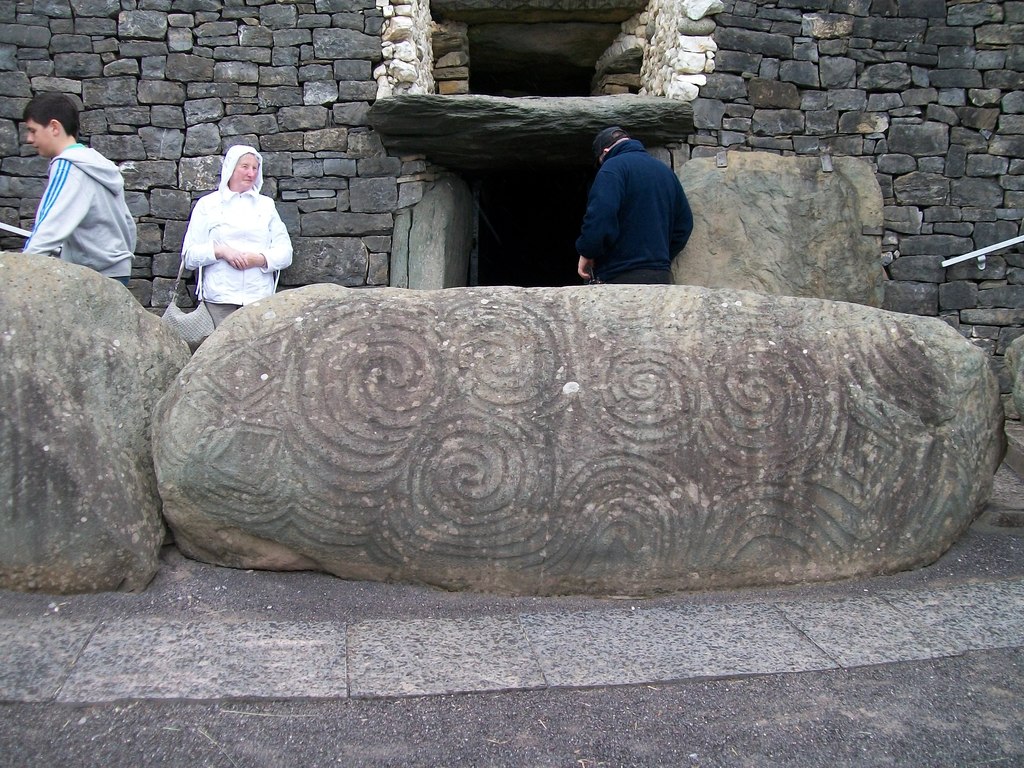2006.](/m/2026/11/nECofgdUSfdarHlf.jpg)
*Via Wikimedia Commons: [Intricately carved stones at the entrance[Entrance toStone the- Newgrange Tomb - geog](https://commons.wikimedia.org/wiki/File:Intricately_carved_stones_at_the_entrance_to_the_Newgrange_Tomb_-_geograph.org.uk_-_2640009.jpg)Detail](https://commons.wikimedia.org/wiki/File:Entrance_Stone_-_Newgrange_-_Detail.jpg) by EricMark Jones,McElroy, [CC BY-SABY 2.0](https://creativecommons.org/licenses/by-sa/2.0).*2.0](https://creativecommons.org/licenses/by/2.0).*
## Ancient monuments
Several Stone Age monuments in Britain and Ireland line up with the Sun at the solstices.[8] Their alignments can be observed; why their builders made them so is a matter of interpretation.
### Newgrange
Newgrange is a Neolithic (late Stone Age) passage tomb at Brú na Bóinne in County Meath, Ireland.[5][6] In a 1989 paper in the journal *Nature*, T. P. Ray reported that at midwinter, about four and a half minutes after sunrise, sunlight passes through an opening above the entrance, known as the "roof-box", and lights the floor of the main chamber about 18 metres inside.[5] Ray calculated that when the tomb was built, the first light would have entered as a very narrow beam across the chamber, and suggested that the width and height of the gap in the roof-box floor may have been designed to follow the solstice Sun; he also noted that Newgrange is about 1,000 years older than the astronomically aligned structures at Stonehenge.[5] Ray presented the deliberate design as a possibility, not a certainty.[5]
Places inside the chamber on the mornings around the solstice are given out by a public lottery run by Ireland's Office of Public Works (OPW). For the 2025 solstice, the OPW reported more than 16,000 entries, the first year that applications could be made online; 38 winners were drawn by local schoolchildren, each to visit the chamber with a guest on one morning between 19 and 23 December 2025, and the sunrise was also streamed online on 21 December 2025.[6]
### Maeshowe
Maeshowe, on Mainland Orkney in Scotland, is a chambered tomb about 5,000 years old, entered by a passage about 10 metres long.[7] According to Historic Environment Scotland, which looks after it, for about three weeks around the winter solstice the light of the low setting Sun shines down the passage and lights the back wall of the central chamber, in line with the Barnhouse Stone.[7] Thousands of years after the tomb was sealed, Norse visitors broke in and carved runic inscriptions on its walls.[7]
### Stonehenge
English Heritage, which manages Stonehenge in Wiltshire, England, states that its great stones were arranged on an axis running from the midsummer sunrise to the midwinter sunset.[8] It describes the midwinter Sun as once setting between the two uprights of the tallest trilithon (a pair of standing stones capped by a lintel), and suggests that the monument's purpose was probably ceremonial and spiritual as well as calendrical, with the midwinter focus possibly linked to feasting at nearby Durrington Walls.[8] English Heritage's page for the 2026 winter solstice, as read on 26 November 2026, says it will provide free access to the monument for the solstice on Tuesday 22 December 2026, with sunrise expected at about 8:09 a.m., and that it plans to stream the sunrise online.[9]
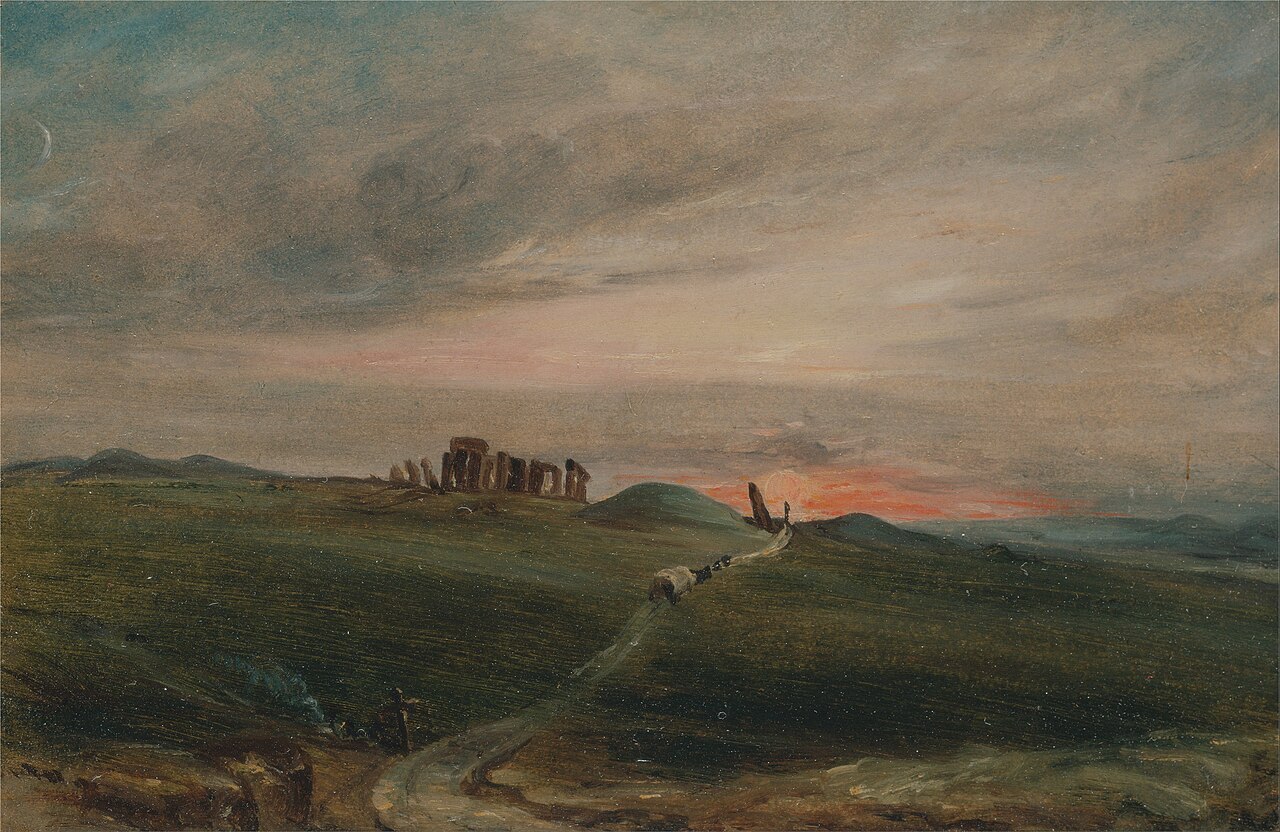
*Via Wikimedia Commons: [John Constable - Stonehenge at Sunset - Google Art Project](https://commons.wikimedia.org/wiki/File:John_Constable_-_Stonehenge_at_Sunset_-_Google_Art_Project.jpg) by John Constable, public domain.*
## Observances in history
### Rome: Saturnalia
The Roman festival of Saturnalia, dedicated to the god Saturn, was originally held on 17 December and was later lengthened to three and then seven days, according to *Encyclopaedia Britannica*; work and business stopped, enslaved people were allowed temporary freedom of speech and action, and a mock king was chosen.[10] Britannica's article links Saturnalia to the winter sowing season rather than to the solstice.[10]
Whether Roman winter festivals shaped Christmas is disputed. Britannica's article states that Saturnalia influenced Christmas and New Year celebrations directly, and notes that Christmas was kept on the birthday of the "unconquered sun" (*dies solis invicti nati*).[10] The historian Andrew McGowan, writing in 2009, concluded that it "seems unlikely" that the date of Christmas was simply chosen to match pagan solar festivals, though Christmas may later have taken on some pagan trappings.[11] The debate over the date is covered in the [Christmas](https://micwyn.com/t/2237/christmas) entry.
### Anglo-Saxon England: Giuli and Modranecht
The English writer Bede describes a midwinter season among the pre-Christian English in his Latin work *The Reckoning of Time*.[12] In the translation by Faith Wallis, Bede writes that the English of old counted their months by the Moon, that both December and January were called *Giuli*, and that these months took their name from the day when the Sun turns back and begins to increase, one month coming before that day and the other after it.[12] He adds that the English began their year on 25 December, and that they called that night by the "heathen" name *Modranecht*, "mother's night", which he explains only by saying that it was "(we suspect)" because of ceremonies they held all night.[12] Bede gives no description of those ceremonies, and his own wording marks the explanation as a guess.[12]
## Observances in the present
### Modern Paganism
In the "Wheel of the Year", the cycle of seasonal festivals observed in Wicca, Yule is the festival of the winter solstice, after which the days grow longer.[13] Joshua J. Mark, writing in the World History Encyclopedia in 2019, states that this modern wheel was first suggested by the scholar Jacob Grimm and was fixed in its present form by the Wicca movement in the 1950s and early 1960s, and that there is no evidence of an ancient Wheel of the Year in its present form.[13]
### Iran and Afghanistan: Yalda/Chella
In 2022 UNESCO inscribed "Yaldā/Chella" on its Representative List of the Intangible Cultural Heritage of Humanity, on a joint nomination by Afghanistan and Iran.[14] UNESCO describes it as a celebration of the Sun and of the warmth of life, held on the last night of autumn, when families gather at the homes of elders around a table set with symbolic objects: a lamp for light, water for cleanliness and red fruits for warmth.[14] According to UNESCO, the night is spent with poetry, storytelling, games and music, and the custom is passed on mainly within families.[14]
### China: Dongzhi
In the traditional Chinese calendar of "solar terms", which mark the Sun's yearly course, the winter solstice is Dongzhi.[15] The Chinese state broadcaster CGTN, in 2023, described Dongzhi as the first solar term to be fixed in Chinese history, with a history of more than 2,000 years, and as an important festive day.[15] CGTN reported that in ancient times people honoured their ancestors with ceremonies on Dongzhi, a custom it said was still kept in homes and ancestral halls in Sanmen County, Zhejiang, in 2023, and that jiaozi dumplings are usually eaten in northern China on the day, while tangyuan, sweet glutinous-rice balls, are a common favourite.[15]
### Japan: Tōji
In Japan the winter solstice, around 22 December, is called Tōji.[16] Nippon.com reports that daytime in Tokyo is about five hours shorter at Tōji than at the summer solstice.[16] A long-standing custom is to float yuzu, a yellow citrus fruit, in the bath; the same article says the practice began in the Edo period as a way for public bathhouses to attract customers, and that the fruit's strong scent was traditionally believed to drive away unhealthy "bad air" and prevent colds, a belief the article notes is not reliably borne out.[16]
## Sources
1. US Naval Observatory, Astronomical Applications Department. "Earth Seasons – Equinoxes and Solstices – 2024-2027." Reproduced by the US National Weather Service. No date shown; accessed 26 November 2026. https://weather.gov/media/ind/seasons.pdf?os=0
2. timeanddate.com. "December Solstice: Longest and Shortest Day of the Year." No date shown; accessed 26 November 2026. https://www.timeanddate.com/calendar/december-solstice.html
3. timeanddate.com. "Earliest sunset" (earliest sunset and latest sunrise, equation of time). No date shown; accessed 26 November 2026. https://www.timeanddate.com/astronomy/earliest-sunset.html
4. Met Office. "6 facts about the winter solstice." No date shown; accessed 26 November 2026. https://www.metoffice.gov.uk/learning/seasons/winter/winter-solstice-facts
5. Ray, T. P. "The winter solstice phenomenon at Newgrange, Ireland: accident or design?" *Nature* 337, 343 (January 1989), doi:10.1038/337343a0. Abstract via NASA Astrophysics Data System; accessed 26 November 2026. https://ui.adsabs.harvard.edu/abs/1989Natur.337..343R/abstract
6. Office of Public Works (Ireland). "Winter Solstice Lottery Draw takes place at Brú na Bóinne Visitor Centre, Co. Meath." gov.ie. No date shown (refers to the 2025 solstice); accessed 26 November 2026. https://www.gov.ie/en/office-of-public-works/press-releases/winter-solstice-lottery-draw-takes-place-at-br%C3%BA-na-b%C3%B3inne-visitor-centre-co-meath
7. Historic Environment Scotland. "Maeshowe Chambered Cairn: History and stories." No date shown; accessed 26 November 2026. https://www.historicenvironment.scot/visit/all/maeshowe-chambered-cairn/history-and-stories/
8. English Heritage. "Celestial Stonehenge." No date shown; accessed 26 November 2026. https://www.english-heritage.org.uk/visit/places/stonehenge/things-to-do/stone-circle/celestial-stonehenge/
9. English Heritage. "Winter Solstice 2026." No date shown; accessed 26 November 2026. https://www.english-heritage.org.uk/visit/places/stonehenge/things-to-do/solstice/winter-solstice-2026/
10. Encyclopaedia Britannica. "Saturnalia (Roman festival)." No date shown; accessed 26 November 2026. https://www.britannica.com/topic/Saturnalia-Roman-festival
11. McGowan, Andrew. "How December 25 Became Christmas." Originally in *Biblical Archaeology Review*; republished by History News Network, 2 December 2009; accessed 26 November 2026. https://www.historynewsnetwork.org/article/andrew-mcgowan-how-december-25-became-christmas
12. Bede. *The Reckoning of Time*, chapter 15, translated by Faith Wallis (Liverpool University Press, 2004), pp. 53–54, as quoted in Roger Pearse, "Bede on Yule," 20 January 2012; accessed 26 November 2026. https://roger-pearse.com/weblog/2012/01/20/bede-on-yule
13. Mark, Joshua J. "Wheel of the Year." World History Encyclopedia, 28 January 2019; accessed 26 November 2026. https://www.worldhistory.org/Wheel_of_the_Year
14. UNESCO Intangible Cultural Heritage. "Yaldā/Chella." Inscribed 2022 (17.COM) on the Representative List; accessed 26 November 2026. https://ich.unesco.org/en/RL/yaldayelda-01877
15. CGTN. "From calendar to culture: Winter Solstice a special occasion in China." 22 December 2023; accessed 26 November 2026. https://news.cgtn.com/news/2023-12-22/From-calendar-to-culture-Winter-Solstice-a-special-occasion-in-China-1pK6qBsVK1O/share_amp.html
16. Nippon.com. "Tōji (Winter Solstice)." 22 December 2023 (page shows a modified date of 7 October 2026); accessed 26 November 2026. https://www.nippon.com/en/articles/-/12930
